
Article 2: You Don’t Need More Motivation. You Need a System That Works When You Don’t

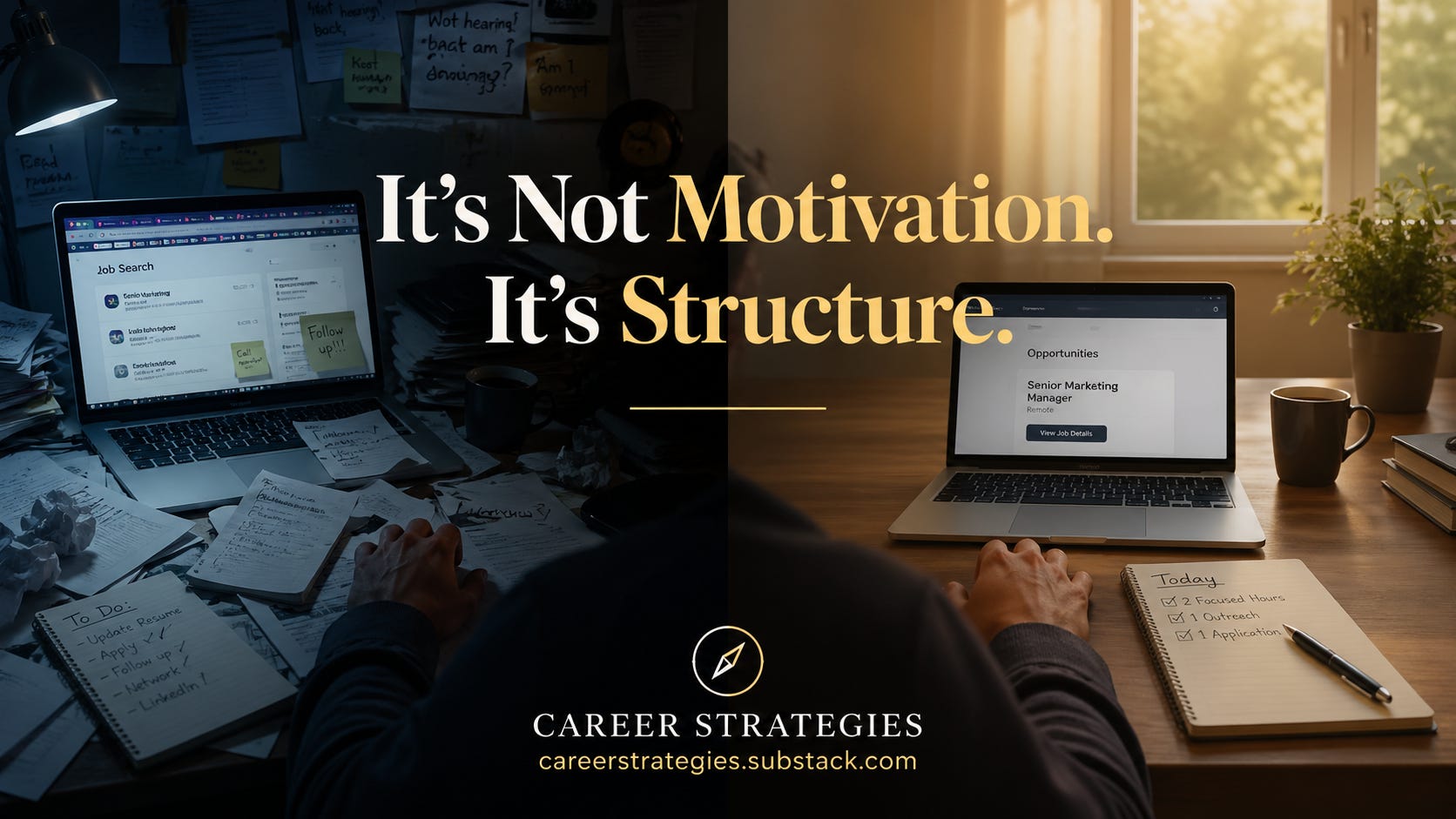
The Survival Architecture
Six dispatches for professionals rebuilding after the floor dropped out
Based on the book, Job Search Survival Guide 2026: Resilience, Strategy, and Real Stories for Today’s Job Market
This book is free from April 26 to April 30, 2026. All we ask is that you leave an honest review.
You tried to be productive yesterday.
You opened your laptop.
Pulled up job listings.
Started updating your resume.
Twenty minutes in, your energy dropped.
Not dramatically.
Just enough.
You clicked another tab.
Checked email.
Scrolled.
Closed the document.
And then came the thought:
“I need to be more disciplined.”
But that’s not what happened.
You didn’t fail.
You ran out of structure.
The Motivation Myth That Breaks People in This Phase
Most job search advice assumes something that isn’t true yet:
That you can rely on motivation.
It tells you:
Stay consistent
Push through
Treat it like a full-time job
But here’s the problem:
Motivation is a high-signal state.
It depends on:
Energy
Clarity
Feedback
Momentum
And right now—
You don’t have consistent access to any of those.
So when you build your job search on motivation, this is what happens:
You surge…
Then stall…
Then question yourself.
Not because you lack discipline—
Because you built on something unstable.
You’re Not Managing Effort. You’re Managing Variability
Before the disruption, your days had shape.
Meetings created pacing.
Deadlines created urgency.
Other people created accountability.
Now?
Every day is self-generated.
Which means the real challenge isn’t effort.
It’s variability.
Some mornings, you feel clear.
Other days, everything feels heavy before you even begin.
And if your system only works on the “clear” days—
You don’t have a system.
You have a streak.
The Shift: From Motivation to Infrastructure
You don’t need to push harder.
You need to lower the activation energy required to move.
That’s what infrastructure does.
It removes the need to decide, negotiate, or feel ready.
It gives you something that works—
even when you don’t.
What a Functional Job Search System Actually Looks Like
Most people overcomplicate this.
They build elaborate plans they can’t sustain.
Or they default to chaos.
The middle path is simpler—and far more durable.
1. Fixed Start Point (Not a Full Day)
Not “I’ll work all day.”
Just:
“I start at 9:00.”
That’s it.
You’re not committing to performance.
You’re committing to initiation.
Because starting is the highest-friction point in this phase.
2. Defined Work Block (Shorter Than You Think)
Forget eight hours.
Start with:
Two focused hours.
No switching tasks.
No optimizing tools.
No rethinking strategy mid-stream.
Just one lane:
Applications
Resume iteration
Outreach
When the block ends—you stop.
Not because you’re done.
Because stopping on time builds trust with yourself.
3. One Daily Signal
Your system needs output.
Not volume.
Signal.
One application
One message
One reconnection
That’s the minimum viable forward motion.
Because right now—
Consistency beats intensity.
4. A Visible Tracker
Not in your head.
Not scattered across tabs.
One place.
Simple.
Date | Action | Outcome
Why this matters:
Your brain is currently biased toward absence of results.
A tracker corrects that distortion.
It shows:
You are moving—even when it doesn’t feel like it.
5. A Hard Stop
This is where most people break their own system.
They keep going when energy is gone.
They push into exhaustion.
And the next day—
They don’t want to start again.
So define the stop point:
Time-based
Or action-based
And honor it.
Because sustainability is the real goal.
Why This Works (When Motivation Doesn’t)
This system does three things your current state requires:
1. It reduces decision fatigue
You’re not negotiating with yourself all day.
2. It creates repeatable wins
Small, visible progress compounds.
3. It stabilizes your identity
You stop feeling like someone who’s “trying to get it together”
and start operating like someone who already has structure.
The Hidden Risk: Overcorrecting Into Overwork
There’s a trap here.
Once people feel a bit of momentum, they swing too far:
Four hours becomes eight.
One outreach becomes twenty.
A system becomes a grind.
And then—
Burnout returns.
Different context.
Same pattern.
So here’s the rule:
Don’t scale effort until the system feels boring.
Boring means stable.
Stable means repeatable.
Repeatable is what gets results.
You’re Not Behind. You’re Between Systems
That feeling—
“I should be further along by now.”
It’s not a time problem.
It’s a structure gap.
You were operating inside a system you didn’t have to think about.
Now you’re building one from scratch.
Of course it feels slow.
Of course it feels uneven.
That’s not failure.
That’s construction.
Hope Anchor
You don’t need more discipline.
You need something that works
on the days you don’t.
Build that—
and everything else starts to follow.
Closing Bridge
Right now, you’re rebuilding rhythm.
But rhythm alone isn’t enough.
Because even with a system—
there’s something else quietly working against you:
The way the market is interpreting you.
Not your experience.
Not your capability.
Your signal.
And most professionals don’t realize:
They’re being filtered out
before they’re ever understood.
Next: Article 3 — The Signal Problem
Before You Go
If this felt familiar, it’s because it’s real.
Most job search advice assumes clarity, energy, and stability.
But that’s not where most people are starting.
That’s why I wrote:
Job Search Survival Guide 2026: Resilience, Strategy, and Real Stories for Today’s Job Market
Not as motivation.
Not as theory.
But as something steadier—
A way to understand what’s happening
while you’re still inside it.
About the Author
Byron K. Veasey is a career strategist and leader in data quality engineering focused on helping professionals navigate job searches, burnout, and career reinvention.
He writes Career Strategies, a newsletter read by over 3,900 professionals navigating today’s evolving job market.
👉 Subscribe to Career Strategies
This is exactly right. The hard part is that the modern job search has almost no natural feedback loops. You can do 20 things “right” and hear nothing.
The missing piece, in my view, is turning the job search into a weekly execution system: clear target roles, focused outreach, tracked conversations, fast resume iteration, and actual learning loops from the market. I shared something complementary on this exact point here
https://consulting2tech.substack.com/p/your-90-day-plan-to-land-a-tech-offer