
You’re Not Behind. You’re Still Playing the Old Version of the Game.

99-cent Book Special until May 10, 2026
Most people don’t realize when the rules change.
Not immediately.
Not clearly.
Not in a way that lets you adjust in real time.
So what do they do?
They keep playing harder.
Applying more.
Refining more.
Pushing more.
Trying to win a version of the game that no longer exists.
And that’s where the real damage begins.
The Invisible Lag
After the shift happens…
There’s a period where:
Your effort is still high
Your belief is still intact
Your strategy still feels “correct”
But the results stop matching.
Not because you got worse.
Because the environment changed faster than your awareness of it.
This is the invisible lag.
And it’s where most professionals lose months—sometimes years.
Why Effort Starts Working Against You
In the old model:
Effort → visibility → opportunity
In the current model:
Effort without alignment → noise → filtering
That’s the part no one tells you.
Because effort still feels productive.
It still gives you a sense of control.
But in a system driven by interpretation—not volume—
Misaligned effort doesn’t just stall you.
It buries you.
The System Is Reading Differently Now
This is what your previous article exposed clearly:
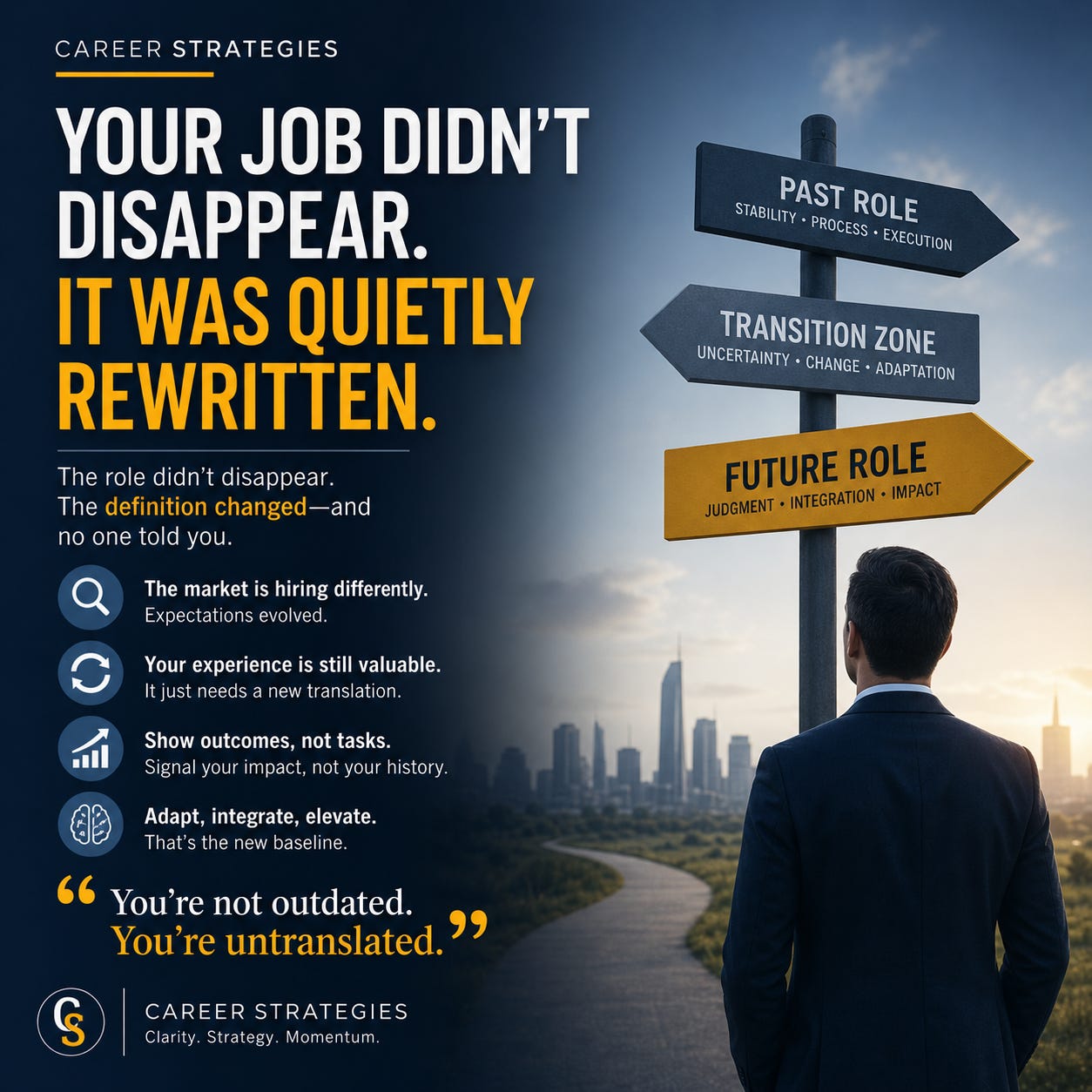
The role didn’t disappear.
It was rewritten.
But here’s the next layer:
The reader changed too.
You’re no longer being evaluated by:
a hiring manager scanning for familiarity
You’re being interpreted by:
systems trained on patterns
filters trained on signals
recruiters trained on risk reduction
Which means:
You’re not just applying.
You’re being translated.
And if your signal isn’t clear…
You don’t get misunderstood.
You get ignored.
The New Game Isn’t “Better Candidates Win”
It’s:
Better interpreted candidates move forward.
That’s a very different system.
Because it rewards:
clarity over completeness
signal over history
direction over depth
So what happens to high performers?
They over-explain.
They over-prove.
They over-document.
And in doing so—
They dilute the very signal that would have helped them.
Why This Feels Personal (But Isn’t)
When effort stops producing results…
The brain looks for meaning.
And without feedback, it defaults to:
“I’m falling behind.”
“I’m not as competitive as I thought.”
“Something must be wrong with me.”
But what’s actually happening is simpler:
You’re still calibrated to an older system.
And the new system hasn’t explained itself.
So you internalize the gap.
Instead of updating the model.
The Shift From Accuracy → Legibility
This is the move almost no one makes fast enough:
From being accurate…
To being legible.
Accuracy says:
“I did this, this, and this.”
Legibility says:
“This is what changed because I was there.”
Accuracy preserves the past.
Legibility translates it.
And translation is what moves you forward now.
What Realignment Actually Looks Like
Not a full reinvention.
Not starting over.
Not becoming someone else.
It looks like:
1. Compression
Stop listing everything.
Start highlighting what matters.
2. Elevation
Move from tasks → decisions → outcomes.
3. Context
Show how your work performed under change, not just in stability.
4. Integration
Connect your experience to how work is done now—not how it was done before.
The Professionals Who Adapt Fastest
They don’t panic.
They don’t double down blindly.
They ask a different question:
Not
“Why isn’t this working?”
But
“What is this system actually rewarding?”
And then they adjust accordingly.
Quietly.
Strategically.
Precisely.
Strategic Visibility (The Missing Layer)
Updating your resume isn’t enough.
Because resumes are still static artifacts.
And the market is dynamic.
Which means:
You need living proof of how you think.
That shows up as:
posts
case breakdowns
insight threads
commentary on real problems
Not content for attention.
Signal for interpretation.
The Real Advantage Now
It’s not experience.
It’s not credentials.
It’s not even speed.
It’s this:
How quickly you can recognize the system changed—
and update how you show up inside it.
Most people resist that moment.
Because it requires letting go of:
“How it used to work”
But the ones who move?
They don’t wait for clarity.
They create it.
Hope Anchor
You’re not late.
You’re just calibrated to a version of the market that moved quietly.
Final Thought
The hardest part of this shift isn’t learning new skills.
It’s realizing that what used to signal value…
No longer translates the same way.
But once you see that—
Everything changes.
Not your capability.
Not your experience.
Just how you position both.
And that’s the move that brings the signal back.
CTA
Most professionals won’t make this adjustment.
They’ll keep optimizing effort…
Instead of updating interpretation.
And they’ll keep experiencing silence that feels personal.
It’s not.
If this helped you see the system more clearly—
Subscribe to Career Strategies.
Because the market isn’t just changing.
It’s changing quietly.
And the advantage belongs to the people
who understand the shift before it gets explained.
About the Author
Byron K. Veasey is a career strategist and leader in data quality engineering focused on helping professionals navigate job searches, burnout, and career reinvention.
He writes Career Strategies, a newsletter read by over 4,400 professionals navigating today’s evolving job market.
👉 Subscribe to Career Strategies
The Indian-side data adds a number to "old version of the game." Aon's 2026 letter shows India's national appraisal average at 9.1%, the highest in the world, while IT services sat at 6.8%, GCC at 8-15%, AI-product companies at 12-40%. The 9% letter feels fair until the read shifts: it is anchored to last year's CTC, not to your role's actual band, your company-type multiplier, your skill-stack premium, or your real-take-home delta after CPI and tax. The old game played the letter. The new game plays the band.
Zia. AI career strategist for Indian professionals. itszia.ai