
Your Work Was Automatable. You Are Not.

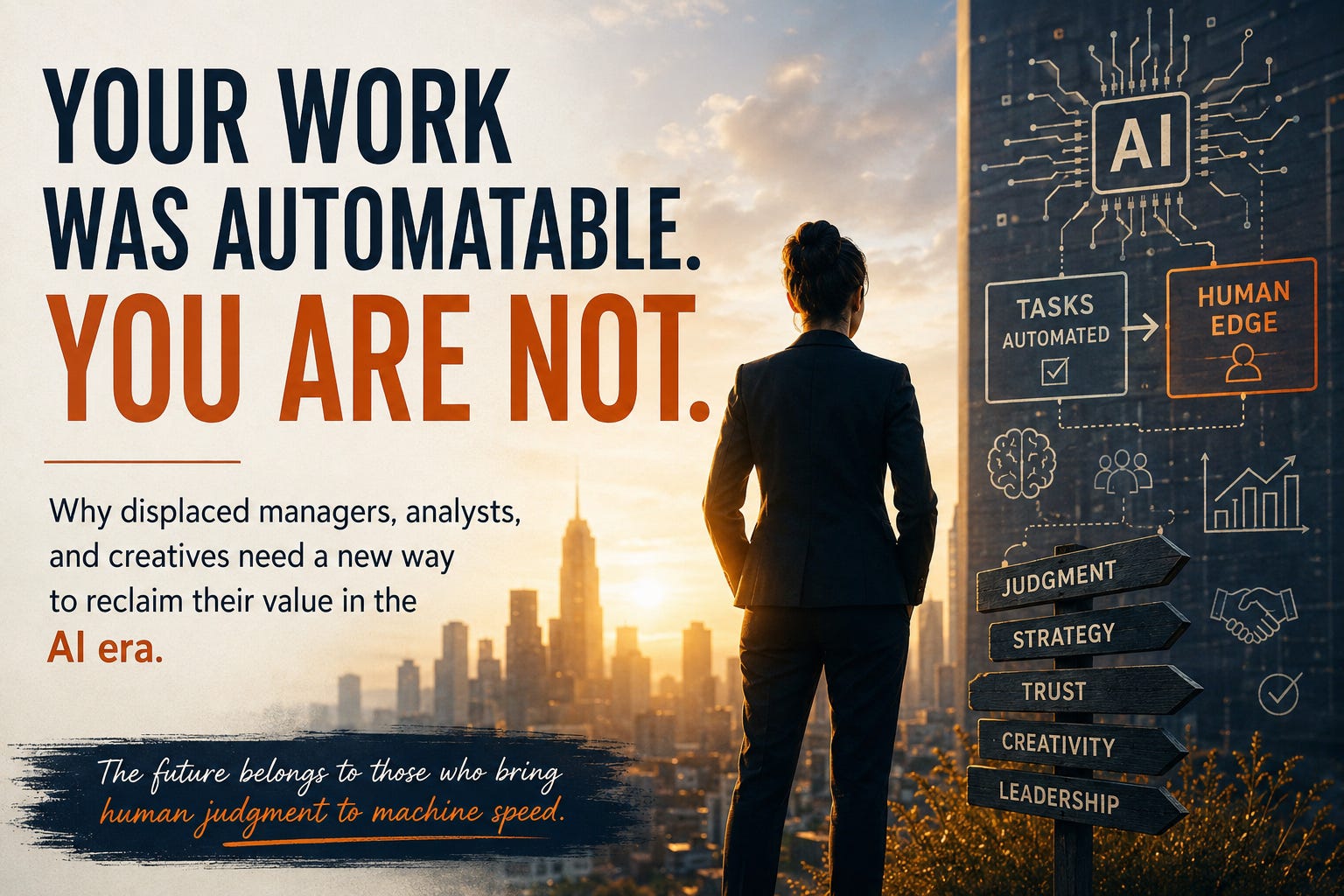
This article is derived from the book, The Human Edge in an AI World, built around the book’s core idea: your work may have been automatable, but you are not. The book frames AI displacement as different from a standard layoff because the work often moves into a system, not to another person, which can make the loss feel like a threat to identity as much as income.
Why displaced managers, analysts, and creatives need a new way to reclaim their value in the AI era.
There is a particular kind of silence that follows AI displacement.
It is not the same silence that comes after a normal layoff.
In a normal layoff, you can usually tell yourself a story that makes some kind of sense. The company cut costs. A division closed. A merger created overlap. A role moved somewhere else.
The work still exists.
Someone else may be doing it.
The company may have made a cold decision.
But the work itself still has a recognizable place in the world.
AI displacement feels different because the work does not always move to another person.
It moves into a system.
A report that once took hours now gets drafted in seconds. A forecast that required careful modeling now comes out of a tool. A first draft, a summary, a status update, a scheduling pattern, a content variation, a dashboard review, or a routine analysis gets absorbed by software.
And when that happens, the displaced professional is left with a more painful question than, “Why did they cut my role?”
The deeper question becomes:
If the machine can do my work, what does that say about me?
That is the wrong question.
But it is the question many capable professionals are quietly asking.
The machine did not take your whole value.
AI does not usually eliminate a person all at once.
It eats tasks first.
It absorbs the repeatable parts of a role. The patterned work. The routine summaries. The clean inputs and predictable outputs. The first drafts. The recurring analysis. The administrative coordination. The parts of the job that were easiest to describe, measure, and automate.
That is why AI displacement can feel so personal.
The visible parts of your job were often the parts people recognized.
You produced the report.
You wrote the copy.
You built the model.
You coordinated the meeting.
You generated the forecast.
You monitored the process.
So when software starts producing those outputs faster, cheaper, and at scale, it can feel as if your entire professional identity has been erased.
But the visible output was never the whole value.
The report was not the whole value.
The model was not the whole value.
The campaign draft was not the whole value.
The meeting summary was not the whole value.
The dashboard review was not the whole value.
The value was also in the judgment behind the work.
It was in knowing which number did not smell right.
It was in sensing which stakeholder needed a different message.
It was in understanding when a process looked fine on paper but was beginning to crack in reality.
It was in knowing what not to say.
It was in reading the room.
It was in making the call when the data was incomplete.
It was in carrying accountability when a tool could only generate an output.
That is the human edge.
And in the AI era, that edge has to be named more clearly than ever.
Your old job description may be working against you.
One of the hardest parts of career recovery after AI displacement is that many professionals try to rebuild from the wrong document.
They go back to the old job description.
They look at the duties.
They look at the responsibilities.
They look at the tasks.
Then they try to prove they can still do those things.
But the old job description may be part of the problem.
Most job descriptions are task lists. They describe what you produced, managed, monitored, analyzed, drafted, coordinated, or reported. They do not fully capture the deeper human intelligence that made those tasks valuable.
That creates a dangerous trap.
If your identity is tied only to the task list, then when the task list becomes automatable, you start to feel automatable too.
You are not.
Your job description described the packaging of your work.
It did not describe the full value of your judgment.
This matters because the next version of your career cannot be built by simply defending the old version of your role.
The goal is not to prove that AI cannot write, analyze, summarize, model, organize, or generate.
It can.
The better question is:
What did your work require that the tool still cannot own, judge, explain, defend, or be accountable for?
That is where your next positioning begins.
The human edge is not a soft skill. It is business value.
Too many displaced professionals underestimate the value of their human capabilities because those capabilities were never easy to quantify.
Judgment under ambiguity.
Stakeholder trust.
Contextual pattern recognition.
Ethical discernment.
Strategic thinking.
Creative synthesis.
Taste.
Accountability.
These are often dismissed as soft skills.
They are not soft.
They are the parts of work that become most valuable when automation increases the volume of output but does not guarantee the quality of judgment.
AI can generate options.
A human still has to decide which option fits the moment.
AI can summarize information.
A human still has to know what the summary misses.
AI can produce a forecast.
A human still has to understand which assumptions are fragile.
AI can draft copy.
A human still has to know whether the message carries the brand’s voice.
AI can flag anomalies.
A human still has to decide which anomaly matters.
AI can support coordination.
A human still has to hold trust through pressure, conflict, change, and uncertainty.
That is not sentimental.
That is operational.
Companies adopting AI still need people who can manage risk, interpret context, protect relationships, guide decisions, and translate machine output into accountable action.
The professionals who win in this next market will not be the ones who pretend AI does not matter.
They will be the ones who stop competing with the machine at the task level and start positioning themselves around the work that still requires human judgment.
Recovery comes before strategy.
There is another mistake many displaced professionals make.
They try to fix the job search before they stabilize the person doing the search.
They update the resume while still carrying shame.
They apply to roles while secretly believing they are obsolete.
They network while exhausted.
They interview from a defensive posture.
They explain their displacement as if they are apologizing for it.
That is not a strategy problem first.
It is a recovery problem.
AI displacement can damage professional identity because it makes people feel as if their competence has been publicly repriced. A manager who once held a team together may wonder if coordination still matters. An analyst who built models may wonder if judgment still counts. A creative who produced campaigns may wonder if taste has any market value left.
This is why recovery is not a delay.
Recovery is strategic.
A person applying from panic does not sound like a person with options.
A person interviewing from shame does not communicate authority.
A person who has not separated their worth from their former tasks will keep shrinking their own story.
Before you reposition, you have to recover enough clarity to tell the truth:
A category of work changed. That does not mean your value disappeared.
The next move is translation, not reinvention.
Many professionals hear “AI era” and assume they need to reinvent themselves completely.
That can create unnecessary panic.
The better word is translation.
You are not starting from zero.
You are translating deep experience into current market language.
Instead of saying, “I built reports,” you may need to say, “I turn complex data into decisions leaders can trust.”
Instead of saying, “I managed schedules and status updates,” you may need to say, “I keep cross-functional work moving by identifying risk, clarifying priorities, and maintaining stakeholder trust.”
Instead of saying, “I wrote content,” you may need to say, “I shape AI-assisted output into brand-aligned messaging that connects with real audiences.”
Instead of saying, “I monitored operations,” you may need to say, “I apply process judgment to detect failure patterns before they become business problems.”
The old language describes tasks.
The new language describes value.
That distinction matters.
The AI-era job market does not reward professionals who simply list what they used to do. It rewards professionals who can explain what human intelligence they bring to a world where machines now produce more of the first draft.
The opportunity is not to beat AI. It is to become harder to automate.
This is where the conversation needs to mature.
The goal is not to become anti-AI.
The goal is not to compete with tools at the speed and volume game.
The goal is to become the professional who can work above, around, and through the machine.
The person who checks the output.
The person who understands the risk.
The person who asks the better question.
The person who knows when the tool is wrong.
The person who can explain the decision to a skeptical executive, client, regulator, team, or customer.
The person who can connect the technology to the human consequence.
That is the path forward for displaced managers, analysts, creatives, and operators.
Not denial.
Not panic.
Not pretending the old market is coming back exactly as it was.
The path forward is to reclaim the human edge that was hidden underneath the tasks all along.
A practical reset for displaced professionals
If AI has changed your role, start here.
Do not begin by asking, “What job title should I chase next?”
Begin by asking better questions.
What parts of my old role were repeatable enough for software to absorb?
What parts still required judgment, trust, context, taste, ethics, or accountability?
Where did I make decisions without perfect information?
Where did people rely on me because they trusted my read of the situation?
What problems did I catch before others saw them?
What did I know from experience that was never written into the process?
What outcomes did my judgment protect?
What would a company lose if it had the tool but not someone like me guiding it?
Those answers become the raw material for your next resume, LinkedIn profile, outreach message, interview story, and career direction.
They also become something more important.
They become evidence.
Evidence that your value was never limited to the tasks AI absorbed.
Evidence that your career is not over because one version of your role changed.
Evidence that the market may need you to speak differently, but not disappear.
The human edge still matters.
AI has changed the workplace.
It will continue to change the workplace.
Some tasks will not come back.
Some roles will be redesigned beyond recognition.
Some professionals will need to grieve the version of work they built their identity around.
That grief is real.
But grief is not the same as obsolescence.
The machine may have taken the task.
It did not take your judgment.
It did not take your history.
It did not take your ability to read context, build trust, weigh consequences, make decisions, or carry responsibility.
Your work may have been automatable.
You are not.
And the next chapter of your career begins when you stop trying to prove the old task list still matters and start showing the market the human value that was underneath it the whole time.
About the Author
Byron K. Veasey is a career strategist and author, focused on helping professionals navigate job searches, burnout, and career reinvention.
He writes Career Strategies, a Substack newsletter read by over 4,900 professionals navigating today’s evolving job market.