
Your Team Is Quiet. But Are They Grieving—or Have They Stopped Believing?

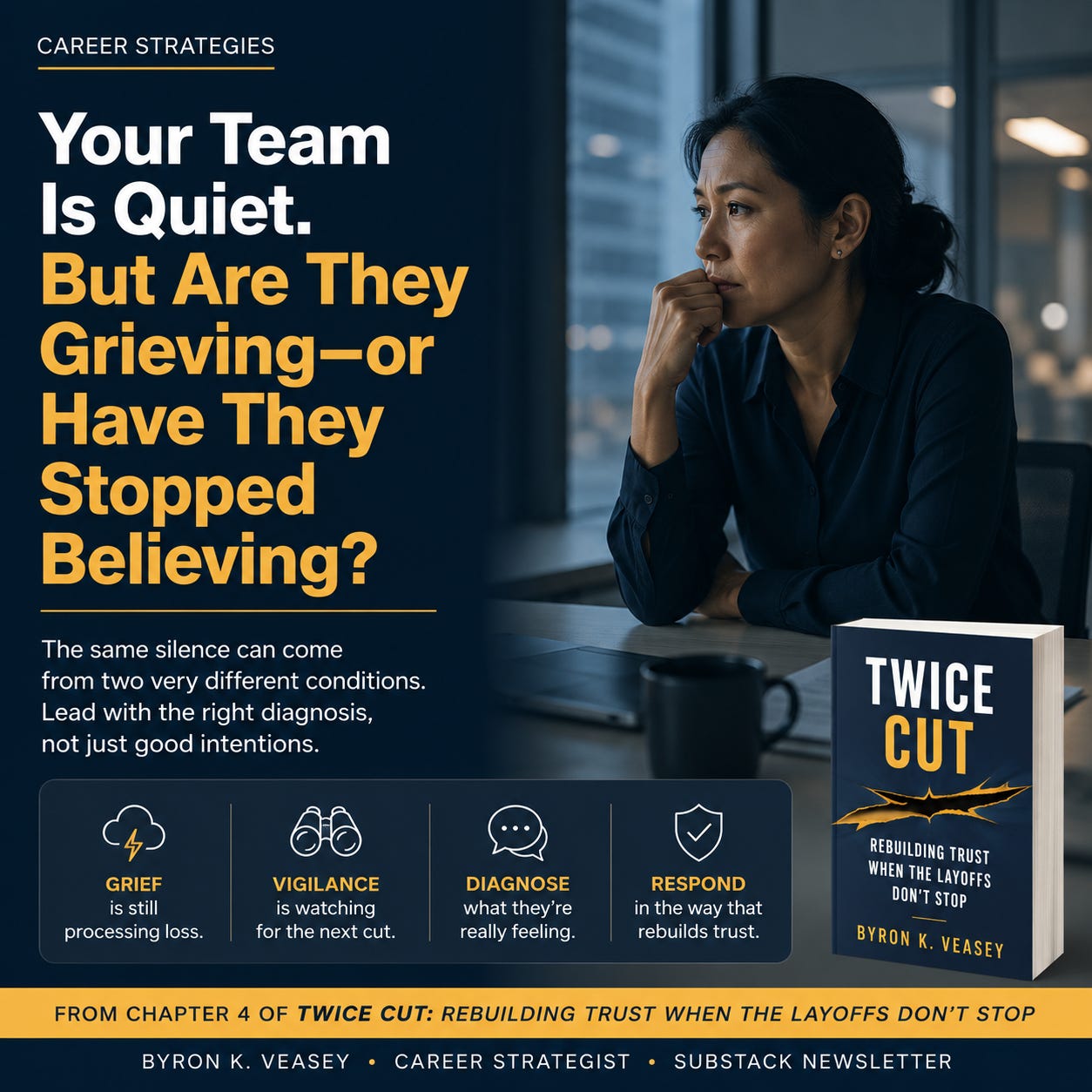
The same post-layoff behavior can come from two very different conditions. Leaders who mistake vigilance for grief may apply the most compassionate response—and accidentally deepen the team’s distrust.
This article is adapted from Chapter 4, “Reading Your Team’s Actual Position,” in Twice Cut: Rebuilding Trust When the Layoffs Don’t Stop. The book examines what happens to teams and leaders after layoffs become recurring rather than exceptional.
Vanessa noticed the change in Mei because Mei used to be the person who filled silences.
For two years, she had been the engineer who asked the second question in every meeting.
The first question usually clarified the immediate issue.
Mei’s second question opened the real conversation.
She challenged assumptions, identified risks other people had missed, and made connections between decisions that initially seemed unrelated. Her questions were not disruptive. They were often the reason the team left a meeting with a better plan than the one it entered with.
After the second round of layoffs, the questions disappeared.
Mei still performed.
Her assignments were completed on time. Her code reviews remained thorough. She attended every meeting, answered direct questions, and gave no one an obvious performance problem to address.
But she rarely volunteered anything.
The employee was still present.
The part of her that used to extend herself into the room was gone.
Vanessa believed she understood what she was seeing.
The team had survived two rounds of layoffs. People had lost colleagues, absorbed additional responsibilities, and returned almost immediately to deadlines that had not been reduced to reflect the smaller staff.
Mei was grieving.
At least, that was Vanessa’s diagnosis.
So she responded the way thoughtful leaders are usually advised to respond to grief.
She gave Mei space.
She checked in without pressuring her.
She acknowledged that the previous months had been difficult. She told Mei there was no rush to feel normal again and reassured her that her position was secure.
Vanessa remained patient for six weeks.
Nothing changed.
Mei did not gradually become more open. She did not start asking questions again. Her distance did not soften as the immediate shock of the layoffs faded.
Instead, the distance became more consistent.
What initially looked like sadness began to feel more like a policy.
Then Vanessa mentioned that a platform migration Mei cared about had finally been reapproved. The project had executive support, and funding had been allocated for the next quarter.
It was genuinely good news.
Mei nodded.
Then she asked whether the budget line had actually posted.
There was no visible relief.
No renewed interest.
No discussion of what the team could begin planning.
Just a procedural request for independently verifiable evidence.
That was the moment Vanessa realized she had been treating the wrong condition.
Mei was not waiting for grief to pass.
She was waiting for proof.
The Same Silence Can Mean Two Different Things
After a layoff, leaders often encounter the same group of behaviors:
People speak less in meetings.
Strong employees stop volunteering for additional assignments.
Questions disappear.
Long-term planning becomes difficult.
People complete their immediate work but seem reluctant to invest anything beyond it.
From the front of the room, those behaviors may look identical.
But they can come from two very different internal positions.
The first is post-layoff grief.
The employee is still processing the loss of colleagues, the disruption of familiar relationships, and the sudden realization that organizational membership is less secure than they believed.
They may feel survivor’s guilt.
They may be angry with leadership.
They may be exhausted from absorbing additional work while also trying to understand why others were selected to leave.
This employee is hurt.
But the connection between the leader’s words and the employee’s beliefs still exists.
They may doubt reassurance.
They may challenge what they hear.
But they still process the leader’s statements as information worth considering.
The second position is vigilance.
A vigilant employee has experienced something more than loss.
They have experienced reassurance that was later contradicted by events.
They may have been told the first layoff completed the restructuring.
They may have been encouraged to stop worrying, concentrate on the work, and begin planning for the future again.
Then another round occurred.
The lesson they absorbed was not simply that layoffs are painful.
It was that leadership’s words about the future do not reliably predict what happens next.
This employee may look hurt.
But their operating position is different.
They are no longer waiting to feel better.
They are gathering evidence.
Grief Still Believes the Relationship Can Help
Grief usually wants acknowledgment.
The grieving employee may not immediately ask for a conversation, but they often respond when the loss is named honestly.
They want the leader to recognize that something meaningful happened.
Not just that headcount was reduced.
Not just that the organization changed its operating model.
People disappeared from the employee’s daily life.
Mentors, friends, project partners, and colleagues with whom they had built routines were suddenly gone. The remaining team may have inherited unfinished work without receiving time to absorb the emotional or operational consequences.
A grieving employee may become quieter, but emotion still leaks through.
Some days they appear frustrated.
Other days they seem sad or unusually tired.
They may become visibly angry when a leader uses language that minimizes what occurred.
Their response changes according to the subject because the underlying condition is emotional.
There is movement.
There is variance.
There is still a relationship between what happens in the room and how the person responds.
Acknowledgment helps because the employee still believes the relationship with the leader can carry something useful.
Time can help because each honest interaction becomes part of the recovery process.
Reassurance may be received cautiously, but it is still considered.
The trust line has been damaged.
It has not been disconnected.
Vigilance Is Not Waiting to Be Comforted
The vigilant employee may display the same withdrawal, but the logic underneath it is different.
They are not primarily trying to process a loss.
They are trying to reduce future exposure.
They may believe that the official explanation for the layoffs was incomplete.
They may suspect that the next decision will be made long before anyone communicates it.
They may have watched leadership confidently describe a stable future shortly before another announcement proved that confidence misplaced.
The vigilant employee is not necessarily angry with the manager.
They may still respect them.
They may even believe the manager was sincere.
But sincerity and predictive value are no longer the same thing.
The employee has learned that a leader can be honest and still be wrong.
So they change how they process information.
They stop asking whether the leader means what they are saying.
They begin asking whether the statement can be verified through another channel.
Has the funding actually been released?
Has the contract been signed?
Has the position been posted?
Has the replacement been approved?
Has the decision appeared in a system that cannot be changed by another executive conversation next week?
This employee is not asking for more reassurance.
They are asking for evidence.
When leaders continue offering emotional reassurance, the employee may not experience it as care.
They may experience it as another unsupported claim.
Why the Wrong Treatment Can Make Things Worse
The distinction between grief and vigilance matters because the two conditions require different responses.
A grieving employee generally benefits from acknowledgment, patience, emotional room, and honest communication.
A vigilant employee responds primarily to demonstrated patterns.
They need to see that updates arrive when promised.
They need leaders to distinguish clearly between facts, assumptions, and unknowns.
They need to see commitments completed, workloads reduced, risks surfaced safely, and bad news communicated before employees discover it informally.
Applying the vigilance response to grief can feel cold.
The leader may become so focused on evidence and execution that they fail to recognize the human loss underneath the behavior.
An employee who needed acknowledgment instead receives a process.
Their grief does not disappear.
It moves underground.
But applying the grief response to vigilance creates a different danger.
The leader offers warmth, patience, and reassurance.
The employee watches those words produce no change in the conditions around them.
Each new reassurance becomes another unsupported entry in a record that already contains too many.
Vanessa’s six weeks of compassion were sincere.
They were also ineffective because Mei was not evaluating Vanessa’s empathy.
She was evaluating whether leadership’s statements could once again be used to make decisions.
The problem was not that Vanessa needed to care more.
She needed to diagnose more accurately.
Four Places the Difference Becomes Visible
Leaders do not have to guess blindly.
Grief and vigilance tend to separate in four observable areas.
1. Listen to how people describe what happened
A grieving employee often names the loss directly.
They may say:
“Since we lost half the team…”
“After Marcus and Elena were laid off…”
“Ever since the March announcement…”
The language may carry anger, sadness, or disbelief.
The employee may repeat the story because grief often tries to organize itself through narration. Naming what happened is part of making sense of it.
A vigilant employee is more likely to use distance.
They may refer to “what happened,” “the changes,” or “the last restructuring.”
When they do name the layoffs, their language may be unusually flat and precise.
There is little emotional charge because the event has already been filed as evidence.
You may also hear more separation from the organization:
“They decided…”
“This place is going in another direction…”
“That is what the company says now…”
Distancing language does not automatically prove vigilance.
But a noticeable shift from “we” to “they” is worth observing.
So is a shortened time horizon.
The vigilant employee may speak fluently about this week or this quarter while rarely discussing next year unless directly asked.
They are not necessarily unable to imagine a future.
They may simply be unwilling to build one on information they do not control.
2. Watch whether meeting behavior varies
Grief is uneven.
A grieving employee may be withdrawn in one meeting and visibly frustrated in another. A discussion about a departed colleague’s project may produce a stronger reaction than a routine operational update.
Their emotions move because different subjects touch the loss differently.
Vigilance is often more uniform.
The employee brings the same controlled flatness to good news, bad news, recognition, and routine status discussions.
They answer what is asked.
They volunteer little.
Their responses are complete enough to avoid further questioning but brief enough to prevent the conversation from opening.
This is not necessarily emotional numbness.
It may be disciplined information control.
The employee has decided that unnecessary expression creates unnecessary exposure.
Notice the questions that have disappeared.
A person who once challenged assumptions may now allow weak assumptions to pass.
Someone who previously asked what a decision meant for the next six months may restrict themselves to what must be completed this week.
The absence of questions is not always the absence of thought.
It may mean the employee no longer believes the meeting is the safest or most useful place to publish that thought.
3. Pay particular attention to good news
Bad news produces caution in almost everyone.
Good news is more revealing.
A grieving employee may remain skeptical, but genuine good news usually creates some visible movement.
Their shoulders relax.
Their tone changes.
They begin discussing possibilities.
They ask what the news means for the team.
The reaction may be small, but something lands.
A vigilant employee often responds procedurally.
Is it finalized?
Has the budget posted?
Who approved it?
When will it appear in the system?
Has the customer signed?
Are the positions actually open?
These are not necessarily cynical questions.
They are verification questions.
The employee is refusing to update their behavior until the announcement appears on a channel they still trust.
Leaders sometimes interpret this response as negativity.
They may become defensive:
“Why can’t you accept good news?”
“Why does everything have to be questioned?”
“We are trying to give the team something positive.”
But the employee may not be rejecting the news.
They are waiting for the news to become real enough to act on.
That distinction matters.
4. Observe how employees treat new commitments
A grieving employee may plan around a new commitment cautiously.
They understand that circumstances can change, but they still allow the official timeline to influence their decisions.
A vigilant employee maintains a private contingency beneath the public plan.
They may accept ownership of a project while describing their involvement in provisional language.
They may decline a relocation, delay a major purchase, avoid adding staff, or resist committing to a multi-year initiative.
They may verify official information through peers before acting on it.
They may also decline stretch assignments they would once have welcomed.
This is where leaders often make the ambition mistake.
They assume the employee no longer wants to grow.
The employee may still want growth.
They simply no longer believe the organization’s promise of opportunity is enough to justify additional exposure.
The project may be exciting.
The promotion may be attractive.
The assignment may be perfectly aligned with the employee’s abilities.
But the employee is calculating the offer against a record the leader may not be considering.
What happens if the project is canceled?
What happens if the executive sponsor leaves?
What happens if increased visibility makes the employee’s compensation or role easier to scrutinize?
What happens if the organization asks for eighteen months of commitment but offers only ninety days of believable stability?
Leaders hear hesitation.
The employee hears risk.
Most Teams Are Not in One Condition
It is tempting to diagnose the whole team at once.
The group is quiet, so the group must be grieving.
Or the group is skeptical, so the group must be vigilant.
Real teams rarely divide that cleanly.
One employee may be experiencing the first layoff of their career.
Another may have survived three reductions in two years.
A third may have joined after the first round but watched the second one eliminate the person who recruited them.
Some employees may still trust their direct manager while distrusting senior leadership.
Others may trust neither.
Some may be angry and emotionally engaged.
Others may have already completed a private withdrawal from the organization.
The same meeting may contain grief, vigilance, exhaustion, job-search preparation, and ordinary dissatisfaction.
A blanket response will therefore land unevenly.
A large emotional town hall may help employees who need acknowledgment.
It may cause vigilant employees to become more suspicious if the event is not followed by observable changes.
A highly procedural update may reassure those waiting for evidence.
It may feel dismissive to employees who still need the loss to be recognized.
The objective is not to place every employee permanently inside a category.
It is to understand their current position well enough to choose a response that does not make that position worse.
Use Observation Before Interpretation
For the next two weeks, resist the urge to label the team’s behavior immediately.
Record what you can actually observe.
Not:
“Mei is disengaged.”
Instead:
“Mei answered two direct questions but did not volunteer the follow-up concern she later mentioned privately.”
Not:
“Daniel has lost his ambition.”
Instead:
“Daniel declined two visible assignments he would previously have requested.”
Not:
“The team is negative about every announcement.”
Instead:
“After the funding announcement, three employees asked whether the budget had been released before discussing next steps.”
This discipline matters because interpretations quickly become management decisions.
Once you label someone disengaged, you may begin coaching them for motivation.
Once you label someone resistant, you may stop including them in important discussions.
Once you assume an employee is burned out, you may reduce opportunities they still want.
Once you decide the team has recovered because complaints have disappeared, you may miss that people have stopped negotiating with the organization.
Description slows the rush toward correction.
It gives you time to consider multiple explanations.
A Practical Second Cut Diagnostic
You can organize your observations across four areas:
Language
Does the employee name the layoffs emotionally, or refer to them with distant precision?
Have they shifted from “we” to “they”?
Do they speak about the future voluntarily, or only about immediate obligations?
Meeting behavior
Does their emotional response vary according to the topic?
Have they stopped asking questions they once asked regularly?
Do their check-in answers invite conversation or close it?
Response to good news
Does positive information produce any visible relief?
Do they ask procedural questions before allowing the news to influence their plans?
Do they wait for confirmation from a second source?
Treatment of commitments
Are they willing to plan around stated timelines?
Do they maintain visible contingencies beneath official plans?
Have they begun declining stretch work or postponing personal decisions connected to the organization?
The purpose is not to diagnose an employee’s mental state from a distance.
It is not a psychological test.
It is a structured leadership judgment based on observable behavior.
Your initial conclusion should remain open to correction.
A private conversation may reveal grief where you expected vigilance.
An employee who appears detached may simply be dealing with an unrelated personal issue.
A person who declines an assignment may genuinely be overloaded.
The diagnostic should improve your questions, not replace them.
What Each Position Needs From the Leader
A team dominated by first-round grief needs acknowledgment before acceleration.
Name what happened.
Recognize the people who left without turning the discussion into a corporate ritual.
Discuss what changed in the work, the relationships, and the team’s sense of security.
Do not rush employees toward gratitude or renewed enthusiasm.
Give people emotional room while continuing to provide structure.
A mixed or transitional team needs acknowledgment paired with evidence.
Recognize the loss, but do not stop at recognition.
Show what has changed in response.
Close small commitments visibly.
Reduce work rather than merely promising to review capacity.
Create safer ways to surface concerns.
Make the distinction between what is known, what is expected, and what remains outside your control.
A vigilance-dominant team needs observable leadership.
Do not lead with another promise about stability.
Do not ask people to trust what they cannot verify.
Tell them what is true now.
Tell them what is unknown.
Then build a repeated pattern they can test.
Send the update when you said you would, even when there is little to report.
Track unanswered questions and return with answers.
Protect employees who bring bad news early.
Do not announce workload relief until tasks have actually been removed.
Do not describe a project as funded until the funding exists in a form the team can see.
The first deposit may seem small.
That is appropriate.
A team that stopped extending large amounts of trust will not reopen the full credit line because of one strong meeting.
It will begin with a small transaction.
Did the leader do what they said they would do this week?
Then another.
And another.
Stop Asking Whether the Team Has “Moved On”
Leaders often want to know when the team will return to normal.
When will people become more energetic?
When will meetings feel easier?
When will employees stop talking about the layoffs?
When will everyone concentrate fully on the future?
Those questions assume recovery is a single path.
But grief and vigilance move differently.
A grieving employee may speak about the layoffs frequently while gradually restoring trust.
A vigilant employee may never mention them while quietly removing the organization from their long-term plans.
The employee who appears emotional may still be engaged enough to want repair.
The calmest employee may have stopped expecting anything from the relationship.
Silence is therefore not a reliable measure of recovery.
Neither is compliance.
Neither is the absence of complaints.
The more useful question is:
What does this person currently allow leadership’s words to change?
Do they plan differently after receiving information from you?
Do they raise a risk because they believe you will act on it?
Do they ask a future-oriented question because they think the answer may be useful?
Do they accept an opportunity without first constructing an escape route?
These are signs that trust is operating again.
Not perfectly.
Not permanently.
But enough to influence behavior.
The Team’s Position Determines the Leadership Response
Vanessa’s mistake was not that she lacked compassion.
She cared enough to give Mei six weeks of patience.
Her mistake was assuming that quietness identified the condition underneath it.
Once she understood that Mei was vigilant rather than simply grieving, Vanessa stopped trying to reassure her.
She became more precise.
When she had confirmed information, she explained what made it confirmed.
When she had an expectation rather than a fact, she labeled it as an expectation.
When she did not know, she said so without decorating the uncertainty.
She followed up on small commitments.
She answered procedural questions without treating them as challenges to her integrity.
Mei did not suddenly become enthusiastic.
That was not the first sign of progress.
The first sign was another question.
Several weeks later, during a planning discussion, Mei raised a risk before Vanessa asked for it.
It was not a dramatic return.
It was one of the second questions she used to ask.
That question meant something had changed.
Mei had decided that bringing information into the room might once again be worth the exposure.
Leaders often wait for restored energy.
They should also watch for restored risk.
A difficult question.
An honest objection.
A concern raised early.
A plan made slightly further into the future.
These moments may look ordinary.
After repeated layoffs, they are not.
They are evidence that an employee is beginning to move from verification back toward participation.
Your team’s silence does not tell you what your team needs.
You must read the position underneath it.
Some people are grieving and need the loss acknowledged.
Some are vigilant and need a pattern they can verify.
Many are carrying both.
The quality of your response depends on knowing the difference.
Before you ask how to make the team more engaged, ask a more precise question:
Are they still processing what happened?
Or have they concluded that what you say cannot safely guide what they do next?
The two conditions can wear the same face.
They should never receive the same treatment.
Adapted from Twice Cut: Rebuilding Trust When the Layoffs Don’t Stop by Byron K. Veasey.
Available on Amazon:
https://www.amazon.com/dp/B0H8RQ4TN7
About the Author
Byron K. Veasey is a career strategist and leader in data quality engineering focused on helping professionals navigate job searches, burnout, and career reinvention.
He writes Career Strategies, a Substack newsletter read by over 4,900 professionals navigating today’s evolving job market.
👉 Subscribe to Career Strategies