
Your Team Is Not Disengaged. They May Be Paying the Vigilance Tax.

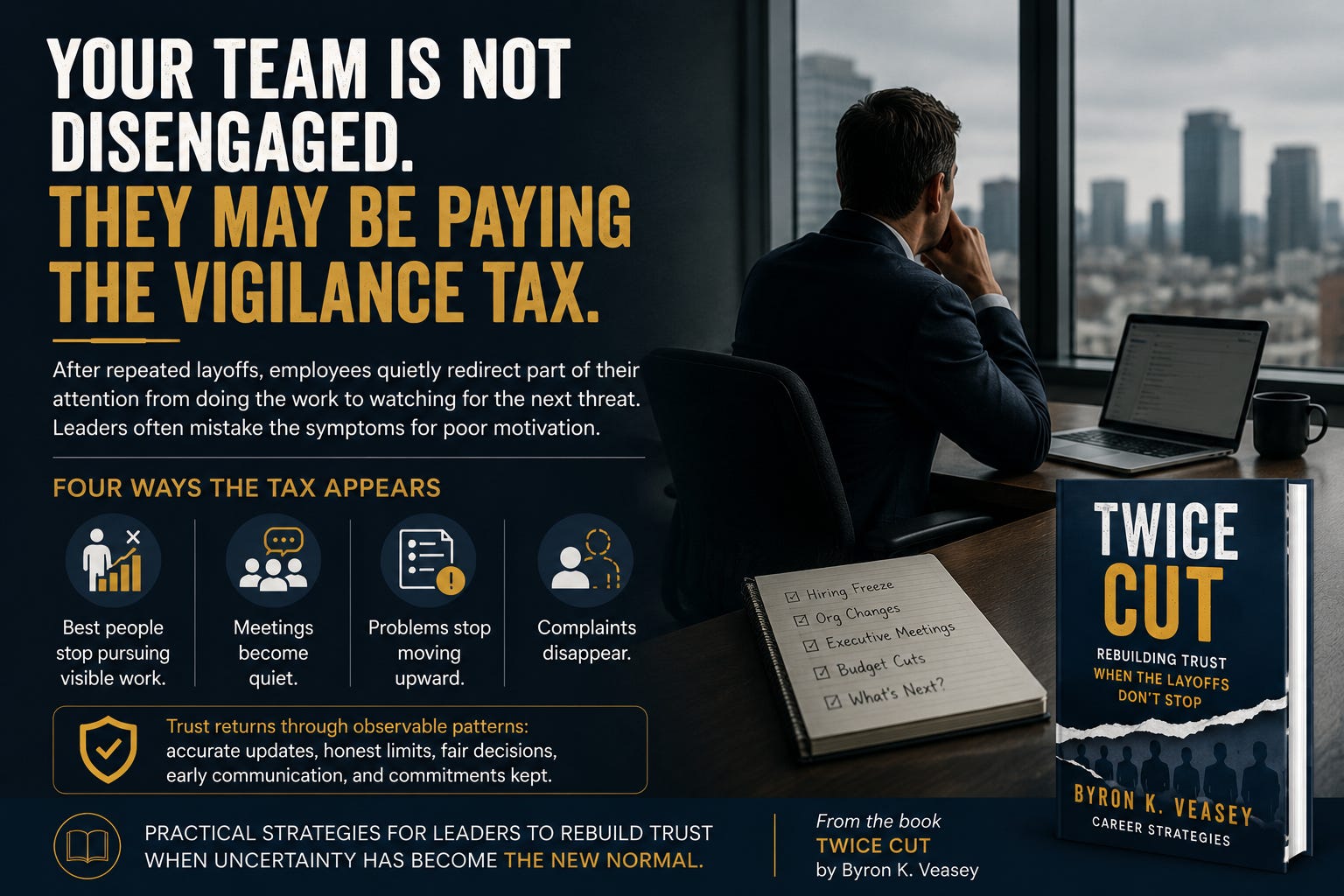
After repeated layoffs, employees quietly redirect part of their attention from working to watching for the next threat. Leaders often mistake the symptoms for poor motivation.
This article is adapted from Chapter 3, “The Vigilance Tax,” in Twice Cut: Rebuilding Trust When the Layoffs Don’t Stop. The book examines what happens to teams and leaders after layoffs become recurring rather than exceptional.
Ingrid offered her strongest engineer the assignment he would once have fought to get.
The project had everything ambitious employees usually want: executive visibility, meaningful technical work, and the chance to influence a major business decision. Eighteen months earlier, he would have accepted it before she finished describing it.
This time, he listened, thanked her, and declined.
He said he wanted to concentrate on his core responsibilities.
Ingrid initially assumed he was exhausted. The team had survived two rounds of layoffs, absorbed additional work, and spent months operating with fewer people. Burnout seemed like the obvious explanation.
She asked about his workload. He told her it was manageable.
Then she wondered whether he was preparing to leave. She watched for the usual signs but saw nothing conclusive.
It took several conversations before he finally explained his reasoning.
Two employees who had been laid off from a nearby team had been leading highly visible projects. He did not believe their visibility caused their dismissal. But he wondered whether those assignments had made their compensation and positions easier to notice during the cost review.
He could not prove the connection.
He did not want to test it.
He had concluded that the safest place in the organization was no longer at the top of the performance curve. It was somewhere in the middle: valuable enough to keep, but quiet enough to avoid becoming a prominent line on someone’s spreadsheet.
The assignment Ingrid viewed as an opportunity, he viewed as exposure.
He had not lost his ambition.
He had changed his survival strategy.
The Work Your Team Never Assigned
After repeated layoffs, employees acquire a second job.
Nobody adds it to their objectives.
It does not appear in project plans, performance reviews, capacity models, or workload discussions.
The job is threat detection.
Employees monitor hiring freezes, budget changes, meeting invitations, executive behavior, contractor reductions, project cancellations, and unexpected calendar gaps. They study which departments are growing and which ones have stopped replacing people.
They notice when leaders suddenly become more visible.
They pay attention when senior executives begin using phrases such as “efficiency,” “simplification,” “operating discipline,” and “strategic realignment.”
They compare internal messages with what they hear from colleagues, recruiters, former employees, and competitors.
This monitoring is not necessarily cynical.
It is often a rational response to what employees have already experienced.
After the first layoff, leadership may have told them the restructuring was complete. They may have believed that reassurance, stopped bracing, and returned their attention to the work.
Then another round arrived.
Once reassurance has failed, employees begin searching for information they can independently verify. Stability becomes self-service.
The attention required for that constant monitoring has to come from somewhere.
It comes from the work.
That diversion is the Vigilance Tax: the portion of every employee’s attention, energy, and willingness to take risks that is redirected from performance to self-protection.
The organization never receives an invoice for it.
It still pays the bill.
Vigilance Is Not a Mood
Leaders often treat post-layoff behavior as an engagement problem.
Employees seem less enthusiastic, less collaborative, and less willing to speak openly. The natural response is to increase motivation: launch a recognition program, hold a team-building session, schedule career conversations, or ask managers to create more energy in meetings.
But vigilance is not simply a negative mood that can be improved with better morale programming.
It is an operating behavior.
The employee who watches organizational signals during a meeting is not necessarily refusing to engage. Part of their cognitive capacity is occupied by a question that has become more urgent than the presentation:
Am I safe here?
That question does not disappear because the meeting includes an icebreaker.
It does not disappear because senior leadership says the company is excited about the future.
And it does not disappear because several months pass without another announcement.
A quiet month proves only that no layoff occurred during that month.
Employees who have already experienced repeated cuts know that the previous round was also preceded by quiet months.
They are not waiting for time to reassure them.
They are watching for evidence.
Four Ways the Tax Appears
The Vigilance Tax is difficult to manage because leaders rarely see it being collected.
They see its downstream effects.
Those effects often arrive disguised as ordinary performance or culture problems.
1. Your best people stop pursuing visible work
Declined stretch assignments are usually interpreted as lost ambition.
A manager may respond with coaching, encouragement, or a conversation about long-term goals. Those responses make sense on a stable team.
But after repeated layoffs, visibility may have been repriced.
An employee may believe that leading an expensive or high-profile initiative makes their role easier to scrutinize. They may worry that becoming strongly associated with a program creates additional risk if that program is later canceled.
The employee is not necessarily afraid of hard work.
They may be afraid of becoming too legible.
This creates a painful contradiction. The people most capable of driving recovery may be the least willing to step forward because they understand the organization’s patterns better than anyone else.
What looks like declining ambition may be calculated caution.
2. Meetings become quiet
Silent meetings are frequently treated as evidence of disengagement.
Leaders respond by increasing participation: calling on people directly, introducing round-robin updates, or requiring everyone to contribute.
But on a vigilant team, silence may be discipline rather than absence.
Every opinion creates exposure.
Disagreeing with a leader may feel dangerous. Supporting the wrong initiative may also feel dangerous. Even visible enthusiasm can feel like a position that might later be remembered by someone making decisions in a room the employee cannot see.
The team has not necessarily stopped thinking.
It has stopped publishing its thinking in places that no longer feel safe.
The real conversation often moves to private messages, small peer groups, and channels without senior leaders.
Forcing more public participation does not automatically restore trust.
It may simply make employees more careful about what they say.
3. Problems stop moving upward
This may be the most expensive form of the Vigilance Tax.
On a healthy team, employees raise risks early. They identify flawed assumptions, challenge deadlines, and admit when a project is drifting.
After repeated layoffs, bad news can begin to feel personally dangerous.
Employees may worry that the person associated with the problem will also become associated with failure. Instead of surfacing concerns, they wait. Estimates become padded. Status reports remain reassuring. Risks are discussed privately but not escalated.
From the leader’s perspective, everything appears under control.
Then the problem becomes too large to conceal.
The leader is surprised by an issue the team has been discussing for weeks.
It is easy to blame poor communication.
The deeper problem may be that employees no longer believe carrying bad news upward is safe.
The organization has not eliminated the risk.
It has delayed learning about it until the risk is more expensive.
4. Complaints disappear
A calm team can look like a recovering team.
There are fewer objections. Employees stop challenging decisions. Difficult conversations become easier. The team appears to have accepted the new reality.
Sometimes that is genuine recovery.
Sometimes it is exit quiet.
People who complain are often still invested. Complaint is a request for change from someone who expects to remain and live with the result.
When complaints disappear without the underlying conditions improving, employees may not have become more satisfied. They may have stopped negotiating with the organization.
Their negotiation has moved elsewhere—to recruiters, job boards, professional networks, and private conversations with former colleagues.
The absence of conflict is not always evidence of trust.
Sometimes it is evidence that employees have emotionally completed a departure they have not yet announced.
The Capacity Your Org Chart Cannot See
Imagine a team of ten people.
The organization plans as though it has ten full units of attention, creativity, judgment, and productive capacity.
But several employees are spending part of each day monitoring threats. Others are avoiding risk, withholding concerns, or preparing alternatives. The team may still have ten names on the organizational chart, but it no longer has ten people’s full attention available for the work.
The official headcount and the usable capacity are no longer the same.
That gap rarely appears in executive reporting.
Instead, it is closed through overtime, delayed maintenance, reduced quality, and the private effort of employees who work at night to complete tasks they could not finish during a day fragmented by uncertainty.
Eventually, some of those employees decide the arrangement is unsustainable.
They leave.
Leadership then attributes the departure to the labor market, compensation, or lack of loyalty.
Those factors may matter.
But the employee may also be leaving because the organization required them to perform one job while privately carrying another.
What Vigilance Feels Like From the Inside
The Vigilance Tax is not just a productivity loss.
It is a lived experience.
It is reading an unexpected all-hands invitation and feeling your body react before you open the agenda.
It is watching a senior leader’s calendar for clues.
It is hearing that a project has been approved and wondering whether the budget has actually been released.
It is calculating mortgage payments against severance and the time it might take to find another role.
It is doing excellent work while wondering whether excellence increases safety or simply attracts attention.
It is feeling proud of an accomplishment and immediately questioning whether pride is wise.
It is trying to concentrate while some part of your mind remains near the door.
That split attention is exhausting.
And employees carry it home.
They are not necessarily directing this behavior at their manager. Vigilance is not always protest, resistance, or disloyalty.
It is often fear being managed with the tools available.
That distinction matters because leaders who read vigilance as defiance are likely to make it worse.
Pressure feels like threat.
Forced participation feels like surveillance.
More reassurance sounds like the same input that failed before.
Stop Treating the Symptoms as Character Flaws
The manager’s first interpretation determines the intervention.
When a high performer declines a project, the leader may think:
“They have lost their drive.”
When a team becomes quiet, the leader may think:
“They do not care anymore.”
When risks surface late, the leader may think:
“They are not taking accountability.”
When complaints disappear, the leader may think:
“They have finally accepted the changes.”
Each interpretation can produce a reasonable response—and still be wrong.
The employee may be protecting their visibility.
The team may be afraid of publishing its thinking.
Problems may be surfacing late because employees believe truth travels upward at a personal cost.
The calmest people may already be interviewing.
The objective is not to excuse every performance problem by blaming layoffs. Employees remain responsible for their work, and leaders still have to address missed commitments, poor behavior, and declining standards.
But diagnosis must come before correction.
You cannot solve threat monitoring with a motivation campaign.
You cannot restore voice by requiring people to speak.
You cannot repair delayed risk reporting by punishing the person who finally brings the problem forward.
And you cannot retain someone who has stopped negotiating by waiting for them to announce they are leaving.
Build a Vigilance Ledger
For the next two weeks, observe your team differently.
Do not create a performance log. Create a reinterpretation ledger.
When you notice behavior that seems unusual, record four things:
What happened?
Describe only what a camera could have captured.
What is the conventional explanation?
Disengagement, burnout, low accountability, weak ambition, or poor communication.
What might the vigilance explanation be?
Fear of visibility, fear of association with failure, distrust of reassurance, or preparation to exit.
What would help you distinguish between the two?
A private conversation, a change in reporting structure, a safer feedback channel, or a review of what happened after previous layoffs.
The point is not to assume every problem is vigilance.
The point is to stop assuming that it is not.
Your management instincts were probably developed on teams where stretch work signaled growth, meetings were reasonably safe, escalating a problem demonstrated ownership, and complaints meant employees wanted improvement.
Repeated layoffs alter those meanings.
The behavior may look the same.
The logic underneath it may be completely different.
The Team Is Watching Because It Learned To
The hardest leadership shift after repeated layoffs is accepting that your team’s vigilance is not irrational.
The organization trained people to watch.
It taught them that formal reassurance may not predict what happens next. It showed them that decisions can be made without their knowledge and communicated only after the outcome is fixed. It demonstrated that employees may need information leadership cannot or will not provide.
The team adapted.
Leaders cannot demand that employees abandon that adaptation before replacing it with something safer.
Trust begins returning when people no longer have to spend so much energy verifying everything for themselves.
That requires observable leadership:
Updates that arrive when promised.
Clear distinctions between facts, assumptions, and unknowns.
Bad news shared before employees discover it elsewhere.
Workload reductions that are real rather than rhetorical.
Questions answered or visibly tracked.
Employees protected when they surface risks early.
Commitments closed instead of forgotten.
One action will not remove the tax.
A repeated pattern may gradually reduce it.
The first sign is unlikely to be enthusiasm.
It may be a difficult question asked sooner.
A risk raised before it becomes urgent.
A strong employee accepting a visible assignment again.
A complaint offered because someone believes the outcome might still change.
Those moments can look small.
They are not.
They are signs that attention is beginning to move away from the watch and back toward the work.
Your team may not be disengaged.
They may be scanning.
Before you ask how to motivate them, ask what the last two rounds taught them to fear.
That question will lead you closer to the real problem—and toward the kind of leadership that can finally begin reducing the tax.
Adapted from Twice Cut: Rebuilding Trust When the Layoffs Don’t Stop by Byron K. Veasey.
Available on Amazon:
https://www.amazon.com/dp/B0H8RQ4TN7
About the Author
Byron K. Veasey is a career strategist and leader in data quality engineering focused on helping professionals navigate job searches, burnout, and career reinvention.
He writes Career Strategies, a Substack newsletter read by over 4,900 professionals navigating today’s evolving job market.
👉 Subscribe to Career Strategies