
Your Résumé Is Not Being Read Yet. It Is Being Parsed.

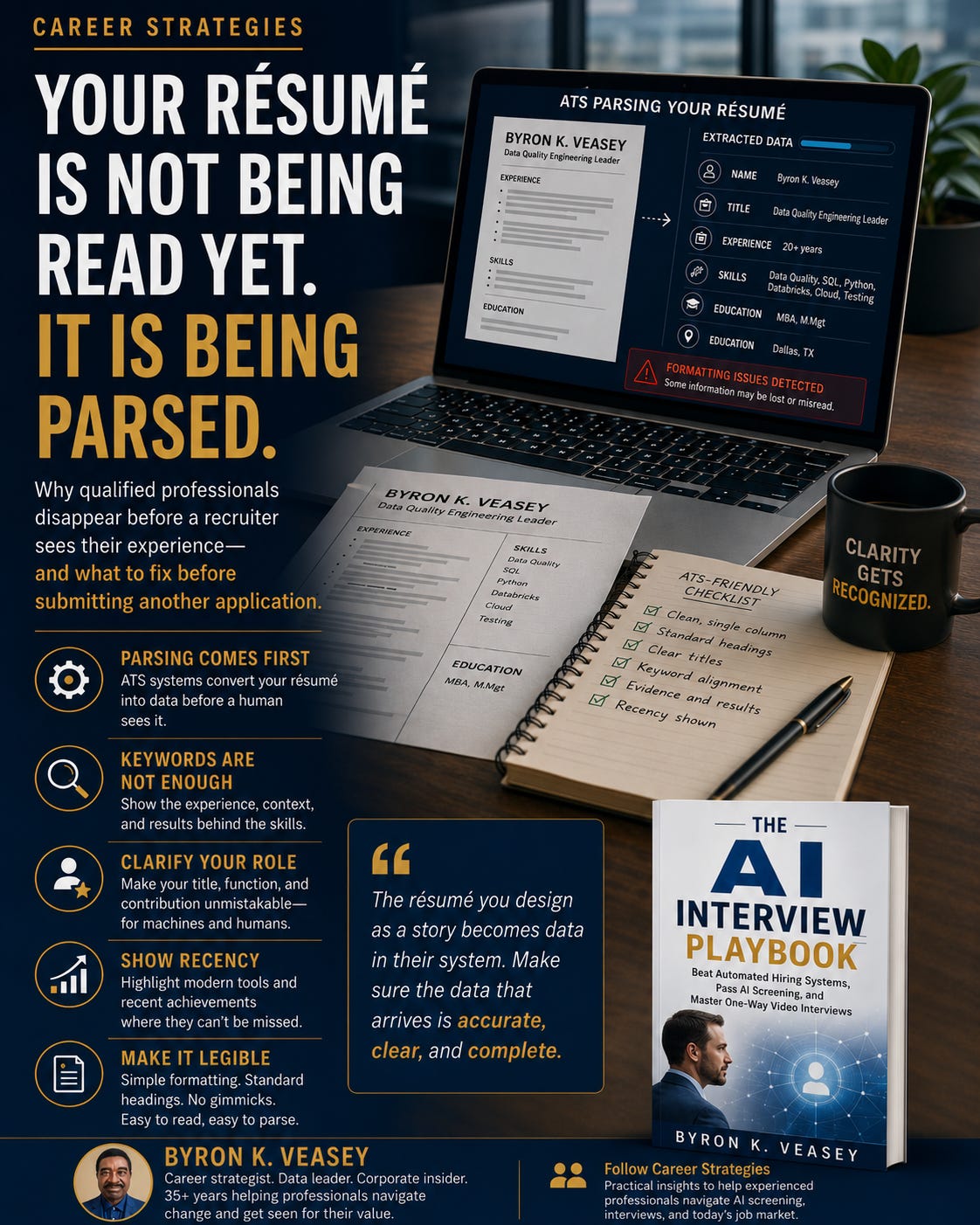
Why qualified professionals disappear before a recruiter sees their experience—and what to fix before submitting another application
This article continues the themes of The AI Interview Playbook: Beat Automated Hiring Systems, Pass AI Screening, and Master One-Way Video Interviews. The book examines the automated hiring pipeline—from résumé parsing and screening questions to assessments, video interviews, scorecards, and the eventual human conversation. The series is designed to help qualified professionals become legible at every stage without pretending to be someone they are not.
The first person to evaluate your résumé may not be a person.
Before a recruiter notices the companies you worked for, the teams you led, or the problems you solved, an applicant tracking system may convert your résumé into structured data.
Job title.
Employer.
Dates.
Skills.
Education.
Certifications.
Keywords.
Location.
Years of experience.
The résumé you designed as a persuasive career story becomes a collection of fields.
That shift matters because a document can look polished to you and still become confusing once the system tries to interpret it.
A two-column layout may separate dates from jobs.
A text box may disappear.
A leadership accomplishment may be assigned to the wrong employer.
An unusual section heading may prevent experience from being categorized correctly.
A title that makes perfect sense inside your company may mean almost nothing to the system evaluating the application.
You may believe you submitted twenty years of evidence.
The employer may receive an incomplete data profile.
This is one of the least visible reasons qualified professionals disappear early in the hiring process.
They are not always rejected after careful consideration.
Sometimes they are never reconstructed accurately enough to be considered.
The Résumé Has Two Audiences
Most job seekers write for one audience:
The recruiter or hiring manager.
They think about readability.
Visual appearance.
Accomplishment language.
Professional tone.
Career progression.
Those things still matter.
A person may eventually review the document.
But the résumé now has a first audience:
The system that must read, classify, extract, and rank the information before the human review begins.
That system is not persuaded by design.
It is not impressed by elegance.
It does not appreciate that the timeline looks cleaner when the dates appear in a narrow right-hand column.
It is trying to answer a more mechanical set of questions:
What roles has this candidate held?
How recently did they perform the required work?
Do the skills match the role?
Does the career history appear coherent?
Are the required credentials present?
How closely does this profile align with the employer’s criteria?
The strategy is not to write for the machine instead of the person.
It is to create a résumé the machine can parse and the person can trust.
Parsing Comes Before Persuasion
Imagine submitting a résumé for a director-level data role.
Your document shows:
a strong executive summary
fifteen years of relevant experience
measurable improvements in quality and delivery
leadership across several major organizations
current cloud and data-platform skills
multiple certifications
The content is relevant.
But the résumé uses a highly designed template.
Company names appear in one column.
Titles appear in another.
Several achievements sit inside shaded text boxes.
A header contains your contact information.
A graphic shows your proficiency levels.
The résumé looks modern.
The parser may not experience it that way.
It may extract:
incomplete contact information
titles without employers
dates detached from roles
missing achievements
duplicated sections
skills without context
What reaches the recruiter is not the document you saw.
It is the profile the software created from it.
That distinction explains why formatting is not a cosmetic issue.
Formatting can become an information-quality issue.
The playbook recommends standard headings, consistent formatting, a clean single-column structure, and avoiding elements such as text boxes, tables, headers, footers, and graphics when they may interfere with structured extraction.
A plain résumé that parses correctly can outperform a beautiful one that becomes unusable data.
The System Is Not Only Counting Keywords
One of the most persistent pieces of job-search advice is simple:
Copy the keywords from the posting.
Place them throughout the résumé.
Repeat the most important phrases.
Increase the match rate.
That advice came from an earlier stage of applicant tracking technology, when exact-term matching played a more dominant role.
Modern systems can be more sophisticated.
They may use semantic analysis to evaluate related meaning, context, and relevance.
A job description may request “project management.”
Your résumé may describe coordinating timelines, dependencies, budgets, stakeholders, and resources across a twelve-month initiative.
A contextual system may recognize that relationship even if the exact phrase does not appear repeatedly.
This does not mean keywords no longer matter.
The employer’s language still helps the system recognize alignment.
But forced repetition is not the same as relevance.
The book explains that newer systems may use semantic and contextual matching, making keyword stuffing less effective and more likely to produce artificial language that human reviewers distrust.
The better goal is not maximum repetition.
It is clear evidence expressed in language the role recognizes.
The Keyword Is Not the Proof
Suppose a job description emphasizes stakeholder management.
A weak optimization strategy adds the phrase everywhere:
“Demonstrated stakeholder management.”
“Strong stakeholder-management skills.”
“Provided stakeholder management across projects.”
The term appears.
The evidence does not.
Now compare:
“Aligned operations, finance, technology, and compliance leaders around a revised data-control model, reducing unresolved ownership issues by 60%.”
The second statement contains the competency without relying only on the label.
It gives the system related language:
aligned
leaders
operations
finance
technology
compliance
ownership
It also gives the human reader:
scale
context
action
result
That is the balance.
Use the terminology the employer expects when it truthfully matches your experience.
Then prove it inside the accomplishment.
Your Company Title May Be Hiding Your Actual Role
Experienced professionals often carry internal titles that made perfect sense inside their organizations.
Vice President.
Executive Director.
Engagement Lead.
Associate.
Principal.
Officer.
Program Lead.
Business Manager.
The title may reflect grade, compensation band, corporate tradition, or internal hierarchy more than the work itself.
A recruiter may understand that “Vice President” at one financial institution is not equivalent to the same title at another company.
A scoring system may not.
It may interpret titles too literally.
A candidate who performed enterprise data-quality leadership may be listed simply as:
Vice President
The title does not reveal:
function
specialization
scope
domain
level of responsibility
You do not need to falsify the official title.
You need to clarify it.
For example:
Vice President — Data Quality Engineering
Or:
Vice President | Enterprise Data Quality and Controls
Or:
Internal Title: Vice President
Functional Role: Data Quality Engineering Lead
Now the system and the human reviewer have more usable information.
Clarity in job titles is part of making the career history machine-readable and professionally legible. The survival-series framework specifically identifies role-title clarity, formatting compliance, and keyword alignment as central to ATS legibility.
Experienced Professionals Have a Translation Problem
A career that spans twenty or thirty years may be impressive to a thoughtful human reader.
It can appear noisy to an automated system.
You may have worked across:
industries
technologies
functions
company sizes
leadership levels
transformation programs
consulting assignments
operational roles
A person can recognize adaptability and breadth.
A system may see weak continuity.
The issue is not always whether the experience is relevant.
It is whether the relevance is visible.
Consider this career:
data modeler
data architect
quality leader
testing manager
governance adviser
cloud-platform specialist
To the candidate, these roles represent a coherent progression through enterprise data.
But if every résumé section uses different terminology and emphasizes different capabilities, the system may not find a consistent professional pattern.
The candidate must make the connecting thread explicit.
For example:
“Enterprise data leader specializing in data quality, architecture, controls, and trusted analytics across regulated environments.”
Now the varied history has an organizing idea.
The system is not forced to infer the professional identity from twenty separate job descriptions.
The candidate has done the translation.
The series describes this challenge as one of legibility: qualifications must appear in a form each stage of the hiring architecture is designed to recognize.
Relevance Is Not the Same as Completeness
Experienced professionals often try to preserve the full record of their careers.
Every role.
Every responsibility.
Every project.
Every technology.
Every promotion.
That instinct is understandable.
You worked hard for the history.
Removing parts of it can feel like erasing evidence.
But an ATS is not evaluating whether the résumé is complete.
It is evaluating whether the profile appears relevant to the current role.
A twenty-five-year history can weaken the signal when the most important information is buried under material that does not support the target.
The question is not:
What have I done?
The stronger question is:
What must this employer understand about what I have done?
That shift affects:
which accomplishments appear first
which roles receive the most space
which technologies are emphasized
which older experience is compressed
which repeated duties are removed
which details are translated into current language
The goal is not to hide age.
It is to prevent historical volume from obscuring current relevance.
The System May Be Looking for Recency
Two candidates may have the same skill.
One used it ten years ago.
The other used it last year.
Many screening systems and recruiters will treat those signals differently.
This is where experienced candidates sometimes create accidental doubt.
A summary may say:
“Extensive experience with cloud platforms, analytics, and modern data environments.”
But the recent roles emphasize:
leadership
governance
budgets
vendor management
strategy
The relevant technology appears only in an older role or a skills list.
The system may identify the skill.
The human reader may still question whether it is current.
Show recency where it is true.
For example:
“Led data-quality engineering across Azure Databricks, Snowflake, Azure DevOps, and automated testing workflows.”
Or:
“Completed recent Databricks and Azure training while leading cloud-based data-quality implementation.”
A skills section can establish presence.
The experience section establishes credibility.
Skills Need Context
Many ATS platforms extract skills from both the dedicated skills section and the experience descriptions. The playbook recommends using a skills section for the employer’s relevant terminology, then reinforcing those capabilities inside the work history.
That is important because listing a skill does not explain proficiency.
Consider:
Skills: Databricks, Snowflake, SQL, Azure DevOps, data quality
Now compare that with:
“Designed automated data-quality controls across Databricks and Azure DevOps pipelines, helping reduce critical production leakage from 15% to below 3%.”
The skills section helps extraction.
The accomplishment creates proof.
Use both.
Ambiguous Language Creates Scoring Risk
A human reader can often resolve ambiguous wording.
Software may not.
Consider:
“The reporting process was redesigned to improve delivery.”
Who redesigned it?
The candidate?
The team?
A vendor?
The manager?
The system may detect “reporting process” and “improve delivery,” but the candidate’s contribution is unclear.
Now compare:
“I redesigned the reporting workflow, reducing delivery time from ten days to three.”
The subject is clear.
The action is clear.
The result is clear.
Modern screening systems may recognize that a competency is present while still struggling to determine who performed the action. Clear subject-verb-object language reduces the possibility of misattribution.
This is not only good ATS writing.
It is stronger human writing.
Stop Hiding Behind “Responsible For”
Many résumés read like job descriptions.
Responsible for data-quality strategy.
Responsible for team leadership.
Responsible for stakeholder communication.
Responsible for testing.
Responsible for reporting.
Responsibility tells the system what belonged to the role.
It does not tell the reader what you accomplished.
Replace responsibility language with action and evidence.
Instead of:
“Responsible for leading a team of nine testers.”
Try:
“Led nine data-quality engineers and testers, expanding automation to 85% while reducing production leakage below 3%.”
Instead of:
“Responsible for stakeholder engagement.”
Try:
“Established a weekly risk-review process across technology and business teams, accelerating defect decisions and reducing unresolved issues.”
The second version provides more semantic signals and a stronger reason to advance the candidate.
The Résumé Should Sound Like Work, Not Optimization
Candidates are increasingly using the same AI tools.
The same prompts.
The same résumé formulas.
The same verbs.
The same polished language.
This creates a new problem.
A résumé may contain all the right words and still feel empty.
Examples include:
spearheaded strategic initiatives
drove cross-functional synergy
leveraged data-driven insights
delivered transformative outcomes
optimized operational excellence
fostered stakeholder alignment
These phrases are not always wrong.
They are simply too broad to establish credibility without context.
Ask:
What initiative?
Which functions?
What insight?
What changed?
How was success measured?
What constraint made the outcome difficult?
Specificity creates authenticity.
Generic polish creates sameness.
The system may recognize the terms.
The human may recognize the template.
A Résumé Is a Data Object
This is the mental shift many candidates need.
You are not only sending a document.
You are submitting a data object into a larger hiring architecture.
The résumé may be:
parsed into fields
compared with a job profile
indexed for recruiter search
scored for relevance
merged with screening answers
ranked against other applicants
reused across future searches
summarized by AI tools
reviewed through a recruiter dashboard
That means a résumé mistake can travel.
An incorrect title extraction may affect matching.
A missing date may create an apparent gap.
An unclear certification may not be recognized.
A badly parsed skill may not surface in recruiter searches.
Before a human can be persuaded, the system must be able to reconstruct an accurate version of you.
Article 3 in the original survival series describes the résumé explicitly as a data object that must be recognized before the candidate can move to the next automated layer.
Test What the System Sees
Most candidates review the résumé visually.
They look for:
spelling errors
spacing
alignment
page length
readability
Add another review:
What happens when the formatting is removed?
Copy the résumé into a plain-text document.
Then inspect it.
Are the sections still in the correct order?
Are titles connected to companies?
Are dates attached to the right roles?
Do bullet points appear beneath the correct position?
Does your contact information remain visible?
Are characters corrupted?
Are headings recognizable?
Can you understand the career story without the visual design?
A basic text test will not reproduce every ATS.
But it can reveal obvious structural problems.
Standard Headings Reduce Interpretation
Creativity is helpful in many forms of communication.
Section labels are not usually the place to use it.
An ATS expects familiar categories.
Use:
Professional Summary
Experience
Education
Certifications
Skills
Technical Skills
Avoid headings that require interpretation, such as:
My Journey
Career Highlights and Adventures
Where I Have Made an Impact
What I Bring
A human may understand.
A parser may not categorize the content correctly.
The objective is not to make the résumé dull.
It is to reserve creativity for the evidence, not the filing system.
Be Careful With Headers and Footers
Candidates often place contact details in the page header to save space.
Some parsing tools may fail to capture them reliably.
The same risk applies to:
page numbers
important certifications
portfolio links
LinkedIn URLs
title information
Keep essential information in the main body of the document unless the employer’s system is known to handle headers correctly.
The reader cannot contact information the parser never captured.
Do Not Let Formatting Become the Story
A résumé should communicate professionalism.
It does not need to win a design award.
Avoid allowing these elements to interfere with extraction:
multiple columns
tables used for layout
decorative text boxes
charts
rating bars
logos
icons in place of words
photographs
complex headers
unusual fonts
graphical timelines
There may be situations where a visually designed résumé is useful.
Creative industries may value it.
A direct human contact may request it.
A portfolio may include it.
But the document submitted through an application portal should prioritize reliable interpretation.
You can maintain two versions:
A clean ATS version.
A designed networking or presentation version.
The content can remain consistent.
The delivery format serves the channel.
The Job Description Is Evidence About the Employer’s Language
A job description is not a perfect specification.
It may be copied from an older role.
It may combine multiple wish lists.
It may include qualifications the team does not truly prioritize.
Still, it provides useful language.
Look for repetition.
Which problems appear more than once?
Which competencies are described in multiple sections?
Which requirements appear near the top?
Which tools are described as required rather than preferred?
Which outcomes define success?
Then compare those signals with your résumé.
Do not ask only:
Did I use the keywords?
Ask:
Did I prove the priorities?
A posting that repeatedly emphasizes governance, risk, executive communication, and regulated data does not merely need those words.
It needs evidence that you have operated in that environment.
Build a Relevance Map Before You Rewrite
Before editing the résumé, create three columns.
Employer requirement
Write the actual requirement from the posting.
Your evidence
Identify the role, accomplishment, project, or result that proves it.
Résumé location
Decide where that evidence should appear.
For example:
Employer requirementYour evidenceRésumé locationLead enterprise data-quality strategyBuilt a DQ framework across cloud and warehouse systemsSummary and recent roleManage cross-functional teamsLed nine engineers and testers across business and technologyRecent roleAutomate controlsIncreased automated coverage to 85%Recent roleReduce production defectsLowered leakage from 15% to under 3%First accomplishmentDatabricks experienceImplemented controls in Azure DatabricksSkills and recent role
This prevents keyword-only editing.
Every important term is attached to proof.
The First Third Carries More Weight
Recruiters and hiring managers may scan quickly once the résumé reaches them.
That means the top section should establish:
current professional identity
target relevance
major domain
level
strongest evidence
modern capabilities
Do not use the summary to describe personality.
Avoid:
“Results-driven professional with a proven record of success and excellent communication skills.”
Use it to clarify fit.
For example:
“Data-quality engineering leader with experience building automated controls, cloud-based testing frameworks, and trusted-data processes across regulated financial and insurance environments.”
Now the reader knows where to place you.
Do Not Make the System Guess Your Target
One résumé cannot communicate five unrelated professional directions equally well.
A candidate may genuinely qualify for:
data-quality leadership
data architecture
product ownership
testing management
governance
analytics leadership
But a résumé trying to lead with all six may become difficult to rank.
Create a clear role family.
The target does not need to be one exact title.
It should represent one coherent problem space.
For example:
Data Quality and Trusted Data Leadership
That may include:
data-quality engineering lead
enterprise data-quality manager
data governance and controls leader
director of trusted data
data reliability leader
The titles vary.
The signal remains consistent.
A Five-Part ATS Review
Before submitting your next application, review the résumé in five stages.
1. Parseability
Can the document be reconstructed accurately?
Use standard headings.
Keep the structure clean.
Avoid layout elements that may break extraction.
2. Role clarity
Do the titles explain what you actually did?
Clarify internal or ambiguous titles without misrepresenting them.
3. Semantic alignment
Does the résumé use truthful language related to the employer’s priorities?
Avoid forced repetition.
Use natural terms connected to real evidence.
4. Evidence
Do required skills appear inside accomplishments?
Show scale, action, and results.
5. Recency
Can the system and human reviewer see that the most important capabilities are current?
Place recent evidence where it cannot be missed.
Do Not Optimize Away Your Voice
The goal is not to make the résumé sound as though software wrote it.
Your professional voice still matters.
A strong résumé should contain:
recognizable language
clear structure
specific evidence
direct attribution
natural phrasing
a coherent career thesis
It should not sound like a collection of terms assembled to trigger a score.
There is a difference between alignment and imitation.
Alignment says:
“I understand what this role requires, and here is truthful evidence that I have done related work.”
Imitation says:
“I copied the posting and rearranged it into résumé bullets.”
The first builds trust.
The second may pass one filter and fail the next.
Stop Calling Every Nonresponse an ATS Rejection
Not every unanswered application was blocked by software.
The role may have been paused.
An internal candidate may have been selected.
The recruiter may never have reviewed the applicant pool.
The company may have changed priorities.
Your application may have been qualified but ranked below others.
An employee referral may have entered late.
The hiring manager may have changed the requirements.
You usually will not know.
Understanding ATS systems should reduce guesswork, not create a new superstition.
The purpose of an ATS review is not to blame software for every outcome.
It is to remove avoidable barriers.
You cannot control the entire process.
You can make sure the system receives a clear, accurate, relevant version of your career.
The Better Question
Do not ask:
How do I beat the ATS?
Ask:
Can the system correctly understand what is true about me?
Can it identify:
your role
your level
your relevant skills
your industry context
your recent experience
your measurable outcomes
your credentials
your career direction
If the answer is unclear, improve the translation.
That is not gaming the system.
It is data quality applied to your career.
You Do Not Need More Keywords. You Need Better Recognition.
Qualified professionals are not always filtered out because their experience is weak.
They may be filtered because:
The title was unclear.
The formatting broke.
The required skill appeared without context.
The recent evidence was buried.
The résumé tried to support too many directions.
The language was generic.
The career story required too much inference.
Your experience cannot help you if the system cannot find it.
So before submitting another application:
Simplify the structure.
Clarify the titles.
Use the employer’s truthful language.
Connect skills to evidence.
Show recency.
Make the career direction coherent.
Then read the résumé twice.
Once as a human.
Once as a machine trying to turn a career into data.
The résumé does not need to become less human.
It needs to remain human after the system parses it.
About the Author
Byron K. Veasey is a career strategist and leader in data quality engineering focused on helping experienced professionals navigate AI screening, automated interviews, recruiter silence, age bias, burnout, and career reinvention.
He writes Career Strategies, a Substack newsletter read by over 5,000 professionals navigating today’s evolving job market.
👉 Subscribe to Career Strategies