
Your Job Search Has Too Many Open Loops to Live in Your Head

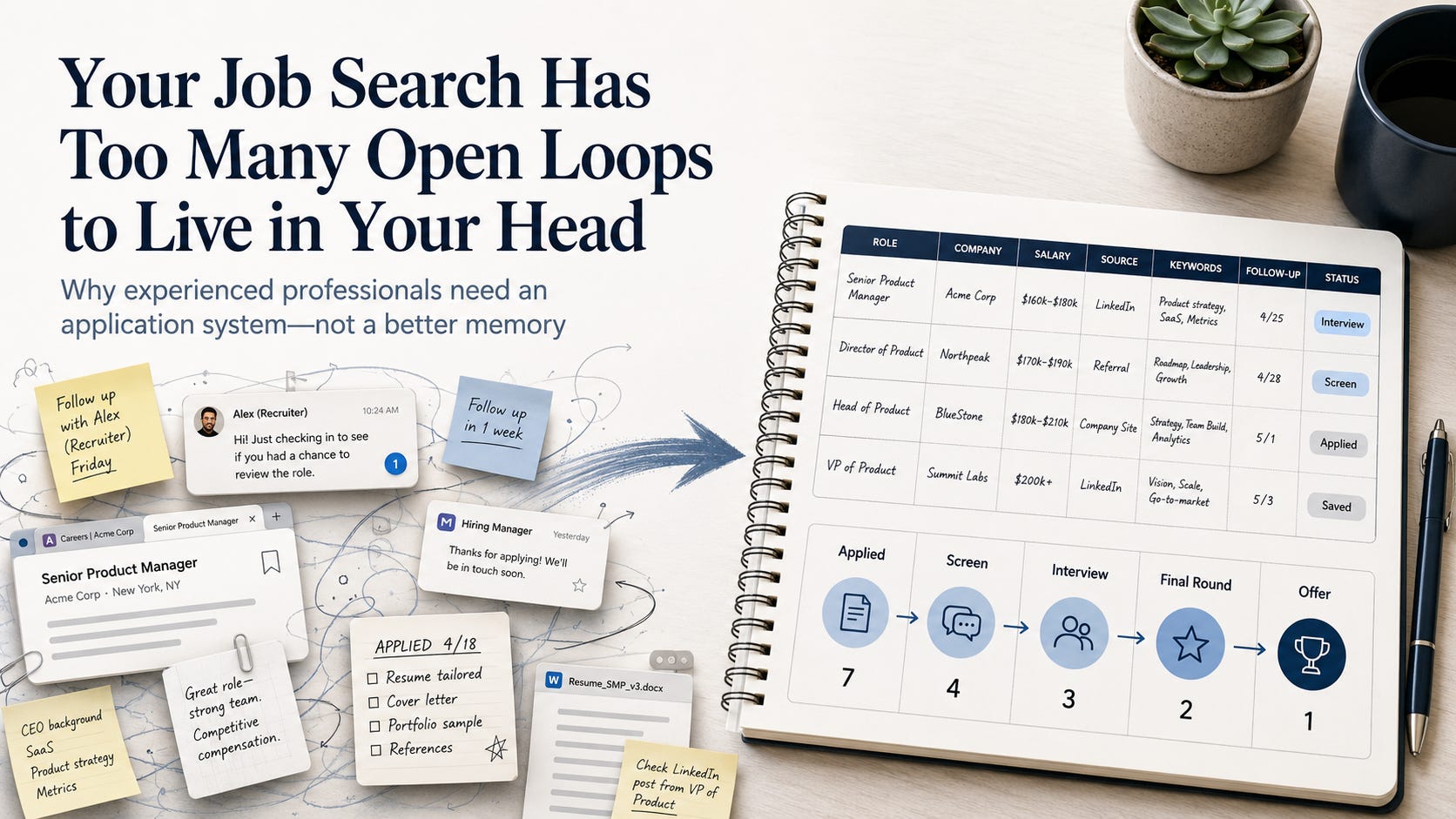
Why experienced professionals need an application system—not a better memory
You applied to a job last Tuesday.
Or was it Wednesday?
You remember the company.
You think you remember the title.
You definitely remember spending nearly an hour adjusting your résumé before submitting it.
But did you tailor it around “program management” or “business transformation”?
Was the salary range $125,000 to $145,000—or was that the other position?
The recruiter who contacted you yesterday: was that connected to the application you submitted two weeks ago?
And there was another company you meant to follow up with.
You were going to do it Friday.
Or maybe Friday was when you were supposed to follow up with someone else.
This is what a modern job search eventually becomes.
Not one search.
Dozens of open threads.
Applications submitted.
Recruiters contacted.
Follow-ups planned.
Interviews scheduled.
Job descriptions saved.
Résumés customized.
Keywords changed.
People contacted on LinkedIn.
Promises to “circle back.”
And long stretches of silence where you are not quite sure whether the opportunity is still alive.
Held in your head, those threads become anxiety.
Held in a system, they become a pipeline.
That distinction matters.
Because one of the most overlooked problems in the modern job search has nothing to do with your résumé, LinkedIn profile, interview skills, or qualifications.
It is operational.
You cannot manage what you cannot see.
The Search Becomes Harder to Manage as It Gets Longer
At the beginning of a job search, tracking everything feels unnecessary.
You apply to three positions.
You remember all three.
A week later, there are seven.
Then twelve.
Then twenty.
Some rejected you immediately.
Some disappeared.
One sent an automated assessment.
Two are still listed as “under review.”
A recruiter contacted you about one that you do not remember applying to.
Another company reposted a position you applied to three weeks ago.
Now you are trying to reconstruct your own search from emails, browser history, LinkedIn notifications, saved files, and memory.
That is when the search begins quietly managing you.
You open your inbox to decide what deserves attention.
You check LinkedIn because you cannot remember whether someone replied.
You revisit job boards because you are unsure what you already applied for.
You start asking:
Did I already apply to this?
Did I follow up?
Which résumé did I send?
What salary range did they list?
Was this the role where I had an internal connection?
Those questions consume mental energy that should be going toward better applications, stronger conversations, interview preparation, and recovery between rounds.
The answer is not to remember harder.
The answer is to stop requiring your memory to run the system.
An Application Is Not Finished When You Click Submit
This may be the biggest mindset shift.
Most job seekers treat “Apply” as the end of the action.
You complete the application.
Click submit.
Receive the confirmation email.
Done.
But strategically, submission is only the beginning of the application lifecycle.
A real application may move through:
Applied → Recruiter Screen → Interview → Final Round → Offer
Or:
Applied → Rejected
Or perhaps the most familiar path of all:
Applied → Silence
That means every application has a status.
Every promising application may have a next action.
Every recruiter interaction creates a new piece of information.
Every interview changes the status again.
If you do not record those changes, all of those opportunities eventually collapse into the same emotional category:
Nothing is happening.
But that may not actually be true.
Perhaps three applications are recent.
Two need follow-up.
One recruiter said to expect an answer next week.
Four were rejected.
Two have received no response.
And one has moved to a hiring-manager conversation.
That is not “nothing.”
That is a pipeline with different stages.
You need to be able to see the difference.
Silence Should Have a Status
One reason job searching becomes psychologically exhausting is that silence has no natural ending.
A rejection closes the loop.
You may not like the answer, but you have an answer.
Silence is different.
It leaves the door psychologically open.
Maybe they are still reviewing applications.
Maybe the recruiter is behind.
Maybe the position was frozen.
Maybe they selected another candidate.
Maybe your application never made it through screening.
Maybe you should follow up.
Maybe you should wait.
That uncertainty creates cognitive drag.
A tracking system cannot force an employer to respond.
But it can keep their silence from controlling your next action.
Instead of:
“I wonder whether I should contact them.”
You have:
“First follow-up scheduled.”
Instead of:
“I think I already emailed the recruiter.”
You know when you contacted them.
Instead of:
“Maybe I should wait another week.”
You have already determined the next step.
This matters because effective persistence feels very different from anxious chasing.
The goal is not to become more aggressive.
It is to become more deliberate.
Persistent, never desperate.
Follow-Up Works Better When It Is Scheduled Before You Need It
Most people decide whether to follow up based on emotion.
They wait.
Then they become uncomfortable.
Then they wonder whether enough time has passed.
Then they worry that following up will make them look desperate.
So they wait longer.
Eventually, either they send a message reactively or they forget about the opportunity altogether.
A better approach is to decide that follow-up belongs to the process.
When you record the application, you also create the next checkpoint.
Now the decision is no longer:
“Do I feel comfortable following up today?”
It becomes:
“This is the next action I planned.”
That small change removes unnecessary emotional negotiation.
You are not chasing the employer.
You are managing your search.
Track the Keywords You Used
This is where tracking becomes more than administration.
It becomes intelligence.
Suppose you apply for ten similar positions.
For each one, you record the major keywords and capabilities you emphasized.
Over time, you begin to see patterns.
Certain phrases appear repeatedly in job descriptions.
Certain capabilities seem to produce more recruiter interest.
Some versions of your positioning appear to perform better than others.
Perhaps “data governance” generates more traction than a broader “data management” description.
Maybe “business transformation” appears far more often in your target roles than “change management.”
Perhaps certain combinations of skills consistently appear together.
Without tracking, each application exists as an isolated event.
With tracking, your applications begin teaching you something about the market.
That is a major difference.
A job search should not simply produce applications.
It should produce information.
Track the Source Too
Where did the opportunity come from?
LinkedIn?
Indeed?
A recruiter?
Your network?
A company career page?
A referral?
An industry group?
This can reveal something equally important.
Imagine submitting 40 applications through large job boards and receiving almost no response—but getting three conversations from eight applications discovered through referrals and direct company research.
That is not just interesting.
That is strategic information.
Your search is telling you where to spend more of your time.
But you cannot see that pattern if you do not record the source.
Memory tends to remember the emotional events.
A tracker remembers the data.
Experienced Professionals Need This More Than They Think
If you have been working for 15, 20, or 30 years, there is another challenge.
You have more material to manage.
More accomplishments.
More versions of your professional story.
More possible directions.
More industries or functions you could potentially pursue.
More ways recruiters might interpret your background.
And sometimes more pressure to explain why you are pursuing a particular role.
That makes intentional targeting even more important.
You should know which companies matter most.
You should know which keywords repeatedly appear in your target market.
You should know where you have applied.
You should know which version of your experience you emphasized.
You should know what needs follow-up.
You should be able to walk into an unexpected recruiter call and quickly reconstruct the application they are discussing.
That is not bureaucracy.
That is professional search management.
The Weekly Review May Be More Valuable Than Another Hour on a Job Board
There is a point in many job searches where activity begins masquerading as progress.
Another hour scrolling.
Another 15 jobs saved.
Another six applications submitted.
Another evening spent wondering why nobody is responding.
Sometimes the more valuable move is to stop applying temporarily and review what you have already done.
Once a week, look across the search.
Ask:
Which applications need follow-up?
Which opportunities have gone silent?
Which companies continue appearing in my target market?
Which job sources are producing conversations?
Which keywords keep appearing?
Which positions are generating recruiter interest?
Where am I applying repeatedly without traction?
Are there companies where a direct relationship would make more sense than another cold application?
What should I do differently next week?
That turns the job search from a sequence of reactions into a feedback system.
Apply. Track. Review. Adjust.
Then repeat.
Tracking Protects You From the Emotional Distortions of a Long Search
There is another reason I believe this matters.
After enough silence, the mind starts rewriting the story.
“Nobody is interested.”
“My experience must not matter anymore.”
“I have applied everywhere.”
“Nothing I am doing is working.”
Those feelings are real.
But feelings are not always accurate summaries of the pipeline.
Your tracker may show something different.
You have not applied “everywhere.”
You have applied to 34 companies.
Six responded.
Three produced recruiter conversations.
One reached a second interview.
Certain types of positions responded more frequently than others.
Several applications are still recent.
A few need follow-up.
Now you have evidence.
The situation may still be frustrating.
But it is measurable.
And what is measurable can be examined.
What can be examined can be adjusted.
That is psychologically different from sitting in front of an inbox wondering whether your career has disappeared.
A Simple Job Search Operating Rhythm
The system does not need to be complicated.
For every serious application:
Before submitting
Record the role, company, salary range, source, and important keywords you used.
When you submit
Record the application and create your follow-up checkpoints.
When something changes
Update the status.
Applied.
Screen.
Interview.
Final round.
Offer.
Rejected.
No response.
Once a week
Review the entire pipeline.
Follow up where appropriate.
Close dead opportunities.
Identify patterns.
Refocus your target-company list.
Update the keywords that appear most often.
Then decide where your effort goes next.
That is the job search functioning as a system instead of a collection of open browser tabs.
You Do Not Need Another Place to Store Information
You need a place to make decisions.
That is why I created The Job Application Tracker: A Job Search Log Book to Track Applications, Follow-Ups & Interviews.
It is intentionally simple.
No motivational journaling.
No complicated productivity system.
No requirement to learn another platform.
Just one clean page for each application and a structure for running the search.
The tracker includes:
110 numbered application log pages
Role, company, salary range, source, and tailored keyword tracking
First and second follow-up scheduling
A clear application status trail
A target-company shortlist
A master-keyword page
Short, practical guidance designed for experienced professionals
It is an undated 8.5 × 11-inch, 120-page paperback built to stay beside you while you conduct the search.
Because the goal is not to make job searching more complicated.
The goal is to make the complexity visible.
Strategy Tells You What to Do. A System Helps You Keep Doing It.
I think of The Job Application Tracker as the “do the work” companion to The 2026 Career Strategies Job Search Guide.
The guide gives you the strategy.
The tracker gives that strategy somewhere to live.
One helps you decide how to approach the market.
The other helps you remember what you did, what happened, and what comes next.
Because your job search is already demanding enough.
Your brain should not also have to function as the database.
Get the applications out of your head.
Get the follow-ups onto a schedule.
Get the pipeline where you can see it.
Then stop asking:
“What was I supposed to do next?”
Your system should already know.
The Job Application Tracker
The Job Application Tracker: A Job Search Log Book to Track Applications, Follow-Ups & Interviews
by Byron K. Veasey
Built for experienced professionals who want a calm, practical system for managing applications, follow-ups, interviews, and the silence between them.
Available on Amazon:
https://www.amazon.com/dp/B0HCMWTS22
About the Author
Byron K. Veasey is a career strategist and leader in data quality engineering focused on helping experienced professionals navigate AI screening, automated interviews, recruiter silence, age bias, burnout, and career reinvention.
He writes Career Strategies, a Substack newsletter read by over 5,000 professionals navigating today’s evolving job market.
👉 Subscribe to Career Strategies