
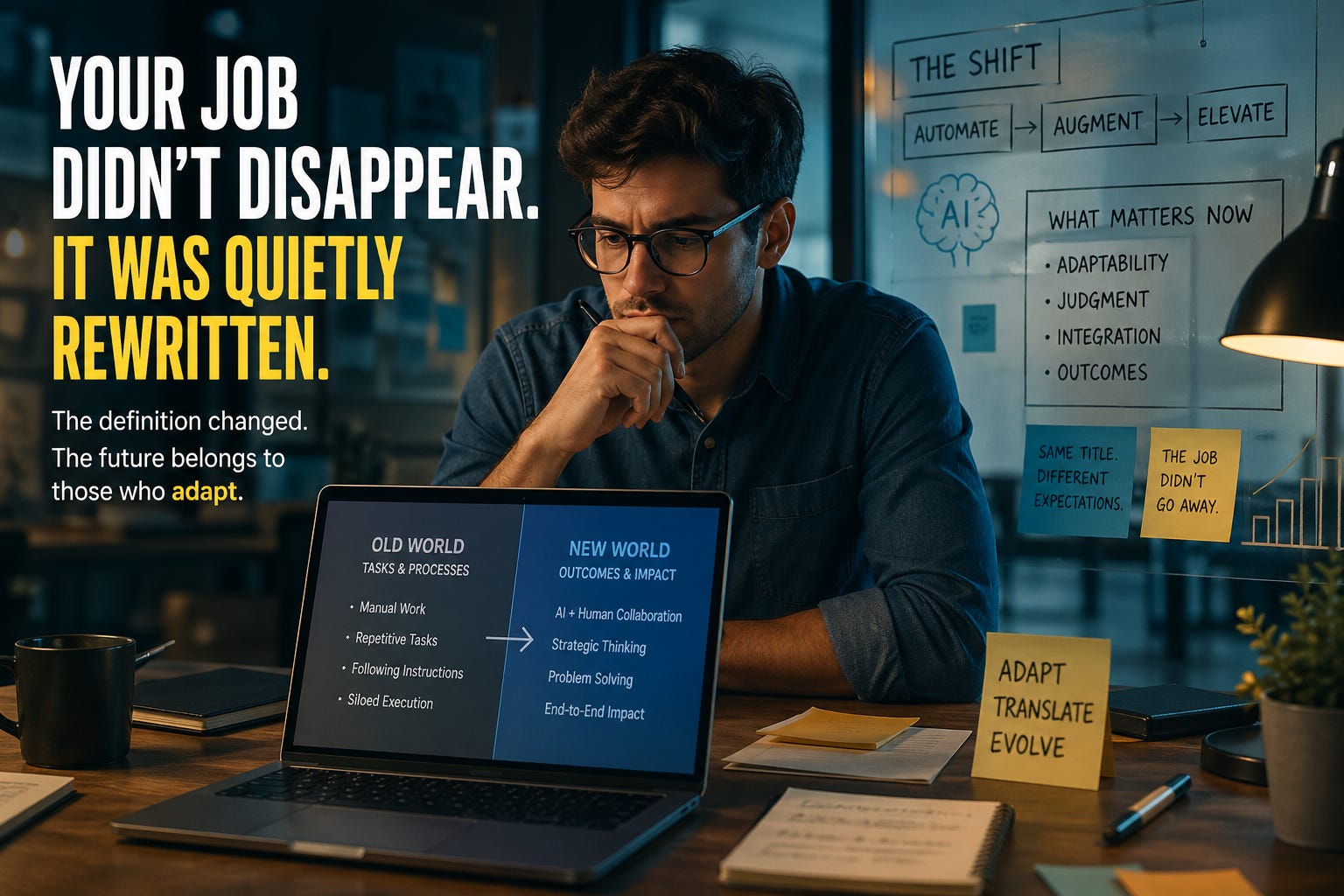
Your Job Didn’t Disappear. It Was Quietly Rewritten.

99-cent Books until May 10, 2026
Free Until April 30, 2026
👉 Job Search Survival Guide 2026: Resilience, Strategy, and Real Stories for Today’s Job Market
Most people are asking the wrong question.
They’re asking:
“Why am I being replaced?”
But here’s what’s actually happening:
You’re not being replaced.
You’re being compared to a version of your role that no longer exists.
And no one told you the definition changed.
The Shift No One Explained
There was a time when your experience translated more directly.
You learned a function.
You executed it well.
You got rewarded for consistency.
But that version of work is fading.
Not because companies don’t need the work.
Because they need it done differently.
The Misalignment Problem (Not a Relevance Problem)
Here’s the part that quietly destabilizes people:
You still know how to do the job.
But the market is no longer hiring for the job you learned.
It’s hiring for:
the compressed version
the automation-assisted version
the decision-layer version
Same title.
Completely different expectations.
What Actually Changed
The role didn’t disappear.
It fractured.
Some parts were automated.
Some parts were accelerated.
Some parts were elevated.
And what remains is a role that requires:
faster interpretation
stronger judgment
tighter integration across tools, people, and systems
That’s not replacement.
That’s redefinition.
Why Your Resume Stops Working
Most resumes are built on a quiet assumption:
If I show everything I’ve done, they’ll understand what I can do.
That assumption no longer holds.
Because resumes describe:
responsibilities
tasks
tools used
But the market is screening for:
how you think
how you adapt
how you produce outcomes in changing conditions
So what happens?
You submit a document describing a role from 2019…
…into a system looking for a role from 2026.
And the system does exactly what it was designed to do:
It filters.
The Translation Gap
This is where most high performers get stuck.
Your experience is real.
But your description of it is outdated.
You’re speaking in:
process language
ownership language
execution language
The market is listening for:
outcome language
decision language
adaptability signals
Example Shift
Old signal:
Managed a team of 12 and oversaw reporting processes
New signal:
Reduced reporting cycle time by 40% by redesigning workflows and integrating automation tools, enabling faster executive decisions
Same experience.
Different translation.
One gets filtered.
The other gets attention.
The Rise of the Hybrid Professional
This is the part most people resist—because it feels like scope creep.
But it’s not.
It’s the new baseline.
The modern role expects:
human judgment + AI acceleration
depth in one area + fluency across adjacent ones
execution + interpretation
Not perfection.
But integration.
The Quiet Expectation Shift
You’re no longer just:
a marketer
a data analyst
an operations leader
You’re expected to be:
someone who uses tools to extend capability
someone who translates data into decisions
someone who adapts faster than the system changes
That’s what “full-stack” actually means in 2026.
Not doing everything.
But understanding enough to connect everything.
Why This Feels Like Identity Loss
Because it is—slightly.
You built your identity around:
being reliable
being experienced
being the person who knows how things work
Now the system is saying:
That’s valuable.
But it’s not enough on its own.
And without clear feedback…
Without clear rejection…
Without clear direction…
It starts to feel like:
“Maybe I’m the problem.”
You’re Not Outdated. You’re Untranslated.
That’s the real issue.
Not capability.
Not intelligence.
Not experience.
Translation.
What Actually Works Now
If the role has been rewritten…
Then your strategy has to shift from:
“Prove I’ve done the job”
to
“Show I understand what the job has become”
That Means:
Show how you adapted, not just what you did
Show how you improved systems, not just maintained them
Show how you used tools to accelerate outcomes, not just completed tasks
Show how you think under changing conditions
Strategic Visibility > Static History
The market can’t respond to what it can’t see.
And it definitely can’t respond to what it can’t interpret.
So your goal isn’t to:
archive your career
preserve your past
list your experience
Your goal is to:
Make your current capability legible.
The Real Reframe
The job didn’t go away.
The definition changed—and no one told you.
So if the process feels harder…
If the silence feels heavier…
If the effort isn’t translating…
It’s not because you’ve lost your edge.
It’s because you’re still describing a role
that no longer exists in the way you learned it.
Hope Anchor
You don’t need to become someone new.
You need to describe yourself in a way the new system can recognize.
Final Thought
The professionals who move forward fastest in this market aren’t the ones with the most experience.
They’re the ones who can translate their experience into signal the current system understands.
That’s the shift.
And once you see it—
You stop questioning your value.
And start updating how it’s seen.
CTA
Most people won’t adjust for this.
They’ll keep sending the same resume
into a system that no longer reads it the same way.
And they’ll interpret the silence as something personal.
It’s not.
If this helped you see the shift more clearly,
subscribe to Career Strategies.
Because the market is changing quietly.
And the advantage now belongs to the people
who understand what actually changed—and move first.
About the Author
Byron K. Veasey is a career strategist and leader in data quality engineering focused on helping professionals navigate job searches, burnout, and career reinvention.
He writes Career Strategies, a newsletter read by over 4,400 professionals navigating today’s evolving job market.
👉 Subscribe to Career Strategies