

This article is adapted from Nothing You’ve Tried Is Working: The Complete 2026 Reference for AI Screening, Ghost Jobs, and Getting Hired and continues the six-part series on AI screening, ghost jobs, job-search silence, and the new rules of getting hired in 2026. It follows Article 1, which explained why the modern job search feels broken now: the market changed, the feedback loop broke, and experienced professionals are being forced to navigate a system that no longer responds the way it used to.
👉 Book link: https://www.amazon.com/dp/B0GMP9DD3B
Your resume may be telling the truth.
That is part of the problem.
It may be accurate.
It may be professional.
It may list the roles you held, the teams you managed, the systems you supported, the budgets you oversaw, the projects you delivered, and the responsibilities you carried.
And still, it may not be doing the one thing the modern job search requires it to do.
It may not be proving what changed because you were there.
That distinction matters.
Because experienced professionals often assume the weight of their career will be obvious.
The title will explain it.
The company name will explain it.
The years of experience will explain it.
The scope will explain it.
The leadership role will explain it.
The reader will understand.
But in the current hiring market, that assumption is dangerous.
The first reader may not be a person.
The first reader may not infer.
The first reader may not understand nuance.
The first reader may not reward modesty.
The first reader may simply scan for evidence, alignment, pattern, relevance, and measurable signal.
And if your resume describes what you were responsible for but does not clearly show what your judgment produced, the system may treat a strong career like an ordinary one.
Not because your experience is weak.
Because your evidence is.
The Resume Problem Is Often an Evidence Problem
A lot of experienced professionals keep rewriting their resumes without solving the deeper issue.
They change the font.
They rearrange the sections.
They rewrite the summary.
They add keywords.
They shorten the bullets.
They lengthen the bullets.
They hire someone.
They use a template.
They ask AI to polish the language.
They upload the new version.
Then the silence continues.
At some point, they start believing the resume itself is the problem.
Maybe it is too long.
Maybe it is too dense.
Maybe it is too senior.
Maybe it makes them look overqualified.
Maybe it makes them look old.
Maybe it does not sound modern enough.
Some of that may be true.
But often, the real issue sits underneath the formatting.
The resume is not failing because it looks bad.
It is failing because it does not carry enough proof.
It tells the reader where you worked.
It tells the reader what you managed.
It tells the reader what you were responsible for.
But it does not consistently tell the reader what improved, what stabilized, what grew, what was reduced, what was protected, what risk was avoided, what decision you made, or what outcome followed.
That is the evidence gap.
And in an AI-filtered, high-volume market, the evidence gap is expensive.
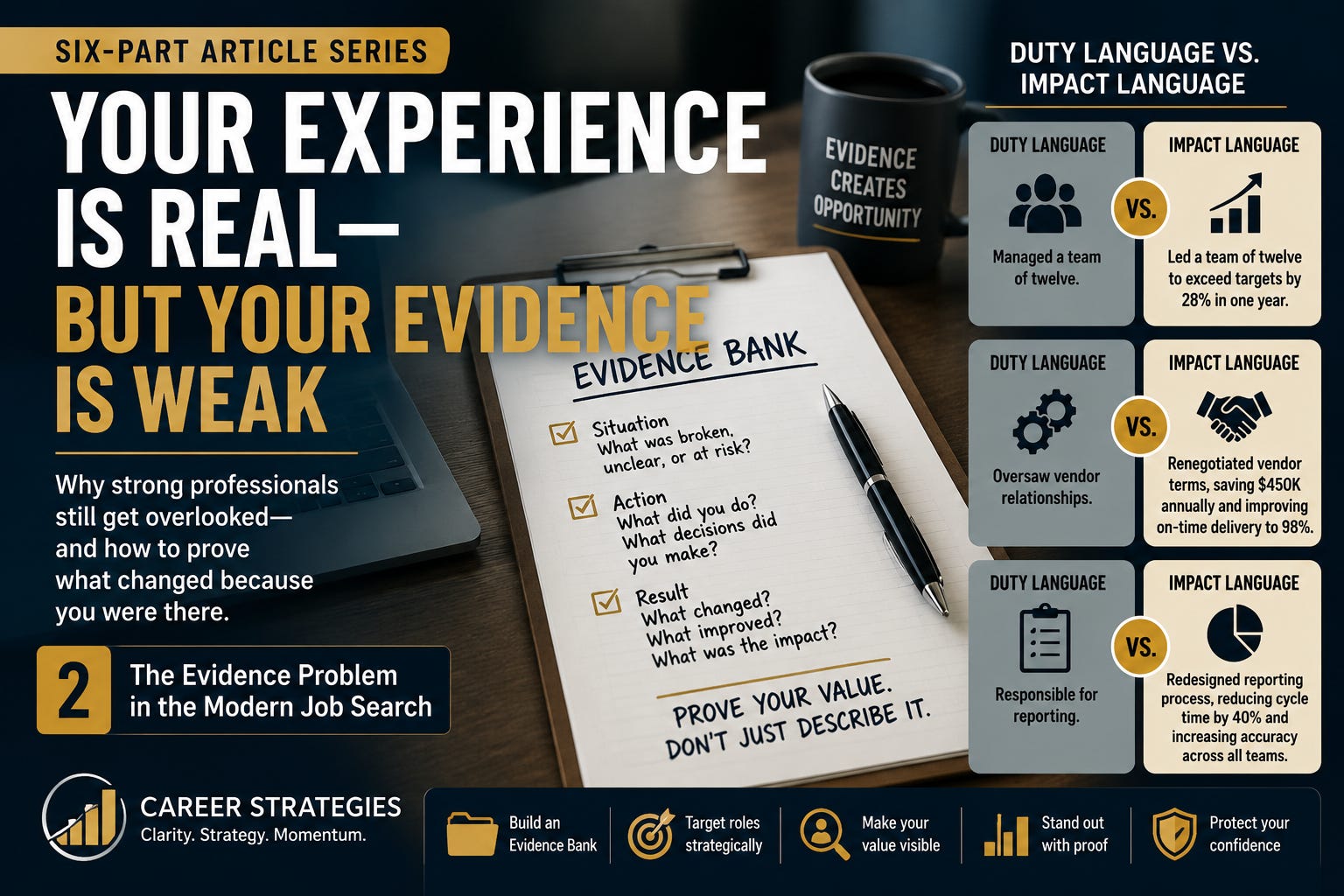
Duty Language Is Not the Same as Impact Language
Experienced professionals often write in duty language.
Managed a team of twelve.
Oversaw vendor relationships.
Led cross-functional initiatives.
Responsible for operational reporting.
Supported enterprise transformation.
Managed stakeholder communication.
Developed strategic plans.
Improved business processes.
These statements may be true.
They may even describe important work.
But they are not enough.
Duty language names the territory you were assigned.
Impact language names what changed because you owned it.
That is the difference.
Duty language says, “This was my area.”
Impact language says, “This is what happened because I exercised judgment in that area.”
One describes responsibility.
The other demonstrates value.
And the modern hiring system is much better at recognizing demonstrated value than implied value.
That is uncomfortable for many experienced professionals because they spent years working in environments where responsibility itself signaled trust.
If you managed the team, people assumed you had earned the role.
If you owned the budget, people assumed you had judgment.
If you led the initiative, people assumed you were capable.
If your title was senior enough, people filled in the blanks.
But screening systems do not fill in blanks.
Recruiters under pressure do not have time to fill in blanks.
Hiring managers scanning dozens of candidates do not always stop to interpret vague seniority.
The burden has shifted.
You have to make the evidence visible.
Modesty Can Become a Liability
Many experienced professionals are not bad at describing their work because they lack accomplishments.
They are bad at it because they were trained not to sound like they were taking too much credit.
They learned to say “we.”
They learned to honor the team.
They learned to avoid sounding arrogant.
They learned to speak in responsibilities instead of claims.
They learned to let the work speak for itself.
That instinct probably served them well inside organizations.
It made them trusted.
It made them collaborative.
It made them mature.
It kept them from sounding self-promotional in rooms where credibility mattered.
But the job search is not the same room.
A resume is not a staff meeting.
A LinkedIn profile is not a team update.
An interview is not a moment to disappear behind collective language.
You can be generous and still be specific.
You can honor the team and still name your judgment.
You can avoid arrogance and still show the result.
The problem is not humility.
The problem is hiding the evidence so deeply that the market cannot find it.
In the old world, modesty could be interpreted by a human who already understood the context.
In the current world, modesty can look like absence of impact.
That is not fair.
But it is important.
Because the system cannot value what you keep making it guess.
Your Career Has More Evidence Than Your Resume Shows
One reason resumes get weak is that people try to write them from memory.
They sit down in front of a blank document and ask themselves:
What did I do?
What should I include?
What sounds impressive?
What should I cut?
What will recruiters want?
What keywords matter?
What if I say too much?
What if I say too little?
That is a terrible emotional environment for clear thinking.
You are trying to summarize years of work while anxious about being judged.
You are trying to remember outcomes while worried about formatting.
You are trying to prove value while already feeling unseen.
So the brain reaches for safe language.
Managed.
Led.
Oversaw.
Supported.
Coordinated.
Responsible for.
Those words are easy because they do not require you to make a strong claim.
They are also weak because they do not create much signal.
That is why the evidence work has to happen before the resume.
Not while you are tailoring.
Not while you are panicking.
Not while a deadline is open in another browser tab.
Before.
You need a place where your accomplishments are collected, sharpened, and stored before you need to use them.
That place is an Evidence Bank.
The Evidence Bank Changes the Whole Search
An Evidence Bank is not a resume.
It is not a brag sheet.
It is not a list of job duties.
It is the raw material behind every visible part of your search.
Your resume pulls from it.
Your LinkedIn profile pulls from it.
Your interview answers pull from it.
Your networking conversations pull from it.
Your salary negotiation pulls from it.
Your consulting pitch pulls from it.
Your confidence pulls from it.
That last one matters.
Because when a search gets long, memory gets unreliable.
You start forgetting your own evidence.
Not literally.
But emotionally.
You remember the silence more vividly than the rooms you stabilized.
You remember the unanswered applications more vividly than the problems you solved.
You remember the stalled interviews more vividly than the people who trusted your judgment.
A long search can make accomplished people feel strangely blank about their own accomplishments.
An Evidence Bank interrupts that.
It gives you a record outside your mood.
It says:
This happened.
This was the problem.
This was the action.
This was the result.
This is still true even if the inbox is quiet today.
That is why evidence is not only a communication tool.
It is an emotional anchor.
Every Strong Evidence Entry Has Three Parts
The structure is simple.
Situation.
Action.
Result.
That is it.
But simple does not mean shallow.
The situation names what you inherited.
What was broken?
What was unclear?
What was behind schedule?
What was at risk?
What was inefficient?
What was costing money?
What was creating friction?
What was unstable?
The action names the decision you made.
What did you change?
What did you design?
What did you stop?
What did you rebuild?
What did you prioritize?
What did you negotiate?
What did you automate?
What did you clarify?
The result names what changed.
What improved?
What decreased?
What increased?
What stabilized?
What accelerated?
What risk was reduced?
What cost was avoided?
What time was saved?
What outcome became possible?
This is where your experience becomes visible.
Not because you used stronger adjectives.
Because you connected your judgment to a result.
That is the language the market can read.
The Same Work Can Sound Weak or Strong
Look at the difference.
Duty language:
Responsible for vendor relationships across three product lines.
That may be true.
But it does not tell us much.
Now convert it into evidence:
Inherited a fractured supplier network during a six-month shortage, renegotiated terms with three primary vendors, onboarded two backup suppliers, and held delivery timelines steady during regional disruption.
Same general work.
Different signal.
The first sentence names responsibility.
The second sentence names context, judgment, and outcome.
That is the move.
Not exaggeration.
Translation.
You are not making the work bigger than it was.
You are making it clearer than it has been.
That is what many experienced professionals have not been taught to do.
They have been taught to list their roles.
They have not been taught to extract the evidence buried inside those roles.
The Further You Rose, the Easier It Is to Undersell Yourself
This seems backwards, but it is common.
The more senior you became, the more your value moved away from visible tasks and toward judgment.
You made decisions.
You prevented problems.
You aligned stakeholders.
You anticipated risk.
You interpreted ambiguity.
You shaped direction.
You kept teams functioning.
You helped the organization avoid mistakes that may never appear on a dashboard because they did not happen.
That work is real.
But it is harder to describe.
A junior employee may have obvious task outputs.
A senior professional often has judgment outputs.
And judgment does not show up clearly unless you name the situation that required it.
That is why “led cross-functional team” is too weak.
What was the team trying to solve?
Why did it matter?
What was stuck?
What decision did you make?
What changed afterward?
That is why “managed reporting process” is too weak.
What was wrong with the reporting process?
Was it slow?
Inaccurate?
Untrusted?
Manual?
Fragmented?
What did you change?
What improved?
The seniority is not in the title.
The seniority is in the problem.
If the problem is invisible, your level becomes harder to see.
The Market Cannot Score What You Do Not Show
This is where many job seekers get frustrated.
They know they can do the work.
They know they have done harder work before.
They know they would be valuable if someone would just have a conversation.
But the market does not evaluate the private truth of your capability.
It evaluates the visible signal you provide.
That can feel unfair.
And in many ways, it is.
But strategy begins where reality is.
If the system rewards visible evidence, then your job is to make the evidence visible.
Not by stuffing your resume with keywords.
Not by inflating your accomplishments.
Not by pretending you have experience you do not have.
But by refusing to leave your strongest proof implied.
This is especially important for experienced professionals who are applying to roles where the competition is dense.
When hundreds of people apply, the candidate with the clearest evidence often has an advantage over the candidate with the richest but vaguest history.
That is the hard truth.
Strong experience does not automatically win.
Clear evidence travels farther.
Keywords Without Evidence Are Just Claims
A lot of candidates misunderstand keyword strategy.
They think the goal is to include more words.
More tools.
More systems.
More platforms.
More phrases from the job description.
More repeated terminology.
But keywords alone do not prove capability.
They only create a claim.
Evidence makes the claim believable.
For example:
Project management.
That is a keyword.
Reduced implementation delays by 35% after rebuilding project intake, prioritization, and executive reporting.
That is evidence.
Data quality.
That is a keyword.
Reduced critical production data defects by implementing automated validation checks, root-cause tracking, and pre-release quality gates.
That is evidence.
Leadership.
That is a keyword.
Stabilized a twelve-person team after a reorganization by clarifying ownership, rebuilding operating rhythms, and reducing missed deliverables within one quarter.
That is evidence.
The keyword gets you into the conversation.
The evidence gives the keyword weight.
Without evidence, the keyword floats.
And in a crowded market, floating claims do not hold attention for long.
Your Resume Should Not Be Invented Under Pressure
This is the practical mistake.
Many professionals only update their evidence when a job posting appears.
They see a role.
They get interested.
They open the resume.
They try to remember the right examples.
They scan old bullets.
They search for metrics.
They rewrite under time pressure.
They submit.
Then they repeat the same exhausting process the next day.
That is not a strategy.
That is emergency document production.
It burns energy.
It increases inconsistency.
It makes every application feel heavier than it needs to feel.
An Evidence Bank reverses the order.
You build the evidence first.
Then the resume becomes selection.
Not invention.
That changes everything.
When a target role appears, you are not asking, “What have I done?”
You are asking, “Which evidence best matches this role?”
That is a calmer question.
It is also a stronger one.
Because a targeted application should be built from proof, not panic.
Build the Bank Before You Need It
Start with your last three roles.
Do not try to write perfect resume bullets.
Just capture raw evidence.
Ask:
What was broken when I arrived?
What did I inherit that was messy, unclear, delayed, political, inefficient, risky, or underperforming?
What did people come to me for?
What decisions did I make that changed the direction of the work?
What problems stopped recurring because I addressed them?
What would have gone wrong if I had not been there?
What did I improve, reduce, prevent, stabilize, grow, clarify, automate, redesign, or recover?
What numbers can I attach?
What proxies can I use if the work was not easily measurable?
Do not edit too early.
Capture first.
Shape later.
The goal is not to produce polished language on the first pass.
The goal is to recover the truth of your work from memory before the job search erases your confidence in it.
Then you shape each entry into situation, action, and result.
Then you tag it by role type, problem type, industry, skill, metric, and seniority signal.
Now you have inventory.
That inventory becomes power.
Not Everything Important Has a Clean Number
Some professionals resist evidence work because they believe their best contributions cannot be measured.
They built trust.
They mentored people.
They improved culture.
They calmed an unstable team.
They helped a leader make a better decision.
They prevented turnover.
They repaired communication.
They absorbed complexity.
They made the work easier for everyone else.
That kind of work matters.
The discipline is finding the trace it left.
Trust may show up in retention.
Mentorship may show up in promotions.
Culture work may show up in engagement scores, fewer escalations, or reduced churn.
Stabilization may show up in fewer missed deadlines.
Process improvement may show up in reduced cycle time.
Risk prevention may show up in fewer defects, fewer incidents, fewer rework loops, or cleaner audits.
And when no clean number exists, use a proxy.
Team size.
Budget size.
Frequency.
Timeframe.
Stakeholder count.
Volume.
Before-and-after condition.
A proxy is not fake.
It is a way of giving shape to work that would otherwise remain invisible.
You do not need every result to be perfect.
You need every claim to become more concrete than it was.
Evidence Protects You From the Wrong Kind of Confidence Loss
A long job search can make people lose confidence for reasons that have nothing to do with competence.
The problem is not that they suddenly forgot how to lead, manage, build, analyze, sell, design, organize, deliver, or solve.
The problem is that the market stopped reflecting those capabilities back.
When nothing comes back, confidence becomes dependent on the inbox.
A recruiter message lifts you.
A rejection drops you.
A silence drains you.
An interview request restores you.
A stalled process shakes you again.
That is emotional day trading.
And it is exhausting.
Evidence gives you a different confidence source.
Not hype.
Not affirmation.
Not motivational language.
Proof.
The goal is not to wake up every morning feeling unstoppable.
The goal is to have a record you can return to when the market gets quiet.
A record that says:
I solved hard problems.
I made decisions under pressure.
I produced results.
I have done valuable work before.
I can communicate that value more clearly now.
That is sturdier than mood.
This Is Also How You Stop Applying Broadly
The Evidence Bank does not only improve your resume.
It improves your targeting.
Once you see your strongest evidence clearly, patterns emerge.
You notice the kinds of problems you solve best.
You notice where your results are strongest.
You notice which industries, functions, teams, and role types actually match your history.
You notice which roles only sound appealing because you are tired of waiting.
That matters.
Because one of the biggest mistakes in a long search is applying broadly because the silence made you afraid to narrow.
But broad applications often weaken signal.
They force your resume to sound general.
They make your LinkedIn less focused.
They create interview stories that do not quite match.
They scatter your energy.
Evidence helps you narrow without panic.
It says:
This is where I have proof.
This is where my value is clearest.
This is where my story is strongest.
This is where the market is most likely to understand me.
That is not limiting.
That is focus.
Your Experience Is Real. But Real Is Not Enough If It Is Hidden.
This is the uncomfortable part.
You can be genuinely accomplished and still undersell yourself.
You can have a strong career and still present weak evidence.
You can be senior and still write bullets that sound junior.
You can be qualified and still be unclear.
That does not mean you lack value.
It means the value needs translation.
The modern job search does not reward the candidate who assumes the reader will figure it out.
It rewards the candidate who makes the value unmistakable.
That is not manipulation.
That is communication.
And communication is now part of the work.
Not because your experience is insufficient.
Because the system has become less generous in how it reads that experience.
The New Starting Point
Do not start with the resume.
Start with the evidence.
Before you rewrite anything, build the inventory.
Before you tailor another application, identify the proof.
Before you add another keyword, ask whether you have an example that supports it.
Before you call yourself overqualified, ask whether your resume actually shows the level of judgment you carry.
Before you assume the market does not want your experience, ask whether the market can clearly see it.
That shift matters.
Because the question is no longer:
“How do I make my resume sound better?”
The better question is:
“What evidence have I failed to surface?”
That is where the next version of your search begins.
Status Upgrade
Stop describing what you were responsible for.
Start proving what changed because you were there.
Because in this market, responsibility is not enough.
Signal matters.
Evidence travels.
Proof gets remembered.
And the work you have already done deserves to be seen clearly.
Coming Next in the Series
Article 3: Your Resume Is Not the Whole Search
The next article will focus on why a strong resume matters, but cannot carry the entire job search by itself.
Because in the modern market, your resume, LinkedIn profile, keywords, positioning, recruiter visibility, and public professional signal all have to tell the same story.
A resume can open a door.
But a scattered signal can quietly close it before you ever know why.
About the Author
Byron K. Veasey is a career strategist and leader in data quality engineering focused on helping professionals navigate job searches, burnout, and career reinvention.
He writes Career Strategies, a Substack newsletter read by over 4,900 professionals navigating today’s evolving job market.
👉 Subscribe to Career Strategies
👉 Career Strategies Amazon Books
👉 AI Job Search Prompt Library
Nothing You’ve Tried Is Working—Because the Job Search Changed Under Your Feet
Jul 07, 2026
This article is adapted from Nothing You’ve Tried Is Working: The Complete 2026 Reference for AI Screening, Ghost Jobs, and Getting Hired. The book is built as a practical reference for experienced professionals navigating AI screening, ghost jobs, application silence, interview stalls, age bias, and the emotional strain of searching in a market that no longer responds the way it used to.
👉 Book link: https://www.amazon.com/dp/B0GMP9DD3B
You keep doing what you were told to do.
You update the resume.
You tailor the application.
You rewrite the summary.
You adjust the keywords.
You network.
You apply again.
You wait.
Then nothing happens.
Not a rejection.
Not a conversation.
Not a meaningful response.
Just silence.
At first, you explain it rationally.
The market is slow.
Recruiters are overwhelmed.
Budgets are frozen.
Companies are cautious.
Then weeks become months, and the explanation starts to change.
Maybe my resume is not strong enough.
Maybe my experience is outdated.
Maybe I waited too long.
Maybe I am too senior.
Maybe I am too expensive.
Maybe the market is telling me something true about myself.
That is where the damage begins.
Because the silence of this market does not come as silence.
It arrives as a question about your worth.
And if you sit with that question long enough, without a system for interpreting what is actually happening, you can start mistaking a broken hiring process for an honest assessment of your value.
It is not.
The Job Search Did Not Just Get Harder
Most professionals are still being given advice built for an older version of the market.
Apply more.
Network more.
Rewrite your resume.
Stay positive.
Follow up.
Be patient.
None of that advice is automatically wrong.
The problem is that it is incomplete.
It assumes the job search is still mainly a human process with some technology around the edges. It assumes that if you are qualified, persistent, and polished enough, your application will eventually reach someone capable of recognizing what you bring.
That assumption is no longer safe.
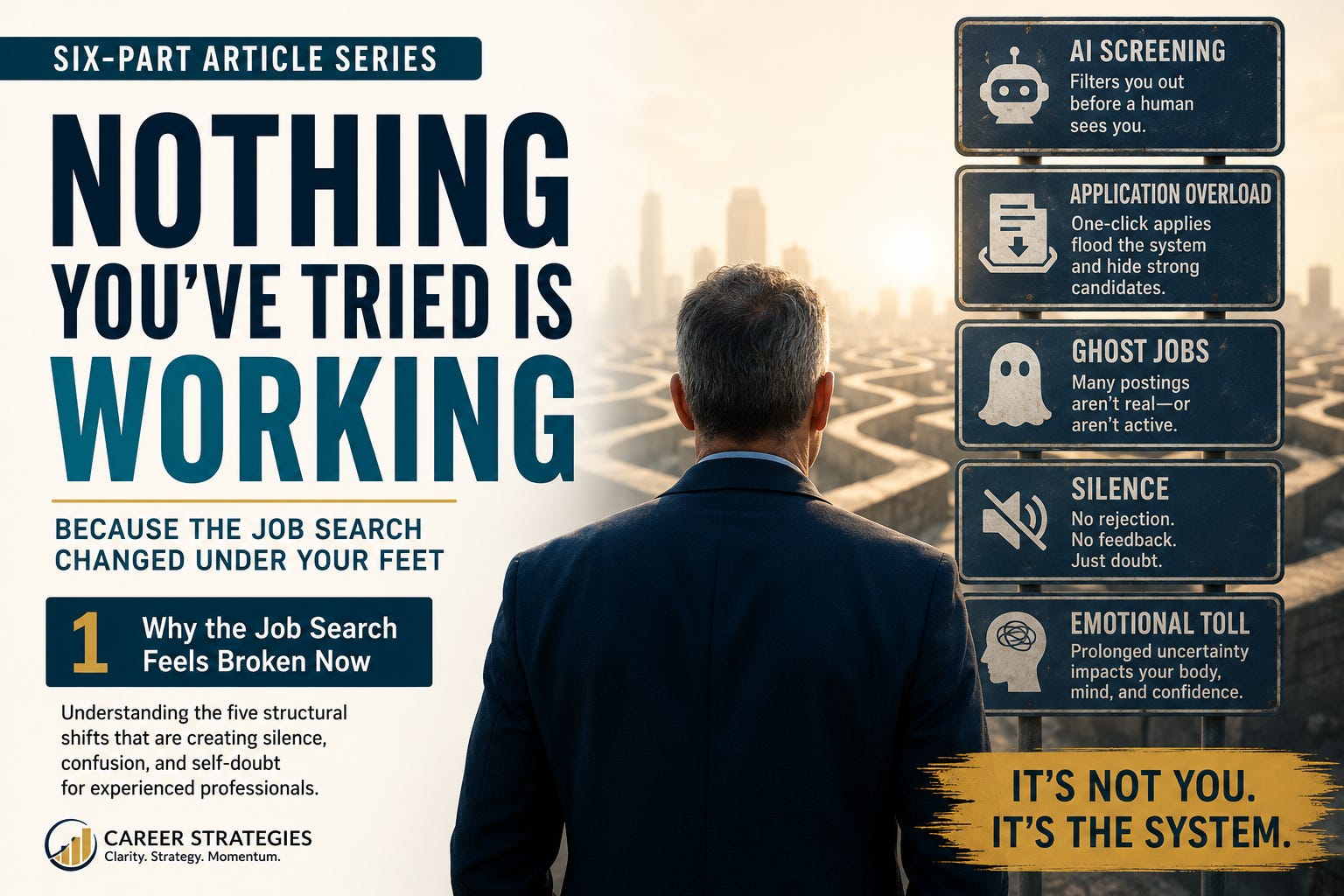
The modern job search is not just more competitive.
It is structurally different.
The system changed underneath the candidate, and many experienced professionals are still being told to solve a structural problem with personal effort.
That is why the search feels so confusing.
You are not just competing against other candidates.
You are competing against filters, ranking models, application floods, ghost postings, recruiter bandwidth, risk-averse hiring teams, and systems that often decide who gets seen before anyone has the chance to understand the full shape of your experience.
You may be doing real work.
You may be qualified.
You may be a strong fit.
And still, the process may never give your materials the kind of human attention you assume they are receiving.
That is not a small change.
That is the whole game shifting.
The First Change Is Mechanical
For most of your career, hiring technology was assistive.
It helped sort.
It helped store.
It helped recruiters manage volume.
But there was still a basic assumption underneath the process: at some point, a human being would look at your background and make sense of it.
That mattered.
A human could understand a lateral move.
A human could recognize transferable judgment.
A human could see that a title did not capture the scope of the work.
A human could understand that your career had range because you were trusted with complicated problems, not because you were unfocused.
But in today’s hiring environment, the system often acts before the human does.
Your resume may be scored, filtered, ranked, or deprioritized before a recruiter ever sees it.
That means the first audience for your career story may not be a person.
It may be a system looking for alignment.
It is not asking, “Is this person capable?”
It is asking, “Does this profile match the pattern we were told to prioritize?”
Those are not the same question.
And that difference matters deeply for experienced professionals.
Because experienced professionals often have careers that are richer than they are linear.
They have moved across functions.
They have solved messy problems.
They have taken on stretch assignments.
They have shifted industries.
They have survived reorganizations.
They have led through ambiguity.
They have built judgment that does not always fit neatly into a keyword field.
A human reader might see that as maturity.
A screening system may see it as inconsistency.
A human reader might understand that breadth is value.
A screening system may struggle to place it.
A human reader might infer seniority from the complexity of the work.
A screening system may only score what is clearly named, structured, repeated, and aligned.
That is why a strong background can still disappear.
Not because it lacks value.
Because the value has not been translated into the language the system is built to recognize.
The Second Change Is Volume
One-click applications changed candidate behavior.
That sounds obvious, but the consequences are bigger than most people realize.
When applying took effort, applicant pools had friction built into them.
People paused.
They read more closely.
They decided whether the role was worth the time.
Now, hundreds of applications can hit a posting quickly, sometimes from people who are not close fits, sometimes from people testing the market, sometimes from people applying because the process is easy enough to try.
That volume affects everyone.
It affects recruiters.
It affects hiring managers.
It affects screening thresholds.
It affects how quickly postings become overwhelmed.
And it affects how silence should be interpreted.
In an older market, silence after a thoughtful application could reasonably feel like feedback.
Maybe they read it and passed.
Maybe the fit was not strong enough.
Maybe someone else had more relevant experience.
That was painful, but at least it felt like a process occurred.
Now, silence may mean something very different.
It may mean the role was flooded.
It may mean the system ranked other profiles higher.
It may mean the posting was never fully active.
It may mean the hiring team paused.
It may mean an internal candidate already existed.
It may mean the recruiter never reached your application at all.
It may mean nothing about your ability.
But because the candidate receives the same output — silence — the mind fills in the blank.
And the explanation it often chooses is the most personal one.
The Third Change Is Psychological
For much of a professional career, the market functions like a mirror.
You work, and something reflects back.
A raise.
A promotion.
A recruiter message.
A performance review.
A colleague asking for your judgment.
A manager trusting you with a difficult problem.
A team depending on your leadership.
You may not think of those moments as emotional infrastructure, but they are.
They tell you that your work is visible.
They tell you that your contribution registers.
They tell you that your professional identity still has weight in the world.
Then the job search begins, and that mirror disappears.
You send out the same competence.
The same history.
The same judgment.
The same work ethic.
But nothing reflects back.
No answer.
No explanation.
No signal.
No context.
And when a person who has spent years being useful suddenly receives no confirmation that their usefulness is still visible, the silence does not stay neutral.
It starts to sound like a verdict.
This is one of the cruelest parts of the modern search.
The market does not simply deny people jobs.
It denies them feedback.
And without feedback, professionals begin manufacturing explanations out of anxiety.
They read silence as rejection.
They read delay as disinterest.
They read no response as proof that they have lost relevance.
But silence is not always a mirror.
Sometimes it is the absence of a mirror.
That distinction can protect you.
Because if the market is not accurately reflecting your value, then you cannot let the silence become the primary source of your self-assessment.
You need another system.
You need evidence.
You need structure.
You need a way to separate what is happening in the market from what is true about you.
The Fourth Change Is Biological
This part is often ignored because job-search advice likes to pretend candidates are machines.
Optimize the resume.
Update the profile.
Send the message.
Track the applications.
Prepare for interviews.
Repeat.
But a long job search does not happen only on a spreadsheet.
It happens in the body.
It happens when you wake up and check your phone before you are fully awake.
It happens when you feel a drop in your stomach after refreshing your inbox.
It happens when an ordinary errand feels irresponsible because some part of you believes you should be applying instead.
It happens when LinkedIn starts to feel like a room where everyone else is moving forward and you are watching through the glass.
It happens when the question “Any luck yet?” feels heavier than the person asking it understands.
The job search activates threat.
Not metaphorically.
Physically.
Professional disconnection can feel like danger because work is not just income. It is rhythm, belonging, identity, social confirmation, structure, and future orientation.
When that disappears, the nervous system does not politely say, “This is a temporary career transition.”
It scans for risk.
It looks for signs.
It treats uncertainty as something that must be solved.
That is why the search can feel exhausting even on days when you did not do much.
You are not only applying.
You are monitoring.
You are waiting.
You are interpreting.
You are bracing.
You are managing the emotional cost of ambiguity.
And ambiguity is expensive.
This Is Why More Effort Alone Does Not Fix It
When nothing is working, the instinct is to increase effort.
More applications.
More resume versions.
More networking messages.
More job boards.
More tabs open.
More late nights.
More urgency.
But if the problem is structural, more effort can become a trap.
More applications into weak postings do not create traction.
More resume edits without a clear evidence strategy do not create signal.
More networking without a clear positioning statement does not create opportunity.
More checking does not create answers.
More urgency does not create control.
At a certain point, effort without diagnosis becomes depletion.
That is why the first step is not to blame yourself.
It is to name the system you are actually in.
You are not searching in the same market that existed ten years ago.
You are not even searching in the same market that existed before AI screening became more common, before ghost postings became part of the landscape, before application volume exploded, before recruiters were buried under more noise than they could reasonably interpret.
You are searching in a market where being qualified is necessary but not always sufficient.
You need to be legible.
You need to be findable.
You need to be specific.
You need to protect your energy from dead-end activity.
You need to rebuild confidence from evidence rather than waiting for the market to hand it back.
That is not pessimism.
That is strategy.
What This Means for Experienced Professionals
Experienced professionals are especially vulnerable to this moment because so much of their value is contextual.
They know how to read a room.
They know how to stabilize a team.
They know how to make judgment calls when the data is incomplete.
They know how to prevent problems that less experienced people only recognize after the damage is visible.
They know how to manage risk.
They know how to translate ambiguity into action.
But many of those strengths do not automatically show up in a screening environment.
A system cannot assume your judgment.
It cannot infer your impact from your title.
It cannot fill in the story behind a vague bullet.
It cannot understand that the most valuable thing you did was prevent a failure that never made it into the metrics.
So the burden shifts.
Not the burden of proving your worth as a human being.
The burden of translating your value into visible evidence.
That is different.
One is identity.
The other is communication.
The modern job search punishes candidates who confuse the two.
When your materials fail to land, it does not automatically mean your career lacks value.
It may mean the value has not been converted into the right kind of signal.
That is fixable.
But only after you stop treating silence as truth.
The New Starting Point
The old starting point was:
“What is wrong with my resume?”
The better starting point is:
“What part of the system am I trying to solve?”
Because those are different questions.
If the issue is AI screening, you need signal architecture.
If the issue is application volume, you need better targeting.
If the issue is ghost jobs, you need triage.
If the issue is unclear positioning, you need an evidence bank.
If the issue is emotional exhaustion, you need boundaries and nervous-system recovery.
If the issue is confidence erosion, you need practiced confidence instead of mood-based confidence.
The mistake is treating every problem as a resume problem.
The resume matters.
But it is not the whole search.
It is one artifact inside a much larger system.
And if the system has changed, your strategy has to change with it.
You Are Not the Problem. But Your Strategy May Be Outdated.
That sentence matters.
Because too much career advice swings between two extremes.
One extreme tells job seekers they are doing everything wrong.
The other tells them they are perfect and the market is simply unfair.
Neither position is useful by itself.
The more honest answer is this:
You may be highly capable.
You may have real experience.
You may have a strong career behind you.
And still, your current strategy may not be built for the market you are facing now.
That does not make you the problem.
It gives you a place to start.
You can rebuild the strategy.
You can translate your experience into evidence.
You can stop applying blindly.
You can learn to identify low-probability postings.
You can strengthen your LinkedIn signal.
You can prepare for interviews around proof rather than performance.
You can negotiate from evidence instead of gratitude.
You can protect your mind while the process unfolds.
But first, you have to stop accepting the market’s silence as a complete and accurate story.
It is not.
What Feels Like Failure May Be a Collision
This is the core truth of the modern search:
What feels like failure is often a collision between your experience and a hiring environment that no longer works the way it used to.
You are bringing a career built in one system into a market operating by another.
That mismatch can feel humiliating.
It can make you question your relevance.
It can make you wonder whether all those years still count.
They do.
But they have to be translated differently now.
The work is not to become younger.
It is not to erase your experience.
It is not to pretend you are less senior than you are.
It is not to chase every posting that appears.
It is not to hand your confidence over to an inbox that was never designed to protect it.
The work is to build a modern search system around the value you already carry.
That starts with understanding the environment clearly.
Not emotionally.
Clearly.
The job search changed under your feet.
Now the strategy has to change under your control.
Status Upgrade
Stop asking, “Why is nothing working?”
Start asking, “What changed, and what system do I need now?”
Because the answer is not more panic.
It is not more random effort.
It is not more self-blame.
It is a clearer operating system for a market that no longer rewards the old one.
Coming Next in the Series
Article 2: Your Experience Is Real — But Your Evidence Is Weak
The next article will focus on one of the most expensive mistakes experienced professionals make in the modern search: describing responsibility when the market is looking for evidence.
Because your resume may be accurate.
It may also be underselling you.
And in an AI-filtered market, what is not clearly evidenced often does not exist.
About the Author
Byron K. Veasey is a career strategist and leader in data quality engineering focused on helping professionals navigate job searches, burnout, and career reinvention.
He writes Career Strategies, a Substack newsletter read by over 4,900 professionals navigating today’s evolving job market.
👉 Subscribe to Career Strategies