
Your Confidence Did Not Disappear. It Went Offline.

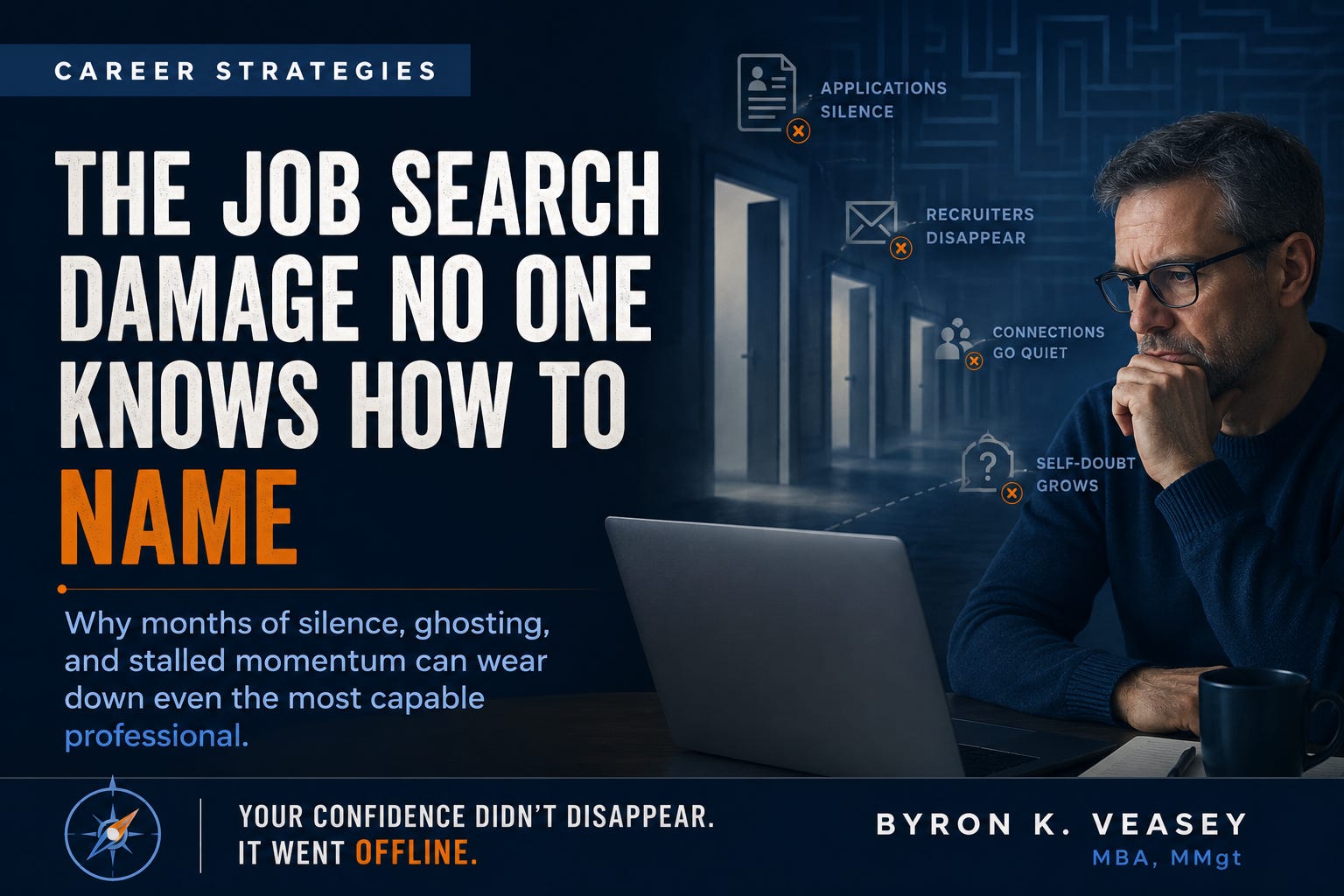
Why job-search silence can make capable professionals stop trusting themselves—and why another pep talk will not fix it
This article is based on Chapter 2, “What Micro-Discouragement Does to the Nervous System,” from How Careers Quietly Erode: How Experienced Professionals Lose Visibility, Confidence, and Career Momentum—and How to Recover in the AI Hiring Era by Byron K. Veasey. The chapter appears within the book’s first movement, which names micro-discouragement and explains how repeated job-search experiences quietly affect experienced professionals.
Somewhere in the last several months, you may have stopped trusting your own read on things.
Not completely.
Not dramatically.
You did not wake up one morning and decide that your career no longer mattered.
It was quieter than that.
You hesitated before applying for a role you would have pursued confidently a year ago.
You reread a recruiter’s message four times, trying to decide whether the tone meant anything.
You considered asking for the salary you had already earned in your previous position—and then reduced the number before anyone challenged it.
You prepared for an interview by reviewing accomplishments you know are real.
But they did not feel real in the way you needed them to.
You could see the facts.
You could not reach the certainty behind them.
That is the part of a long job search that many people misread.
They call it a confidence problem.
It may be something more precise.
Your confidence may not have disappeared.
It may have gone offline.
The Change Happens Quietly
Imagine a former operations leader named Marcus.
For fourteen years, Marcus ran environments where delays were expensive and mistakes had consequences.
He had led a turnaround that restored a failing production line.
He had made decisions under pressure.
He had managed people, budgets, schedules, vendors, and problems that could not be solved with motivational language.
Then he was laid off.
Months later, he earned a second-round interview for a role that genuinely matched his background.
He sat down to prepare.
He opened his notes.
He reviewed the turnaround.
He read the metrics.
He knew every line was true.
And he felt almost nothing.
Not disbelief.
Not exactly fear.
A distance.
It was as though the achievements belonged to someone whose résumé he had been asked to review.
The book describes this gap as the distance between knowing that an accomplishment is true and being able to draw on that truth under pressure. Micro-discouragement builds through small experiences that teach the system, one data point at a time, that effort does not reliably lead anywhere.
That is why the experience can be so disorienting.
You still possess the knowledge.
You still possess the skills.
You may no longer feel immediate access to the confidence they once generated.
Why Pep Talks Stop Working
Most people respond to declining confidence in predictable ways.
They repeat affirmations.
They reread their résumé.
They ask a friend to remind them how accomplished they are.
They tell themselves:
You’ve got this.
You’ve done harder things.
You just need to believe in yourself.
These statements may be sincere.
They may even help briefly.
But they often fail to reach the actual problem.
Confidence is commonly treated as a belief you either possess or lack.
Under that model, the solution is to install a stronger belief.
Say the right words.
Think more positively.
Challenge the negative thought.
But confidence is not merely a statement you make about yourself.
It is also a state produced when your system expects that the environment is stable enough for you to act.
When your actions usually create understandable responses, confidence comes more easily.
When your decisions have consequences you can observe, confidence has evidence.
When effort and outcome remain connected, you learn to trust your judgment.
A prolonged job search can remove those conditions.
You apply and hear nothing.
You follow up and receive no answer.
You interview and never learn what happened.
You improve your materials and cannot determine whether the improvement mattered.
You network and wonder whether the conversation created an opportunity or merely consumed another hour.
Eventually, your system stops treating confident action as obviously safe.
Not because you became incapable.
Because the environment became unpredictable.
The book frames confidence as a state associated with safety and predictability. When the environment becomes uncertain, threatening, and difficult to interpret, confidence becomes less available even though the facts of a person’s career remain intact.
That distinction changes the recovery strategy.
You do not need to shout louder at yourself.
You need to rebuild some of the conditions that confidence depends on.
What Safety Means in a Job Search
The word safety can sound overly clinical or abstract in a career discussion.
But here it means something practical.
Your system is constantly trying to answer three questions:
Can I predict what happens next?
Will this experience reach a clear ending?
Is there a meaningful connection between what I do and what happens?
These are questions about predictability, closure, and control.
A stable job quietly supplies all three.
You complete a report, and someone reviews it.
You attend a meeting, and a decision is made.
You finish a project, and the project closes.
You raise a concern, and a response arrives.
You may not like every response.
But the environment usually gives you enough information to understand where you stand.
A job search often does the opposite.
You submit an application without knowing whether a person will see it.
You complete an interview without knowing when the process will end.
You send a follow-up without knowing whether silence means delay, rejection, disorganization, budget trouble, or nothing at all.
Your system is not reacting to one closed door.
It is reacting to a hallway filled with doors that never fully open or close.
Silence Is Harder Than a Clear No
A rejection hurts.
But a clear rejection resolves.
It gives the experience an endpoint.
You can be disappointed.
You can question the decision.
You can ask for feedback.
You can decide what to change.
Then you can redirect your attention.
Silence does not give you that clean ending.
Suppose two professionals apply for similar roles.
The first receives a rejection three days later.
She is disappointed.
She calls a friend.
She complains over dinner.
The next morning, the role is no longer occupying the same amount of mental space.
The second candidate completes a strong screening interview.
The recruiter says:
“We should have next steps by Friday.”
Friday passes.
Then Monday.
Then another week.
The candidate checks email repeatedly.
He reviews the conversation.
He wonders whether his salary expectations ended the process.
He questions an answer that seemed perfectly reasonable when he gave it.
He tells himself the company may still be deciding.
Three weeks later, an automated rejection appears.
The rejection is brief.
But it lands after three weeks of uncertainty.
The pain does not come only from the final answer.
It comes from everything the open loop required him to carry before the answer arrived.
A closed door allows you to stop watching it.
An open door with nothing behind it does not.
That is why ghosting can become more corrosive than direct rejection.
The system stays mildly activated because the experience still appears unresolved.
One unresolved loop may be manageable.
Ten become distracting.
Thirty begin to shape how you approach the next opportunity.
The Open Loops Follow You Into the Interview
The effects of uncertainty do not remain inside your inbox.
They travel.
They show up when you begin preparing for the next interview.
You are not only preparing for the new company.
You are carrying every previous process that never closed.
You may notice yourself hedging.
Softening answers.
Avoiding direct statements.
Reducing your enthusiasm so a future disappointment will hurt less.
You tell yourself you are being measured.
Realistic.
Professional.
But sometimes you are protecting yourself from hope.
You no longer say:
“I led the transformation.”
You say:
“I was involved in several aspects of the transformation.”
You no longer say:
“I am targeting director-level opportunities.”
You say:
“I’m flexible and open to several levels.”
You no longer ask:
“What would success look like in the first six months?”
You ask less because caring openly has started to feel risky.
The market has not only affected your search activity.
It has begun changing the way you occupy the room.
You Are Not Becoming Less Capable
This is where experienced professionals often draw the wrong conclusion.
They notice hesitation and assume their judgment has weakened.
They feel less decisive and assume age has reduced their confidence.
They struggle to speak about accomplishments and assume the accomplishments are no longer relevant.
But the facts have not necessarily changed.
The team still improved under your leadership.
The cost reduction still happened.
The system still launched.
The crisis was still resolved.
The client still stayed.
The problem is not always the strength of the evidence.
The problem may be your present access to it.
Months of silence can become the loudest source of current feedback in your life.
Your career evidence may be five, ten, or fifteen years deep.
The silence is arriving today.
Repeatedly.
Your mind begins giving disproportionate weight to the most recent signal.
And because that signal contains almost no information, you fill in the gap yourself.
Usually with the harshest available explanation.
Maybe I am no longer competitive.
Maybe employers can tell I am behind.
Maybe my best work is too old.
Maybe I have been overestimating myself.
That is not objective analysis.
That is an exhausted system trying to create certainty inside an uncertain environment.
The Difference Between Decision Fatigue and Emotional Load
Not every exhausted job seeker needs the same intervention.
Sometimes you are overwhelmed because the search requires too many decisions.
Which résumé version?
Which role?
Which keywords?
Which recruiter?
Which follow-up?
Which salary range?
Which networking message?
That is decision fatigue.
Structure can help.
A checklist can help.
Templates can help.
Batching similar work can help.
But sometimes a clear list of tasks feels beside the point.
Someone gives you five practical steps, and instead of feeling relieved, you feel irritated.
You already know what to do.
You simply cannot access the energy required to do it.
That is closer to emotional load.
The book offers a useful one-question self-check:
If someone handed me a clear, simple list of exactly what to do next, would that genuinely help—or would it feel beside the point?
When a list would help, the problem is likely structural decision fatigue. When a list feels irrelevant or irritating, the need may be rest, human connection, and permission to step away from search activity for a defined period.
This matters because job seekers often apply structure to emotional load.
They create a tighter schedule.
A larger tracker.
A more demanding application goal.
Then they blame themselves when the structure does not restore them.
A checklist cannot close an emotional loop.
And rest cannot organize forty scattered decisions.
You need the intervention that matches the problem.
The One-Question Self-Check
Pause before deciding what you need next.
Ask yourself:
If someone gave me a clear and realistic plan for tomorrow, would I feel relieved?
Your honest reaction matters more than the answer you think you should give.
If the answer is yes
You may need less ambiguity.
Reduce the number of decisions.
Choose a defined application target.
Create one résumé baseline for each role family.
Set specific outreach days.
Decide in advance when you will check email.
Use a “good enough” rule for low-value choices.
The goal is not perfect optimization.
The goal is to stop forcing your mind to renegotiate the entire search every morning.
If the answer is no
You may not need another plan.
You may need a period in which the search is not allowed to make demands on you.
One evening.
One full day.
A weekend.
A conversation with someone who does not need an update.
A walk without a podcast about hiring.
A meal during which no one asks what you are doing next.
This is not avoidance when the period is defined.
It is recovery.
The critical part is refusing to treat recovery as proof that you are falling behind.
You are not stepping away from your future.
You are trying to return to it with more of yourself available.
Rebuild Predictability Deliberately
You cannot make the entire hiring market predictable.
You can create predictability inside your own process.
Choose specific days for applications.
Choose a fixed follow-up window.
Choose the number of times you will contact a recruiter before closing the loop yourself.
Choose when you will stop checking an application portal.
Choose the maximum number of roles you will pursue at once.
This does not force companies to respond.
It prevents their silence from controlling your entire week.
For example:
Applications happen Tuesday through Thursday.
Networking outreach happens Monday morning.
Follow-ups happen Friday afternoon.
Email is checked at three defined times—not continuously.
A recruiter who has not responded after two follow-ups moves into a closed category unless new information arrives.
The market remains uncertain.
Your behavior becomes more predictable.
That predictability matters.
You are giving your system a schedule it can trust, even when employers do not provide one.
Create Closure When Employers Will Not
Closure does not always require an employer’s participation.
You can create an operational ending.
That may sound like this:
“I submitted the application, completed one follow-up, and reached out to one relevant contact. My part is complete.”
Or:
“The recruiter missed the promised date. I followed up twice. I am closing this process unless they re-engage.”
Or:
“I completed the interview and sent the thank-you message. I will not replay the conversation without new information.”
You are not pretending the outcome does not matter.
You are deciding that uncertainty will not retain unlimited access to your attention.
Some doors will reopen.
A recruiter may contact you three weeks later.
A delayed process may restart.
You can respond then.
You do not have to keep the role psychologically active every day until that happens.
Separate What Is Controllable From What Is Not
A prolonged search creates the illusion that constant monitoring is productive.
You check the application portal.
You reopen the recruiter’s email.
You revisit the job description.
You search LinkedIn to see whether the position is still posted.
You study the profiles of people who may be interviewing.
You replay your answers.
The activity feels like involvement.
But much of it is emotional surveillance.
It consumes energy without increasing influence.
Draw two columns.
Controllable
The roles you select.
The quality of your tailoring.
The clarity of your résumé.
The number of warm outreach messages you send.
How you prepare.
How you recover.
Whether you document accomplishments.
Whether you follow up professionally.
Not controllable
Whether the role is still funded.
Whether a human reads the application.
How many internal candidates exist.
Whether priorities change.
Whether the hiring manager delays the decision.
Whether a recruiter communicates well.
Whether bias affects the process.
Then ask:
Where did most of my emotional energy go this week?
The book’s Reclaiming Agency practice recommends redirecting attention toward controllable actions and treating outcomes outside your control as information about the system rather than verdicts about you.
You may discover that your actions were focused on the controllable column while your attention lived almost entirely in the other one.
That split is exhausting.
Agency returns when your attention begins following your actual influence.
Confidence Needs Evidence, Not Performance
There is a temptation to perform confidence when genuine confidence feels unavailable.
You sit up straighter.
Use stronger language.
Repeat a polished positioning statement.
Tell everyone you are excited about what is next.
There is nothing inherently wrong with presenting yourself well.
But your own mind can detect when the performance has no recent evidence behind it.
The larger the claim, the more visible the missing proof can feel.
This is why broad affirmations often lose to specific facts.
“I am an exceptional leader” may feel difficult to believe today.
“I identified the actual blocker during a vendor discussion and redirected the team toward the real problem” is harder to dismiss.
“I am highly valuable” may feel abstract.
“I helped a former colleague clarify a difficult decision this week” is observable.
“I am still sharp” may invite an internal argument.
“I found the error everyone else had missed” is evidence.
Micro-discouragement accumulated through repeated small experiences.
It is unlikely to be reversed by one large declaration.
It must be answered at a similar scale.
One small, verifiable proof at a time.
Your Career Evidence Is Still Being Produced
A job search can create the false impression that nothing counts unless it produces an interview or offer.
That is too narrow.
You are still making decisions.
Still solving problems.
Still writing.
Still advising.
Still helping.
Still noticing what others miss.
Still managing difficult conversations.
Still learning.
Still showing professional judgment.
Those moments may not arrive with a title, salary, or formal review.
But they are still evidence.
The danger is that you stop recording them.
Your attention becomes trained to notice only search outcomes.
Application submitted: no response.
Message sent: no response.
Interview completed: no decision.
Meanwhile, evidence of capability continues appearing outside the hiring system, but it receives no psychological weight because it did not come from an employer.
That is how silence becomes the only side of the argument with documentation.
Start a Small Evidence Record
At the end of each day, record one action that required judgment, discipline, composure, or skill.
Not a feeling.
A fact.
For example:
“I clarified a confusing technical issue for a former colleague.”
“I rewrote my professional summary so it focused on outcomes rather than responsibilities.”
“I asked a direct question in a networking conversation instead of overexplaining my background.”
“I stopped working on an application once the additional effort stopped improving it.”
“I handled a difficult personal conversation without becoming defensive.”
“I learned enough about a new tool to explain its business relevance.”
Keep these entries in one place.
Do not edit older entries because they later appear small.
The point is accumulation.
The book’s Counter-Evidence approach uses small factual entries collected over time so that repeated proof can begin to outweigh repeated silence. It emphasizes writing facts rather than feelings and keeping the evidence together in one ongoing record.
You are not creating a gratitude journal.
You are building a record the discouragement loop cannot easily rewrite.
Do Not Ask the Market to Be Your Only Mirror
One of the most damaging features of a long search is that the market can become your primary source of professional feedback.
That is a poor arrangement.
The market is inconsistent.
Slow.
Automated.
Overloaded.
Sometimes biased.
Frequently silent.
It is not qualified to serve as your only mirror.
You need people who can reflect your capability accurately.
Not people who offer empty encouragement.
Not people who pressure you to apply harder.
Not people who turn every conversation into an interrogation about progress.
You need someone who can say:
“That answer is too cautious. It does not sound like you.”
“You are minimizing the scale of what you led.”
“This role is below your actual level.”
“You are tired, not incapable.”
“That résumé section is unclear.”
“You handled that situation well.”
A good mirror can offer both correction and recognition.
The purpose is not to protect you from every difficult truth.
It is to prevent an unresponsive system from becoming the only source allowed to define reality.
Your Nervous System Is Not Betraying You
The hesitation is not proof that you have lost your edge.
The flatness is not proof that your achievements no longer matter.
The caution is not proof that you are becoming less capable.
Your system has been trying to function inside an environment with too little predictability, too little closure, and too little visible connection between effort and outcome.
It adjusted.
That adjustment may now be limiting you.
But it was not irrational.
It was protective.
Once you understand that, the recovery stops sounding like:
“Why can’t I be the person I used to be?”
It becomes:
“What conditions would help me access that person again?”
That is a better question.
It carries less shame.
It produces more useful answers.
A Practical Reset for This Week
Do not attempt to repair everything at once.
Choose one action from each category.
Restore predictability
Set two defined job-search work periods.
Decide in advance what will happen during them.
Stop renegotiating the schedule every day.
Create closure
Choose three inactive applications.
Complete one final follow-up if appropriate.
Then mark them closed unless new information arrives.
Reclaim control
Write your controllable and uncontrollable columns.
Notice where your attention has been living.
Record evidence
Write down one factual example of professional judgment each day.
Small is acceptable.
Specific is required.
Reduce vigilance
Choose fixed times to check email and application portals.
Do not let every notification—or absence of one—interrupt the day.
Find one mirror
Contact one person who can offer honest, grounded feedback.
Ask a precise question.
Not:
“Do you think I’ll be okay?”
Ask:
“Where am I minimizing my experience?”
Or:
“What part of my positioning sounds less confident than the work I actually did?”
This is not a complete recovery system.
It is a way to begin bringing confidence back online.
You Do Not Need to Feel Powerful Before You Act
There is a harmful idea hidden inside much career advice:
You must regain confidence before you can move forward.
That creates another delay.
You wait to feel ready.
Wait to feel certain.
Wait to feel like yourself.
But confidence often returns after the system receives enough evidence that action is safe again.
You do not need complete confidence to send one well-chosen application.
You do not need complete confidence to contact one trusted person.
You do not need complete confidence to document one accomplishment.
You do not need complete confidence to close one unresolved loop.
The goal is not to manufacture certainty.
The goal is to create small experiences that make certainty possible again.
Your Confidence Is Still There
The market did not remove your judgment.
It disrupted your access to it.
The silence did not erase your accomplishments.
It became louder than them.
The stalled processes did not prove that your experience lacks value.
They created an environment in which value became difficult to feel.
That can be reversed.
Not through performance.
Not through pressure.
Not by forcing yourself to believe what your system currently distrusts.
You rebuild confidence by restoring predictability where you can.
Creating closure where others will not.
Redirecting attention toward what you control.
Recording evidence before silence can erase it.
And staying connected to people who can see you more accurately than an automated system ever will.
Your confidence did not disappear.
It went offline because the conditions supporting it went offline first.
The work now is not to become someone new.
It is to rebuild the ground that allows the capable person already there to come back online.
About the Author
Byron K. Veasey is a career strategist and leader in data quality engineering focused on helping experienced professionals navigate job searches, burnout, career disruption, and reinvention.
He is the author of How Careers Quietly Erode: How Experienced Professionals Lose Visibility, Confidence, and Career Momentum—and How to Recover in the AI Hiring Era and writes Career Strategies, a Substack newsletter read by over 5,000 professionals navigating today’s evolving job market.
👉 Subscribe to Career Strategies