
Your Competence Did Not Disappear. Your Nervous System Is Still Bracing.

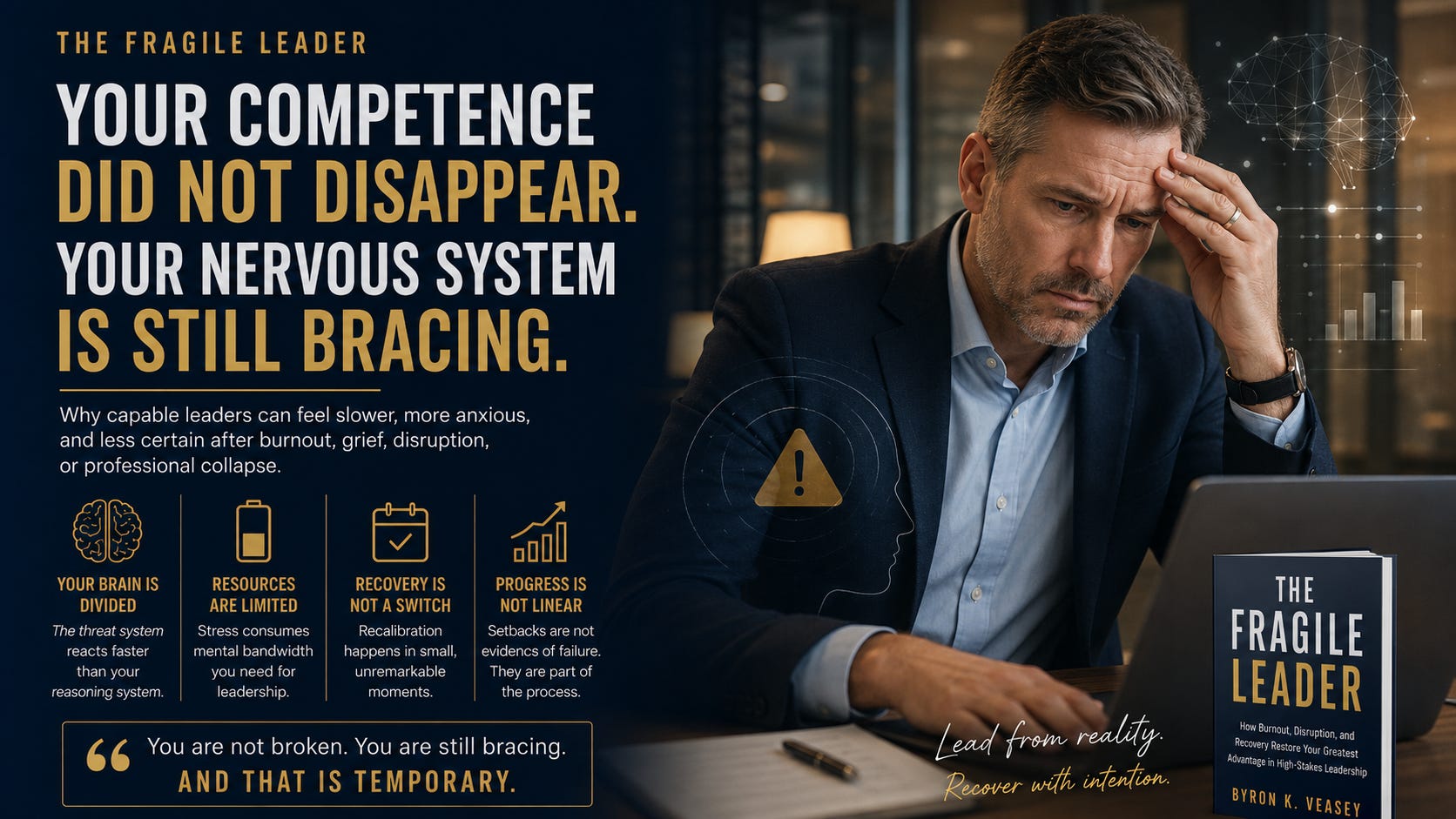
Why capable leaders can feel slower, more anxious, and less certain after burnout, grief, disruption, or professional collapse
This article is based on Chapter Two, “The Anatomy of the High-Performance Survivor,” from The Fragile Leader: How Burnout, Disruption, and Recovery Become Your Greatest Advantage in High-Stakes Leadership by Byron K. Veasey.
Renee had opened the same folder dozens of times.
The budget model was where it had always been. She had created the file, maintained it, and used it in previous quarterly planning meetings without giving the process much thought.
But on this particular morning, she stared at the folder structure and could not find it.
The pause lasted only a few seconds.
Nobody in the meeting appeared to notice.
Renee noticed.
She noticed the silence between opening the laptop and locating the file. She noticed how long four seconds could feel when other people were waiting. She noticed the immediate thought that appeared beneath her professional composure:
Something is wrong with me.
Her divorce had been finalized three weeks earlier. She had returned to work the following Monday because her organization had no meaningful policy for the kind of absence she needed—and because she did not know how to request time for a loss that did not come with a funeral.
She had continued leading.
Her calendar remained full. Her title had not changed. Her team still expected decisions, guidance, and answers.
But her internal resources had changed.
What Renee interpreted as evidence that she was losing her capability was something more temporary and more understandable: her brain was allocating a significant portion of its available resources to surviving a major disruption.
This is one of the most frightening experiences a high-performing leader can have.
You still know who you are.
You still possess the experience.
You can remember solving more complicated problems in the past.
Yet tasks that once felt automatic suddenly require preparation, concentration, or unusual effort.
The temptation is to make the experience personal:
I am slipping.
I am no longer as sharp as I used to be.
Maybe I came back too soon.
Perhaps everyone else can see it.
But the better explanation may be this:
Your competence did not disappear. Your access to it has temporarily narrowed.
Different Disruptions Can Produce the Same Internal Experience
Renee’s disruption was personal.
Another leader may have been laid off and recently started a new job.
Someone else may be recovering from burnout while continuing to manage the same team.
Another leader may be implementing an AI transformation while wondering whether the finished system will reduce the need for their role.
Someone may be leading meetings while privately managing grief, divorce, illness, financial pressure, caregiving responsibilities, or the aftermath of a public professional failure.
The events are different.
The body does not necessarily care which category the event belongs to.
Chapter Two of The Fragile Leader, “The Anatomy of the High-Performance Survivor,” argues that different forms of disruption can lead to the same underlying competition for the brain’s resources. Burnout, grief, health crises, personal loss, and prolonged professional uncertainty may enter through different doors, but they can produce similar patterns of hypervigilance, reduced working memory, emotional reactivity, and difficulty sustaining long-range thinking.
The diagram on page 20 of the book illustrates this convergence.
On one side are several different triggers:
Burnout.
AI-driven disruption.
Grief and loss.
A health crisis or breakdown.
They all lead toward the same competition between two systems: the part of the brain responsible for planning and judgment, and the system responsible for detecting threats and initiating a survival response.
Different doors.
The same room.
The Two Systems Competing for Your Attention
Leadership depends heavily on the prefrontal cortex.
This is the part of the brain associated with planning, prioritizing, weighing trade-offs, controlling impulses, holding multiple pieces of information, and choosing a measured response instead of an immediate one.
In other words, it supports much of what leaders are paid to do.
The threat-detection system operates differently.
Its job is not to produce the most thoughtful interpretation of a situation. Its job is to react quickly enough to protect you.
Under ordinary conditions, these systems work together. Something captures your attention, the threat-response system raises the alarm, and your reasoning system evaluates whether the situation is genuinely dangerous.
Prolonged or acute stress can interrupt that handoff.
The threat-response system becomes faster and more sensitive. At the same time, the part of the brain responsible for executive functioning has fewer resources available.
This does not mean that intelligence has disappeared.
It means that a portion of your processing capacity is being redirected toward protection.
That is why you may know that an unexpected message from your manager is probably harmless and still feel your chest tighten before you read it. The reaction arrives before your rational assessment because the system producing the reaction operates more quickly.
You are not consciously choosing panic.
Your body is making a prediction before your strategic mind has finished reviewing the evidence.
When Ordinary Work Begins to Require Extraordinary Preparation
A high-performance survivor often remains productive.
That is what makes the experience difficult to recognize.
You are not necessarily unable to work. Instead, you begin using more energy to produce the same visible result.
You rehearse conversations that once required no preparation.
You reread simple emails several times before sending them.
You arrive early because being fully prepared feels safer than being surprised.
You create multiple versions of an answer before a meeting.
You check your calendar repeatedly.
You mentally build contingency plans for interactions that would once have felt routine.
From the outside, this may look like increased diligence.
Internally, you know it feels different.
Preparation is no longer simply a professional habit. It has become a way to compensate for a mind that does not feel as immediately available as it once did.
Chapter Two describes working memory as the mental workspace that allows us to hold and manipulate several pieces of information during a conversation or complex decision. Under prolonged stress, access to that workspace can narrow. A leader may feel a thought forming and then lose it before being able to express it—not because the intelligence behind the thought has vanished, but because the pathway to it is temporarily less reliable.
This explains why a previously effortless conversation may suddenly need to be rehearsed in advance.
The preparation is not proof that you are incapable.
It may be a rational adaptation to reduced bandwidth.
Why One Good Meeting Does Not Reset the System
Marcus had evidence that things were improving.
His project was progressing.
His manager trusted him with more responsibility.
He had delivered strong updates and experienced several calm weeks.
Yet an unexpected invitation from a senior leader still caused his stomach to drop.
The nervous system does not always weigh evidence the way a performance dashboard does.
It does not necessarily average every recent experience and conclude that the overall trend is positive. Emotionally intense events can retain more authority than ordinary calm ones.
One restructuring announcement may outweigh ten uneventful meetings.
One humiliating professional failure may remain louder than several months of competent performance.
One devastating personal event may continue shaping reactions long after the paperwork, ceremony, hospital stay, or public crisis has ended.
That is why one good day rarely resets a system trained under sustained threat.
The book explains that recalibration requires repeated counterexamples—enough ordinary moments in which the predicted catastrophe does not occur to gradually weaken the old threat model.
The reassuring calendar invitation matters.
The meeting that ends without criticism matters.
The manager who responds reasonably matters.
The presentation that goes well matters.
But no single moment is likely to feel transformative.
The change becomes visible only after the moments accumulate.
Recovery Rarely Feels Like Recovery While It Is Happening
People often imagine recovery as a clear emotional turning point.
One morning, you wake up and feel like yourself again.
The anxiety disappears.
Your confidence returns.
The old reactions stop.
But recalibration is usually much less dramatic.
It may look like receiving a message and noticing that your chest tightened for five minutes instead of the rest of the afternoon.
It may look like making a small mistake without interpreting it as proof that your career is collapsing.
It may look like entering a meeting only five minutes early instead of fifteen.
It may look like recovering from difficult feedback in two hours rather than two days.
It may look like noticing the internal alarm without automatically obeying it.
Chapter Two describes recovery as an accumulation of small, unremarkable moments in which an expected catastrophe fails to happen. None of those moments necessarily feels like healing on its own. Progress becomes visible in retrospect, after enough of them have formed a pattern.
This matters because many leaders mistakenly evaluate recovery by asking:
Did the reaction return?
A more useful question is:
When it returned, how long did it stay—and how much authority did I give it?
The goal is not immediate emotional silence.
The goal is a gradually changing relationship with the alarm.
The Doubt That Arrives After Success
Theo delivered an excellent quarterly presentation.
The data was accurate. The narrative was clear. His manager praised the work.
Then the doubt arrived:
You fooled them.
This is one of the more surprising patterns in leadership recovery. Fear does not always peak before the performance or after a mistake.
Sometimes it arrives after success.
Failure fits the survival brain’s existing model.
If you already believe that you are one mistake away from exposure, a bad outcome requires no new explanation.
Success creates a problem for the old model.
The mind has to decide whether to revise its belief or dismiss the evidence.
So it may conclude:
They were not paying close attention.
The standards were lower this time.
You were lucky.
The next presentation will expose you.
Theo’s strategic mind could see that the work was good. His survival mind concluded that approval was temporary and the next collapse had merely been delayed. Both conclusions arrived at the same time.
That is more than ordinary self-doubt.
It is a competition between an evidence-based assessment of the present and a threat model constructed from the past.
The feeling may become especially intense after praise, promotion, visibility, or a major accomplishment. Success raises the stakes because it creates something that can now be lost.
For leaders rebuilding after professional failure or prolonged instability, recognition can feel less like safety and more like the beginning of another countdown.
Progress Is Not a Straight Line
Theo experienced several good weeks.
Then another division announced a routine reorganization.
The announcement had nothing to do with him.
His body responded as though it did.
By that evening, he was mentally drafting a resignation letter he had no intention of sending.
This did not mean that his recovery had failed.
A familiar trigger temporarily increased the volume of the old survival response.
Over time, the important change was not that the surge never returned. It was that the response became shorter, quieter, and easier to observe without automatically turning it into action.
Recovery can include recurrence.
A difficult week does not erase the progress of the previous three months.
An intense reaction does not necessarily mean you are back at the beginning.
A familiar fear can return without regaining complete control.
The honest measure is not perfection.
It is reduced duration, reduced intensity, and increased choice.
Your Nervous System Does Not Recognize Corporate Categories
Organizations separate professional and personal life.
The nervous system does not.
Human resources may categorize a layoff, divorce, bereavement, medical diagnosis, reorganization, and burnout as entirely different events.
Your body evaluates something more basic:
How threatening was this?
How long did it continue?
Did you have any control?
Did you have support?
Has the danger clearly ended?
The chapter connects grief-related cognitive changes with patterns also found in prolonged occupational stress. It argues that the nervous system does not maintain separate departments for professional and personal catastrophe. It responds to the magnitude and duration of disruption rather than the administrative category assigned to it.
This is especially relevant for leaders experiencing losses that the workplace does not fully recognize.
A divorce can disrupt attachment, identity, finances, routines, friendships, living arrangements, and parenting responsibilities.
A layoff can remove income, status, structure, belonging, and confidence simultaneously.
A health crisis can end while the fear of recurrence remains.
Burnout may continue affecting the body after the workload has been reduced.
A person may be “back” according to the calendar and still be recovering according to their biology.
The Body Keeps Its Own Calendar
A start date does not prove that you are ready.
A return-to-work date does not end grief.
A promotion does not erase what happened in the previous role.
A signed divorce decree does not immediately resolve the disruption surrounding it.
A successful project does not make the nervous system forget the months of uncertainty that preceded it.
One of the chapter’s central ideas is that the external end of a stressor and the body’s recognition that it has ended are not the same event.
The return to baseline can take months or longer, particularly after prolonged exposure. The duration of the original disruption may matter as much as—or more than—the intensity of its worst day.
The body keeps its own calendar.
It does not check your Outlook.
Understanding this does not remove the responsibility of leadership.
It changes how you interpret the difficulty.
Instead of asking, “Why am I not over this?” you can ask, “What support does my current level of bandwidth require?”
That is a more useful leadership question.
Signs Your System May Still Be Bracing
Consider the last two weeks.
Has a routine task taken noticeably longer or required unusual effort?
Have you experienced a recurring physical response around a particular type of meeting, person, notification, or conversation?
Are you preparing excessively for interactions that once felt ordinary?
Are you arriving unusually early, checking messages repeatedly, or constructing several contingency plans for low-risk situations?
How long has it been since the event—or the beginning of the ongoing situation—you associate with these changes?
These questions come from the chapter’s “Signs Your System Is Still Bracing” worksheet. They are not designed to diagnose you. They help separate an observable pattern from the larger fear that your competence has permanently changed.
Naming the pattern reduces the need to invent a more catastrophic explanation.
The Ninety-Second Pause
What helped Renee was smaller than the dramatic recovery intervention she imagined she needed.
When a familiar task was not landing correctly, she stopped forcing herself through it.
She took ninety seconds.
The pause was not surrender.
It was not proof that she was no longer capable of leadership.
It was an intentional accommodation for a nervous system temporarily operating with less available prefrontal bandwidth.
The pause did not eliminate every moment of confusion. It reduced the additional panic those moments created because Renee now understood what was happening.
That distinction matters.
The original cognitive pause may last four seconds.
The fear about the pause may consume the rest of the meeting.
Once the experience has a name and a mechanism, you can stop turning a temporary delay into a permanent verdict about your future.
You Are Still the Leader
You may need more preparation than you once did.
You may occasionally lose a word, miss a detail, or feel an outsized reaction to an ordinary request.
You may deliver strong work and still struggle to believe the praise.
You may be leading successfully while using more internal energy than anyone around you realizes.
None of this automatically means that your leadership capacity has disappeared.
You may be a high-performance survivor: someone whose competence remains intact while the nervous system is still recalibrating after something the professional world expects you to have already moved beyond.
Your credentials did not expire.
Your experience was not erased.
Your intelligence did not leave.
Your system may simply be protecting you according to conditions that are no longer fully present—or that have not yet clearly ended.
The work is not to shame it into silence.
The work is to understand what it is doing, give it new evidence, and build a way of leading that respects the resources you actually have today.
You are not broken.
You are still bracing.
And those are not the same thing.
About the Author
Byron K. Veasey is a career strategist and leader in data quality engineering focused on helping experienced professionals navigate AI screening, automated interviews, recruiter silence, age bias, burnout, and career reinvention.
He writes Career Strategies, a Substack newsletter read by over 5,000 professionals navigating today’s evolving job market.
👉 Subscribe to Career Strategies