

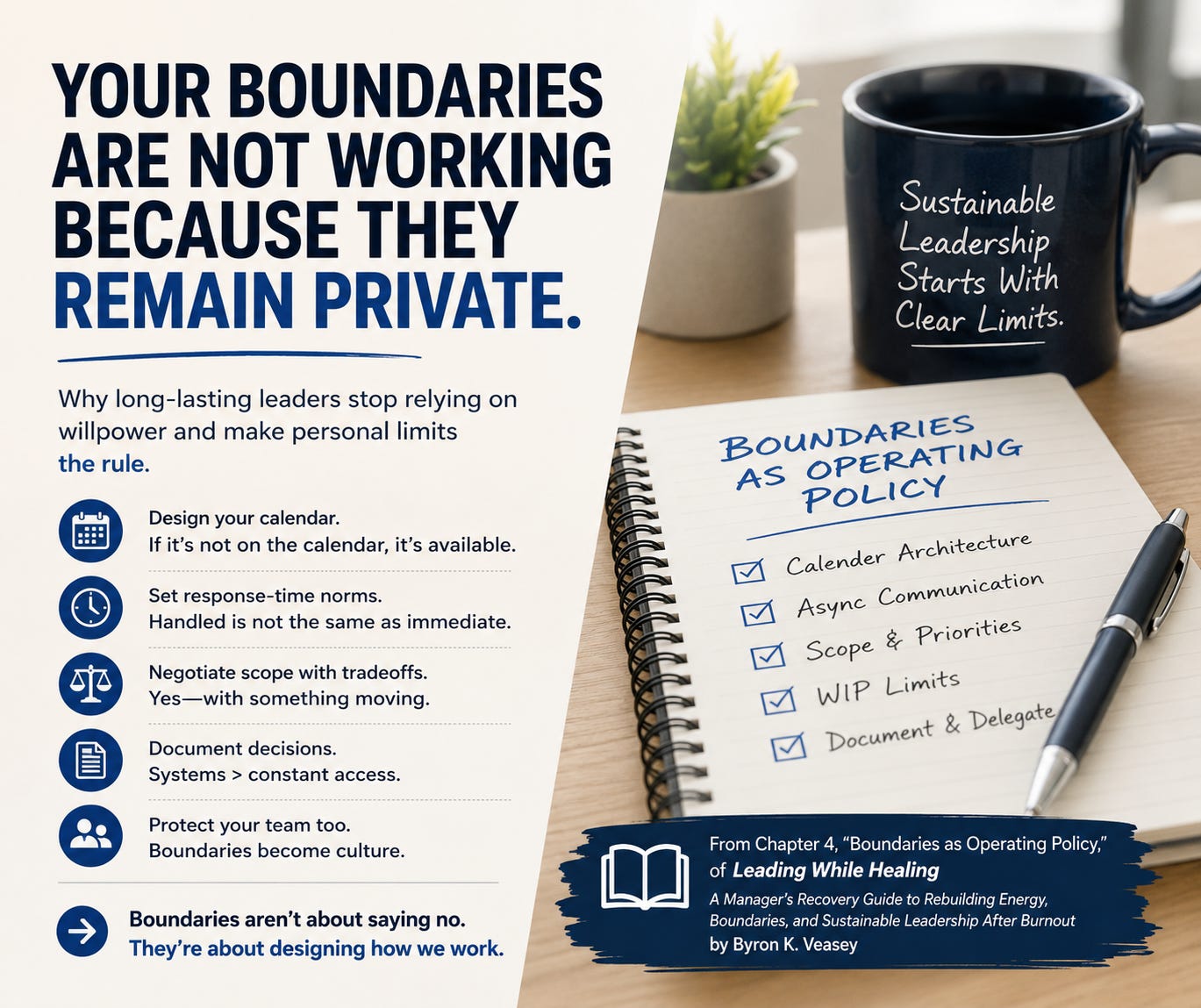
Why sustainable leaders stop relying on willpower and turn personal limits into operating policy
Adapted from Chapter 4, “Boundaries as Operating Policy,” in Leading While Healing: A Manager’s Recovery Guide to Rebuilding Energy, Boundaries, and Sustainable Leadership After Burnout by Byron K. Veasey.
You decided you were done answering messages after 7:00 p.m.
You meant it.
You told yourself this time would be different.
Then Tuesday night arrives.
It is 9:40.
A director you respect sent you a message 25 minutes ago. It is not urgent. It could easily wait until morning.
But your phone is sitting there.
You can see the notification.
And now the calculation begins.
Will they think I’m unresponsive?
What if this holds something up?
It will only take a minute.
So you answer.
And you tell yourself this was the exception.
Except you answered last Thursday too.
And the Sunday before that.
And you accepted the 8:30 meeting your boss scheduled even though you had promised yourself you would protect your mornings.
Eventually, you start blaming yourself.
“I’m terrible at boundaries.”
Maybe not.
Maybe you are trying to solve a structural problem with personal discipline.
That is a very different problem.
Chapter 4 of Leading While Healing begins with a simple but consequential idea:
A boundary that exists only in your head will almost always be broken.
Not because everyone around you is trying to take advantage of you.
Not because you lack discipline.
But because other people cannot organize around a limit they cannot see.
A Private Boundary Has No Standing
Think about some of the boundaries professionals routinely set for themselves:
I don’t take meetings before 10.
I’m going to protect Friday afternoons for focused work.
I won’t check email after dinner.
I’m not taking on another project.
They sound reasonable.
The problem is where they live.
Inside your head.
Your calendar does not know you need uninterrupted mornings.
Your team may not understand that a 9:00 p.m. message activates your attention even if they do not expect an immediate response.
Your boss may not realize your team is already carrying six major initiatives when they hand you number seven.
The systems around you operate on what they can see.
If your calendar says you are available, people schedule you.
If you consistently answer after hours, people learn that you are reachable after hours.
If every new request receives a yes, leadership learns that your capacity is expandable.
Observable behavior becomes the operating rule.
That is why private boundaries become exhausting.
Every violation creates another decision:
Do I enforce the boundary?
Do I decline the meeting?
Do I ignore the message?
Do I push back?
Do I disappoint someone?
Or do I just make an exception this time?
When you are already depleted, you will often choose the option that creates the least immediate friction.
You say yes.
You respond.
You accept the meeting.
You absorb the work.
Not because the boundary did not matter.
Because enforcing it manually required energy you did not have.
That is the flaw in the design.
Stop Making Boundaries a Test of Willpower
We often talk about boundaries as though they are a personality trait.
Some people are “good at boundaries.”
Others “need to get better at saying no.”
That framing puts nearly all the responsibility on the individual.
But imagine running any other important business process this way.
Suppose your organization’s cybersecurity policy existed only in the CIO’s head.
Suppose budget controls depended on everyone remembering what they promised themselves last quarter.
Suppose quality standards changed depending on how tired the manager was when a decision arrived.
We would call that poor governance.
Yet this is exactly how many leaders manage their own capacity.
They make private rules and then expect themselves to enforce each one manually.
A stronger approach is to convert the boundary from a personal preference into an operating condition.
Instead of:
“I try not to answer after six.”
Make the team norm:
“We do not expect responses after six unless something meets our defined emergency criteria.”
Instead of:
“I need more focus time.”
Put recurring focus blocks on the calendar so they cannot casually be booked over.
Instead of:
“I really need to stop taking everything on.”
Create an explicit prioritization conversation whenever new work arrives:
“We can take this on. Which existing priority moves?”
The boundary stops depending entirely on your ability to defend it.
The system begins defending it with you.
That is the shift:
Policy, not preference.
Your Calendar Is an Operating System
Open next week’s calendar.
What do you see?
For many managers, it looks less like a plan and more like evidence from an accident scene.
Meeting.
Meeting.
Meeting.
Fifteen-minute gap.
Meeting.
Thirty-minute gap that someone will probably fill tomorrow.
Meeting.
Meeting.
Then, around 6:15 p.m., the strategic work finally begins.
We call this being busy.
But often what we are really looking at is a week no one actually designed.
It simply accumulated.
Someone needed 30 minutes, so they took it.
Someone else needed an hour.
A recurring meeting appeared six months ago and never disappeared.
Your theoretical free space became everyone else’s practical availability.
The result is a calendar that reflects other people’s priorities far better than your own.
Chapter 4 introduces calendar architecture: designing the week intentionally and making that structure visible enough for other people to work around it.
Put Focus Time on the Calendar
Do not leave important thinking time blank.
Blank means available.
Put it on the calendar as a real event:
Focus Block — Do Not Book
Give the work that requires judgment, writing, analysis, planning, and strategy a legitimate place in your schedule.
Do not hope you somehow find time after everyone else finishes using you.
Shorten the Default Meeting
Not every conversation requires 30 minutes.
Not every meeting requires 60.
Try 25 and 50.
That small buffer gives you time to close one conversation before entering another instead of carrying fragments of five meetings around in your head.
Then question recurring meetings:
Does this need to happen this often?
Does everyone currently invited need to attend?
Does this need to be a meeting at all?
Protect the Beginning and End of the Day
If the first thing you do every morning is open email, you have effectively allowed everyone else to determine what your brain thinks about first.
Protect part of the opening hour for your highest-value work.
Protect the closing period too.
Close loops.
Capture decisions.
Prepare tomorrow.
Finish the workday deliberately rather than letting it dissolve gradually into evening email.
Replace “Anytime” With Office Hours
The traditional open-door policy sounds supportive:
Come to me anytime.
But for a manager trying to do concentrated work, “anytime” can quickly become “all the time.”
Consider designated office hours instead.
Create predictable windows when people know you are available for questions, coaching, conversation, and problems.
Accessibility does not have to mean continuous interruptibility.
Sometimes structured access creates better access because the person sitting across from you gets your full attention instead of whatever remains between two meetings.
Not Everything Is Urgent
The workday no longer ends when people leave the building.
The phone follows you.
Email follows you.
Slack follows you.
Teams follows you.
A message can arrive while you are eating dinner, sitting with family, watching television, or preparing for bed.
And even if you do not answer, the work can still get inside.
You notice the notification.
You read enough of the preview to wonder.
You begin constructing the response mentally.
Technically, you did not work.
Your nervous system may disagree.
That is why simply telling yourself “I won’t respond” often does not solve the problem.
The expectation itself needs to change.
One powerful shift is moving toward an async default.
The assumption becomes:
Most communication does not require two people to be available at exactly the same moment.
A message can be sent now and handled later.
A thoughtful response tomorrow is often more useful than an immediate response tonight.
Responsiveness should mean:
Handled reliably within a reasonable timeframe.
Not:
Available constantly.
Define What “Urgent” Actually Means
Ambiguity creates anxiety.
If nobody knows when a response is expected, many people assume the safest response window is:
Immediately.
Remove the ambiguity.
Your team might establish something like:
Chat: handled during the workday.
Email: handled within one business day.
True emergencies: phone call or designated urgent channel.
Then define an emergency.
A client escalation threatening significant loss may qualify.
A system outage may qualify.
Something someone suddenly remembered at 8:47 p.m. probably does not.
Once the norm becomes explicit, the notification loses some of its power.
Everyone knows tomorrow is acceptable.
Including you.
Documentation Is a Boundary Tool
There is another reason leaders feel they must remain constantly available:
Too much organizational knowledge lives inside their heads.
A decision gets made in a meeting.
You know why.
Two weeks later someone asks:
“Why did we decide that?”
Now everyone needs you again.
The problem is not availability.
The problem is documentation.
Write down:
What was decided
Why it was decided
Who owns the next step
What happens next
A simple decision log can remove dozens of future interruptions.
Instead of summoning the manager who remembers the conversation, someone shares the documented decision.
Question answered.
Thread closed.
Evening preserved.
This points to a deeper principle:
A system that requires your constant presence is not yet a resilient system.
Documentation allows the work to continue when you are unavailable.
That means documentation is not merely an efficiency practice.
It is a boundary mechanism.
But None of This Works If You Keep Saying Yes
You can create the perfect calendar.
You can adopt asynchronous communication.
You can document every decision.
You can protect Wednesdays from meetings.
And still burn out again.
Why?
Because there is one boundary underneath all the others:
Scope.
If you are already carrying more work than available capacity can support, scheduling tricks will not rescue you.
This is where many leaders struggle most.
Your boss arrives with another initiative.
It is important.
High visibility.
Leadership wants it.
You immediately feel two things.
The professional reflex:
“Absolutely. We can do it.”
And the internal reality:
There is nowhere to put this.
For high performers, saying yes has often been part of how they built their reputations.
Yes meant capable.
Yes meant ambitious.
Yes meant dependable.
Yes meant leadership material.
Eventually yes can also mean:
Overloaded.
Late.
Distracted.
Understaffed.
Exhausted.
And quietly failing.
Don’t Just Say No. Force the Trade.
Good scope management is not simply about becoming better at saying no.
A more powerful sentence is:
“Yes—and here is what moves.”
Imagine your team is currently carrying six significant initiatives.
Your boss wants to add a seventh.
Instead of automatically accepting it, make current capacity visible.
Then say:
“We can take this on. To do it well, one of these current priorities needs to pause, move, or reduce in scope. Which one should it displace?”
Suddenly the capacity problem becomes visible.
You are not saying:
I don’t want to do this.
You are saying:
The organization has finite resources. Let’s make the prioritization decision consciously.
Another version:
“I can deliver this by the end of the quarter if the reporting redesign moves into next quarter. Does that trade work?”
Or:
“Give me until tomorrow to look at what this does to our other commitments, and I’ll come back with a real answer rather than an optimistic one.”
That last sentence may be especially important for high performers.
The automatic yes can feel like competence in the moment.
But a considered answer grounded in actual capacity is often the more senior form of leadership.
Start Less. Finish More.
Overloaded organizations love beginning things.
Kickoffs feel productive.
New initiatives feel energetic.
Every priority gets a project name, a team, a deck, and a recurring meeting.
Soon twelve things are moving.
Nothing is finishing.
Chapter 4 introduces a work-in-progress limit: deliberately limiting how many major items are active at the same time.
This requires an uncomfortable discipline:
Finish something before starting something else.
Fewer simultaneous priorities can mean:
Less coordination.
Less status reporting.
Less task switching.
Fewer competing decisions.
More concentration.
More completion.
And completion matters psychologically.
A team surrounded by perpetually unfinished work experiences constant low-level pressure.
A team that regularly finishes meaningful work gets evidence that effort leads somewhere.
Start less. Finish more.
That may be one of the healthiest operating policies an overloaded team can adopt.
Protecting Yourself Isn’t Enough
There is one final test.
You create boundaries around your own time.
You stop answering at night.
You protect your focus blocks.
You negotiate your scope.
Then you continue allowing your team to work under the conditions that burned you out.
That is not sustainable leadership.
The real evolution happens when the protections move downward.
Protect your team’s focus blocks.
Do not send messages at night that quietly communicate:
I know you don’t have to answer, but I’m still working.
Challenge unnecessary meetings they are invited to.
Push back on scope that will crush them.
Normalize reasonable response times.
Defend their capacity in rooms where they are not present.
Do not become the heroic buffer who absorbs every organizational problem personally.
That simply rebuilds burnout under a more noble description.
Build the boundary into the team.
Then it stops being your personal recovery accommodation.
It becomes how the group operates.
The Boundary Should Eventually Hold Without You
Go back to Tuesday night.
9:40 p.m.
The phone lights up.
But this time something is different.
The communication policy is already written.
The team knows responses are not expected tonight.
Your calendar has protected space tomorrow.
Important decisions are documented.
Your boss already knows what the team is carrying.
New priorities require a trade.
You do not have to conduct another internal debate.
You do not need another burst of discipline.
You do not have to defend your recovery with your bare hands.
The structure is holding the boundary for you.
That is the destination.
Not stronger willpower.
Better architecture.
The most sustainable boundaries are not the ones you heroically enforce every day.
They are the ones you have made so clear, visible, and operational that everyone can work around them.
Including you.
Turn the Limit Into a Policy
Chapter 4 ends with a Boundary-to-Policy Converter built around a simple exercise.
Take one limit that currently lives only in your head and ask:
What is my private limit?
What would the stated policy be?
Who needs to know?
How can the system hold it without requiring me to renegotiate it every time?
Try it with one boundary this week.
Not ten.
One.
Maybe:
No messages after 7 p.m.
becomes:
“Our team does not expect evening responses. Nonurgent messages are handled the next business day.”
Maybe:
I need more time to think.
becomes:
Three protected focus blocks on the shared calendar every week.
Maybe:
I cannot take another project.
becomes:
No new priority enters the active queue without another priority moving out.
That is the difference between hoping a boundary survives and designing one that can.
About Leading While Healing
Leading While Healing: A Manager’s Recovery Guide to Rebuilding Energy, Boundaries, and Sustainable Leadership After Burnout addresses an operational challenge that is often missing from recovery conversations:
How do you continue leading a department, managing people, handling expectations, and delivering results while your own capacity is still rebuilding?
Chapter 4, “Boundaries as Operating Policy,” goes beyond telling leaders to “set better boundaries.” It shows how to turn personal limits into visible systems through calendar architecture, asynchronous communication, scope negotiation, work-in-progress limits, and team-wide operating norms.
Because the boundary you must personally defend every night will eventually exhaust you.
The boundary built into the system can protect you even when you are too tired to protect yourself.
About the Author
Byron K. Veasey is a career strategist and leader in data quality engineering focused on helping experienced professionals navigate AI screening, automated interviews, recruiter silence, age bias, burnout, and career reinvention.
He writes Career Strategies, a Substack newsletter read by over 5,000 professionals navigating today’s evolving job market.
👉 Subscribe to Career Strategies