
You Were So Busy Being Watched That You Forgot to Be Read

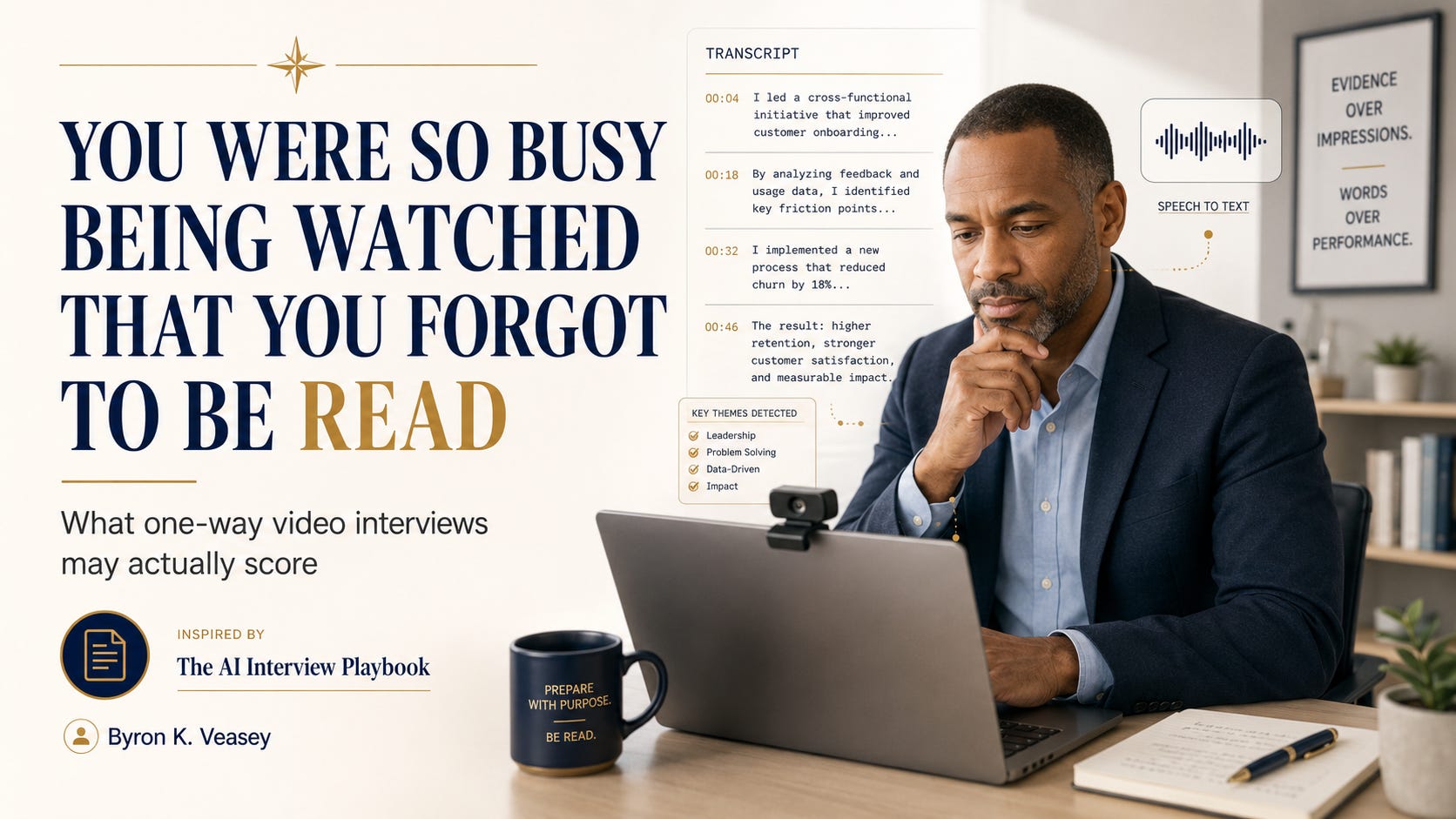
The most important shift in preparing for an AI-scored video interview may have nothing to do with your facial expression, posture, or camera presence.
This article was inspired by Chapter Two, “What the Machine Actually Scores,” from The AI Interview Playbook: Beat Automated Hiring Systems, Pass AI Screening, and Master One-Way Video Interviews by Byron K. Veasey.
The book examines the modern hiring pipeline using vendor documentation, published evidence, candidate rights, practical exercises, and reusable preparation tools. It is available on Amazon.
You finish recording your answer and immediately watch it back.
You study your face.
Did you smile enough at the beginning? Did you look away at the wrong moment? Was your posture too stiff? Did your voice sound confident? Should you record it again?
The second version feels more controlled, but less natural.
So you try a third.
By the fifth attempt, you are no longer answering the interview question. You are performing a version of yourself designed to satisfy a scoring system you have never seen.
This is how many experienced professionals approach a one-way video interview. They assume the software is measuring eye contact, facial expressions, enthusiasm, body language, and tone. They try to manage all of those signals simultaneously while also remembering the substance of their answer.
But what if they are preparing for the wrong test?
Chapter Two of The AI Interview Playbook examines several widely repeated beliefs about automated hiring systems—including what video-interview platforms may actually evaluate. The central lesson is not that these systems are fair, accurate, or harmless.
It is that they are often different from the machines candidates have been taught to fear.
The Rubric You Invented
Most candidates never receive a meaningful explanation of how a recorded interview will be evaluated.
They are given a question, a timer, a camera, and perhaps one or two opportunities to record an answer. They are rarely shown the scoring criteria. They do not know whether the first review will be performed by a recruiter, a hiring manager, software, or some combination of the three.
The information vacuum creates what I call an invented rubric.
An invented rubric is the private scoring model you build from online articles, social-media warnings, vendor marketing, secondhand advice, and your own anxiety.
It tells you:
The machine is reading your face.
Looking away will reduce your score.
Your tone must sound energetic.
Your background may count against you.
A pause will make you appear uncertain.
You must look directly into the camera at all times.
Once you accept that rubric, your preparation changes.
You spend more time rehearsing your expression than sharpening your evidence. You shorten pauses that might have helped you think. You remove details because you are concentrating on delivery. You record the answer repeatedly until the result sounds polished, cautious, and strangely unlike you.
The preparation feels responsible.
But it may be solving a problem that no longer exists—or never existed on the platform you are using.
The Industry Moved, but the Advice Did Not
One of the most persistent stories about AI interviews is that software studies the candidate’s face and scores expressions, body language, vocal tone, and other visual signals.
That belief did not appear from nowhere. Some companies previously promoted visual-analysis capabilities, and those claims traveled widely through journalism, career advice, and social media.
But technology changes faster than career folklore.
According to the vendor materials examined in the book, the company behind one of the best-known video-interview systems announced in 2021 that it would stop using visual analysis in its pre-hire algorithms. Its later documentation stated that scoring depended on what the candidate said rather than facial expression, body language, surroundings, or tone of voice.
Other systems may score a transcript of the candidate’s spoken answer. Some platforms do not require a camera at all.
The industry increasingly moved toward language.
Candidates were still being coached to manage their eyebrows.
That correction needs an important qualification.
Not every platform publishes equally clear documentation. Employers configure systems differently. A human reviewer may still watch your recording and form an ordinary human impression of your presentation. Candidates should not assume that appearance can never influence any decision.
But the practical conclusion is still significant:
On many major platforms, the machine-scored component may be evaluating the words captured in your transcript—not the expression on your face.
Prepare for a reader, not only a camera.
What the System Can Read
A human listener can interpret context that software may miss.
A person may understand what you mean when you say:
“We had a complicated situation across several locations, but eventually we got it under control.”
A scoring system working from a transcript sees only general language.
Compare that with:
“I reduced unplanned downtime from 11% to under 4% across three manufacturing sites within 14 months.”
The second answer gives the transcript something usable:
A specific problem
A measurable result
A defined scale
A timeframe
Evidence of personal contribution
The system does not need to infer what “got it under control” means. The evidence is present in the words.
This is especially important because the book’s analysis shows that language appears throughout the hiring pipeline: structured application answers, extracted résumé fields, screening responses, interview transcripts, and scorecard evidence.
That means the candidate who communicates clearly and specifically has an advantage over the candidate who merely appears polished.
Your objective is not to sound robotic.
It is to make your evidence legible.
Why Experienced Professionals Often Struggle
Experienced professionals usually have more evidence than they know how to deliver.
They have led complicated projects, navigated organizational politics, prevented failures, managed competing priorities, mentored teams, rebuilt processes, and made decisions whose value only became visible months later.
The problem is rarely a lack of substance.
The problem is that depth creates context.
When experienced candidates answer a question, they want to explain why the situation was difficult. They want to distinguish their contribution from the team’s work. They want to acknowledge exceptions, constraints, competing interpretations, and what changed along the way.
Those instincts reflect professional maturity.
But a time-limited, transcript-based system may not wait for the conclusion buried at the end of the explanation.
The candidate may deliver an accurate five-minute account inside a ninety-second recording window. Then, realizing the answer is too long, they overcorrect. They remove the evidence, compress the story into vague language, and submit an answer that sounds less capable than the career behind it.
The answer is not to become less experienced.
It is to change the order.
Lead with the result. Then add the context required to understand it.
Instead of:
“There were several issues involved, and different departments had different priorities…”
Try:
“I reduced the reporting cycle from ten days to three by redesigning the handoff between finance, operations, and data engineering.”
The complexity has not disappeared.
It has simply moved behind the evidence.
Eleven Takes and the Wrong Problem
Chapter Two introduces Nadia, a composite example of an experienced regulatory-affairs leader facing her first one-way video interview.
She recorded her first answer eleven times.
With each attempt, she watched herself for signs that might be interpreted negatively. She became increasingly careful about her expression and delivery. Unfortunately, every attempt also became less specific and less natural.
When she later reviewed the platform’s documentation, she learned that the scoring system focused on what she said rather than how she appeared.
She had spent the evening improving the part the system was not scoring while gradually weakening the transcript it was.
Her conclusion captured the problem:
“I was so busy being watched that I forgot to be read.”
That sentence should change how candidates prepare.
You still want to look professional. You still want appropriate lighting, a clean background, and a comfortable camera position. A person may eventually watch the recording.
But once those basics are handled, stop auditing your face.
Start auditing your evidence.
A Transcript-First Preparation Method
Before your next recorded interview, prepare your answer in five steps.
1. Answer the question in the first sentence
Do not spend twenty seconds approaching the point.
For a question about leadership, begin with the leadership action. For a question about conflict, identify the conflict and your response. For a question about results, state the result.
A strong opening might be:
“I stabilized a delayed data-conversion program and brought it back within six weeks of the revised schedule.”
Now the evaluator knows what the story proves.
2. Use specific nouns
Vague references weaken a transcript.
Replace:
“the system” with the platform or process name
“several locations” with the actual number
“a significant improvement” with the percentage
“various stakeholders” with the functions involved
“a large team” with the team size
Specific nouns reduce the amount of interpretation required.
3. Include real numbers
Numbers create clarity quickly.
They communicate scale, duration, scope, cost, volume, quality, and measurable improvement. They also help differentiate a genuine accomplishment from a generic competency claim.
You do not need a number in every sentence. You need enough evidence to make the contribution concrete.
4. Fix the audio before obsessing over the camera
When speech is converted into text, poor audio can become a content problem.
A weak microphone, excessive echo, background noise, or inconsistent volume may produce a degraded transcript. Every later evaluation then works from an inaccurate representation of your answer.
Test your microphone. Close unnecessary applications. Silence notifications. Record in a room with soft furnishings when possible. Play the audio back without watching the screen.
Can you understand every word?
The book identifies audio quality as one of the highest-return preparation areas because transcription errors can affect everything evaluated afterward.
5. Use the two-take rule
Repeated recording creates diminishing returns.
The first answer may be slightly rough but specific. The second may improve the structure. By the sixth, the candidate is often managing the performance rather than communicating the evidence.
Record two serious takes.
When the second is clearer, use it.
When the second is more polished but less specific, return to the first.
Do not erase the strongest part of your answer in pursuit of a flawless delivery.
Stop Treating Folklore as Documentation
The larger lesson extends beyond video interviews.
Candidates are surrounded by confident claims about hiring technology:
Most résumés are automatically rejected.
Recruiters spend exactly seven seconds on every résumé.
AI can read personality from facial expressions.
The scoring model is completely unknowable.
Adding more keywords is always the answer.
Before allowing one of these claims to change your behavior, ask three questions:
Who published it?
Was it an employer, an independent researcher, a software vendor, a job board, a career coach, or an article repeating another article?
When was it published?
A description of a platform from 2018 may not describe the product currently being used.
What was actually measured?
Did the study examine interviews, clicks, résumé scans, contact rates, entry-level candidates, executive candidates, or vendor customers?
A claim that cannot answer those questions may be folklore, regardless of how frequently it appears.
You Do Not Need to Perform More
This is not reassurance that automated hiring is fair.
It is not.
These systems may be inconsistent, poorly explained, unevenly configured, and difficult for candidates to challenge. Transcript-based scoring can still create disadvantages, especially when audio quality, accents, speech differences, or transcription errors affect the text being evaluated.
Knowing what a system reads does not guarantee that it reads accurately.
But it gives you something more useful than fear.
It gives you a preparation target.
You were told to perform for the camera.
Your real task may be simpler:
Say what happened.
Say what you did.
Say what changed.
Use the number.
Name the scale.
Complete the thought.
Then stop recording.
The machine may not be looking at you in the way you feared.
It may be listening for evidence.
And after twenty or twenty-five years of solving real problems, evidence is the one advantage you already have.
About the Author
Byron K. Veasey is a career strategist and leader in data quality engineering focused on helping professionals navigate job searches, burnout, and career reinvention.
He writes Career Strategies, a Substack newsletter read by over 5,000 professionals navigating today’s evolving job market.
👉 Subscribe to Career Strategies