
You Are Not the Problem. The System Changed.

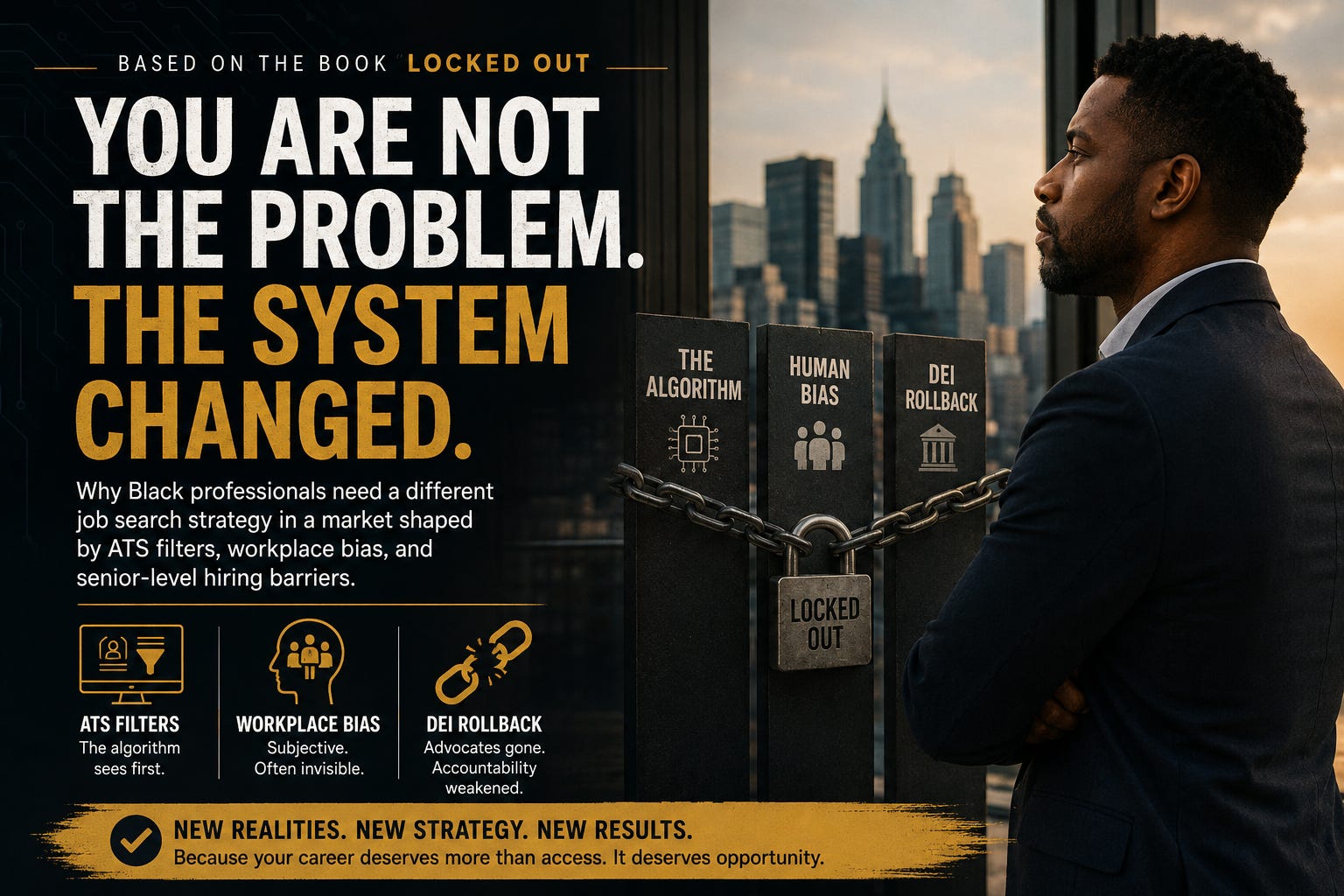
Why Black professionals need a different job search strategy in a market shaped by ATS filters, workplace bias, and senior-level hiring barriers.
There is a particular kind of exhaustion that comes from being qualified and still being ignored.
Not underqualified.
Not unprepared.
Not careless.
Qualified.
Experienced.
Proven.
The kind of professional who has led teams, solved problems, survived restructures, delivered under pressure, mentored others, and built a career that should speak for itself.
And yet, in this market, the resume goes out and nothing comes back.
When Silence Starts to Feel Like a Verdict
The application disappears.
The recruiter goes quiet.
The interview feels positive, then stalls.
The referral produces less than it used to.
The job posting stays up for weeks after you apply.
And somewhere between the tenth silence and the fiftieth, the question starts moving inward.
Maybe my resume is wrong.
Maybe I am too senior.
Maybe I am too expensive.
Maybe my experience is outdated.
Maybe I am not as competitive as I thought.
And for Black professionals, there is often another question underneath all of that.
Maybe it is something I am not supposed to say out loud.
Based on Locked Out
This article is based on my book, Locked Out: A Job Search Strategy Guide for Black Professionals Navigating ATS Filters, Workplace Bias, and Senior-Level Hiring Barriers.
You can find the book here:
https://www.amazon.com/dp/B0H3GZC28C
The book is free online from Amazon until June 22, 2026. Please help show you support by posting an honest review of the book.
I wrote the book because too many Black professionals are being handed job search advice that does not fully name the market they are in.
They are told to apply more.
Rewrite the resume.
Network harder.
Stay positive.
Keep going.
And while some of that advice may be useful, it is incomplete.
Because many Black professionals are not failing because they lack talent, discipline, ambition, or experience.
They are navigating a system that has changed faster than the advice has.
The Old Advice Does Not Explain the New Market
The old job search advice assumes the main problem is competition.
But the modern job search is not just competitive.
It is filtered.
It is automated.
It is overloaded.
It is biased.
And for Black mid-career and senior-level professionals, those forces do not operate separately.
They stack.
That is what I call the Triple Barrier.
Barrier One: The Algorithm
The first barrier is the algorithm.
Most large companies are not reading your resume first. Software is. Applicant Tracking Systems scan for keywords, titles, credentials, formatting, and match signals before a human being ever sees your story.
That creates a problem for everyone.
But it creates a deeper problem when the systems are built on historical hiring patterns that were never neutral.
If past hiring favored certain schools, titles, companies, career paths, and networks, then the technology built on top of that history can quietly reproduce those patterns at scale.
The machine may not know your race.
But it can still learn from a biased past.
It can still reward familiar patterns.
It can still penalize unconventional paths.
It can still filter out qualified people before anyone has a chance to recognize their value.
That is the first barrier.
Barrier Two: Human Bias
The second barrier is human bias.
Bias in hiring does not always announce itself.
It does not always sound like open discrimination.
Often, it sounds softer.
“Not quite the right fit.”
“We had a very competitive pool.”
“We decided to move in another direction.”
“We are looking for someone who feels more aligned.”
“We liked the candidate, but something was missing.”
That “something” is often where bias hides.
Especially at senior levels.
The higher you go, the more subjective the process becomes.
People are no longer just evaluating technical skills. They are evaluating leadership presence, culture fit, executive communication, confidence, influence, and trust.
Those are not neutral categories.
They are shaped by what the evaluator is used to seeing.
And because Black professionals remain underrepresented in many senior leadership spaces, many hiring teams have less experience recognizing Black excellence at those levels.
That lack of familiarity can become hesitation.
Hesitation can become doubt.
Doubt can become rejection.
And rejection can be explained afterward with language that sounds professional but reveals very little.
That is the second barrier.
Barrier Three: The DEI Rollback
The third barrier is the rollback of DEI infrastructure.
After 2020, many companies made public commitments to diversity, equity, and inclusion. Some of those commitments were performative. But some created real internal structures.
Chief Diversity Officers.
Employee resource groups.
HBCU recruiting pipelines.
Diversity recruiting partnerships.
Mentorship programs.
Internal advocates.
Accountability systems.
Those structures were not perfect. But they mattered.
They created people inside organizations whose job was to notice when qualified Black candidates were not advancing.
They created someone who could ask why every finalist looked the same.
They created someone who could challenge vague “culture fit” feedback.
They created recruiting channels that reached talent outside the usual networks.
Now, much of that infrastructure has been weakened, reduced, defunded, or quietly removed.
And when those advocates disappear, the algorithm and human bias do not become less powerful.
They become less checked.
That is the third barrier.
The Triple Barrier
Algorithmic filtering.
Human bias.
DEI rollback.
That is the Triple Barrier.
And this is why so many Black professionals are exhausted.
They are trying to solve a structural problem with personal shame.
They are trying to fix their confidence when the real issue may be visibility.
They are trying to rewrite their resume again when the deeper problem may be that the system never parsed it correctly.
They are trying to be more likeable in interviews when the real issue may be that they need to make their proof impossible to dismiss.
They are trying to revive old networks when the internal advocates who once helped move candidates through the process may no longer be there.
This Is Not an Excuse. It Is a Diagnosis.
This does not mean there is nothing you can do.
That is not the point.
The point is the opposite.
There are things you can do.
But you have to stop solving the wrong problem.
If your applications are disappearing before you get a response, that may be an ATS problem.
If you are getting recruiter screens but not advancing, that may be an interview framing or bias-navigation problem.
If you are making it to final rounds and stalling, that may be a senior-level trust, culture fit, or moving-goalpost problem.
If your network is not producing the way it used to, that may be a visibility and advocacy problem.
Each problem requires a different strategy.
That is why diagnosis matters.
A Modern Job Search Is About Finding the Breakdown
A modern job search is not just about effort.
It is about knowing where the breakdown is happening.
You do not respond to an ATS filter the same way you respond to an interview stall.
You do not respond to network silence the same way you respond to salary compression.
You do not respond to bias by pretending it does not exist.
And you do not respond to silence by assuming the market has delivered a fair verdict on your value.
The silence is not always a verdict.
Sometimes it is a system failure.
Sometimes it is a filter.
Sometimes it is bias.
Sometimes it is a company with no real hiring urgency.
Sometimes it is a role that was never truly open in the first place.
But when you treat every silence as proof that something is wrong with you, you give the system more power than it deserves.
Stop Carrying What Does Not Belong to You
Some things are yours to own.
Your resume clarity is yours.
Your LinkedIn positioning is yours.
Your interview preparation is yours.
Your networking discipline is yours.
Your salary research is yours.
Your visibility strategy is yours.
But the whole burden is not yours.
You did not create algorithmic bias.
You did not create vague culture-fit evaluations.
You did not create the rollback of internal advocacy structures.
You did not create a hiring market where qualified professionals are filtered, delayed, ghosted, and quietly dismissed without explanation.
You are responsible for your strategy.
You are not responsible for pretending the system is fair.
The Shift: From Self-Blame to Strategic Clarity
This is the shift Black professionals need right now.
Not from effort to excuse.
From self-blame to strategic clarity.
Not from ambition to resignation.
From emotional exhaustion to focused action.
Not from confidence to bitterness.
From misplaced shame to a better diagnosis.
Because you are not the problem.
But you do need a strategy built for the market you are actually in.
A strategy that understands ATS filters.
A strategy that prepares for bias without being controlled by it.
A strategy that builds visibility before you need it.
A strategy that uses networks as infrastructure, not afterthought.
A strategy that helps you document your value, communicate your proof, and stop depending on broken systems to interpret your career correctly.
You Are Still Qualified
The job search can make talented people forget what they have already survived.
It can make leaders doubt their leadership.
It can make experienced professionals shrink their story.
It can make people who have spent years proving themselves feel like they are starting from zero.
But you are not starting from zero.
You are starting from experience.
You are starting from proof.
You are starting from a career that already contains evidence.
Now the work is to translate that evidence for a market that does not always know how to see you.
That is not easy.
But it is possible.
And it begins with one truth:
You are not the problem.
The system changed.
Now your strategy has to change with it.
About the Author
Byron K. Veasey is a career strategist and leader in data quality engineering focused on helping professionals navigate job searches, burnout, and career reinvention.
He writes Career Strategies, a Substack newsletter read by over 4,900 professionals navigating today’s evolving job market.