
You Are Not the Problem. The System Changed.
How Black mid-career professionals can name the barriers, read the silence, and rebuild their strategy for a job market that was not designed with them in mind.

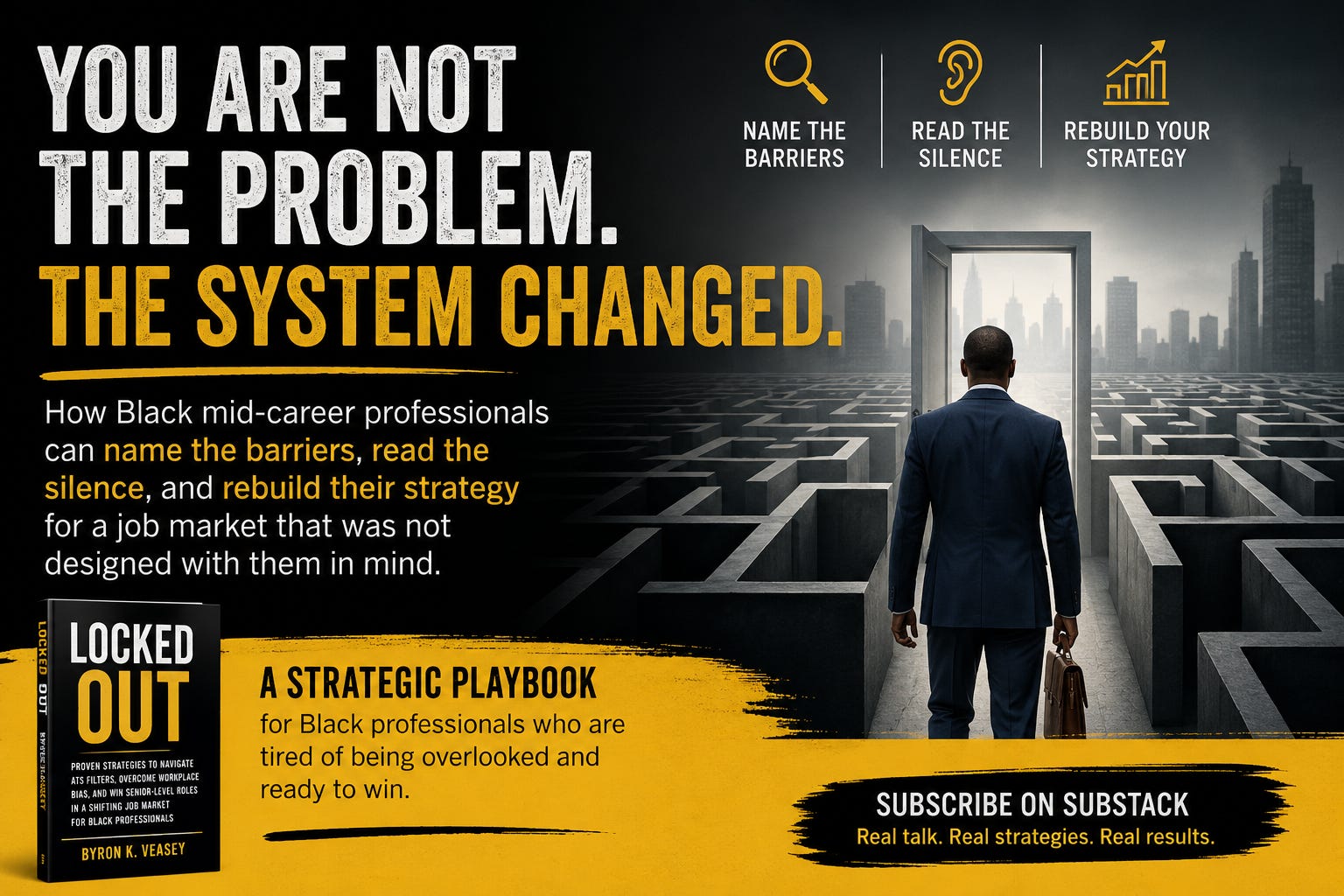
This article is from the book Locked Out: Proven Strategies to Navigate ATS Filters, Overcome Workplace Bias, and Win Senior-Level Roles in a Shifting Job Market for Black Professionals.
There is a kind of silence in the job search that begins to bother you.
Not rejection.
Not feedback.
Not even a clear “no.”
Just nothing.
You apply for a role that looks like a strong match. Nothing.
You have the recruiter screen, and the conversation feels positive. Nothing.
You make it to the second or third round, start thinking maybe this one is different, and then the process slows down, shifts, or disappears.
At first, you try to stay reasonable.
Maybe they are busy.
Maybe the role changed.
Maybe they went with an internal candidate.
Maybe budgets froze.
But after a while, the silence starts talking.
And what it says is not kind.
Maybe I am not as competitive as I thought.
Maybe my experience is outdated.
Maybe I am too senior.
Maybe I am too expensive.
Maybe I am doing something wrong.
For Black mid-career professionals, that silence can carry an even heavier meaning.
Because after years of building experience, leading teams, solving problems, delivering results, and proving yourself in rooms that were not always designed with you in mind, the question is not simply:
Why am I not hearing back?
The deeper question becomes:
Is the market failing to see me, or is it telling me something true about my value?
That is the question Locked Out was written to answer.
And the first answer is this:
You are not the problem.
But you may be trying to navigate a hiring system that was never designed to fully recognize your value.
The Job Search Is Not Just Hard. It Is Filtered.
Most job search advice still talks as if the market is simple.
Fix your resume.
Apply more.
Network harder.
Practice your interview answers.
Stay encouraged.
And listen, some of that advice is useful. A better resume matters. A stronger network matters. Interview preparation matters.
But that advice does not tell the whole story.
Because today’s job search is not just competitive.
It is filtered.
Before a hiring manager ever understands your background, before a recruiter fully reads your experience, before anyone hears how you think, lead, solve problems, or create value, your candidacy may already have been reduced to keywords, software settings, scoring logic, assumptions, and bias.
That matters for everyone.
But it matters especially for Black professionals who have been in the workforce for ten, fifteen, or twenty years and are trying to compete for senior-level roles in a market that has become colder, quieter, and more automated.
The system is not reading your career the way a person would.
It is scanning it.
And when a system scans instead of understands, a lot of qualified people disappear.
The Triple Barrier Black Professionals Are Navigating
In Locked Out, I talk about what I call the Triple Barrier.
Because many Black mid-career professionals are not facing just one obstacle in the job search.
They are facing three at the same time.
The first barrier is the algorithm.
Applicant Tracking Systems screen resumes before human beings ever see them. These systems look for keywords, titles, credentials, formatting, and direct alignment with the job description.
They do not understand nuance.
They do not understand that your title was smaller than your actual responsibility.
They do not understand that you were already doing director-level work before the company gave you the title.
They do not understand the politics behind why your career path may not look as linear as someone else’s.
They only understand what they can parse.
And if your resume is not built for that reality, your experience may never reach a human being.
The second barrier is human bias.
This does not mean every recruiter or hiring manager is consciously trying to exclude anyone. That is not how most bias works.
Bias often sounds polite.
It sounds like:
“Not quite the right fit.”
“We liked them, but something was missing.”
“We’re looking for stronger executive presence.”
“The team just didn’t feel alignment.”
At senior levels, this gets even more complicated. The higher you move in an organization, the fewer Black professionals are represented in those rooms. That means many hiring teams have limited experience evaluating Black candidates for senior-level leadership roles.
Sometimes unfamiliarity becomes discomfort.
Discomfort becomes doubt.
And doubt becomes a rejection that sounds neutral.
The third barrier is the DEI rollback.
After 2020, many companies built systems that created at least some level of accountability. Diversity leaders. Employee resource groups. HBCU partnerships. Internal advocates. Recruiting pipelines. People whose job was to notice when qualified Black candidates were being overlooked.
A lot of that infrastructure has now been reduced, renamed, defunded, or removed altogether.
And that matters.
Because when the people whose job it was to question the process are gone, the process does not automatically become fairer.
It just becomes less visible.
The algorithm still filters.
Human bias still operates.
But now there may be fewer people inside the company asking:
Why did this candidate fall out of the process?
That is the Triple Barrier.
And when those three barriers operate at the same time, the danger is that you start blaming yourself for what the system is doing.
The Silence Has a Pattern
One of the things I want Black professionals to understand is that silence is not always random.
Sometimes it has a pattern.
And once you can see the pattern, you can stop treating every unanswered application as a personal verdict.
In the book, I describe four kinds of silence.
The first is the Black Hole.
This is when you apply and never hear anything back. No acknowledgment. No recruiter. No rejection. Just nothing.
That often points to an ATS problem. Your resume may not be making it through the system.
The second is the First-Round Freeze.
This is when you get the recruiter screen or first interview, the conversation seems to go well, and then everything stops.
That may mean your value is not being framed clearly enough. It may mean the interviewer did not understand your level. It may also mean bias entered the process early, especially if the evaluation was vague or unstructured.
The third is the Late-Stage Stall.
This is when you make it deep into the process, maybe even to the final round, and then the timeline keeps shifting. Suddenly there are delays. Suddenly there are new decision-makers. Suddenly the role changes.
That can be one of the most painful patterns because you have already invested time, energy, preparation, and hope.
The fourth is the Network Fade.
This happens when even your network is not producing the way it used to. People are slower to respond. Referrals are weaker. Introductions do not move. Former advocates have been laid off, reassigned, or gone quiet.
That does not mean your network has no value.
It means you may need to build a different kind of network.
One rooted in relationships, community, and visibility that does not depend entirely on formal corporate channels.
Stop Treating Every Silence Like a Personal Failure
This is the part I really want people to sit with.
When you are in a long job search, it is easy to start treating silence as proof.
Proof that you aimed too high.
Proof that your resume is weak.
Proof that your career has lost value.
Proof that the market has moved on without you.
But silence is not always proof.
Sometimes silence means your resume never reached a human being.
Sometimes it means the role was never truly open.
Sometimes it means the hiring team did not know how to evaluate your background.
Sometimes it means bias showed up under the language of “fit.”
Sometimes it means there was no advocate in the room.
And sometimes it means the company was not the right place for you in the first place.
That does not mean you ignore the silence.
It means you diagnose it.
You look for the pattern.
You ask better questions.
Where am I falling out of the process?
Am I getting no responses at all?
Am I getting first rounds but no second rounds?
Am I making it deep into interviews but not receiving offers?
Is my network no longer producing movement?
Each answer points to a different strategy.
That is where your power begins to return.
Your Resume Has to Work for the Machine and the Human
A lot of experienced professionals have strong careers and weak resumes.
That may sound harsh, but it is true.
You can have fifteen or twenty years of meaningful work behind you and still have a resume that does not survive an ATS scan.
That does not mean your experience is weak.
It may mean the document is not doing its job.
In this market, your resume has to work for two audiences.
First, it has to survive the machine.
That means clean formatting, simple structure, clear headings, relevant keywords, and language that connects directly to the roles you are targeting.
Second, it has to persuade the human.
That means your resume cannot just list responsibilities. It has to show impact.
What did you improve?
What did you reduce?
What did you build?
What did you lead?
What changed because of your work?
Too many professionals are still writing resumes like job descriptions.
But a resume is not a job description.
It is a proof document.
It has to make your value easy to see quickly.
Especially when the market is crowded.
Especially when attention spans are short.
Especially when the system is already looking for reasons to move on.
Do Not Shrink in the Interview
The interview room creates another challenge.
Many Black professionals have been taught, directly or indirectly, to manage how they show up.
Be confident, but not arrogant.
Be direct, but not aggressive.
Be warm, but not too familiar.
Be accomplished, but not boastful.
Be strong, but not threatening.
That is exhausting.
And it is real.
But the answer is not to shrink.
The answer is to prepare so clearly that your competence becomes difficult to dismiss.
That means leading with evidence.
Not vague confidence.
Evidence.
Scope.
Numbers.
Results.
Complexity.
Leadership.
Business impact.
Risk reduced.
Revenue protected.
Quality improved.
Teams developed.
Systems rebuilt.
When you bring proof into the room, you give the interviewer less room to rely on vague impressions.
You are not trying to perform your way into approval.
You are trying to make your value undeniable.
That is a different kind of interview strategy.
And for many professionals, it requires unlearning the habit of understatement.
Your Network Has to Be More Than an Emergency Tool
A lot of people only think about networking when they need a job.
That is understandable.
But it is also too late.
Your network is not just a list of people who can help you when you are in trouble.
Your network is career infrastructure.
It is the set of relationships, communities, and professional spaces where your value is known before you need someone to vouch for it.
For Black mid-career professionals, this matters deeply.
Because formal hiring systems often filter before they understand. A strong network can help you get around cold application channels and reach people who can interpret your experience correctly.
That may include former colleagues.
Black professional associations.
Industry communities.
Conference connections.
Alumni groups.
Mentors.
Sponsors.
Peers who know your work.
People who have seen you lead.
The goal is not to ask everyone for a job.
The goal is to become visible in the right rooms before the role is even posted.
That is the shift.
Do not just network for openings.
Network for recognition.
Do Not Let Gratitude Replace Negotiation
There is another moment in the job search that does not get talked about enough.
The offer.
When you have been searching for months, the first offer can feel like relief.
Maybe even rescue.
And because of that, it can be tempting to accept quickly and quietly.
I understand that.
But here is the danger: if your previous salary was already shaped by under-leveling, bias, or years of being paid less than your market value, then using that number as your anchor can carry the damage forward.
That is why negotiation has to be grounded in market data.
Not ego.
Not emotion.
Not desperation.
Data.
What does the market pay for this role?
What does the scope require?
What level are you actually operating at?
What value are you bringing?
What would it cost the company not to have someone who can do what you do?
Negotiation is not being difficult.
Negotiation is refusing to let an uneven system quietly define your worth for the next chapter.
The Goal Is Not Just to Get Hired
Of course, when you are in the middle of the search, the immediate goal is obvious.
You want the job.
You want the offer.
You want the income.
You want the stability.
You want the waiting to end.
But the deeper goal is bigger than that.
The deeper goal is to build a career that is harder to erase.
That means building proof outside of your employer.
It means maintaining relationships that survive layoffs.
It means creating visibility that does not disappear when your badge stops working.
It means keeping your skills current.
It means knowing how to tell the story of your value without needing a company title to validate it.
That is what I mean by career architecture.
A job is important.
But a job is not the whole structure.
You need something underneath it.
Something that belongs to you.
Something that cannot be taken away by a reorganization, a budget freeze, a bad manager, or an algorithmic rejection.
You Are Not Behind. You Are Being Asked to See Clearly.
The hardest part of being locked out is not just the applications.
It is what the silence does to your identity.
You start questioning things you used to know.
Your value.
Your relevance.
Your confidence.
Your place in the market.
Your ability to recover.
But a broken hiring process is not an accurate measurement of your worth.
An ATS rejection is not a full evaluation of your career.
A vague “not a fit” is not a complete truth.
A stalled interview process is not proof that you were not enough.
You may need a sharper strategy.
You may need a stronger resume.
You may need a more intentional network.
You may need to practice telling your story with more force and less apology.
You may need to walk away from companies that reveal their culture before you ever accept the offer.
But you do not need to confuse being filtered out with being unqualified.
That is the message of Locked Out.
Name the barrier.
Read the pattern.
Rebuild your signal.
Lead with proof.
Negotiate with data.
Build for the long game.
And above all, remember this:
You are not the problem.
But you do need a strategy built for the market you are actually in.
About the Author
Byron K. Veasey is a career strategist and data quality engineering leader focused on helping professionals navigate job searches, workplace disruption, career reinvention, and the emotional weight of being overlooked in a changing market.
He writes Career Strategies, a Substack newsletter for professionals navigating today’s evolving job market.
👉 Subscribe to Career Strategies
🎙️ Listen to the Podcasts
👉 Career Strategies Amazon Books
👉 eBook Discount Store