
Why Strong Professionals Still Get Overlooked—The Evidence Problem

You may have the experience employers need.
But that does not mean they can see it.
You have led teams.
Solved complicated problems.
Protected revenue.
Reduced risk.
Improved systems.
Managed difficult transitions.
Built processes that continued working long after you moved on.
Yet when you apply for jobs, the response does not match the value you know you can provide.
Your résumé is accurate.
Your LinkedIn profile is complete.
Your career history is substantial.
But the interviews do not come.
Or they come inconsistently.
Or you reach the interview and struggle to explain twenty years of experience in a way that feels concise, current, and directly connected to the employer’s problem.
Eventually, you begin asking the wrong question:
How can someone with this much experience still be overlooked?
The answer is uncomfortable but useful:
Employers do not hire experience in the abstract.
They hire evidence they can recognize quickly.
And many strong professionals are presenting history when the market is searching for proof.
Your résumé may be accurate and still not be persuasive
Most experienced professionals do not have an experience problem.
They have an evidence problem.
Their résumés contain years of responsibilities, job titles, systems, projects, and leadership assignments.
Everything may be factually correct.
But accuracy is not the same as clarity.
And clarity is not the same as persuasion.
Consider the language that appears on many senior-level résumés:
Responsible for managing cross-functional teams.
Led strategic initiatives.
Oversaw operational performance.
Partnered with senior stakeholders.
Supported organizational transformation.
Managed complex projects.
These statements describe work.
They do not prove value.
They tell the reader what category of responsibility you occupied, but they do not show what changed because you were there.
How large was the team?
What was at risk?
What problem existed before you became involved?
What decision did you make?
What resistance did you overcome?
What improved?
How much time, money, risk, rework, or confusion did you eliminate?
What became possible because of your leadership?
Without those details, your experience remains difficult to evaluate.
The employer is not necessarily questioning whether you worked hard.
The employer is trying to determine whether your past performance predicts success in this role.
That prediction requires evidence.
Responsibility is not the same as impact
Job descriptions are written around responsibilities.
Hiring decisions are made around outcomes.
That distinction is where many experienced candidates lose signal.
You may write:
Managed a data quality team responsible for enterprise testing.
But the stronger evidence may be:
Led a nine-person data quality engineering team that increased automated testing coverage, reduced critical data leakage, and moved defect detection earlier in the development process.
The first statement tells the employer what you were assigned.
The second shows what you changed.
You may write:
Worked with business and technology stakeholders to improve reporting.
But the real evidence may be:
Aligned business, engineering, and reporting teams around shared data definitions, reducing reconciliation disputes and improving confidence in executive reporting.
You may write:
Responsible for process improvement.
But the evidence may be:
Redesigned a manual review process that shortened delivery time, reduced repeated errors, and gave leadership earlier visibility into operational risk.
Responsibilities explain your position.
Outcomes explain your value.
When a résumé contains mostly responsibility language, the reader must do too much interpretation.
They must imagine the scale.
Infer the difficulty.
Estimate the impact.
And connect your experience to the role themselves.
Most recruiters and hiring managers will not do that work for you.
They are reviewing too many candidates, moving too quickly, and searching for reasons to reduce uncertainty.
Your evidence has to make the connection easier.
Senior professionals often hide their strongest work
There is a strange pattern among experienced professionals.
The more they have accomplished, the more likely they are to describe those accomplishments vaguely.
Part of this comes from familiarity.
You have done the work for so long that it no longer feels exceptional.
You forget that not everyone can walk into a disorganized function, identify the structural problem, align competing stakeholders, and build something that works.
You call it doing your job.
The employer may call it the exact capability they have been unable to find.
Part of it comes from humility.
You do not want to exaggerate.
You do not want to claim work that belonged to the team.
You do not want to sound self-promotional.
So you remove the details that would help someone understand your contribution.
You replace:
Designed the operating model, secured stakeholder agreement, and led implementation across three teams.
With:
Participated in a cross-functional transformation initiative.
The second statement may feel safer.
It is also much weaker.
There is a difference between exaggerating and documenting.
You do not need to claim every result as yours alone.
You can accurately explain your role.
You can say:
Led.
Designed.
Recommended.
Influenced.
Coordinated.
Built.
Negotiated.
Implemented.
Recovered.
Reduced.
Stabilized.
These words do not diminish the contributions of others.
They clarify yours.
Humility should shape how you describe your achievements.
It should not erase them.
Breadth can make you harder to understand
Experienced professionals often bring significant range.
You may have worked across operations, technology, strategy, governance, transformation, leadership, and delivery.
That range may be one of your greatest advantages.
It can also weaken your job-search signal.
When every part of your career receives equal emphasis, employers may struggle to understand what you want to do next.
A recruiter sees multiple possible identities:
Project leader.
Operations manager.
Technology professional.
Strategist.
Consultant.
Transformation leader.
People manager.
Subject-matter expert.
All may be true.
But the hiring process rarely rewards the candidate who could do many different jobs.
It rewards the candidate who appears clearly aligned with this job.
That means you must make a decision before the employer makes one for you.
What problem do you want to be hired to solve now?
Which part of your experience provides the strongest evidence?
What should the employer understand about you within the first few seconds?
Breadth becomes valuable after relevance has been established.
Before that, breadth can look like uncertainty.
This is why applying broadly often creates weaker results.
Each additional target requires different evidence.
A résumé designed for five unrelated job families usually communicates none of them strongly.
The problem is not that you are capable of too much.
The problem is that the market cannot tell which capability it should evaluate first.
Experience does not explain itself
One of the most costly assumptions experienced professionals make is that employers will understand the significance of their background.
They may assume a recognizable company name will carry the meaning.
Or that a senior title will explain the level of responsibility.
Or that twenty years in an industry will automatically establish credibility.
But employers are not hiring your past.
They are evaluating whether your past is relevant to their present.
A project you completed ten years ago may still be highly valuable.
But you must translate it.
What does that experience prove today?
Does it show that you can lead through uncertainty?
Build governance where none existed?
Reduce operational risk?
Improve quality at scale?
Influence leaders without direct authority?
Recover a failing initiative?
Modernize an outdated process?
Stabilize a team during disruption?
The date of the accomplishment matters less than the capability it proves.
But that connection must be made visible.
Otherwise, the employer may see old technology, an unfamiliar organizational structure, or experience that appears disconnected from the current role.
Your history becomes relevant when you explain what it demonstrates.
That is the work of translation.
Your résumé is not the first document you need
When the job search slows down, most people immediately rewrite their résumé.
Then they rewrite it again.
They change the summary.
Move sections around.
Replace verbs.
Add keywords.
Remove older experience.
Adjust the formatting.
A few weeks later, they create another version.
But the résumé is not always the real problem.
Sometimes the problem is that the source material underneath it is incomplete.
You are trying to improve the document before fully documenting the evidence.
A stronger process begins with an Evidence Bank.
An Evidence Bank is a private collection of accomplishments, decisions, challenges, results, examples, and career stories.
It is not written for a recruiter.
It does not need perfect formatting.
It does not need to fit on two pages.
Its purpose is to recover the proof that has become buried inside your career.
For each significant example, document:
What was happening?
What problem needed to be solved?
What was at risk?
What obstacles existed?
What role did you play?
What action did you take?
What changed?
What result can be measured?
What capability does the example demonstrate?
Where could that evidence be relevant now?
This process often reveals something important.
Your strongest proof may not come from your most recent job.
It may come from the crisis you stabilized.
The process you created from nothing.
The employee you developed.
The conflict you resolved.
The failure you diagnosed before it became expensive.
The decision you influenced when you did not have formal authority.
The system you simplified.
The risk you prevented.
These examples are easy to forget because they became part of the ordinary flow of work.
But they are exactly what employers need in order to understand how you operate.
Build the evidence before selecting the wording
The traditional résumé process starts with the page.
The stronger process starts with the proof.
First, collect the evidence.
Then identify the target role.
Then select the examples that are most relevant to that role.
Then translate those examples into résumé bullets, LinkedIn content, networking messages, and interview stories.
The order matters.
When you begin with the résumé, you tend to write from memory under pressure.
You remember job duties.
You remember project names.
You remember what the department was responsible for.
You may not remember the moments that demonstrate judgment, leadership, recovery, influence, or measurable impact.
The Evidence Bank gives you a larger source of truth.
Your résumé becomes a selection from that source.
Your LinkedIn profile becomes another selection.
Your interview answers become another.
Your networking conversations become another.
You are no longer inventing a different professional identity for every channel.
You are drawing from a consistent body of proof.
That consistency strengthens your signal.
Metrics matter, but numbers are not the only evidence
Candidates are frequently told that every résumé bullet must include a number.
Numbers are useful.
They establish scale.
They show movement.
They help the reader understand significance.
Revenue increased by 18 percent.
Delivery time decreased by six weeks.
Defects fell from 15 percent to less than 3 percent.
Automation coverage reached 85 percent.
The team expanded from four people to twelve.
Those details are powerful.
But not every valuable result fits neatly into a percentage.
You may have repaired a damaged relationship between two departments.
Created clarity in a poorly defined function.
Improved confidence in leadership reporting.
Prevented a regulatory problem.
Retained key employees during uncertainty.
Built a decision framework that reduced repeated conflict.
Identified a risk before the organization could measure the cost.
These results still require specificity.
What changed after your intervention?
What became faster, safer, clearer, more stable, or more reliable?
Who was affected?
What decision became possible?
What recurring problem stopped happening?
Evidence is broader than metrics.
But it must still describe a change.
“Improved communication” is vague.
“Established a weekly decision forum that clarified ownership and prevented unresolved issues from moving into production” is evidence.
The difference is not the presence of a percentage.
It is the presence of a visible before and after.
Your evidence should match the employer’s problem
A strong accomplishment is not automatically the right accomplishment.
Relevance matters.
Imagine that you have ten excellent career stories.
One shows cost reduction.
One shows team development.
One shows crisis recovery.
One shows technical depth.
One shows stakeholder influence.
One shows process design.
One shows revenue growth.
One shows regulatory discipline.
One shows organizational transformation.
One shows customer retention.
All ten may be impressive.
But the employer may be hiring because one specific problem has become urgent.
Perhaps the team cannot deliver consistently.
Perhaps leaders do not trust the data.
Perhaps a transformation has stalled.
Perhaps the company is growing faster than its processes.
Perhaps departments are working in conflict.
Perhaps the previous leader created instability.
Your application should not present every form of value you have ever created.
It should emphasize the evidence that reduces uncertainty around the employer’s most immediate concern.
This is why job descriptions must be read as problem statements, not just qualification lists.
What appears to be broken?
What outcome is being requested repeatedly?
What language signals urgency?
What risk is the organization trying to reduce?
What would success look like six months after someone is hired?
Your evidence becomes stronger when it answers those questions.
The interview is an evidence conversation
Many candidates enter interviews prepared to describe themselves.
They explain their career path.
Their leadership style.
Their strengths.
Their responsibilities.
Their interest in the role.
But employers are not only listening for description.
They are looking for evidence.
Can you show that you have solved something similar?
Can you explain how you think?
Can you separate your contribution from the team’s?
Can you describe a difficult decision?
Can you acknowledge what did not work?
Can you connect your past experience to the employer’s current situation?
A strong interview answer does not need to be dramatic.
It needs structure.
Here was the situation.
Here was the risk.
Here was my responsibility.
Here was the decision I made.
Here was how I involved others.
Here was the outcome.
Here was what I learned.
Here is why that experience matters for this role.
When your Evidence Bank is complete, interview preparation changes.
You are no longer trying to invent examples the night before.
You are selecting from documented proof.
You can choose stories that demonstrate different capabilities.
Leadership.
Adaptability.
Influence.
Technical judgment.
Conflict management.
Strategic thinking.
Execution.
Recovery.
You also become less likely to ramble.
Evidence gives the answer a destination.
Stop asking the employer to discover your value
Many experienced professionals are waiting for the right employer to recognize what they bring.
They believe that once a hiring manager takes the time to understand their background, the value will become obvious.
That may be true.
But the modern hiring system often does not provide that time.
Your résumé may receive seconds.
Your LinkedIn profile may be skimmed.
Your message may appear between dozens of others.
Your interview answer may be evaluated against a scorecard you never see.
You cannot control every decision.
But you can reduce the amount of interpretation required.
Do not make the employer discover the scale of your work.
State it.
Do not make the recruiter determine what role you want.
Clarify it.
Do not make the hiring manager connect an old accomplishment to a current problem.
Translate it.
Do not list every responsibility and hope one feels relevant.
Select the evidence deliberately.
Your value should not be hidden inside your career history.
It should be visible in the first layer of your communication.
What has to change now
Before rewriting another résumé bullet, pause.
Build the source material first.
Choose five to ten meaningful accomplishments from your career.
Do not begin by asking which ones sound impressive.
Ask which ones reveal how you create value.
Document the situation.
The problem.
The stakes.
Your actions.
The result.
The capability demonstrated.
Then examine the roles you are pursuing.
What problems appear repeatedly?
Which examples provide the strongest evidence that you can solve them?
Where is your current résumé describing responsibility instead of impact?
Where is your LinkedIn profile presenting breadth without direction?
Where are your interview answers explaining what happened without clarifying what you did?
Where are you assuming that the employer understands the significance of your experience?
These are fixable problems.
You do not need to manufacture a more impressive career.
You need to recover the evidence already inside the one you have built.
Why this matters now
The modern hiring process is designed to reduce uncertainty quickly.
Automated systems search for recognizable language.
Recruiters search for alignment.
Hiring managers search for evidence that a candidate can address an immediate problem.
Interview teams search for consistent examples across multiple conversations.
Vague experience creates uncertainty.
Clear evidence reduces it.
This does not mean you should turn yourself into a collection of statistics.
It means your career story needs proof.
The employer should be able to see:
What you changed.
How you think.
What level you operated at.
What kind of problems you solve.
What results followed.
And why that evidence matters now.
Your experience is not too old.
It is not automatically too broad.
It is not necessarily too senior.
But it may be too difficult to interpret.
Translation changes that.
Evidence changes that.
Clarity changes that.
Why I wrote this book
I wrote Nothing You’ve Tried Is Working for experienced professionals who know they have value but are struggling to make that value visible in today’s hiring system.
The person whose résumé contains years of responsibility but does not generate enough interviews.
The person who has done meaningful work but struggles to remember measurable examples.
The person whose broad experience has created confusion instead of opportunity.
The person who keeps rewriting the same document without improving the evidence underneath it.
The book includes a practical Evidence Bank process because your résumé should not be built from scattered memory.
Your LinkedIn profile should not be built from generic claims.
Your interviews should not depend on examples you try to reconstruct under pressure.
You need a source of proof.
A structured record of the problems you have solved, the decisions you have made, the outcomes you have created, and the capabilities those examples demonstrate.
Once that evidence exists, everything else becomes easier to build.
Your résumé becomes more relevant.
Your LinkedIn profile becomes more credible.
Your outreach becomes more focused.
Your interview answers become clearer.
And your experience becomes easier for the market to understand.
A free copy through July 17
From July 13 through July 17, 2026, the Kindle edition of Nothing You’ve Tried Is Working is available as a free download on Amazon.
Download the book and begin with the Evidence Bank module.
Do not start by changing fonts.
Do not begin by rewriting your summary for the tenth time.
Do not remove years of experience simply because you are afraid an employer may misread them.
Recover the proof first.
Document what you changed.
Identify the problems you are best equipped to solve.
Then build your résumé, LinkedIn profile, outreach, and interview strategy around evidence the market can recognize.
You are not being overlooked because your career contains nothing valuable.
You may be overlooked because the most valuable parts are still buried.
Your experience is the material.
Evidence is what makes it visible.
Download the Kindle edition free through July 17:
https://www.amazon.com/dp/B0GMP9DD3B
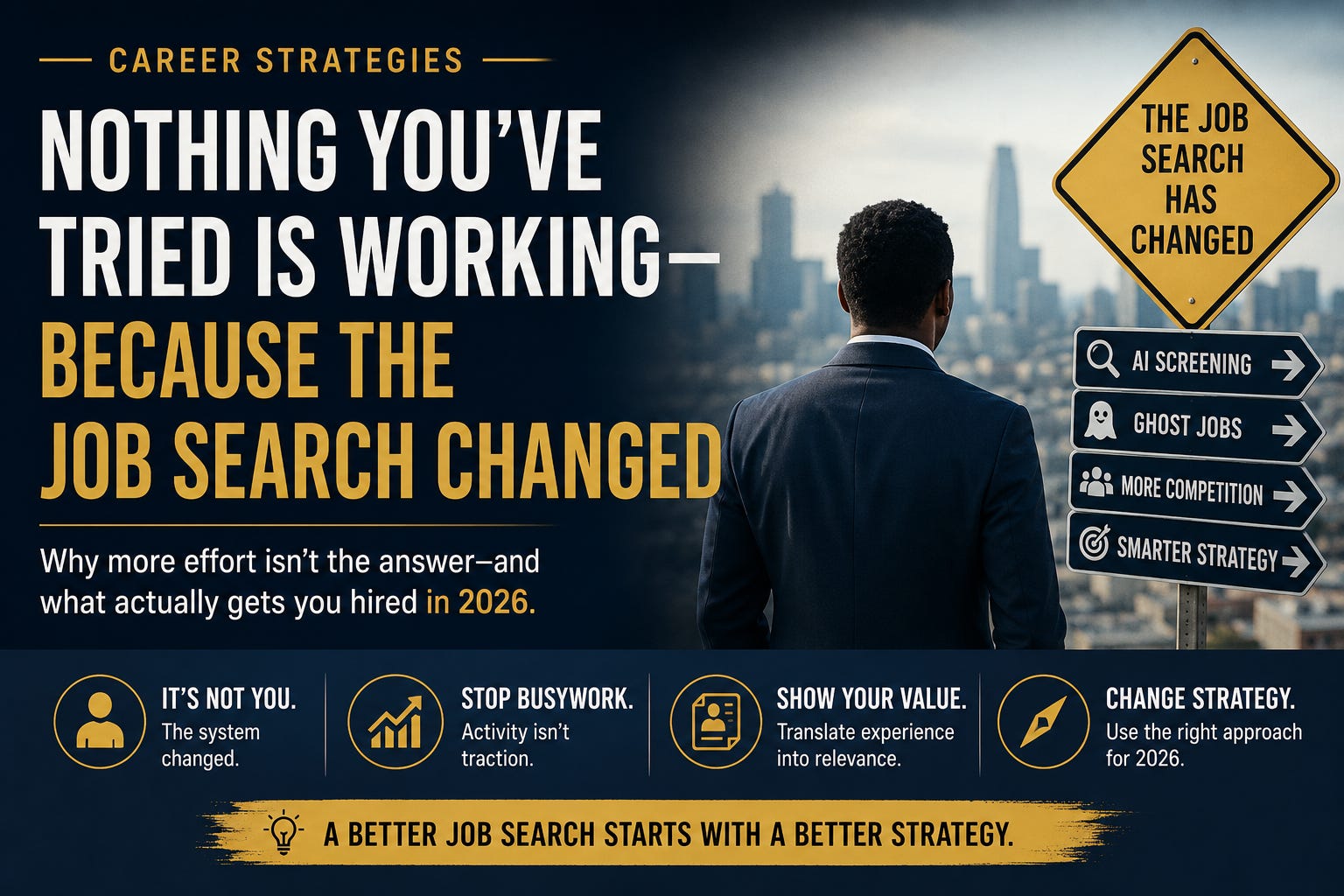
Nothing You’ve Tried Is Working: The Complete 2026 Reference for AI Screening, Ghost Jobs, and Getting Hired
By Byron K. Veasey
About the Author
Byron K. Veasey is a career strategist and leader in data quality engineering focused on helping professionals navigate job searches, burnout, and career reinvention.
He writes Career Strategies, a Substack newsletter read by over 4,900 professionals navigating today’s evolving job market.
👉 Subscribe to Career Strategies