
Why Generic Job Loss Advice Fails High Performers

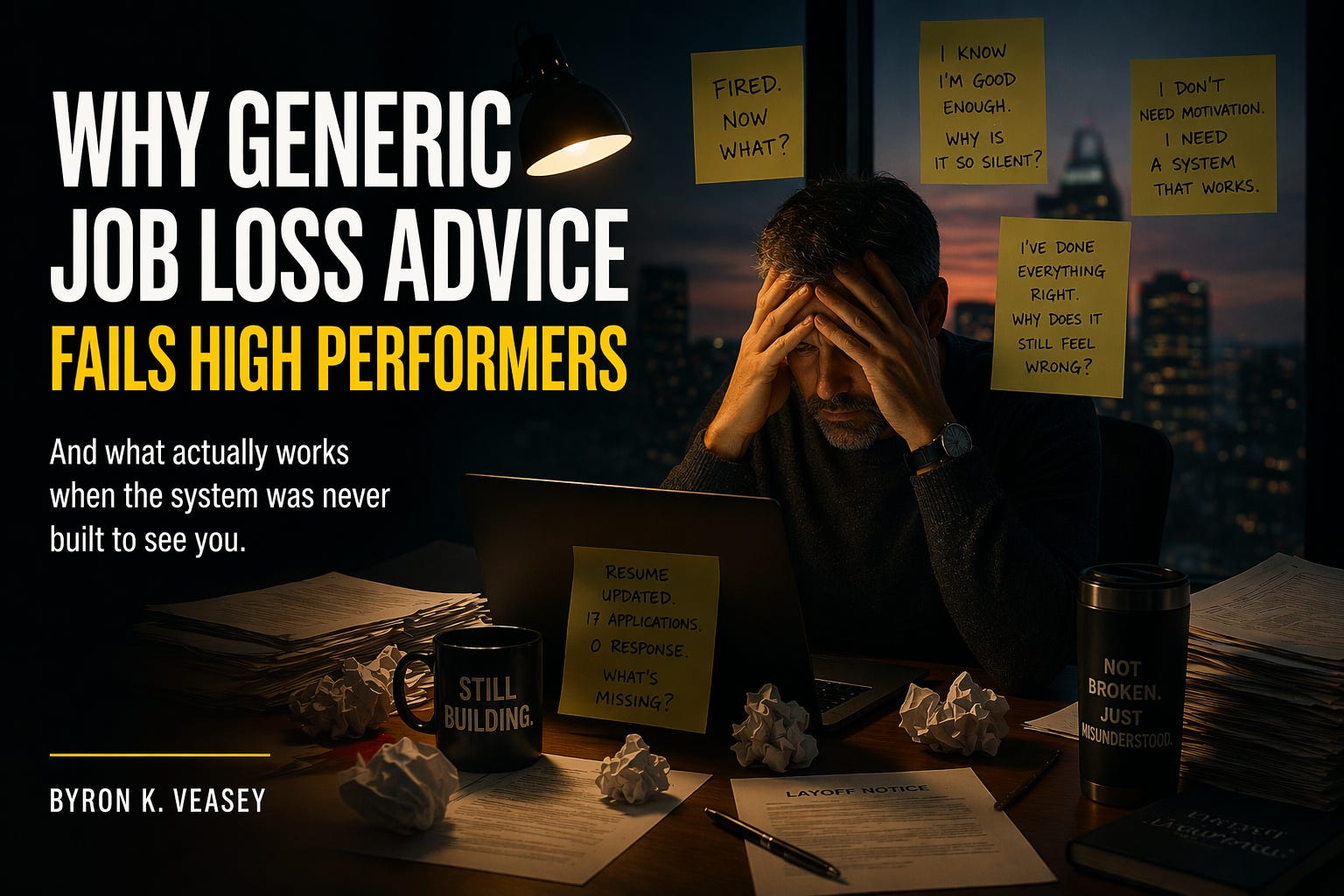
And what actually works when the system was never built to see you
The book, Fired, Ghosted, Invisible: A Recovery Operating System for High Performers Trapped in the Silent Job Market This book is free from April 14 to April 18, 2026. All we ask is that you leave an honest review.
There’s no shortage of advice about losing a job.
Entire shelves of it.
Well-intentioned.
Widely shared.
Repeated so often it starts to sound like truth.
“Fix your résumé.”
“Network more.”
“Stay positive.”
“Your next chapter is waiting.”
But if you’re a high performer…
That advice doesn’t just miss.
It feels… off.
Because it was never written for you.
The Advice Wasn’t Built for You
Most job loss advice is designed for the average job seeker.
Someone who needs momentum.
Someone who needs direction.
Someone still figuring out how to operate at a high level.
That’s not you.
You’ve been:
driving outcomes
making decisions under pressure
carrying responsibility most people avoid
You didn’t need a framework to perform.
You were the framework.
So when you read advice that tells you to “try harder”…
It doesn’t land.
Because effort was never your problem.
What Generic Advice Gets Wrong
1. It treats job loss like a motivation problem
Most advice tries to convince you that you can do this.
But you already know that.
You’ve done harder things before breakfast.
This isn’t about belief.
It’s about signal.
Your value is real.
Your track record is real.
The system just isn’t reflecting it back to you.
2. It pushes volume when you need precision
“Apply to more jobs.”
You’ve heard it.
You’ve probably tried it.
And what happened?
Silence.
Or worse—
opportunities that are three levels below where you were.
Because volume doesn’t create visibility.
Positioning does.
Effort doesn’t separate a scattered search from a strategic one.
Clarity does.
And generic advice never teaches that—
because it was never designed to.
3. It completely ignores identity collapse
Three months ago:
You were the one people relied on.
The one pulled into meetings to unblock decisions.
The one who understood how things actually worked.
Then one day…
It stopped.
Generic advice calls this:
“A difficult transition.”
What it really is:
Identity Drift.
Your brain didn’t break.
But the external signals it used to understand who you are…
…disappeared.
And the silence that replaced them?
It doesn’t feel neutral.
It feels like judgment.
Most advice never touches this.
Because it doesn’t know how.
4. It assumes a fair system
This is the most dangerous mistake.
Hidden inside generic advice is an outdated belief:
Do the work → get the result
That used to be true.
It isn’t anymore.
Today:
ATS systems strip away context
nonlinear careers get filtered out
recruiters look for patterns, not depth
high performers get overlooked—not because they lack ability, but because they don’t fit the mold
This is not a pure meritocracy anymore.
So telling a high performer to “just keep applying”…
Isn’t helpful.
It’s misleading.
What High Performers Actually Need
You don’t need more generic tactics.
You need something far more specific:
A strategy built for signal, not volume
A way to rebuild identity while moving forward
A system that works with your brain when it’s operating at 30–40% capacity
A clear understanding of how decisions are really made in today’s hiring environment
You need to move from:
Talking about your experience…
To making decision-makers feel your relevance.
The Real Problem with Generic Advice
It treats job loss like a short-term interruption.
For high performers?
It’s a system disruption.
Your role wasn’t just a job.
It was:
structure
identity
contribution
feedback
And any advice that skips that…
…and jumps straight to résumé edits and interview tips…
Misses the part that actually needs to be rebuilt.
A Different Place to Start
You are not broken.
You are not behind.
You are not invisible because you lack value.
You are invisible because:
👉 the system isn’t built to interpret what you bring
👉 the tools you’re using weren’t designed for your level
The signal is still there.
The capability is still there.
What’s missing…
Is the operating system that makes it visible again.
That’s the Work Now
Not more effort.
Not more applications.
But:
precision
positioning
strategic visibility
Final Thought
If this resonated with you…
You already know something wasn’t adding up.
And you were right.
If you know someone who’s been told to “just keep applying”…
…and quietly feels like something is off—
Share this with them.
Sometimes clarity is the first real form of momentum.
About the Author
Byron K. Veasey is a career strategist and leader in data quality engineering focused on helping professionals navigate job searches, burnout, and career reinvention.
He writes Career Strategies, a newsletter read by over 3,900 professionals navigating today’s evolving job market.