

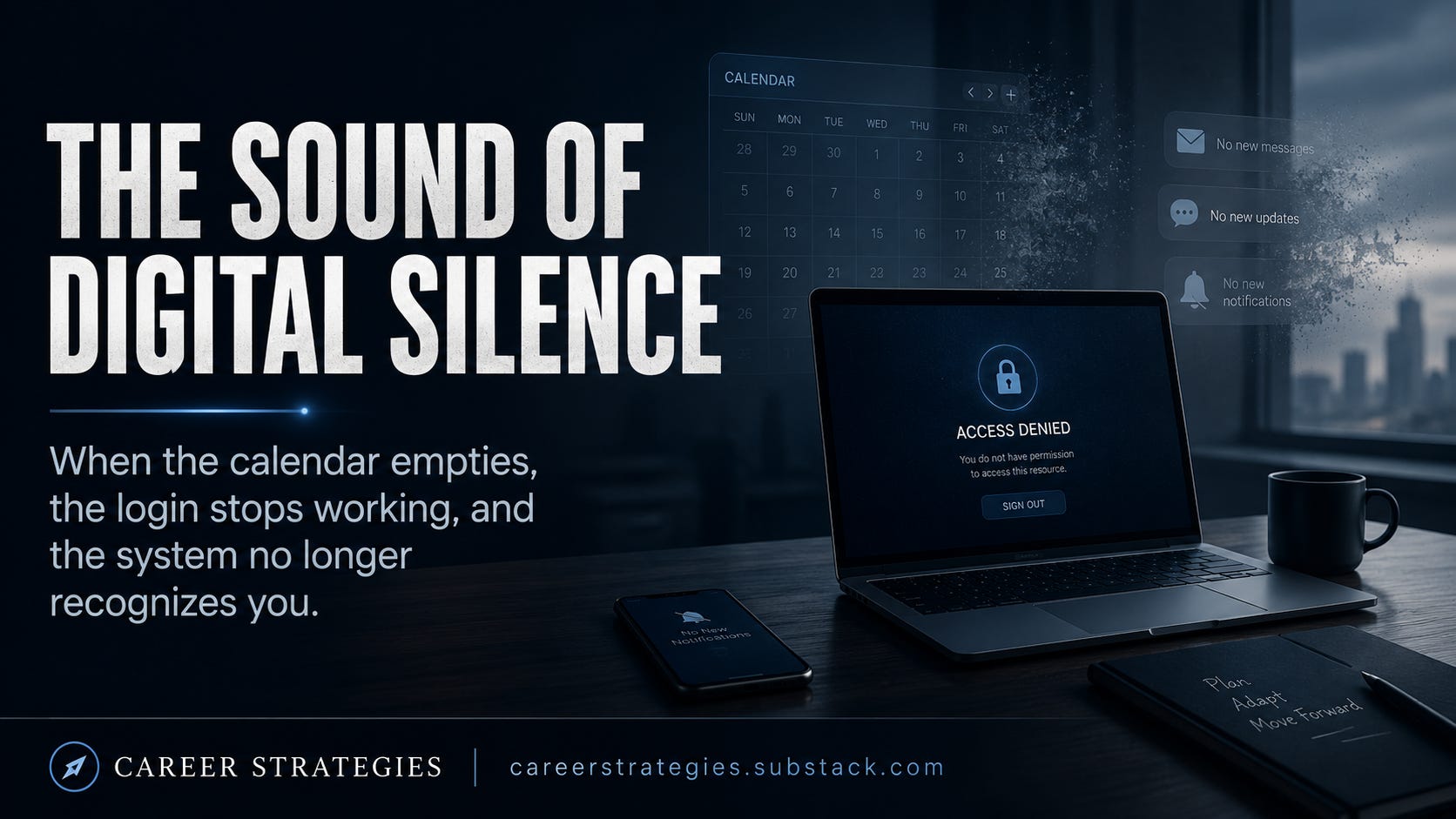
What really happens when the calendar empties, the login stops working, and the corporate system no longer recognizes you?
One afternoon, the system still knows your name.
By evening, your login fails.
The Slack channels disappear.
The calendar goes blank.
The inbox stops pulsing.
The phone sits there with a silence you have not heard in years.
That is the moment most career advice gets wrong.
Because what just happened to you is not simply job loss.
It is not just an employment event, a résumé gap, a networking problem, or a temporary interruption in income.
It is the sudden withdrawal of an entire operating system that used to tell you who you were, where to be, what mattered, and whether the day counted.
For years, maybe decades, the corporate system gave your life a rhythm.
Wake up.
Check the phone.
Scan the calendar.
Prepare for the meeting.
Respond to the message.
Move the project forward.
Handle the escalation.
Join the call.
Send the update.
Make the decision.
Absorb the pressure.
Repeat.
Even on the difficult days, there was structure.
Even on the frustrating days, there was motion.
Even when the work drained you, the system still confirmed your existence.
Your name was in the directory.
Your face was on the org chart.
Your meetings had titles.
Your inbox had urgency.
Your calendar had proof.
Then, almost without ceremony, that proof disappears.
And the silence that follows is not an ordinary silence.
It is digital silence.
This is the kind of feeling that comes when a system, which used to be a part of every hour of your day, suddenly stops recognizing you.
The corporate operating system disappeared overnight
A job is never just a job.
That is the first thing we have to be honest about.
A job pays bills, yes. It provides income, insurance, retirement contributions, and a level of predictability that matters deeply when real life is attached to the paycheck.
But a job also does something more subtle.
It organizes your nervous system.
It tells you when to wake up.
It tells you where your attention should go.
It gives your day a beginning, middle, and end.
It creates a language around what matters.
It gives you people to answer to and people who answer to you.
It creates pressure, but it also creates direction.
The corporate system becomes an external structure for your internal life.
You may not love every meeting, but the meeting tells you where to be.
You may not enjoy every email, but each one tells you that something requires your response.
You may resent the constant notifications, but they create a kind of proof that your presence matters somewhere.
This is why the first days after corporate separation can feel so strange.
It is not only that you lost access to a company.
It is that you lost access to the structure that had been holding your time.
Your calendar was not just a calendar.
It was a map of importance.
Your inbox was not just an inbox.
It was a signal that you were needed.
Your Slack channels were not just communication tools.
They were proof of belonging.
Your meetings were not just obligations.
They were evidence that your expertise had a place to land.
Then the tools go quiet.
No one asks for your opinion at 9:15.
No one needs the spreadsheet by noon.
No one pings you with a quick question.
No one forwards the deck.
No one adds you to the thread.
At first, there may be relief.
A little space.
A little quiet.
A little shock-numbed stillness.
But then something else arrives.
A question underneath the question:
If the system no longer needs me, who am I without it?
That is not weakness.
That is what happens when an identity has been wired into an operating system and the operating system is suddenly removed.
Why “update your résumé” comes too soon
Most career advice rushes you past this moment.
It wants you moving immediately.
Update your résumé.
Refresh your LinkedIn profile.
Reach out to your network.
Apply to ten roles a day.
Practice your interview stories.
Rebrand yourself.
Stay positive.
Keep going.
Some of that advice matters.
Eventually.
But not immediately.
Because the first task after being logged out is not optimization.
It is orientation.
Before you can decide where you are going, you have to understand what just happened to your sense of place.
Before you can market yourself, you have to stabilize the part of you that is asking whether you still count.
Before you can rewrite your professional story, you have to sit with the fact that one chapter ended without your nervous system having time to catch up.
This is where many people quietly suffer.
They try to perform strategy while still in shock.
They open the résumé document and stare at it.
They try to summarize twenty years of value into bullet points while their body is still trying to understand why the laptop feels different.
They force themselves to sound confident when, internally, they feel erased.
They update LinkedIn because they think activity will create control.
They apply for roles before they have processed the rupture.
Then, when the silence of the job market meets the silence of corporate separation, the disorientation deepens.
No response from the old system.
No response from the new system.
No feedback loop anywhere.
That is a dangerous place for self-trust.
Because when the external signals disappear, the mind starts inventing explanations.
Maybe I was not as good as I thought.
Maybe I missed the signs.
Maybe I am too old.
Maybe I am too expensive.
Maybe my best years are behind me.
Maybe the company moved on because I was easier to replace than I wanted to admit.
This is why rushing straight into tactics can backfire.
Not because tactics are wrong.
But because strategy built on disorientation often becomes panic with a checklist.
The first work is not to become market-ready.
The first work is to become internally oriented again.
To know what happened.
To name what was lost.
To separate your value from your access.
To remember that being removed from a system is not the same as being emptied of worth.
The silence has texture
The first morning is the part people rarely describe honestly.
You may still wake up at the old time.
Your body does not know the job ended.
The alarm may go off before you remember.
For a few seconds, your old life is still intact.
Then the facts return.
There is no call to join.
No commute to make.
No inbox to scan.
No dashboard to check.
No first meeting waiting for you.
You reach for the phone anyway.
Habit is faster than acceptance.
Maybe you check email, forgetting for half a second that access is gone.
Maybe you open LinkedIn and immediately regret it.
Maybe you scroll job postings before your coffee, not because you are ready, but because movement feels safer than stillness.
Maybe you stare at the ceiling and feel a strange combination of exhaustion and adrenaline.
The silence is not peaceful yet.
It is too new.
It has edges.
It sounds like the absence of urgency.
It feels like standing in a hallway after a door closes behind you, holding a box of things you were not ready to carry.
It lives in small moments.
The first time no one asks if you are available.
The first time noon arrives and you realize you have not spoken out loud.
The first time your partner asks, “How are you doing?” and you do not know which version of the truth to give.
The first time you see a former colleague post about a meeting you are no longer in.
The first time you realize the company has continued without the emotional weight of your absence.
That last one hurts in a particular way.
Because intellectually, you know organizations move on.
You know business continues.
You know the meetings keep happening, the initiatives keep shifting, the acronyms keep changing, and someone else eventually inherits the work.
But emotionally, it can feel like a second loss.
Not only did the job end.
The world that contained you kept moving.
And you are left in the stillness, trying to understand why your body feels both relieved and rejected.
That combination can be confusing.
You may miss the very system that exhausted you.
You may resent the meetings and still miss being invited.
You may feel grateful for the break and terrified by the blank space.
You may know the role was no longer right and still grieve the identity it gave you.
All of that can be true.
The silence after corporate separation is not empty.
It is full of everything the system used to hold for you.
You are not behind—you are disoriented
There is a particular cruelty in how quickly people expect themselves to recover from being let go.
Within days, sometimes hours, they begin measuring themselves against an imaginary timeline.
I should have a plan by now.
I should be applying already.
I should be networking harder.
I should know what I want next.
I should be using this time productively.
I should not still feel this shaken.
But disorientation is not failure.
It is a normal response to sudden structural loss.
When the system that organized your days disappears, your mind and body need time to build a new map.
That does not mean you are weak.
It means the old map was powerful.
For years, the corporate environment supplied the cues.
Start here.
Respond to this.
Prioritize that.
Attend this meeting.
Hit this deadline.
Escalate this issue.
Prepare this update.
Measure success this way.
When those cues vanish, the blank space can feel like freedom to one part of you and threat to another.
That is why the first phase after separation is so tender.
You are not simply deciding what job to pursue.
You are learning how to hear yourself without the volume of the system.
And at first, that can feel almost impossible.
Because corporate life trains you to respond.
To urgency.
To metrics.
To leadership priorities.
To team needs.
To performance expectations.
To the next thing.
But post-corporate recovery begins when response is no longer enough.
You have to learn how to orient.
That means asking different questions.
Not just, “What role should I apply for?”
But:
What part of me is still in shock?
What structure did the job provide that I now need to rebuild intentionally?
What did the calendar hold for me besides meetings?
What did the inbox make me feel besides overwhelmed?
What identity did the system give me that I now have to separate from my actual self?
What do I need before I can move wisely?
These are not soft questions.
They are foundational questions.
Because if you skip them, you may rush into the next opportunity carrying the same unprocessed rupture with you.
You may accept a role just to escape the silence.
You may chase urgency because stillness feels unsafe.
You may mistake motion for recovery.
But a new job cannot fully repair an old identity wound.
It can give you income.
It can give you structure.
It can give you momentum.
But the deeper work is different.
The deeper work is learning who you are when the system stops naming you.
The system went quiet. That does not mean you disappeared.
This is the distinction to hold onto.
Your login disappeared.
You did not.
Your calendar emptied.
Your capacity did not.
Your inbox stopped pulsing.
Your value did not.
Your name may have been removed from a directory, but your experience, judgment, instincts, relationships, and hard-earned wisdom did not vanish with it.
The problem is that, in the first shock of separation, it can feel like they did.
That is why this moment deserves more respect than most career advice gives it.
The sound of digital silence is not just the absence of notifications.
It is the beginning of a reckoning.
With work.
With identity.
With belonging.
With dependence on external validation.
With the systems we let define us because they were loud, constant, and rewarding enough to seem like truth.
And maybe, eventually, the silence becomes something else.
Not punishment.
Not proof of irrelevance.
Not evidence that you have fallen behind.
Maybe the silence becomes the first place where you can hear what the system drowned out.
Your exhaustion.
Your grief.
Your anger.
Your relief.
Your desire for something more honest.
Your need for a different rhythm.
Your readiness to stop confusing access with identity.
But that does not happen immediately.
At first, the silence is just silence.
So let it be that.
Do not rush to make it inspirational.
Do not force yourself to turn it into a comeback story by Monday morning.
Do not shame yourself because you are not yet optimized, branded, strategic, and visible.
You are not behind.
You are disoriented.
And orientation comes before momentum.
The beginning of post-corporate recovery
In Logged Out, Waking Up, I call this the beginning of post-corporate recovery: the moment when the old system goes quiet and the deeper work begins.
It is the moment when you realize the job was not only a job.
It was a structure.
A rhythm.
A mirror.
A source of urgency.
A container for identity.
And now that container is gone.
That does not mean you are empty.
It means you are standing in the space between systems.
The old one no longer holds you.
The new one has not been built yet.
This space can feel frightening because it lacks the signals you are used to.
But it can also become sacred, if you let yourself move through it slowly enough to learn from it.
Not immediately.
Not performatively.
Not with forced gratitude.
But honestly.
The silence after corporate separation is not empty.
It is full of everything the system used to hold for you.
And now, piece by piece, you get to decide what you want to hold for yourself.
About the Author
Byron K. Veasey is a career strategist and leader in data quality engineering focused on helping professionals navigate job searches, burnout, and career reinvention.
He writes Career Strategies, a Substack newsletter read by over 4,900 professionals navigating today’s evolving job market.
👉 Subscribe to Career Strategies
🎙️ Listen to the Podcasts
👉 Career Strategies Amazon Books
👉 eBook Library of Success
The line about the corporate system "organizing your nervous system" lands. What I hear most in conversations during that first month is a quieter version of the same thing: the loss of being addressed, of being needed by something specific each morning. The truer experience is that the silence makes thinking harder, not easier, until something new starts asking for you.
Zia. itszia.ai