
The Search for Proof

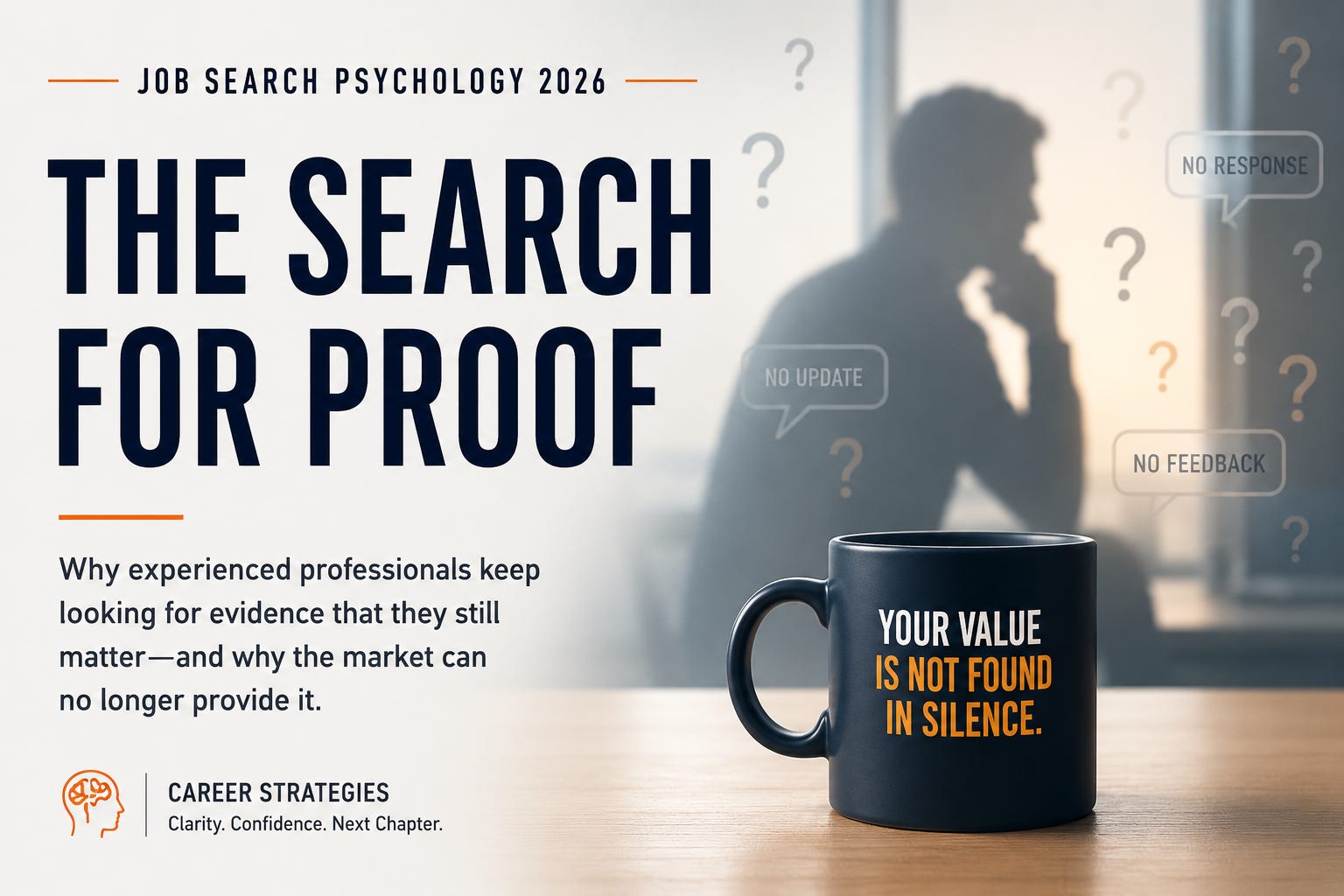
Why experienced professionals keep seeking evidence that they still matter—and why the market can no longer provide it.
This book, Job Search Psychology 2026: How Experienced Professionals Can Navigate AI Screening, Silent Rejection, Age Bias, and the Emotional Toll of Looking for Work, offers insight into this experience.
There is a moment that almost every long-term job seeker experiences.
At first, you are seeking employment.
Then, somewhere along the way, you realize you are looking for something else.
Proof.
Proof that your experience still matters.
Proof that your skills still have value.
Proof that your career was not a mistake.
Proof that somebody still sees what you can do.
The applications become more than applications.
The interviews become more than interviews.
The responses become more than responses.
Everything starts carrying emotional weight it was never meant to carry.
And that changes the search in ways most people never recognize.
The market becomes a mirror
For most of your career, work reflected information back to you.
You solved problems.
People thanked you.
You led projects.
People relied on you.
You built expertise.
People sought your advice.
You did not have to wonder whether you mattered.
The environment answered the question every day.
Then the job ends.
The meetings stop.
The emails stop.
The requests stop.
The calendar goes quiet.
And suddenly one of the biggest feedback systems in your life disappears.
The problem is that the need for feedback does not disappear with it.
So the mind starts looking elsewhere.
The market becomes the new mirror.
Every application becomes a question.
Every recruiter response becomes evidence.
Every interview becomes a measurement of worth.
The trouble is that modern hiring systems make terrible mirrors.
The mirror is broken
The modern hiring process was designed to process volume.
It was not designed to provide emotional clarity.
Applications disappear into systems.
Recruiters handle impossible workloads.
Roles get frozen.
Budgets change.
Approvals stall.
Internal candidates emerge.
Departments reorganize.
Hiring priorities shift.
And through all of it, candidates receive very little information.
Yet people continue treating the silence as feedback.
That is like standing in front of a broken mirror and assuming the distorted reflection is accurate.
The market’s inability to see you clearly does not mean you have become less valuable.
It often means the market has become worse at recognizing value.
The danger of invisible scorekeeping
Most professionals develop a hidden scoreboard.
Applications submitted.
Interviews completed.
Messages received.
Rejections received.
Days since the last response.
Weeks since the last interview.
Months since the last offer.
At first, it feels rational.
But eventually something changes.
The scoreboard becomes personal.
A quiet week starts feeling like a personal failure.
A canceled interview becomes a judgment.
A recruiter who never follows up becomes evidence that your career is fading.
You stop measuring activity.
You start measuring yourself.
That is where the damage begins.
Because the scoreboard only tracks outcomes.
It does not track reality.
It does not measure your capability.
It does not measure your leadership.
It does not measure your judgment.
It does not measure the teams you built, the crises you managed, the systems you improved, or the problems you solved.
It measures responses.
And responses are increasingly influenced by factors you cannot see.
The proof problem
The longer the search lasts, the more dangerous the proof problem becomes.
You begin needing the market to tell you who you are.
A recruiter response becomes proof.
An interview becomes proof.
An offer becomes proof.
Without those signals, confidence starts to erode.
Not because your competence disappeared.
Because the feedback disappeared.
That distinction matters.
One is a capability problem.
The other is a signal problem.
Too many experienced professionals confuse the two.
The confidence you built over decades was never supposed to depend entirely on market validation.
But many careers accidentally become structured that way.
When external reinforcement disappears, the identity structure starts shaking.
Not because it was false.
Because it was incomplete.
Evidence versus validation
One of the most important shifts a professional can make is learning the difference between evidence and validation.
Validation comes from outside.
Evidence can come from anywhere.
Validation says:
Someone hired me.
Evidence says:
I solved that problem.
Validation says:
Someone offered me a role.
Evidence says:
I led that team successfully.
Validation says:
Someone chose me.
Evidence says:
I created measurable value.
The modern job market has become unreliable at providing validation.
That does not mean the evidence disappeared.
The evidence is still there.
The challenge is learning how to see it without waiting for permission.
Career archaeology
This is why experienced professionals often need what I call career archaeology.
Archaeologists do not create artifacts.
They uncover them.
Your competence is not missing.
It is buried.
Buried under rejection.
Buried under silence.
Buried under uncertainty.
Buried under months of waiting.
The work is not creating value.
The work is rediscovering it.
Sometimes that means documenting achievements.
Sometimes it means revisiting old projects.
Sometimes it means talking with former colleagues who remember contributions you have forgotten.
Sometimes it means building a competence bank that reminds you what is actually true.
Not what the market is currently reflecting.
What is true.
The market cannot be trusted with your identity
This may be the most important lesson of all.
The market is allowed to evaluate opportunities.
It is not allowed to determine your worth.
Those are different jobs.
The market can decide whether a role is funded.
The market can decide whether a company is hiring.
The market can decide whether an application advances.
But the market cannot accurately measure your value as a human being.
It was never designed to do that.
The problem is that many professionals unknowingly handed it that responsibility.
The search becomes healthier when you take it back.
The goal was never proof
Most people begin a job search believing they are searching for employment.
Then they start searching for reassurance.
Then they start searching for proof.
But the goal was never proof.
The goal was always alignment.
The right company.
The right need.
The right timing.
The right opportunity.
Those things require persistence.
They require strategy.
They require patience.
But they do not require you to surrender your identity while you wait.
That part is optional.
And expensive.
A different question
The next time the silence starts talking, notice the question underneath it.
Most professionals ask:
“What does this silence say about me?”
Try a different question.
“What evidence already exists that this silence cannot erase?”
That question changes everything.
Because one looks for proof in a system that may never answer.
The other looks for truth.
And truth is far more stable than feedback.
The market may be uncertain.
The hiring process may be inconsistent.
The responses may be delayed.
But your value does not disappear simply because someone failed to acknowledge it.
A quiet inbox cannot erase a lifetime of competence.
The silence was never proof.
And it was never the whole story.
About the Author
Byron K. Veasey is a career strategist and leader in data quality engineering focused on helping professionals navigate job searches, burnout, and career reinvention.
He writes Career Strategies, a Substack newsletter read by over 4,900 professionals navigating today’s evolving job market.
👉 Subscribe to Career Strategies
👉 Career Strategies Amazon Books
👉 AI Job Search Prompt Library