
The Resume Was Never the Whole Problem

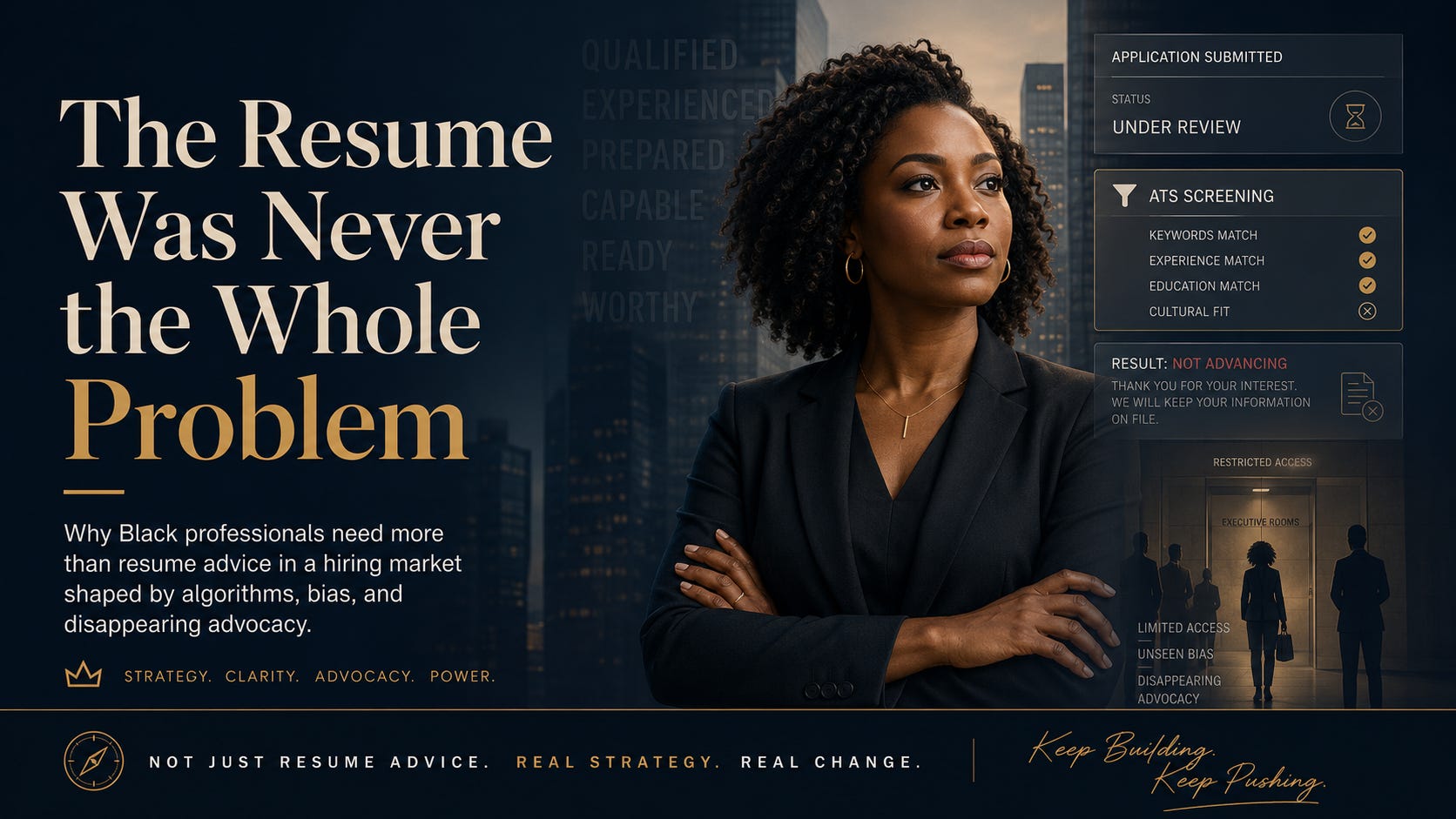
Why Black professionals need more than resume advice in a hiring market shaped by algorithms, bias, and disappearing advocacy.
Based on Locked Out
This article is based on my book, Locked Out: A Job Search Strategy Guide for Black Professionals Navigating ATS Filters, Workplace Bias, and Senior-Level Hiring Barriers.
You can find the book here: https://www.amazon.com/dp/B0H3GZC28C The book is free online from Amazon until June 22, 2026. Please help show you support by posting an honest review of the book.
There is a particular kind of frustration that comes from doing everything you were told to do and still not getting through.
You updated the resume.
You added the keywords.
You cleaned up the formatting.
You rewrote the summary.
You tailored the bullets.
You quantified the results.
You made the language more strategic.
You made it more concise.
You made it more executive.
You made it more ATS friendly.
And still, the silence continued.
Not once.
Not twice.
Repeatedly.
The application went out.
The confirmation email arrived.
Then nothing.
No screen.
No rejection.
No explanation.
Just the quiet disappearance of your experience into a system that never tells you where the breakdown happened.
When Good Advice Stops Working
For years, job seekers were told the resume was the center of the search.
If you were not getting interviews, the answer was simple.
Fix the resume.
If you were still not getting interviews, fix it again.
Add stronger verbs.
Use better formatting.
Rewrite the headline.
Change the order.
Make it more results-driven.
Remove older experience.
Add more keywords.
And yes, resume clarity matters.
Your resume should be focused.
Your accomplishments should be visible.
Your leadership should be easy to understand.
Your value should not be buried under task lists and generic language.
But for many Black professionals navigating the current job market, the resume is not the whole problem.
Sometimes the resume is strong and still unseen.
Sometimes the experience is relevant and still filtered out.
Sometimes the candidate is qualified and still treated as uncertain.
Sometimes the issue is not whether you have value.
The issue is whether the system is built to recognize it.
Based on Locked Out
This article is based on my book, Locked Out: A Job Search Strategy Guide for Black Professionals Navigating ATS Filters, Workplace Bias, and Senior-Level Hiring Barriers.
You can find the book here: https://www.amazon.com/dp/B0H3GZC28C
I wrote the book because too many Black professionals are being told to solve a structural hiring problem with individual self-blame.
They are told to keep improving their resume.
Keep polishing their LinkedIn profile.
Keep practicing interviews.
Keep networking.
Keep staying positive.
And while all of that may help, it does not fully explain what happens when a qualified professional keeps doing the work and still cannot get a fair look.
Because the modern job search is not just about presentation.
It is about passage.
Can your resume pass the algorithm?
Can your story survive recruiter overload?
Can your leadership be understood by someone who may not recognize your path?
Can your credibility move through a process where bias is rarely named but often present?
Can your experience translate into trust before someone decides you are not the right “fit”?
That is the real challenge.
The Resume Is Only the Front Door
A resume is not a career.
It is a signal.
It is a translation tool.
It is the front door to a larger process.
But many job seekers are being told to obsess over the door while ignoring what happens behind it.
The resume may get scanned by software before a human sees it.
The recruiter may spend only seconds looking for a title match.
The hiring manager may compare you against an internal favorite.
The company may have no urgency to fill the role.
The job may already have a preferred candidate.
The posting may exist for compliance, benchmarking, pipeline building, or appearances.
The process may stall because budgets shifted.
The feedback may be vague because the real concern was never clearly stated.
And when all of that happens, the job seeker is often told the same thing.
Fix the resume.
But the resume cannot solve every part of a broken process.
It cannot force a company to be serious.
It cannot make a biased evaluator neutral.
It cannot restore deleted DEI infrastructure.
It cannot create urgency where there is none.
It cannot guarantee that your leadership will be interpreted fairly.
The resume matters.
But it is not magic.
The Danger of Endless Resume Revision
There is a point where resume revision becomes a form of self-punishment.
You stop improving the document and start interrogating yourself.
Was that bullet too strong?
Was that title too senior?
Did I sound too expensive?
Did I include too much experience?
Did I remove too much experience?
Should I make myself sound smaller?
Should I hide the leadership?
Should I soften the accomplishments?
Should I take out the graduation year?
Should I make the resume less threatening?
This is where the emotional damage begins.
Because the job search starts training you to shrink.
Not because you lack proof.
But because the market keeps failing to respond to it.
And for Black professionals, that pressure can carry an added weight.
You are not only trying to prove competence.
You may also feel pressure to manage perception.
To sound confident but not arrogant.
Experienced but not intimidating.
Strategic but not threatening.
Direct but not difficult.
Polished but not performative.
Authentic but not too different from what the evaluator expects.
That is a heavy load to place on a two-page document.
What the Resume Cannot Say Alone
Your resume can show that you led a team.
But it may not fully show how you led under pressure.
Your resume can show that you improved a process.
But it may not fully show the resistance you had to overcome.
Your resume can show that you delivered results.
But it may not fully show the judgment, influence, and political skill required to deliver them.
Your resume can show that you managed complexity.
But it may not fully show the cost of being the person who had to stay composed while navigating rooms where your authority was questioned before your work was understood.
That is why Black professionals need more than resume optimization.
They need career translation.
They need proof architecture.
They need visibility strategy.
They need interview language that names value clearly without waiting for the interviewer to connect the dots.
They need networking that builds advocacy before a role is posted.
They need a strategy that understands how bias can enter at every stage without making bias the only story.
Because the goal is not to walk into the market wounded.
The goal is to walk in prepared.
From Resume Fixing to Signal Building
A modern job search requires a different question.
Not just:
Is my resume good?
But:
Is my value visible before I apply?
Is my LinkedIn profile reinforcing the same message?
Are my accomplishments translated into business outcomes?
Do I have proof points ready for interviews?
Do people in my network understand what I do now?
Do I have advocates who can speak for me when I am not in the room?
Am I applying to roles where my experience is likely to be recognized?
Am I tracking where the process breaks down?
Am I adjusting based on evidence instead of emotion?
That is the shift.
From resume fixing to signal building.
A resume is one signal.
LinkedIn is another.
Your network is another.
Your interview examples are another.
Your thought leadership is another.
Your referrals are another.
Your portfolio of proof is another.
The stronger the signal system, the less pressure you place on one document to carry your entire career.
Diagnose the Breakdown
If you are applying and getting no response, the breakdown may be visibility.
That could mean ATS alignment.
It could mean title mismatch.
It could mean weak keyword translation.
It could mean the role was not truly active.
It could mean you are applying too cold without relationship support.
If you are getting recruiter screens but not moving forward, the breakdown may be positioning.
That could mean your value is not landing quickly enough.
It could mean the recruiter does not understand the seniority of your experience.
It could mean your story sounds too broad.
It could mean you are being screened against a narrow checklist instead of the full business problem.
If you are getting interviews but stalling after hiring manager conversations, the breakdown may be trust.
That could mean the team is unsure how your leadership style fits.
It could mean they are comparing you to a more familiar profile.
It could mean vague “fit” concerns are entering the process.
It could mean your proof needs to be sharper, more specific, and harder to dismiss.
If you are making it to final rounds and then losing momentum, the breakdown may be advocacy.
That could mean no one inside the company is actively pushing your candidacy forward.
It could mean the organization is risk-averse.
It could mean the role has shifted.
It could mean the process was never as open as it appeared.
Each breakdown requires a different response.
That is why “fix your resume” is too small.
Your Strategy Has to Travel Further Than the Application
The application is no longer enough.
It may be the least powerful part of the process.
The modern search requires movement before, during, and after the application.
Before you apply, your positioning needs to be clear.
What role are you targeting?
What business problem do you solve?
What level are you operating at?
What proof supports that level?
What language does the market use for that work now?
During the application, your resume needs to speak the system’s language without erasing your real experience.
It needs keywords.
It needs outcomes.
It needs clarity.
It needs alignment.
But after you apply, the work cannot stop.
You need follow-up.
You need relationship paths.
You need internal contacts.
You need recruiters who understand your lane.
You need visibility outside the applicant pool.
You need people who can connect your name to value before the system reduces you to a file.
This is not about begging for access.
It is about building routes around silence.
Stop Letting Silence Rewrite Your Story
The most dangerous part of the job search is not rejection.
It is interpretation.
When you get rejected, at least there is an answer.
When you are ghosted, your mind fills in the blank.
You start building explanations with no evidence.
Maybe I am not good enough.
Maybe I waited too long.
Maybe my career is over.
Maybe the market has passed me by.
Maybe I should lower everything.
Maybe I should stop aiming high.
Maybe I should be grateful for anything.
That is how silence becomes a story.
And if you hear that story long enough, you may start believing it.
But silence is not always truth.
Sometimes silence means the system never read you correctly.
Sometimes silence means the company was not ready.
Sometimes silence means a process was broken.
Sometimes silence means your application entered a crowd of hundreds.
Sometimes silence means someone else had an advocate.
Sometimes silence means nothing about your worth at all.
Do not let a broken process become your biography.
This Is Not About Ignoring the Resume
Your resume still matters.
Make it clear.
Make it targeted.
Make it readable.
Make it aligned.
Make your accomplishments measurable.
Make your leadership visible.
Make sure the keywords match the roles you want.
Make sure the first third of the page tells the reader where you belong.
But do not keep rewriting the resume because the market refuses to explain itself.
At some point, the better move is not another version.
It is a better system.
A better target list.
A better networking rhythm.
A better follow-up process.
A better interview proof bank.
A better way to track patterns.
A better way to protect your confidence from silence that was never a fair evaluation.
The goal is not to stop improving.
The goal is to stop misdiagnosing.
You Need a Strategy That Sees the Whole Market
Black professionals do not need job search advice that pretends the market is neutral.
They need advice that is honest enough to name the barriers and practical enough to move through them.
A strategy that understands ATS filters.
A strategy that understands bias.
A strategy that understands senior-level ambiguity.
A strategy that understands the loss of internal advocacy.
A strategy that understands how silence affects confidence.
A strategy that helps you keep your dignity while still adapting.
Because adaptation is not surrender.
It is strategy.
You are not changing because the system is right.
You are changing because you deserve to be seen clearly inside a system that often fails to see clearly on its own.
The Shift: From Resume Anxiety to Market Strategy
This is the shift.
Not from resume work to no resume work.
From resume anxiety to market strategy.
Not from confidence to denial.
From self-blame to diagnosis.
Not from effort to exhaustion.
From scattered activity to targeted movement.
Because the resume was never the whole problem.
It was only one part of the system.
And once you understand that, you can stop asking one document to do the work of an entire strategy.
You can build stronger signals.
You can create better routes.
You can prepare sharper proof.
You can protect your confidence.
You can stop shrinking your career to fit someone else’s limited imagination.
You Are More Than the File They Ignored
The job search can make you feel like a document.
A PDF.
A profile.
A submission.
A candidate ID.
A line in a tracking system.
But you are not a file.
You are not a keyword score.
You are not a vague rejection.
You are not the silence after an application.
You are not the hesitation someone could not explain.
You are a professional with evidence.
You have led.
You have built.
You have solved.
You have recovered.
You have adapted.
You have earned the right to be evaluated fully.
Now your strategy has to make that harder to ignore.
Not because your worth depends on the market recognizing it.
But because your next opportunity should not depend on a broken system guessing correctly.
You are not starting from zero.
You are starting from proof.
Now the work is to make that proof visible, portable, and impossible to casually dismiss.
The resume matters.
But your strategy has to be bigger than the resume.
About the Author
Byron K. Veasey is a career strategist and leader in data quality engineering focused on helping professionals navigate job searches, burnout, and career reinvention.
He writes Career Strategies, a Substack newsletter read by over 4,900 professionals navigating today’s evolving job market.