
The Psychology of Job Searching 2026: Why This Isn’t Just a Career Problem — It’s a Human One

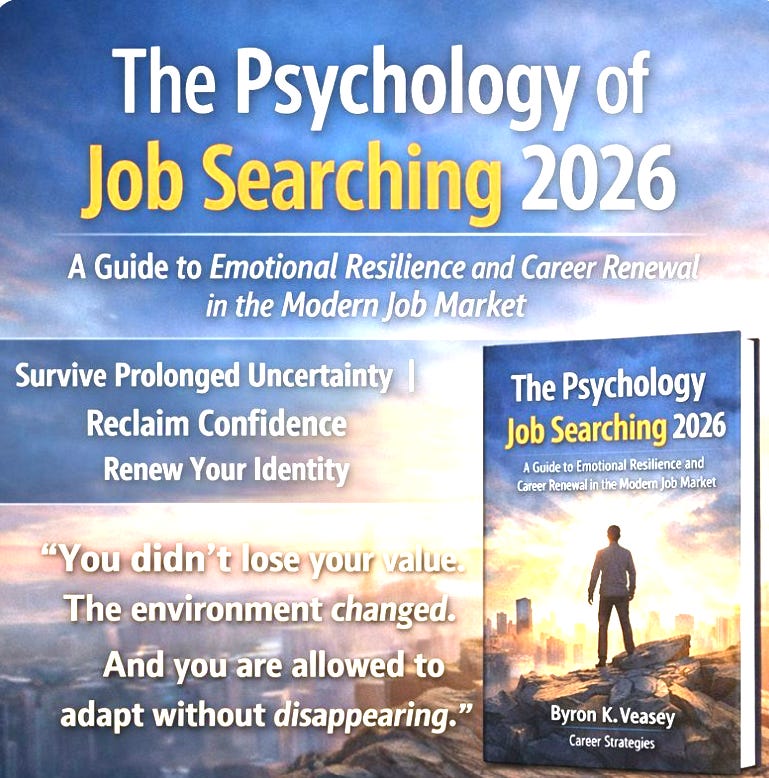
The Psychology of Job Searching 2026.
Most people approach the job search like a puzzle to solve.
Fix the résumé.
Optimize LinkedIn.
Apply more. Network harder. Stay positive.
And when it doesn’t work, they assume they’re doing something wrong.
But after years of watching talented, capable, hardworking people struggle in silence, I’ve come to believe something different:
The job search isn’t failing you because you lack strategy.
It’s exhausting you because it’s quietly working on your psychology.
That’s why I wrote The Psychology of Job Searching.
Not as another tactical guide.
Not as a motivational pep talk.
But as a companion for the inner terrain no one prepares you for.
The Hidden Curriculum of the Job Search
Every job search teaches lessons — whether you want them or not.
Some are useful:
How to articulate your value
How to tell your story
How to adapt to changing markets
Others are corrosive:
Silence starts to feel personal
Rejection erodes self-trust
Waiting trains helplessness
Comparison distorts self-worth
Over time, many job seekers don’t just lose momentum.
They lose confidence, clarity, and a stable sense of identity.
And because no one names this psychological toll, people internalize it as failure.
This book exists to say plainly:
Nothing is wrong with you.
You’re navigating a system that quietly strains the human nervous system.
Why Tactics Alone Aren’t Enough Anymore
In earlier job markets, effort reliably converted into opportunity.
In today’s market — and especially heading into 2026 — that feedback loop is broken.
You can:
Do everything “right”
Follow expert advice
Be qualified, prepared, and persistent
…and still experience long stretches of silence.
When that happens, purely tactical advice starts to backfire.
Because when effort doesn’t yield results, the mind fills in the gap:
Maybe I’m not good enough.
Maybe I waited too long.
Maybe my best years are behind me.
This is where the job search quietly becomes an identity crisis.
The Psychology of Job Searching addresses what tactics can’t:
Confidence erosion
Decision fatigue
Emotional whiplash
Identity drift
Hope depletion
Transition exhaustion
These aren’t personal weaknesses.
They’re predictable psychological responses to prolonged uncertainty.
What This Book Is — And Isn’t
This is not a book about:
Résumé templates
ATS hacks
Cold outreach scripts
Interview question lists
Those tools matter — but they’re not the core problem most people are facing anymore.
This is a book about:
Rebuilding self-trust after prolonged rejection
Separating market noise from personal worth
Designing emotional sustainability, not just job-search intensity
Learning how to pause without quitting
Reclaiming agency when outcomes feel uncontrollable
It’s about staying psychologically intact long enough for opportunity to find you — and recognizing yourself when it does.
The Real Cost No One Talks About
The most damaging part of the job search isn’t rejection.
It’s what rejection teaches if left unexamined.
People start to:
Shrink their ambitions
Lower their standards prematurely
Abandon creativity for safety
Accept roles that quietly break them
Confuse adaptability with self-erasure
This book helps interrupt that cycle.
Not with forced optimism.
But with language, structure, and perspective that restore orientation when everything feels blurred.
Hope Without Delusion
One of the hardest balances in the job search is hope.
Too little, and you collapse.
Too much, and every disappointment devastates you.
The Psychology of Job Searching introduces a different approach:
Grounded hope
Durable confidence
Evidence-based self-belief
Not the kind that ignores reality — but the kind that can coexist with uncertainty.
Hope that doesn’t shatter when timelines slip.
Confidence that isn’t dependent on immediate validation.
Momentum that survives pauses.
Who This Book Is For
This book is for:
Mid-career professionals navigating long searches
High performers experiencing unexpected stagnation
Burned-out achievers unsure how to start again
Quietly grieving the career they thought they’d have by now
Anyone who feels capable — but tired, invisible, or misaligned
If you’ve ever thought:
“I know I’m good… so why does this feel so hard?”
This book is for you.
A Final Truth
The job search will test your skills.
But more than that, it will test your relationship with yourself.
How you interpret silence.
How you hold uncertainty.
How you speak to yourself when no one else is responding.
The Psychology of Job Searching exists to help you emerge from this season
not just employed —
but intact.
Clearer.
Wiser.
More anchored in who you are than what the market happens to be doing.
Because this chapter of your career isn’t proof of your limits.
It’s evidence of your endurance.
About Byron Veasey
Byron is a data quality engineer and career strategist. His newsletter, Career Strategies, Career Strategies Podcast, Career Strategies Premium provide insight and clarity for career transitions, job search, and career growth.