
The Private Costs of a Stalled Job Market. Part 1 — Ghosted by a Machine
Five-part Series

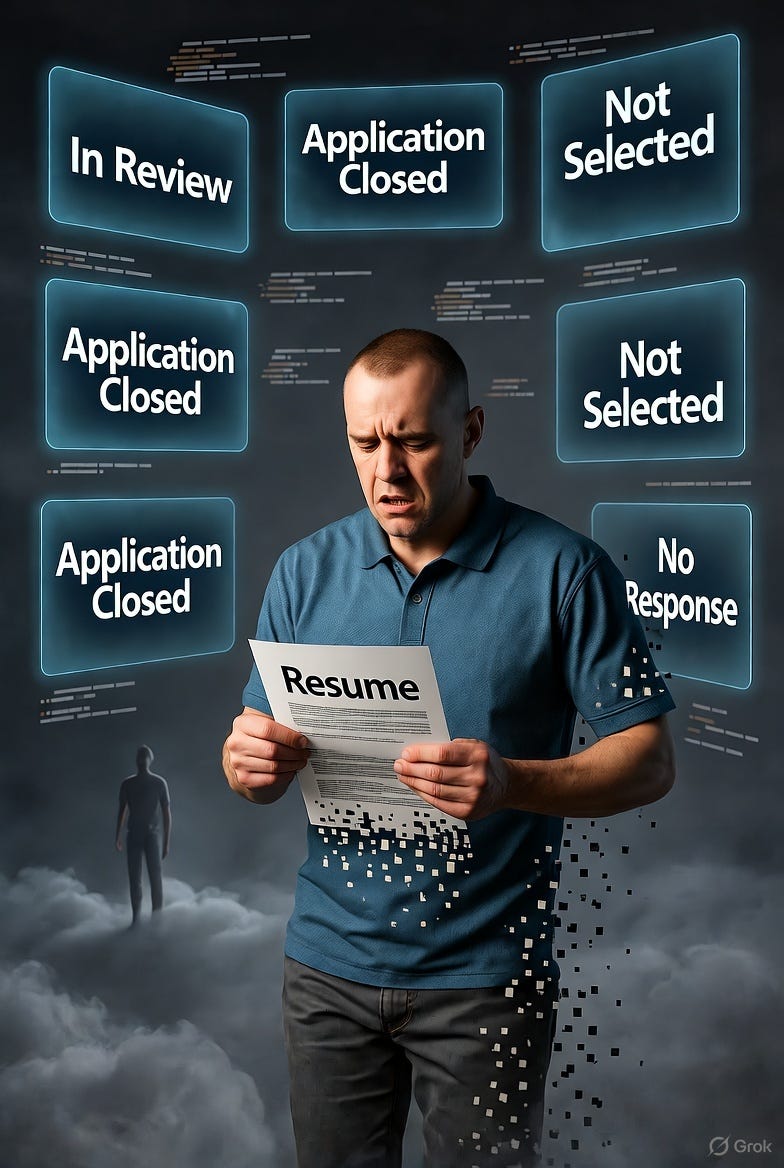
Silent Rejection at Scale
There’s a moment in every job search when silence becomes louder than words.
I. The Week of Waiting
Day 1: You hit “Submit.” The résumé gleams, the cover letter feels honest but strategic, and you tell yourself, This one fits.
Day 3: You check your inbox twice before breakfast. Nothing. You convince yourself it’s still early.
Day 7: You refresh the application portal. Still “In Review.” Optimism begins to wilt.
Day 10: You whisper, Maybe they filled it internally.
Day 14: The posting disappears. You never hear back.
You haven’t been rejected. You’ve been erased — politely, automatically, and invisibly.
That’s the new normal in 2025. Ghosting used to mean a human decided not to reply; now it means a system decided you didn’t exist.
II. How the Silence Is Made
Behind every “Apply Now” button sits a maze of software: résumé parsers, keyword rankers, fit-score calculators, scheduling bots.
Together they process hundreds of applications in seconds.
The promise is efficiency. The result is distance.
A résumé uploads → the parser converts it → AI matches skills → a score appears → the cutoff drops you.
Maybe your file type was wrong. Maybe your phrasing confused the algorithm. Maybe it never even opened.
The system doesn’t ghost you out of malice. It simply never noticed you existed.
To the company, it’s optimization.
To the applicant, it’s erasure.
III. What Silence Does to the Mind
Psychologists call it ambiguous loss — grief without closure.
You rationalize: Maybe they’re busy.
Then you personalize: Maybe I’m not enough.
Your brain fills the blank space with self-blame. Silence becomes a mirror, reflecting every insecurity you’ve ever stored.
Job-search fatigue isn’t just exhaustion; it’s the slow erosion of self-trust.
Hope becomes something you ration carefully, like batteries in a blackout.
IV. The Psychology of Invisible Rejection
A normal rejection gives data: We went with another candidate.
Automated rejection gives nothing. You’re left in “maybe,” and the nervous system hates “maybe.”
It keeps scanning for resolution. Cortisol spikes. Sleep fractures. Days blur.
Meanwhile LinkedIn scrolls on, full of “exciting new opportunities,” and you start wondering if you’re the only one left behind.
You’re not. You’re just living in the widening gap between human effort and machine attention.
V. The Human Cost of Scale
Recruiters aren’t villains. They’re drowning in dashboards and throughput metrics.
When 400 people apply to one role, empathy becomes a luxury.
In 2025, the average posting gets 250 + applications. Only 5 percent reach a human.
The rest vanish into digital purgatory.
The technology that promised meritocracy built opacity instead.
Companies now complain about a “talent shortage” while ignoring the talent standing at their gates.
VI. What Helps When You’re Still in the Dark
1️⃣ Re-humanize the process.
Referrals and introductions still cut through filters. A single human can override an algorithmic “no.” Unfair? Yes. Effective? Also yes.
2️⃣ Treat silence as data, not verdict.
Log it: Applied → No response → Closed. Information, not identity.
3️⃣ Anchor your worth in evidence.
Keep an Evidence Bank of finished projects, compliments, impact metrics. Review weekly. Silence can’t rewrite numbers.
4️⃣ Set communication boundaries.
Decide: If I hear nothing by day 10, I move on. Your nervous system needs a finish line.
5️⃣ Shift from waiting to creating.
During quiet weeks, build portfolio pieces or micro-certs. Progress doesn’t require a reply—it requires movement.
VII. When the Silence Gets Too Loud
If quiet starts to sound like proof you’ve failed, stop the chase.
Not forever — just long enough to remind your body it’s safe.
Take a digital fast from job boards.
Walk. Cook. Draw. Call someone who remembers the version of you untouched by this process.
Then restart small: one connection, one résumé tweak, one act of care.
Momentum returns through rhythm, not force.
VIII. Mini-Guide → Seeing Behind the Black Box
You can’t demand empathy from software, but you can ask for transparency.
Step 1 — Know your rights.
Privacy laws (GDPR, CCPA) let you request the data a company holds on you—including automated scoring.
Step 2 — Request it clearly.
“Under applicable data-protection law, I request a copy of all personal data your hiring systems hold about me, including any automated decision or scoring data.”
They must respond—often within 30 days. Even if they send little, the act reminds everyone you are visible.
Step 3 — Audit your own trail.
Search your name + “applicant tracking system.” Close duplicate portals, delete stale profiles, reclaim your narrative.
IX. What Companies Could Do (But Don’t)
It would cost almost nothing to restore dignity:
Send a simple rejection note.
Offer one line of context.
Publish time-to-hire ranges.
Mark “Application Closed” clearly.
Yet most don’t—out of inertia or fear of liability.
Efficiency eclipses empathy, and candidates pay the emotional tax.
The few employers who do communicate earn loyalty money can’t buy.
People remember being treated like people.
X. Reframing the Silence
If you’ve been ghosted, it’s not proof you lack value—it’s proof the system lacks vision.
Rejection hurts. Invisibility wounds.
But invisibility isn’t permanent.
Every message you send, every introduction you request, every project you publish is a flare through the fog.
Enough flares, and the machines can’t pretend not to see you.
Your goal isn’t to win every algorithm; it’s to reach one human who gets it.
💫 Hope Anchor
You are not behind — you are beneath the noise, waiting to surface.
Your worth is measured not by the inboxes that stayed silent, but by the lives you’ve already touched.
Take a breath. Name one thing this week that proves you’re still in motion. Write it down. That’s how momentum begins again.
About Byron Veasey
Byron is a data quality engineer and career strategist. His newsletter, Career Strategies, Career Strategies Podcast, Career Strategies Premium provide insight and clarity for career transitions, job search, and career growth. Membership Discount until October 31, 2025.
He is the author of the eBook, Job Search Survival Guide 2025 - Resilience, Strategy, and Real Stories for Today’s Job Market. Use discount code HZIHMPX for 30% off at checkout until October 31, 2025.