

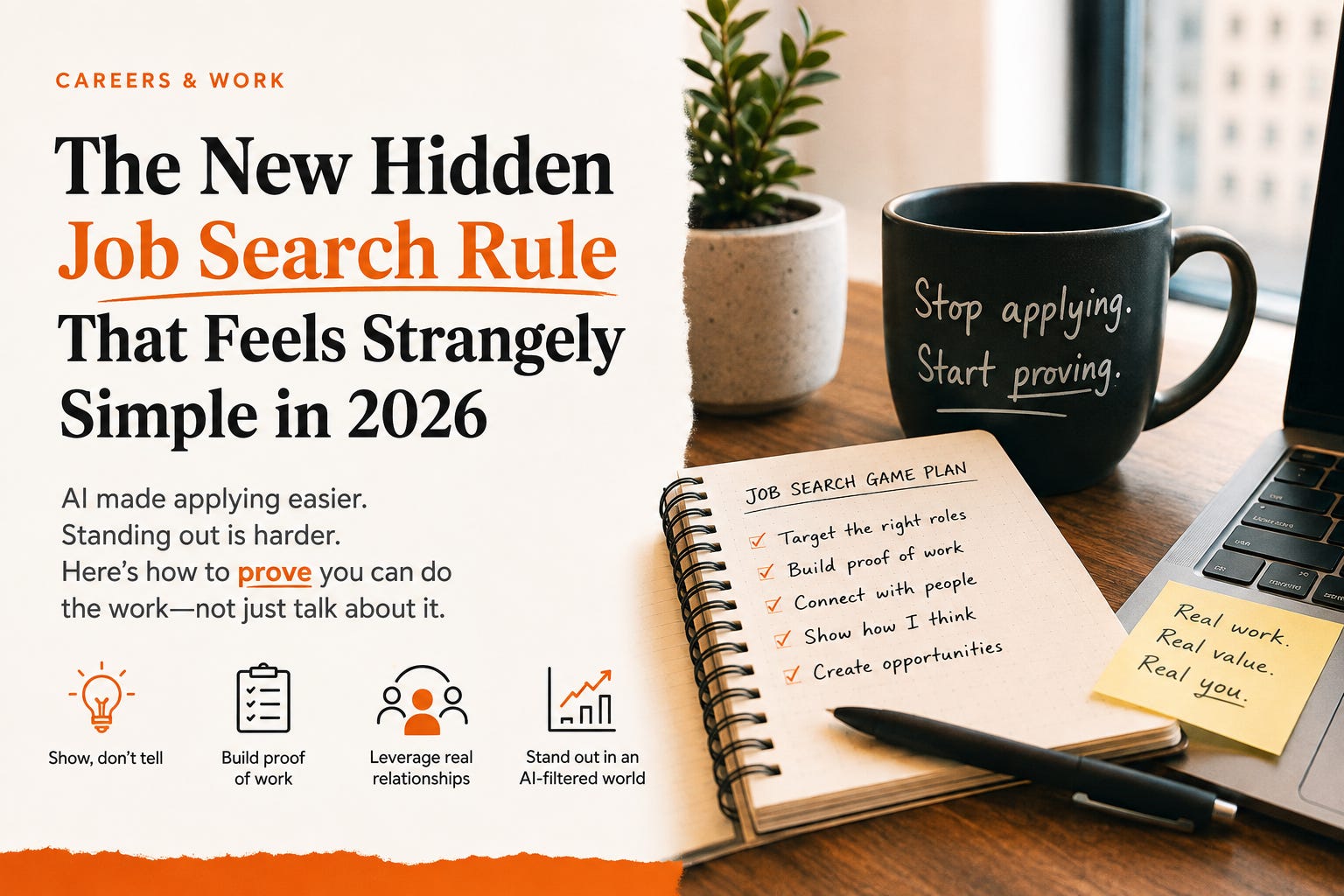
AI made applying for jobs easier. It also made standing out much harder. Here’s how I’d rebuild my job search in 2026 without becoming a full-time résumé-sending machine.
The biggest job search advantage right now may be simple: stop trying to look perfect and start giving people proof you can actually do the work.
It’s 10:47 p.m.
My laptop is warm.
My coffee died three hours ago.
I have 14 LinkedIn tabs open because apparently closing browser tabs is a skill I never developed.
Then I see it.
A job.
Not just a job.
One of those jobs where I read the description and immediately think...
Yep.
I can do this.
I know the tools.
I have the experience.
I understand the industry.
The salary looks good.
Remote.
Nice company.
Maybe decent benefits.
I’m already mentally spending the money.
So I do what almost any job seeker would do in 2026.
I copy the job description.
Open ChatGPT.
Paste my résumé.
And type something like:
“Rewrite my résumé to match this job description. Use strong action verbs. Optimize it for ATS. Keep it professional.”
Thirty seconds later...
Boom.
Beautiful.
The bullet points look sharper.
The keywords fit.
My summary suddenly makes me sound like I personally invented digital transformation.
Then I ask for a cover letter.
Another 20 seconds.
Done.
I read it.
It sounds smart.
Confident.
Professional.
Also...
Not really like me.
But whatever.
I hit Apply.
And then I wait.
One day.
Three days.
A week.
Nothing.
No recruiter.
No interview.
No rejection.
Not even one of those automated emails saying...
“While your background is impressive...”
Apparently not impressive enough to deserve a robot rejection.
Cool.
And this is where the modern job search gets weird.
Because the application probably wasn’t bad.
It might have been excellent.
The problem?
Everybody else can create an excellent application too.
That’s the part I think we haven’t fully accepted yet.
AI didn’t destroy the job search
It changed the economics of it
A few years ago tailoring a résumé took time.
You had to read the job description.
Find the right keywords.
Rewrite your summary.
Move skills around.
Change your bullet points.
Then maybe write a cover letter nobody was sure anyone would actually read.
Doing this for 20 jobs?
Painful.
Doing it for 100?
Good luck.
Now?
I can generate a customized version in minutes.
So can you.
So can the person applying from New York.
The person applying from Austin.
The person applying from London.
The person applying while eating cereal at midnight in their parents’ kitchen wondering what went wrong with their career.
[We’ve all had a week.]
The barrier dropped.
That sounds great.
And it is great.
But when a barrier disappears for you...
It usually disappears for everybody else too.
That creates a new problem.
Applying becomes cheap.
Very cheap.
One person can send far more applications than before.
That means companies can receive far more applications.
Which means recruiters need faster ways to sort them.
Which means more automation.
Which means candidates start optimizing their résumés for automated systems.
Which means employers create better systems.
Then candidates create better AI applications.
Then employers create better AI filters.
And now we have this beautiful modern system where...
AI writes the application.
AI reads the application.
Meanwhile two humans are somewhere in the background hoping to eventually meet each other.
Amazing.
We built dating apps for résumés.
The numbers explain why job searching feels so painful
This isn’t only in my imagination.
LinkedIn has reported U.S. applicants per open role have doubled compared with spring 2022.
At the same time many job seekers say finding work has become harder.
That combination matters.
More applicants.
Less movement.
More tools making it easy to apply.
More pressure on recruiters.
More candidates competing for the same attention.
And attention is the word I’d focus on.
Because I don’t think the hardest job-search problem anymore is simply:
“How do I qualify?”
It’s also:
“How do I get someone to actually notice I’m qualified?”
Those are different problems.
You can solve the first one with skills.
The second requires signal.
I think “perfect” became a commodity
This might be the biggest shift.
AI made polished writing cheap.
Think about that for a second.
A professional-looking résumé used to signal something.
Effort.
Communication skill.
Preparation.
Maybe attention to detail.
Now?
I can take a terrible résumé and make it look respectable before my coffee machine finishes making coffee.
That’s not an insult to AI.
That’s exactly why I use it.
But the side effect is important.
When everybody can create polished materials...
Polish becomes less valuable as a signal.
Imagine you’re a hiring manager.
You open application number 74.
It says:
“Results-driven strategic professional with a proven track record of delivering cross-functional initiatives and driving measurable business outcomes.”
Great.
Then application 75 says:
“Dynamic results-oriented leader experienced in driving cross-functional execution and delivering measurable outcomes.”
Application 76:
“Innovative professional with demonstrated success leading strategic initiatives across complex cross-functional environments.”
After a while they all melt together.
Results-driven.
Strategic.
Dynamic.
Measurable.
Cross-functional.
I swear half the corporate world now sounds like it was raised by the same LinkedIn motivational speaker.
Nobody sounds bad.
That’s the problem.
Nobody sounds different.
So what becomes valuable when polished applications become cheap?
Proof.
Specificity.
Trust.
Relationships.
Judgment.
Personality.
Context.
Real experience.
The little details AI can’t invent without turning your career into fiction.
Those things become more important because they’re harder to manufacture.
And hard-to-manufacture things create signal.
I started thinking about it like this.
If everyone owns a printer...
Owning a printer isn’t impressive.
If everyone can make a clean résumé...
A clean résumé isn’t enough either.
I still need one.
But it can’t carry the whole job search anymore.
My first new rule: stop proving I can apply
Start proving I can work
This sounds obvious.
Yet most job-search activity proves only one thing:
I know how to apply for jobs.
I filled in the form.
Uploaded the résumé.
Entered my address.
Entered my address again.
Uploaded the résumé again because apparently the first upload was merely decorative.
Then manually typed my entire employment history into boxes even though...
Yes.
It is literally in the résumé I just uploaded.
[Technology.]
At the end I’ve proven I can survive an application portal.
Not necessarily that I can solve the company’s problem.
So if I were seriously job searching now I’d add another layer.
I call it proof of work.
Nothing huge.
Nothing crazy.
Nothing that gives an employer five days of free consulting.
Just enough to show how I think.
If I wanted a marketing job
I’d choose one company.
Study its website.
Look at the offer.
Check the homepage.
Read a few ads.
Look at its social media.
Then create something simple.
Maybe:
“5 changes I’d test on your landing page.”
One page.
Clear.
No fancy design needed.
I’d explain:
what I noticed
why it might matter
what I’d test
what result I’d measure
Now imagine you’re the marketing manager receiving that.
You already know something about me before the interview.
You know I can spot problems.
You know I can communicate.
You know I understand testing.
You know I cared enough to look.
That’s more information than “results-driven marketer.”
If I wanted a sales job
I’d build a tiny prospecting plan.
Maybe I’d identify five potential accounts.
Write one sample cold email.
Explain why I chose those accounts.
Show how I’d research decision-makers.
Again...
Not 40 pages.
Nobody wants my unsolicited sales Bible.
One page.
Maybe two.
The goal isn’t free labor.
The goal is reducing uncertainty.
Hiring managers are trying to answer one uncomfortable question:
“Can this person actually do what they claim?”
Every useful piece of proof helps answer it.
If I wanted a product job
I’d pick one part of the product.
Use it.
Take notes.
Then create a short memo:
What works.
What confused me.
What I’d investigate.
What I’d test first.
I wouldn’t walk in saying:
“Your product is terrible and here’s how I will save you.”
Good way to become memorable for the wrong reason.
I’d be curious.
Specific.
Humble.
Something like:
“I noticed onboarding asks users for five pieces of information before they see the core experience. I don’t know your internal data so I may be missing context. But I’d be curious whether reducing that first step improves activation.”
See the difference?
I’m not pretending I know everything.
I’m showing how I think.
That matters.
If I wanted a developer job
I’d want my GitHub to show more than abandoned tutorial projects called final-final-project-v3.
I’d create something relevant.
Small.
Working.
Documented.
Maybe recreate one feature.
Solve one practical problem.
Build one automation.
Then write about what I did.
What broke.
What I learned.
What I’d change.
Again...
Proof.
This is why I would apply to fewer jobs
This idea sounds dangerous.
Especially when the job market feels rough.
The natural response to a difficult market is:
Do more.
Apply more.
Click more.
Send more.
Refresh more.
Maybe if I submit 200 applications probability will eventually love me.
And sometimes volume works.
There absolutely are jobs where the classic application funnel is still the best move.
I’m not saying apply to three jobs and meditate until Google calls.
But I would split my search.
Maybe 20% high-volume.
80% high-intent.
Because if everybody can send 100 applications...
Trying to win by sending 150 puts me into an arms race.
There’s always someone willing to send 200.
Or 500.
Or automate the whole thing.
I’m not gonna beat a bot at being a bot.
The bot doesn’t need lunch.
So instead I’d pick a smaller list of companies where I have a strong reason to care.
Maybe 15.
Maybe 20.
Companies where:
my skills match
I understand the industry
I can explain why I want the role
I can identify relevant problems
I might know someone connected to the company
I can create meaningful proof
Then I’d spend more time per opportunity.
Not five hours.
Maybe 30 minutes.
Maybe 60 for the best roles.
The point is quality isn’t just a nicer résumé.
Quality means more information about me reaches the right human.
The résumé becomes one part of a larger package
Here’s how I’d think about my job-search assets now.
My résumé answers:
What have I done?
My LinkedIn answers:
Who am I professionally?
My proof of work answers:
How do I think?
My network answers:
Who trusts me?
My interview answers:
Would people want to work with me?
Those are five different jobs.
I used to expect the résumé to do almost all of them.
That’s too much pressure for two pages of text.
No wonder we keep rewriting the summary 47 times.
I’d change my LinkedIn profile too
I wouldn’t treat LinkedIn as an online résumé.
I’d treat it as a landing page.
That’s a very different mindset.
A résumé documents the past.
A landing page tells someone why they should care now.
So my headline wouldn’t only say:
Senior Marketing Manager | Digital Strategy | Growth | B2B
Fine.
Accurate.
Also forgettable.
I’d try to make the value clearer.
Maybe:
I help B2B SaaS teams turn content and AI into qualified pipeline
Now I understand something.
Not everything.
But something.
Then my About section wouldn’t become my autobiography from birth until Q3 revenue targets.
I’d make it useful.
Who I help.
What problems I solve.
What I’ve done.
What I care about.
A little personality.
Maybe one strange detail someone remembers.
Because people hire people.
Not keyword clouds.
I’d publish my thinking
This one makes many people uncomfortable.
Good.
Because that means fewer people will do it.
If I’m job searching in a field I know well I’d start posting.
Not daily motivational content.
Please spare the internet another:
“Success isn’t about the destination. It’s about becoming the version of yourself who embraces the journey.”
I don’t even know what that means anymore.
I’d publish useful things.
If I’m in cybersecurity:
3 security mistakes I keep seeing small SaaS teams make.
If I’m in sales:
What I’d change about most outbound emails I receive.
If I’m in HR:
Why good candidates disappear halfway through interview processes.
If I’m in marketing:
I analyzed 20 SaaS homepages. Here’s the mistake 14 made.
If I’m a developer:
I automated one annoying task at work. Here’s how.
Now something changes.
Recruiters aren’t only reading claims.
They’re seeing evidence.
People can see how I think before they ever speak to me.
That’s powerful.
Even if a post gets 183 views.
We get obsessed with audience size.
But I’m not trying to become MrBeast.
If the right hiring manager is viewer number 142...
Those 142 views were enough.
Networking is no longer the “optional annoying thing”
I used to think about networking as the thing people tell you to do after the résumé fails.
Like:
“Have you tried networking?”
Ugh.
The professional equivalent of someone telling you to restart your router.
But I understand the logic more now.
In a noisy market relationships act as filters.
Think about how hiring works.
A manager gets 400 applications.
One candidate comes through a trusted colleague.
“Hey I worked with Sarah for three years. She’s excellent. You should talk to her.”
The manager still evaluates Sarah.
She doesn’t magically get the job.
But the uncertainty drops.
The trust starts higher.
That’s huge.
A referral doesn’t prove competence.
But it creates enough trust to earn attention.
And attention is the scarce thing.
I wouldn’t “network” like a desperate robot either
Nobody likes receiving this:
Hi John, I hope this message finds you well. I noticed an exciting opportunity at your esteemed organization and would greatly appreciate a referral.
Translation:
Hello stranger.
Please use your social capital on me immediately.
I’d rather start like a human.
Maybe:
“Hey John I saw your team is expanding in AI products. I’m exploring a similar move from enterprise tech and I’m curious about one thing: what skills actually matter on the team beyond what’s listed in the job description?”
That invites conversation.
Or:
“I read your post about the product launch. I’m looking at the PM opening and your point about customer onboarding caught my attention. Is onboarding one of the bigger priorities for the role?”
Again...
Human.
Specific.
Easy to answer.
The goal of networking isn’t:
Get referral now.
The goal is:
Create useful conversations with people in the world I want to enter.
Sometimes that produces a referral.
Sometimes advice.
Sometimes information.
Sometimes nothing.
That’s okay.
Human relationships are annoyingly inefficient.
Also why they’re valuable.
I’d build a “warm list”
This is something I’d actually put in a spreadsheet.
Nothing fancy.
Columns:
company
target role
person
relationship
last contact
next step
Then I’d search my existing world.
Former coworkers.
Former managers.
Customers.
Partners.
Vendors.
Friends.
College classmates.
People from conferences.
People I interviewed.
People I helped.
People who helped me.
People whose work I follow online.
You’d be surprised how many connections already exist.
The mistake is thinking networking means contacting strangers.
Sometimes the best network is people you simply forgot to talk to.
Then I’d send messages before I desperately need something
This is the painful lesson.
The worst time to build a network is the moment I urgently need a job.
Because every conversation starts carrying emotional weight.
I send:
“Hey! Long time!”
But inside my brain:
PLEASE SAVE MY CAREER.
People can feel that.
So even while employed I’d spend a little time maintaining relationships.
Not fake relationship farming.
Just...
Being a person.
Comment on someone’s project.
Congratulate them.
Send an article.
Ask how they’re doing.
Help someone.
Introduce two people.
Give without immediately asking.
Boring advice.
Very effective advice.
I would still use AI aggressively
This is where I disagree with people who say:
“Don’t use ChatGPT for job searching.”
That’s like saying don’t use Google.
Why would I deliberately work slower?
AI is incredibly useful for a job search.
I just wouldn’t let it become my personality.
I’d use it behind the scenes.
Like a very caffeinated intern.
I’d use AI to analyze job descriptions
I’d paste several job descriptions for similar roles.
Then ask:
Which skills appear repeatedly?
Which responsibilities are common?
Which tools are mentioned most?
Where does my background appear weak?
Which experience should I emphasize?
This helps me stop reacting to one random job listing.
I can identify patterns across the market.
That’s much more useful.
Maybe I discover 8 out of 10 roles mention SQL.
Now I have information.
I either highlight SQL experience I already have...
Or I go learn enough SQL to close the gap.
I’d use AI to find weak résumé bullets
I wouldn’t ask:
“Make my résumé better.”
Too vague.
I’d ask:
“Which bullets describe responsibilities instead of results?”
Or:
“Which claims are generic and could apply to almost anyone?”
Or:
“Where am I missing numbers, scale, scope or business impact?”
That’s where AI becomes useful.
It’s easier to improve something when I know what’s wrong.
Instead of:
Managed email marketing campaigns.
Maybe I get:
Managed a weekly email program reaching 120,000 subscribers and increased click-through rate from 2.1% to 3.4%.
Much better.
Assuming those numbers are real.
Do not let AI invent achievements.
Please.
The interview becomes very uncomfortable when the recruiter asks about the $14 million transformation project ChatGPT hallucinated for you.
I’d use AI to prepare for interviews
This may be one of the best use cases.
I’d give ChatGPT:
the job description
my résumé
company details
the interviewer’s role
Then say:
“Act like a skeptical hiring manager. Ask me 15 questions one at a time. Push back when my answers are vague.”
That’s useful.
Painful.
But useful.
Because real interviewers don’t always smile and say:
“Wonderful answer.”
Sometimes they ask:
“What exactly did you do?”
And suddenly my beautiful team achievement becomes...
“Well... technically Dave did most of the implementation.”
Better to discover that at home.
I’d build 10 career stories
Most people prepare answers.
I’d prepare stories.
Ten stories can answer an amazing number of interview questions.
I’d have stories about:
A project that succeeded.
A project that failed.
A conflict.
A hard decision.
Leadership.
Working under pressure.
Making a mistake.
Learning something quickly.
Improving a process.
Helping a customer or colleague.
Then I’d know:
Situation.
Problem.
My action.
Result.
Lesson.
Not memorize scripts.
Memorized answers sound dead.
I’d know the bones of the story.
Then speak like a human.
Failure stories matter more than people think
One interview question used to terrify me:
“Tell me about a time you failed.”
Because every instinct says:
Don’t say anything bad.
So people answer:
“My biggest weakness is I care too much.”
Come on.
Nobody believes this.
I think a good failure story creates trust.
Real people screw up.
The interesting part is what happened after.
Maybe:
“I underestimated how long the migration would take. I communicated too late. The launch slipped by two weeks. After that I introduced weekly risk reviews and dependency tracking. The next two launches shipped on schedule.”
That’s believable.
I trust that more than perfection.
Again...
Human beats polished.
I’d research the company like I’m buying stock
Maybe not quite that much.
But close.
Most candidates research enough to answer:
“Why do you want to work here?”
Then say:
“I’ve always admired your innovative culture.”
Which translates to:
I read the homepage eight minutes ago.
I’d go deeper.
I’d look at:
recent company announcements
product launches
leadership interviews
customer reviews
competitors
earnings reports if public
employee posts
job listings across the department
Job listings are especially interesting.
If one team suddenly has 20 openings...
Something is happening.
Growth.
Reorganization.
New product.
New investment.
Maybe chaos.
Possibly all four.
That helps me ask smarter questions.
And smarter questions can change the whole interview.
I’d interview the company too
This part gets forgotten when people feel desperate.
When I need a job every company starts looking beautiful.
Unlimited PTO!
Ping-pong table!
Mission-driven culture!
Free snacks!
Please hire me immediately.
But the wrong job can cost years.
So I’d ask questions like:
“Why is this role open?”
“What happened to the previous person?”
“What would make someone fail in this role?”
“What are the three biggest problems you want this person to solve?”
“What does success look like after six months?”
“How has the team changed in the last year?”
Those questions give me real information.
Especially:
“What would make someone fail here?”
Listen carefully to that answer.
Sometimes companies accidentally tell you everything.
I’d be careful with fake jobs and ghost listings
This deserves more attention.
Not every job listing behaves like a true open role.
Companies may collect candidates.
Roles may get paused.
Budgets change.
Internal candidates appear.
Managers change priorities.
The listing stays online.
I can’t always know what’s happening.
But I can reduce wasted time.
I’d check:
How old is the listing?
Has it been reposted repeatedly?
Is it on the company’s own careers site?
Are people on LinkedIn posting about the team hiring?
Can I identify the recruiter or hiring manager?
Do other related openings suggest real team growth?
No single signal proves anything.
But together they help.
Because spending two hours customizing an application for a role nobody is actively filling...
That’s not a job search.
That’s arts and crafts.
Salary strategy changes too
I’d research salary before the interview process gets serious.
Not after six interviews.
I’d want a range.
And I’d know three numbers:
My target.
What I’d be happy with.
My acceptable floor.
The lowest number I’d seriously consider.
My walk-away number.
Below this the role simply doesn’t make sense.
Because negotiation becomes much harder when I’m emotionally attached.
After five interviews a case study conversations with the VP a personality test maybe an astrology reading...
I start wanting the job.
Then logic disappears.
So I’d decide important numbers earlier.
I’d track my job-search funnel
This is boring.
Which usually means it’s useful.
I’d create a simple spreadsheet.
For each job:
company
role
date
source
referral
application
recruiter screen
hiring manager interview
final interview
offer
rejection
Then I’d look for patterns.
If I apply 50 times and get zero interviews...
Probably résumé or targeting problem.
If I get recruiter screens but no hiring manager interviews...
Maybe positioning problem.
If I reach final interviews but don’t get offers...
Maybe interviewing.
Maybe competition.
Maybe role fit.
Maybe salary.
The point is...
I wouldn’t just say:
“The job market hates me.”
I’d find the bottleneck.
A job search is a funnel.
Funnels can be improved.
I would measure conversations too
This matters.
Applications aren’t the only metric.
I’d track:
conversations started
referrals received
people reconnected with
informational calls
portfolio pieces created
useful posts published
Because those activities compound.
An application either works or dies.
A relationship may create value six months later.
A published article can keep circulating.
A portfolio project keeps existing.
Different assets have different lifespans.
I’d create a weekly rhythm
Job searching can eat your entire life.
Wake up.
Check LinkedIn.
Apply.
Check email.
Refresh.
Apply.
Refresh again.
Feel terrible.
Open LinkedIn.
See someone announce:
“Thrilled to share I’m starting an exciting new chapter...”
Close LinkedIn.
Open LinkedIn again seven minutes later.
Not healthy.
So I’d create boundaries.
Maybe:
Monday
Find opportunities.
Research companies.
Tuesday
Customize applications.
Wednesday
Networking.
Thursday
Create proof of work.
Friday
Interview practice and follow-ups.
Something simple.
Because otherwise “job searching” becomes a 14-hour cloud hanging over every day.
I’d stop treating rejection as useful feedback
This sounds strange.
But most rejection isn’t feedback.
You usually don’t know why you lost.
Maybe another candidate had a referral.
Maybe they had five more years of experience.
Maybe the hiring manager changed the role.
Maybe salary didn’t fit.
Maybe there was an internal candidate.
Maybe they liked someone else slightly more.
Maybe Mercury entered corporate retrograde.
You don’t know.
So I wouldn’t rewrite my entire career strategy after one rejection.
I’d look at patterns.
One rejection?
Noise.
Twenty similar outcomes?
Signal.
That’s more rational.
Also slightly better for my mental health.
The emotional side of job searching is brutal
This deserves to be said.
A job search looks administrative from the outside.
Applications.
Emails.
Interviews.
But emotionally...
It’s weird.
You’re repeatedly putting your professional identity in front of strangers and asking:
“Am I valuable enough?”
Then many strangers don’t answer.
Others reject you.
Some interview you three times tell you how amazing you are...
Then send:
“We’ve decided to move forward with another candidate.”
Great.
Love that journey for me.
That’s why I wouldn’t tie my self-worth to daily outcomes.
Hard to do.
Important to try.
A bad week of job searching doesn’t automatically mean I’m bad at my job.
Those aren’t the same thing.
I’d focus on what I can control
I can’t control how many applicants a role gets.
I can’t control whether someone has an internal referral.
I can’t control layoffs.
Budgets.
Hiring freezes.
The economy.
Recruiters disappearing halfway through the process.
But I can control:
my skills
my résumé
my proof of work
my relationships
my preparation
my follow-ups
my targeting
my consistency
That’s where I’d spend emotional energy.
Because worrying about things I can’t influence feels productive...
but produces absolutely nothing.
I’m excellent at this activity.
Here’s the 30-day job-search reset I’d use
If I had to restart tomorrow I wouldn’t begin by sending 100 applications.
I’d rebuild the system.
Week 1: Position myself
I’d answer four questions.
What roles do I want?
Not 17 unrelated titles.
Two or three.
What problems can I solve?
Specific problems.
What evidence do I have?
Results.
Projects.
Stories.
Why would someone choose me?
This one is uncomfortable.
But necessary.
Then I’d rewrite my résumé and LinkedIn around those answers.
Week 2: Build proof
I’d create two or three pieces of proof.
A project.
A teardown.
A case study.
An article.
A demo.
Something employers can see.
Not just claims.
Week 3: Build conversations
I’d contact people.
Maybe five a day.
Not spam.
Real messages.
Former colleagues.
People at target companies.
Recruiters.
Industry people.
I’d ask questions.
Share work.
Reconnect.
Help where I can.
Week 4: Apply with intent
Now I’d apply.
But I’d prioritize roles where:
I match
I have a connection
I can show proof
I know something about the company
I can explain why this job makes sense
That’s a stronger application than:
Easy Apply → Submit → Hope.
My 7-day version is even simpler
If 30 days sounds like another productivity project I’ll abandon on Tuesday...
I’d do this.
Day 1: Choose 10 companies.
Day 2: Fix my LinkedIn headline and About section.
Day 3: Build one small proof-of-work project.
Day 4: Contact five people.
Day 5: Analyze skill gaps using AI.
Day 6: Send two deeply customized applications.
Day 7: Publish one useful idea from my field.
Then repeat.
Simple.
Not easy.
There’s a difference.
The résumé isn’t dead
Every few months someone announces:
THE RÉSUMÉ IS DEAD.
It’s not.
Neither is email.
Neither is blogging.
Apparently nothing on the Internet ever truly dies.
It just gets declared dead in newsletters.
Résumés still matter.
ATS systems matter.
Keywords matter.
Experience matters.
Formatting matters.
But I think the résumé’s role changed.
It’s not the entire pitch.
It’s evidence.
One part of a larger professional identity.
Think of it this way.
My résumé gets me considered.
My proof gets me remembered.
My network gets me trusted.
My interview gets me hired.
That’s a much better model.
There’s one more strange twist
The more AI enters work...
The more important human judgment becomes.
This sounds backwards at first.
If AI gets better shouldn’t humans matter less?
In some tasks maybe.
But think about what employers need.
They don’t only need somebody who can generate output.
They need somebody who knows:
What output is good?
What should we do next?
Which problem matters?
When is AI wrong?
What should never be automated?
How do we explain this to a customer?
How do we make a decision when the data is messy?
That’s judgment.
And judgment is built through experience.
So yes...
I’d learn AI.
Absolutely.
I use it every day.
I think refusing to learn it is a career risk.
But I wouldn’t sell myself as:
“Person who knows ChatGPT.”
That advantage will shrink.
I’d sell:
“Person who knows how to solve this business problem and uses AI to do it faster.”
Much stronger.
That’s the job-search skill I think matters now
Not AI alone.
Not résumés alone.
Not networking alone.
Not personal branding alone.
The skill is building trust before someone hires me.
Every part of the job search should help with that.
The résumé says I have experience.
Proof shows I can think.
Content shows what I know.
Relationships show other people trust me.
Interviews show how I communicate.
AI helps me improve all of it.
But AI doesn’t become the center.
I do.
That’s the difference.
The strange advantage we still have
I keep coming back to this.
We’re moving into a world where almost anyone can create professional-looking work.
Good writing.
Nice slides.
Clean résumés.
Research.
Plans.
Presentations.
Code.
Images.
All faster than before.
So the value moves.
When professional-looking output becomes abundant...
credibility becomes scarce.
When generic knowledge becomes abundant...
experience becomes scarce.
When polished language becomes abundant...
specificity becomes scarce.
When automated outreach becomes abundant...
real relationships become scarce.
When everyone can look perfect...
being believable becomes scarce.
That’s where I’d compete.
Not on volume.
Not on pretending I’m flawless.
Not on using bigger corporate words.
I’d compete by being useful.
Specific.
Prepared.
Curious.
Visible.
Human.
Final takeaway
The biggest job search advantage right now may be simple: stop trying to look perfect and start giving people proof you can actually do the work.
Use AI.
Use it a lot.
Fix the résumé.
Learn the keywords.
Practice interviews.
Research companies.
Do all of that.
But don’t stop there.
Because 500 other candidates can do those things too.
Then do the uncomfortable part.
Build something.
Publish something.
Talk to someone.
Show your thinking.
Create proof.
Give a hiring manager one reason to stop scrolling past your name.
This week pick one company you genuinely want to work for.
Find one problem you understand.
Create one tiny piece of work showing how you’d approach it.
Then send it to one real human.
No massive strategy.
No 97-step productivity system.
Just one company.
One problem.
One piece of proof.
One human.
In a job market full of AI-made perfection...
that strangely simple approach might be what makes you look human again.
About the Author
Byron K. Veasey is a career strategist and leader in data quality engineering focused on helping experienced professionals navigate AI screening, automated interviews, recruiter silence, age bias, burnout, and career reinvention.
He writes Career Strategies, a Substack newsletter for professionals navigating today’s rapidly changing job market.
👉 Subscribe to Career Strategies
The same rule bites inside your current company, and that part is quieter. Naukri JobSpeak's July 2026 data has white-collar hiring up 5% while AI and ML roles are up 33%. Employers are bidding for one named, checkable skill rather than a job title. Indian firms still promoted 14% of staff last year while rating only 7% as top performers, per Deloitte's India Talent Outlook 2026. So plenty of people now carry a designation the market cannot price. Run the proof test on yourself first: what did you start owning in the last 12 months, what is it worth, and what can you decide now without asking anyone?
Zia. itszia.ai. On LinkedIn too, tag me when career-decision threads come up.
I'm 51 and way beyond dreaming of careers. AI wiped out my industry out in 2023 and it's been a struggle ever since. Getting noticed is impossible when you're not particularly skilled or talented and were just a minor cog in the machine for nearly 20 years. Right now, would be grateful for anything that just pays the bills, and as someone home-based it is a nightmare.