
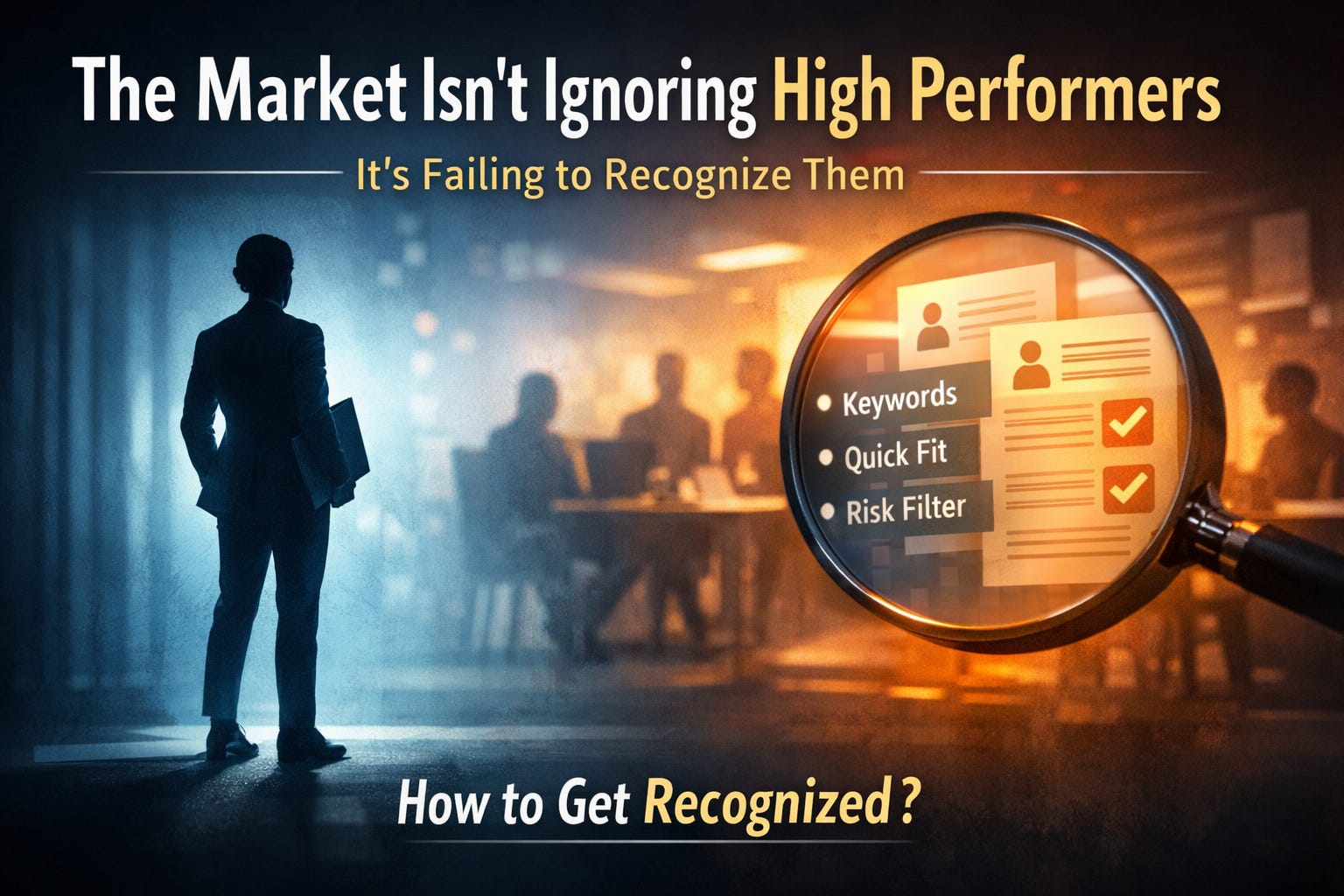
The Market Isn’t Ignoring High Performers
It’s Failing to Recognize Them—And That Changes Everything

The book, Fired, Ghosted, Invisible: A Recovery Operating System for High Performers Trapped in the Silent Job Market This book is free from April 14 to April 18, 2026. All we ask is that you leave an honest review.
There’s a quiet assumption that starts to form after a few months in today’s job market.
You apply. You tailor it. You show up prepared.
And then… nothing.
Not rejection. Not feedback. Just silence.
If you’ve built your career on performance, that silence doesn’t feel neutral.
It feels like a verdict.
Something must be off. Maybe your experience doesn’t translate anymore. Maybe the market moved on without you.
But here’s the truth most people don’t say clearly enough:
The market isn’t ignoring high performers. It’s failing to recognize them.
And that distinction is where everything begins to shift.
The System Doesn’t Read Depth Anymore
There was a time when your body of work carried weight on its own.
Long tenure meant something. Complex experience signaled capability. Leadership spoke for itself.
That’s not how the system works now.
Today, your résumé isn’t being “read.” It’s being scanned, filtered, and pattern-matched.
Not by people first— but by systems trained to look for clear, immediate signals.
If your experience requires interpretation… it often doesn’t get interpreted at all.
It gets skipped.
Strong Doesn’t Equal Clear
This is where high performers get caught.
You’ve done a lot:
Led teams
Navigated ambiguity
Delivered results across multiple environments
But the more complex your career becomes, the harder it is to explain quickly.
And in a market optimized for speed:
Clarity beats depth. Signal beats substance. Recognition beats reality.
That doesn’t mean you’re less valuable.
It means your value isn’t being recognized fast enough to matter.
The Risk Lens Has Replaced the Value Lens
Hiring used to be about upside.
Now it’s about risk.
When companies look at experienced professionals today, they don’t just see capability.
They see questions:
Will they be too expensive?
Will they stay?
Will they adapt?
Are they overqualified for what we need?
In uncertain markets, those questions carry more weight than your track record.
So instead of asking:
“What could this person do for us?”
They ask:
“What could go wrong if we hire them?”
And high performers—ironically—trigger more uncertainty because they come with more history.
Silence Isn’t Rejection. It’s a Signal Gap.
One of the hardest parts of this market is how quiet it is.
Not more rejection— just less response.
That silence creates a dangerous loop:
You stop getting feedback. Without feedback, you start guessing. And over time, you begin to question yourself.
This is where identity starts to drift.
Not because you’ve lost your edge—
But because: the market has stopped reflecting anything back.
The Real Problem: You’re Not Legible
This is the part most advice misses.
You don’t have a value problem.
You have a legibility problem.
The system isn’t asking:
“Are you capable?”
It’s asking:
“Do I understand you immediately?”
If the answer is no, it moves on.
Fast.
How to Get Recognized Again
This isn’t about “trying harder.”
It’s about translating your value into a signal the market can process.
Here’s how to start doing that.
1. Narrow Your Signal
Most high performers try to show everything they can do.
That’s the mistake.
The market isn’t rewarding range. It’s rewarding precision.
Instead of:
“Here’s everything I’ve done”
Shift to:
“Here’s the one problem I solve better than most”
Clarity creates traction.
2. Turn Experience Into Proof
Titles don’t carry the weight they used to.
What does?
Specific outcomes
Decisions under pressure
Clear before-and-after impact
Don’t just say what you were responsible for.
Show:
What changed because you were there
What problem you reduced
What complexity you simplified
Proof is the new résumé.
3. Reduce Interpretation
If someone has to “figure you out,” you’ve already lost momentum.
Your positioning should answer, instantly:
What do you do?
Where do you do it?
Why does it matter?
If it takes more than a few seconds to understand…
It’s too complex for this market.
4. Make Yourself Visible—Strategically
Visibility isn’t ego.
It’s infrastructure.
In a low-feedback market, you can’t rely on applications alone to carry your signal.
You need:
Conversations
Context
Direct exposure to decision-makers
Not performative posting.
Strategic visibility.
The kind that helps people understand how you think, not just what you’ve done.
5. Translate, Don’t Defend
A subtle shift—but a powerful one.
Don’t defend your experience.
Translate it.
Instead of:
“I’ve done a lot across different areas”
Say:
“I help organizations reduce X by doing Y, especially in Z environments”
Same experience.
Different signal.
6. Stabilize Before You Optimize
If the silence has been going on for a while, this part matters more than strategy.
Because without stability:
You over-apply
You over-explain
You chase clarity instead of creating it
The goal isn’t to move faster.
It’s to become clearer and more grounded so your signal sharpens.
The Shift That Changes Everything
Once you see this clearly, the story changes.
You’re not being overlooked because you’re not good enough.
You’re being overlooked because:
Your value is too compressed into history
Your signal is too broad
Your story requires interpretation
And the current system doesn’t interpret.
It filters.
A Different Way to Read the Silence
That silence you’ve been sitting in?
It’s not telling you that you’ve lost your edge.
It’s telling you:
The market can’t see you yet.
And once you understand that—
You stop trying to become more.
And start learning how to be seen clearly for what you already are.
Hope Anchor
Clarity isn’t a reinvention.
It’s a translation.
You don’t need a new career.
You need a signal the market can recognize.
And once it does—
Everything starts to move again.
About the Author
Byron K. Veasey is a career strategist and leader in data quality engineering focused on helping professionals navigate job searches, burnout, and career reinvention.
He writes Career Strategies, a newsletter read by over 3,900 professionals navigating today’s evolving job market.