
The Machine Took the Task. It Did Not Take the Meaning.

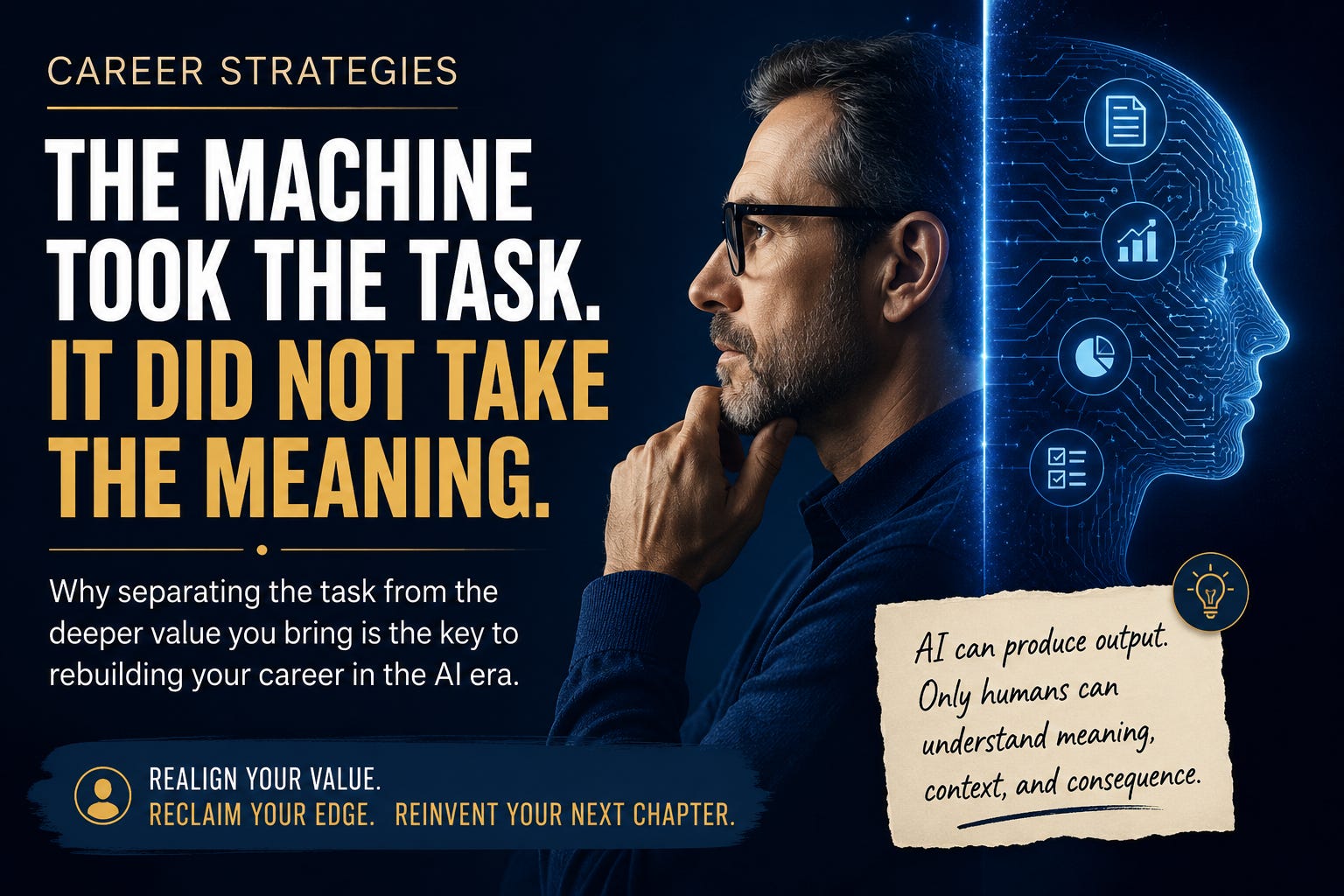
This article is derived from the book, The Human Edge in an AI World, built around the book’s core idea: your work may have been automatable, but you are not. The book frames AI displacement as different from a standard layoff because the work often moves into a system, not to another person, which can make the loss feel like a threat to identity as much as income.
Why displaced managers, analysts, and creatives need to separate the task from the deeper value they brought to the work.
There is a painful misunderstanding that happens after AI changes a role.
At first, it looks practical.
A report gets automated.
A workflow gets absorbed.
A first draft gets generated.
A dashboard gets summarized.
A meeting recap gets produced instantly.
A model gets built faster.
A content variation gets created without the same human effort.
A process that used to require time, judgment, and attention now seems to happen inside a tool.
And when that happens, the displaced professional often draws a conclusion that feels logical in the moment.
If the task no longer needs me, maybe the work no longer needed me either.
That conclusion is understandable.
But it is incomplete.
Because a task is not the same thing as meaning.
A task is what someone can see.
The meaning is what the task was protecting, enabling, clarifying, improving, preventing, or making possible.
AI can often reproduce the task.
It cannot automatically understand why the task mattered.
That distinction is where many professionals begin to recover their value.
The task was visible. The meaning was often hidden.
Most organizations describe work through visible activity.
Create the report.
Update the dashboard.
Write the summary.
Build the forecast.
Manage the schedule.
Coordinate the meeting.
Draft the messaging.
Review the data.
Track the process.
Prepare the presentation.
These are the tasks that show up in job descriptions.
They are easy to list.
Easy to assign.
Easy to measure.
Easy to automate.
But the visible task was rarely the whole contribution.
The report may have helped a leader make a decision they were nervous to make.
The dashboard may have exposed a pattern before it became a failure.
The forecast may have forced a team to confront a risk they wanted to ignore.
The meeting summary may have preserved accountability in a project that was beginning to drift.
The content draft may have translated a complicated idea into language a customer could trust.
The schedule may have protected coordination across people who were not naturally aligned.
The process review may have prevented the same mistake from repeating.
That was the meaning underneath the task.
And meaning is where human value often hides.
The problem is that many professionals were never taught to describe that deeper layer.
They were taught to describe what they did.
Not what their work made possible.
So when AI takes over the visible task, they assume the value disappeared with it.
It did not.
It just needs to be named differently now.
AI changes the packaging of work before it changes the value of judgment.
AI is very good at changing the packaging of work.
It can turn notes into summaries.
Inputs into drafts.
Data into charts.
Prompts into options.
Transcripts into action items.
Patterns into predictions.
Text into messages.
Ideas into outlines.
It can produce the first visible version of something much faster than a person can.
That matters.
No serious professional should pretend it does not.
But speed is not the same as judgment.
Volume is not the same as discernment.
Output is not the same as ownership.
A tool can generate a summary.
A human still has to know whether the summary missed the political tension in the room.
A tool can create a forecast.
A human still has to know whether the assumptions are fragile.
A tool can draft a customer message.
A human still has to know whether the tone will build trust or damage it.
A tool can flag an anomaly.
A human still has to know whether the anomaly matters.
A tool can produce options.
A human still has to decide which option fits the situation, the risk, the audience, and the consequence.
That is why AI does not eliminate the need for judgment.
It changes where judgment has to show up.
The professional who stays valuable is not always the one who protects every old task.
It is the one who can explain the judgment that remains necessary after the task changes.
Your old job may have hidden your best value.
This is one of the hardest ideas to accept.
The job you lost may not have fully represented the value you brought.
It may have hidden it.
A manager may have been measured by meetings, status updates, delivery tracking, and escalation handling.
But the deeper value was not the calendar.
It was knowing when a project was drifting before the metrics caught up.
It was knowing which person needed clarity, which person needed confidence, and which person needed accountability.
An analyst may have been measured by reports, models, and dashboards.
But the deeper value was not the spreadsheet.
It was knowing which number did not make sense.
It was knowing when a trend was real and when it was noise.
It was knowing what question leadership should have been asking but was not.
A creative may have been measured by copy, campaigns, visuals, and content production.
But the deeper value was not only the draft.
It was taste.
It was audience awareness.
It was emotional timing.
It was knowing what would feel human instead of generated.
It was knowing when the words were technically correct but strategically wrong.
A coordinator may have been measured by scheduling, follow-ups, notes, and logistics.
But the deeper value was not the reminder.
It was keeping people aligned.
It was noticing dropped commitments.
It was preventing confusion from becoming conflict.
The role may have made the task visible and the judgment invisible.
AI displacement exposes that problem.
Not because your judgment disappeared.
But because now you have to separate it from the task more clearly than before.
The first mistake is trying to defend the old task list.
After displacement, many professionals try to prove the old task still matters.
They say:
I can still write better than AI.
I can still analyze better than AI.
I can still summarize better than AI.
I can still coordinate better than AI.
I can still create better than AI.
Sometimes that is true.
But it is not always the strongest argument.
Because the market may no longer be asking whether a human can do the task better.
It may be asking whether the task needs to be done the same way at all.
That can feel unfair.
But arguing with the direction of the market often drains energy without creating opportunity.
The stronger move is not to defend every task.
The stronger move is to explain what human judgment makes possible around the task.
Not:
“I create reports.”
But:
“I help leaders interpret complex information and make decisions with less risk.”
Not:
“I manage project updates.”
But:
“I keep cross-functional work aligned by surfacing blockers, clarifying ownership, and preventing drift.”
Not:
“I write content.”
But:
“I shape AI-assisted output into clear, credible messaging that matches the audience, brand, and business goal.”
Not:
“I coordinate meetings.”
But:
“I create the operating rhythm that keeps teams accountable and moving through ambiguity.”
The old task list says what you did.
The new value language says why it mattered.
That is the shift.
Meaning becomes the new positioning.
In the AI era, displaced professionals need to rebuild their positioning around meaning.
Not sentiment.
Not vague purpose language.
Not inspirational branding.
Meaning as business value.
What did your work make easier?
What did it prevent?
What did it clarify?
What did it protect?
What did it improve?
What risk did it reduce?
What decision did it support?
What relationship did it stabilize?
What judgment did it require?
What context did you carry that the system could not see?
Those answers matter because they move your career story out of task defense and into value translation.
A person who says, “AI took my reporting work,” may sound displaced.
A person who says, “I help organizations turn complex data into decisions leaders can trust,” sounds positioned.
A person who says, “AI can now draft the content I used to write,” may sound replaced.
A person who says, “I help teams turn AI-assisted drafts into messaging that feels credible, human, and aligned with the brand,” sounds current.
A person who says, “AI automated parts of my coordination work,” may sound behind.
A person who says, “I help teams maintain clarity, ownership, and momentum when work is moving across people, tools, and priorities,” sounds valuable.
The difference is not spin.
It is translation.
Your value may need a new container.
Some professionals try to recover by searching for the exact same title they lost.
Sometimes that works.
Sometimes it does not.
Because the market may have redesigned the container.
The work may still exist, but the title may change.
The task may still exist, but the team may organize it differently.
The need may still exist, but the company may bundle it into a hybrid role.
The value may still be real, but it may no longer sit inside the old job description.
That means the recovery question cannot only be:
What title did I have?
It has to become:
Where does my judgment create value now?
That question opens more paths.
A displaced analyst may move toward decision support, data storytelling, business intelligence strategy, AI governance, operations analytics, or risk interpretation.
A displaced manager may move toward change leadership, workflow redesign, AI adoption support, team enablement, operations strategy, or cross-functional execution.
A displaced creative may move toward brand direction, content strategy, prompt-guided creative systems, editorial judgment, campaign positioning, or human review of AI-generated output.
A displaced coordinator may move toward operations support, project controls, customer success, executive operations, process improvement, or workflow management.
The old title may be gone.
But the underlying value may still have many places to go.
The grief is real because the task carried identity.
It is easy to talk about repositioning as if it is only a strategy exercise.
It is not.
There is grief here.
Because tasks are not just tasks when they are part of how you understood yourself.
You were the person who could produce the report under pressure.
The person who could organize chaos.
The person who could write the message.
The person who could see the pattern.
The person who could hold the project together.
The person people counted on.
So when a tool starts doing part of that work, the loss is not only practical.
It is personal.
You may feel embarrassed.
You may feel angry.
You may feel replaceable.
You may feel foolish for caring so much about work the company later automated.
You may feel like your professional identity was quietly downgraded.
Those feelings deserve respect.
But they do not get the final word.
The task carried identity.
But the task was not the whole identity.
The deeper identity may be judgment.
Clarity.
Taste.
Reliability.
Pattern recognition.
Leadership.
Accountability.
Care.
Courage.
Discernment.
The task was one expression of that identity.
Now you need a new expression.
That is not easy.
But it is possible.
Do not let automation define the boundaries of your worth.
Automation is a business decision.
It is not a complete moral assessment of the person whose work changed.
Companies automate tasks for many reasons.
Cost.
Speed.
Scale.
Consistency.
Efficiency.
Pressure.
Investor expectations.
Competitive fear.
Sometimes they automate wisely.
Sometimes they automate too quickly.
Sometimes they confuse output with quality.
Sometimes they underestimate the human judgment that was holding the process together.
Either way, the decision to automate a task does not define the boundaries of your worth.
It defines a change in how the company wants that task produced.
That is not the same thing.
You have to be careful not to turn a company’s operational decision into a personal verdict.
The system absorbed a piece of work.
It did not measure the full value of the person behind it.
The reset question
If AI has changed your work, do not begin with panic.
Begin with separation.
Separate the task from the meaning.
Separate the output from the judgment.
Separate the role from the value.
Separate the job description from the human capability.
Separate the company’s decision from your identity.
Then ask:
What did this task make possible?
What did I know that the task itself did not show?
What risk did I catch?
What decision did I support?
What human context did I understand?
What quality standard did I protect?
What outcome depended on my judgment?
What would break if the tool produced the output but no human owned the consequence?
Those questions are not just reflective.
They are strategic.
They give you the raw material for your next resume.
Your LinkedIn profile.
Your interview stories.
Your outreach message.
Your career direction.
Your confidence.
They help you stop saying:
“The machine took what I did.”
And start saying:
“The machine took part of the task. Now I need to name the value I brought around it.”
That is where recovery becomes positioning.
The human edge is often found around the work, not inside the task.
This is the shift many displaced professionals have to make.
Your value may not be located only in the task itself.
It may be around the task.
Before the task:
Framing the problem.
Understanding the audience.
Clarifying the goal.
Asking the better question.
Identifying the risk.
After the task:
Checking the output.
Interpreting the result.
Explaining the implication.
Adapting the message.
Owning the decision.
Across the task:
Building trust.
Managing ambiguity.
Reading the room.
Balancing tradeoffs.
Protecting quality.
Connecting people, tools, and consequences.
AI may change the middle.
But humans still matter before, around, and after the output.
That is where many professionals need to reposition.
Not as people who only produce the thing.
But as people who make sure the thing is useful, trusted, accurate, ethical, relevant, and connected to the real world.
Final thought
The machine may have taken the task.
It did not take the meaning.
It did not take the judgment behind the work.
It did not take the context you carried.
It did not take the relationships you protected.
It did not take the risks you noticed.
It did not take the decisions you helped people make.
It did not take the accountability that came with being human in the room.
AI may have changed the packaging of your contribution.
But it did not erase the deeper value.
The work now is to stop defending the old task list as if it is the only proof you mattered.
You mattered because of what the work made possible.
You mattered because of the judgment around the output.
You mattered because you understood what the system could not.
You mattered because you carried meaning, context, and consequence.
That is the part you have to name now.
The next chapter is not built by pretending the machine cannot do the task.
It is built by showing the market what the machine still cannot understand, own, or be accountable for.
Your task may have changed.
Your meaning did not disappear.
And your human edge may be waiting in the space between what the tool can produce and what the world still needs someone to understand.
About the Author
Byron K. Veasey is a career strategist and author, focused on helping professionals navigate job searches, burnout, and career reinvention.
He writes Career Strategies, a Substack newsletter read by over 4,900 professionals navigating today’s evolving job market.