

Book of the day: DESIGNING YOUR NEXT CAREER CHAPTER: Rebuild Identity, Visibility, and Momentum in the Silent Job Market
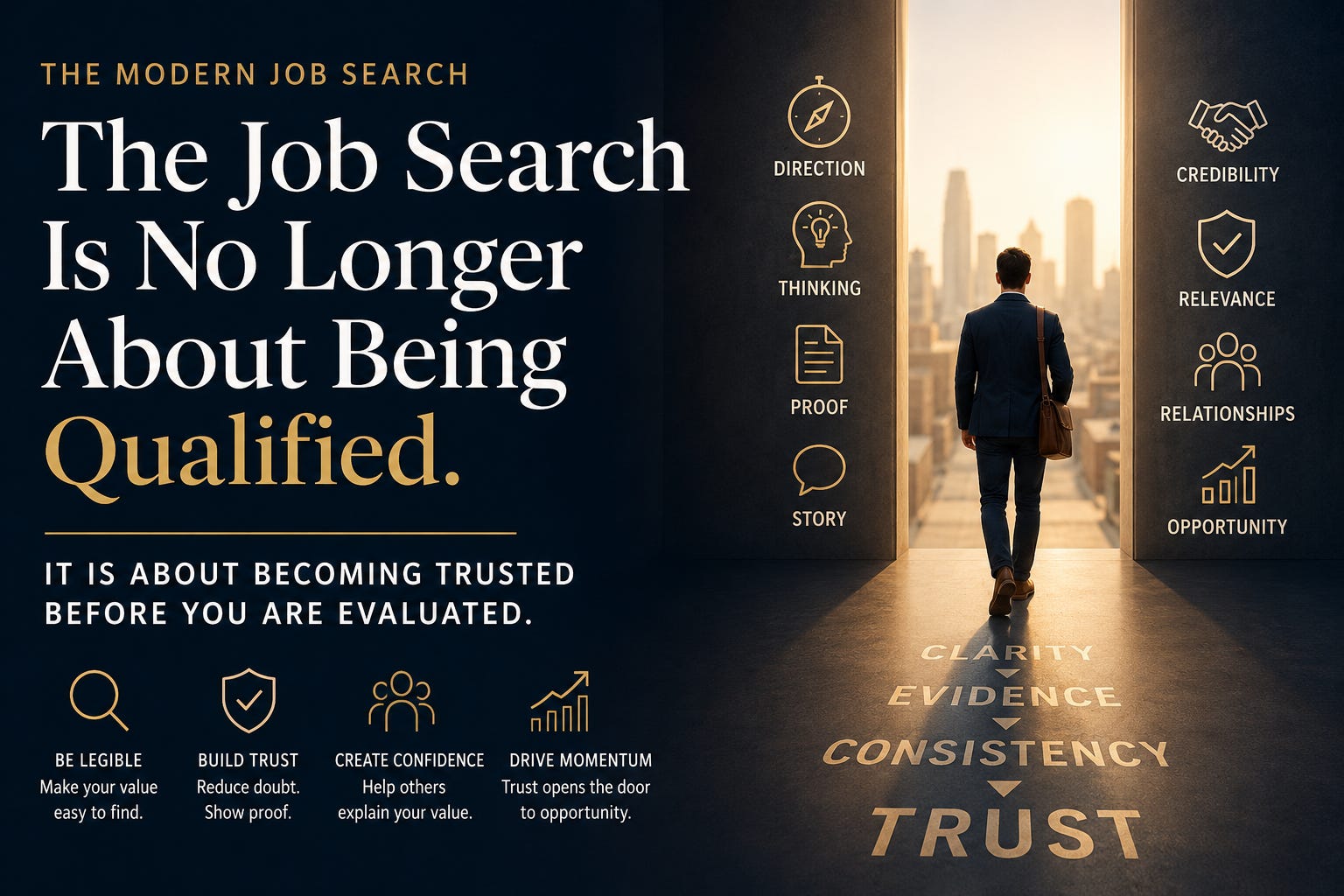
It Is About Becoming Trusted Before You Are Evaluated
There is a painful truth in the modern job search that most professionals only discover after months of silence.
Being qualified is no longer enough.
Not because qualifications stopped mattering.
Not because experience has no value.
Not because hiring managers no longer care about competence.
But because qualification is often judged too late.
By the time a human being evaluates your full story, the market may have already made several decisions about you.
The algorithm may have sorted you.
The recruiter may have skimmed you.
The hiring manager may have compared you against a cleaner signal.
The referral may have gone to someone who was easier to explain.
The opportunity may have moved before you ever knew it existed.
That is why the modern job search cannot be built only around proving you are qualified.
It has to be built around becoming trusted before you are formally evaluated.
That is the next shift.
In the previous article, we talked about becoming legible before you apply — building signal, translating experience, and making your value easier for the market to recognize.
But legibility is only the first layer.
Once the market can understand you, the next question becomes deeper:
Can the market trust you?
Not trust you as a person.
Trust your relevance.
Trust your direction.
Trust your judgment.
Trust that your experience connects to the problem in front of them.
Trust that you are not just available.
Trust that you are prepared.
That is where many capable professionals are still losing momentum.
They have experience.
They have skills.
They have credentials.
They may even have a stronger resume than before.
But the market still hesitates.
Because clarity gets you noticed.
Trust gets you considered.
And in the silent job market, consideration is where momentum begins.
The Hidden Question Behind Every Hiring Decision
Every job description has a visible question.
Can you do the work?
But every hiring decision has hidden questions underneath it.
Can we understand your value quickly?
Can we trust that your experience is current?
Can we see how you would solve our problem?
Can we explain you to the decision makers?
Can we defend choosing you over someone else?
Can we believe you actually want this role?
Can we reduce risk by moving you forward?
That last question matters more than most job seekers realize.
Hiring is not just a selection process.
It is a risk process.
Every candidate represents a possible bet.
A good hire creates momentum.
A bad hire creates cost, delay, conflict, and exposure.
That means employers are not only looking for talent.
They are looking for confidence.
Confidence that you can do the work.
Confidence that you understand the environment.
Confidence that your story makes sense.
Confidence that the gap between your background and their need is not too wide.
Confidence that you will not require too much interpretation.
This is why qualified candidates get ignored.
Not because they are unqualified.
But because their materials create unresolved questions.
And when the market is overloaded, unresolved questions often turn into silence.
Silence Often Means Risk Was Not Resolved
This is hard to accept because silence feels personal.
You apply.
You wait.
Nothing comes back.
No rejection.
No explanation.
No feedback.
No signal.
So your mind fills the gap.
Maybe I am too old.
Maybe I am overqualified.
Maybe my experience is outdated.
Maybe the market has moved on.
Maybe I am not as strong as I thought.
Sometimes those fears point to real positioning issues.
But often, the problem is not your ability.
The problem is unresolved risk.
The employer could not quickly answer:
Why this person?
Why this role?
Why now?
Why should we believe the transition makes sense?
Why should we trust this background for this problem?
Why should we move them forward instead of someone easier to categorize?
That is not always fair.
But it is how decisions get made in crowded markets.
When the reader has to work too hard to understand your fit, doubt enters.
When doubt enters, momentum slows.
When momentum slows, silence follows.
This is why trust has to be built into the job search before the interview.
Not after.
Before.
Your Resume Can Prove Experience, But It Cannot Build Full Trust Alone
A resume is important.
But a resume is a compressed document.
It reduces years of judgment, leadership, problem-solving, adaptation, crisis management, and execution into a few pages of bullet points.
That compression creates a problem.
The more complex your career has been, the harder it is for a resume alone to carry your value.
A resume can show what you did.
But it may not fully show how you think.
It can list outcomes.
But it may not reveal your decision-making.
It can name responsibilities.
But it may not demonstrate your judgment.
It can summarize experience.
But it may not answer the employer’s hidden fears.
That is especially true for experienced professionals.
At a certain level, employers are not just hiring tasks.
They are hiring judgment.
They are hiring maturity.
They are hiring pattern recognition.
They are hiring someone who can enter ambiguity and create order.
But if the only proof you offer is a resume, the market may never see that.
This is why the job search has to expand beyond documents.
Your resume should prove alignment.
Your LinkedIn profile should reinforce direction.
Your content should demonstrate thinking.
Your conversations should build trust.
Your portfolio should show evidence.
Your interviews should resolve risk.
Together, those signals create confidence.
Alone, the resume is often asked to do too much.
Trust Is Built Through Repetition
One of the biggest mistakes job seekers make is believing trust is built in one moment.
One perfect application.
One perfect LinkedIn message.
One perfect interview answer.
One perfect resume bullet.
But trust rarely forms that way.
Trust is built through repeated signals.
The same direction showing up in multiple places.
The same professional thesis appearing across your resume, LinkedIn, outreach, content, and interviews.
The same problem-solving pattern becoming clear again and again.
The same evidence reinforcing the same promise.
That repetition matters.
Because the market does not know you.
It only knows the signals you give it.
If those signals are scattered, trust weakens.
If they are consistent, trust compounds.
This is where many professionals accidentally dilute themselves.
They say one thing on the resume.
Another thing in the LinkedIn headline.
Another thing in the About section.
Another thing in networking conversations.
Another thing in interviews.
Another thing when they feel desperate.
The market cannot build confidence from contradiction.
It builds confidence from coherence.
That does not mean you reduce yourself to one narrow label.
It means you create a recognizable center of gravity.
A clear professional direction.
A repeatable explanation of the value you bring.
A story that can travel from you to a recruiter to a hiring manager to a decision meeting without falling apart.
That is trust architecture.
The Employer Has to Be Able to Explain You
This is one of the most overlooked realities in hiring.
It is not enough for one person to like you.
They often have to explain you to someone else.
A recruiter has to explain you to a hiring manager.
A hiring manager has to explain you to a panel.
A panel has to compare you to other candidates.
A decision maker has to justify the choice.
Someone may have to defend the hire.
That means your positioning has to be portable.
If your value is too vague, it does not travel.
If your story is too complex, it gets simplified incorrectly.
If your direction is unclear, someone else may fill in the blanks.
And when other people fill in the blanks, they may not do it in your favor.
This is why your message has to be simple enough to repeat.
Not shallow.
Not generic.
Not over-polished.
Repeatable.
For example:
“I help organizations turn complex operational and data challenges into clearer systems, stronger execution, and measurable business outcomes.”
That kind of statement travels.
It gives people language.
It gives them a frame.
It helps them understand what to do with your background.
The modern job search requires more than being impressive.
You have to become explainable.
Because explainable candidates move faster.
The Market Trusts Evidence More Than Claims
Most job seekers make claims.
I am strategic.
I am adaptable.
I am a strong communicator.
I am a problem solver.
I am results-driven.
I am collaborative.
Those may all be true.
But claims are weak without evidence.
The market has heard every claim before.
What it trusts is proof.
A short case study.
A specific result.
A before-and-after example.
A clear explanation of a problem you solved.
A LinkedIn post that shows your thinking.
A portfolio sample.
A process breakdown.
A story that demonstrates judgment under pressure.
A measurable outcome tied to business value.
Evidence does something language alone cannot do.
It reduces doubt.
It gives the employer something to believe.
It turns your experience from assertion into signal.
This matters because the modern hiring system is full of inflated language.
Everyone is passionate.
Everyone is strategic.
Everyone is innovative.
Everyone is a leader.
Everyone is results-oriented.
The professionals who stand out are not always the ones with the biggest claims.
They are the ones with the clearest evidence.
Proof beats adjectives.
Specificity beats polish.
Demonstration beats declaration.
Build a Trust Bank Before You Need One
Most professionals wait too long to build evidence.
They wait until they are applying.
They wait until they are unemployed.
They wait until they need a referral.
They wait until the interview.
They wait until the market has already gone quiet.
But trust is easier to build before urgency arrives.
That does not mean you need to post every day.
It does not mean you need to become a content creator.
It does not mean you need to perform expertise online.
It means you need visible proof that your professional thinking is alive.
A trust bank can be simple.
Three short LinkedIn posts about problems in your field.
One article explaining how you approach a recurring challenge.
A one-page portfolio with three examples of business impact.
A featured document on LinkedIn that summarizes your leadership philosophy or operating model.
A few thoughtful comments on industry posts that reveal your judgment.
A short case study showing how you solved a complex problem.
A clear About section that explains what you solve now.
These are not vanity activities.
They are trust assets.
They help someone believe you before they speak to you.
They give your network something to remember.
They give recruiters more context.
They give hiring managers more confidence.
They give your experience a visible shelf life.
The goal is not attention.
The goal is evidence.
AI Can Help You Identify the Trust Gap
Most people use AI to make their materials sound better.
That is useful.
But it is not enough.
A stronger use of AI is to identify where trust breaks down.
Here is a prompt worth using:
Prompt:
Here is my resume, LinkedIn About section, and target role. Act like a skeptical hiring manager. Identify the top five reasons you might hesitate to move me forward. Focus on unclear positioning, missing evidence, outdated language, seniority concerns, lack of measurable outcomes, or weak connection to the role. Then recommend how I can address each concern honestly.
This prompt is powerful because it forces you to see your materials from the other side of the table.
Not from your intention.
From their risk.
That distinction matters.
You know what you meant.
The market only knows what it can interpret.
AI can help expose the gaps between your intended message and the message the reader may actually receive.
Another prompt:
Prompt:
Based on this job description and my background, what specific proof would make me more credible for this role? Suggest examples I could include in my resume, LinkedIn profile, portfolio, outreach message, or interview stories.
That prompt moves you beyond optimization.
It moves you toward evidence design.
And evidence design is where trust begins.
Stop Hiding the Thinking Behind the Work
Many experienced professionals under-explain their judgment.
They describe the task.
They mention the result.
But they leave out the thinking.
That is a mistake.
The thinking is often the value.
Anyone can say they led a project.
Fewer people can explain how they aligned stakeholders, clarified tradeoffs, reduced risk, handled resistance, prioritized constraints, and moved the work forward.
Anyone can say they improved a process.
Fewer people can explain how they diagnosed the bottleneck, separated symptoms from root causes, redesigned the workflow, and measured the outcome.
Anyone can say they managed change.
Fewer people can explain how they created trust in a system that was uncertain, political, or fragmented.
That is the difference between activity and judgment.
When you hide the thinking, you flatten your value.
When you reveal the thinking, you build trust.
This is especially important for professionals with deep experience.
Your advantage is not only what you have done.
It is how you see.
How you diagnose.
How you anticipate.
How you decide.
How you recover.
How you lead through ambiguity.
That is what the market needs to understand.
The Interview Should Not Be the First Time They Trust You
Many job seekers treat the interview as the place where trust begins.
But in the modern market, the interview is often where trust is confirmed.
The first layer of trust begins earlier.
In your LinkedIn presence.
In your resume clarity.
In your referral conversations.
In your outreach.
In your proof.
In the consistency of your positioning.
In the way your story makes sense before you enter the room.
By the time you reach the interview, the employer should already have a working theory of your value.
The interview should deepen it.
Not create it from scratch.
That changes how you prepare.
You are not just preparing answers.
You are preparing confirmation.
You are helping them see that the signal they noticed is real.
That the evidence holds up.
That your story is coherent.
That your judgment is sound.
That the risk is manageable.
That the value is clear.
That is why interview preparation should not start with memorizing responses.
It should start with identifying the trust questions.
What might they doubt?
What might they misunderstand?
What risk might they see?
What proof would reduce that risk?
What story would make your value believable?
That is how you move from performing confidence to creating confidence.
The New Weekly Question
A reactive job search asks:
What jobs can I apply to today?
A stronger job search asks:
What trust can I build this week?
That question changes your behavior.
It moves you from panic to architecture.
From volume to evidence.
From scattered effort to strategic clarity.
From hoping to be chosen to becoming easier to choose.
Here is a simple weekly trust system:
Monday: Clarify the market.
Review five target roles. Identify what employers repeatedly value.
Tuesday: Strengthen one proof point.
Update one resume bullet, case study, or LinkedIn section with clearer evidence.
Wednesday: Make your thinking visible.
Post or comment on one issue connected to your target market.
Thursday: Resolve one risk.
Identify one reason an employer may hesitate and address it in your materials.
Friday: Start one trust conversation.
Reach out to someone in your network with a clear, specific message about the kind of problems you are focused on solving.
That system is not glamorous.
But it compounds.
Signal by signal.
Proof by proof.
Conversation by conversation.
You are no longer just applying.
You are creating reasons for the market to believe you.
The Emotional Shift: From Proving Worth to Reducing Doubt
This matters emotionally too.
Because the job search can make you feel like you are constantly defending your worth.
Every silence feels like a verdict.
Every rejection feels like evidence.
Every unanswered message feels like proof that you are fading.
But the trust-based job search gives you a different frame.
You are not trying to prove you are worthy.
You are trying to reduce uncertainty.
That is a much healthier assignment.
Worth is personal.
Uncertainty is strategic.
Worth is heavy.
Uncertainty can be addressed.
Worth makes every silence feel like identity damage.
Uncertainty allows you to ask better questions.
Where is my message unclear?
What proof is missing?
What risk have I not addressed?
Where does my story lose coherence?
What does the employer need to believe before they move me forward?
That shift gives you back agency.
Not total control.
But agency.
And in a silent job market, agency matters.
Your Experience Is Not the Problem
Your experience is not the problem.
The problem may be that your experience has not been translated into trust.
The problem may be that your story is clear to you but not portable to others.
The problem may be that your proof is real but hidden.
The problem may be that your judgment is strong but invisible.
The problem may be that your materials show history but not direction.
The problem may be that your resume says what you did, but your market cannot yet see why it should believe you now.
That is fixable.
Not instantly.
Not magically.
But deliberately.
You can build clearer proof.
You can create a stronger role thesis.
You can make your thinking visible.
You can align your signals.
You can prepare for risk questions.
You can help people explain your value.
You can become easier to trust.
And once trust increases, momentum has a place to begin.
Before You Apply Again, Ask This
Before your next application, pause.
Ask five questions:
Does this employer’s problem match the proof I am showing?
Would a recruiter understand my value in ten seconds?
Would a hiring manager be able to explain me to someone else?
Have I addressed the most likely concern about my candidacy?
Is there evidence beyond my claims?
If the answer is no, do not just apply harder.
Build trust first.
Because the goal is not to flood the market with more applications.
The goal is to reduce the distance between your value and the market’s confidence.
That distance is where silence lives.
Close the distance.
Final Thought
The job search is no longer just about being qualified.
It is about being understood.
Then trusted.
Then remembered.
Then referred.
Then considered.
Then chosen.
That sequence matters.
Too many professionals are trying to be chosen before they have been understood.
Too many are trying to be understood before they have become legible.
Too many are trying to create trust with one resume, one application, or one interview.
But trust does not work that way.
Trust is built through coherence.
Through evidence.
Through repeated signals.
Through clear direction.
Through proof that your experience is not just impressive, but relevant.
That is the work now.
Not becoming louder.
Not becoming someone else.
Not turning your career into a performance.
But making your value easier to believe.
Because in this market, the hidden professional is not always the least qualified.
Sometimes they are the least trusted because their proof has not yet become visible.
And once you understand that, the job search changes.
You stop asking:
“Why won’t they see me?”
You start asking:
“What would help them trust what I already know I can do?”
That is where momentum returns.
Not through noise.
Through clarity.
Not through desperation.
Through proof.
Not through endless applying.
Through becoming the kind of candidate the market can understand, explain, and believe.
About the Author
Byron K. Veasey is a career strategist and leader in data quality engineering focused on helping professionals navigate job searches, burnout, and career reinvention.
He writes Career Strategies, a newsletter read by over 4,800 professionals navigating today’s evolving job market.
👉 Subscribe to Career Strategies
I absolutely love this conversation!
"One of the biggest mistakes job seekers make is believing trust is built in one moment"
We are a walking brand. Jobs no longer look for pure competence, they look for consistency, and an idealistic version of what they want to see fit into their company's current goals. The sooner we understand that, the more marketable we become!