

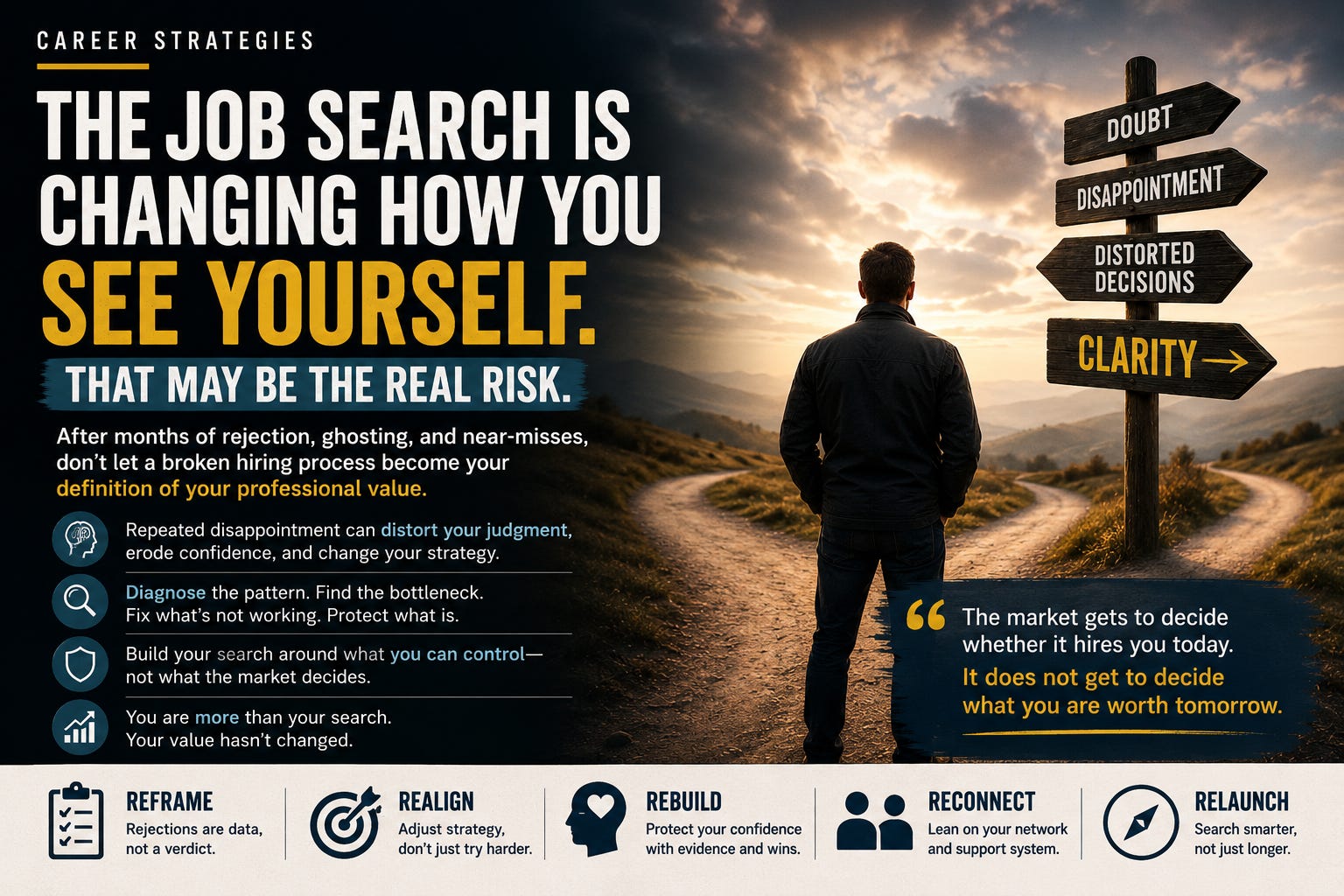
After months of rejection, ghosting, and near-misses, the biggest danger isn’t simply losing motivation. It’s allowing a broken hiring process to become your definition of your professional value.
There is a point in a long job search when disappointment stops feeling like an event.
It becomes the atmosphere.
At first, you remember every rejection.
The company.
The role.
The interview.
The email.
You replay the conversation and wonder which answer cost you the opportunity.
Then enough time passes.
The rejections start blending together.
So do the applications.
The jobs you were excited about become entries in a spreadsheet.
The interviews that once created adrenaline start producing something closer to caution.
And the companies that never respond?
Eventually, you barely remember applying.
That is when the real danger of a long job search begins.
Not when you receive another rejection.
Not when someone ghosts you after the third interview.
Not even when you lose a position you were convinced was yours.
The deeper danger is this:
You start using the job market’s behavior as evidence about yourself.
And the market is a terrible place to outsource your self-assessment.
The First Rejections Hurt. The Later Ones Rewrite the Story.
Early in a search, most professionals can separate an outcome from their identity.
You get rejected and think:
Wrong fit.
Internal candidate.
They wanted something different.
I’ll get the next one.
You still have enough confidence left to put the rejection in context.
But repeated disappointment changes the equation.
After ten rejections, you start analyzing.
After twenty, you start questioning.
After months of silence, something more subtle can happen.
The question changes from:
“Why didn’t this opportunity work?”
to:
“Why isn’t anyone choosing me?”
And eventually:
“What is the market seeing that I don’t?”
That final question can be useful if you ask it strategically.
It becomes dangerous when you ask it emotionally.
Because without reliable feedback, your brain starts creating explanations.
Maybe I’m too old.
Maybe I’m too expensive.
Maybe my experience isn’t relevant anymore.
Maybe I’ve been out too long.
Maybe my career peaked.
Maybe everyone else adapted and I didn’t.
Maybe the years I spent building expertise don’t count the way I thought they did.
The market rarely confirms any of those conclusions.
But silence leaves enough empty space for them to grow.
Disappointment Has a Compounding Effect
One rejection usually doesn’t change your strategy.
Repeated disappointment can.
Quietly.
You become more conservative.
You begin eliminating yourself before employers have the opportunity.
You see a position requiring eight qualifications.
You have seven.
Six months ago, you would have applied.
Now you think:
Why bother?
You see a director role that fits your experience.
Instead, you apply for manager positions because they feel safer.
You lower your salary expectations before anyone asks.
You remove accomplishments because they might make you look “too senior.”
You stop contacting former colleagues because you’re embarrassed to still be searching.
You make your résumé broader because you’re afraid specificity is eliminating opportunities.
You apply to more jobs because volume feels like control.
And slowly, disappointment begins redesigning your job search.
Not based on strategy.
Based on self-protection.
That distinction matters.
The Job Search Can Create Decision Distortion
When a search lasts long enough, you are no longer making decisions from the same psychological position you occupied at the beginning.
The person who entered the search may have thought:
I know what I bring to the table.
Months later, the same person may be thinking:
I’ll take almost anything if someone will just give me a chance.
Those two people evaluate opportunities very differently.
That creates what I call:
Job-Search Decision Distortion
The market has not necessarily changed your actual value.
It has changed the emotional conditions under which you evaluate your value.
And that can show up everywhere.
You over-apply.
Sending more applications feels productive, even when the conversion rate says the strategy isn’t working.
You under-target.
You begin pursuing roles beneath your real capability because rejection has made ambition feel risky.
You overcorrect your résumé.
Every silence becomes another reason to rewrite it, until your professional identity gets edited into generic language.
You overprepare for interviews.
Instead of having a conversation, you try to anticipate every possible question because you are terrified of getting one wrong.
You overvalue every opportunity.
A recruiter response feels rare enough that even a mediocre position suddenly looks precious.
You under-negotiate.
When the offer finally appears, you are so relieved that asking for more feels dangerous.
That is why emotional recovery and job-search strategy cannot be separated.
Your emotional state influences your career decisions.
The Near-Miss May Hurt More Than the Rejection
There is a special kind of disappointment reserved for the final round.
You survive the recruiter screen.
Then the hiring manager.
Then the panel.
Then the executive interview.
Maybe they ask for references.
Maybe someone says:
“Everyone really liked you.”
You start imagining the commute.
The office.
The first week.
You tell someone close to you:
“I think this might be it.”
Then the email arrives.
They chose someone else.
Or worse:
Nothing arrives.
The process simply disappears.
That hurts differently from an application rejection.
Because by the final round, hope has become specific.
You weren’t imagining some hypothetical future.
You were picturing that job.
That team.
That salary.
That return to work.
And suddenly you are back at the beginning.
This is where people often make a strategic mistake.
They interpret the near-miss as proof that they are failing.
But getting repeatedly deep into interview processes tells you something else.
Your candidacy is working.
The problem is downstream.
Maybe your interview positioning needs refinement.
Maybe your leadership stories are not landing.
Maybe another candidate had slightly closer industry experience.
Maybe an internal candidate entered late.
Maybe the hiring manager preferred someone they already knew.
Maybe the decision was political.
Maybe your compensation created concern.
Maybe your answer to one question produced hesitation.
You need to diagnose the pattern.
But don’t destroy the parts of your strategy that got you into the room.
A near-miss is painful.
It is also data.
Stop Turning Silence Into Certainty
Ghosting may be the most psychologically destructive feature of the modern job search because it gives you almost nothing to work with.
A rejection says:
No.
Silence says:
Maybe.
For days.
Then weeks.
Sometimes months.
Your brain hates unfinished stories.
So it finishes them for you.
Usually badly.
You begin thinking:
They hated my interview.
I wasn’t impressive enough.
I asked for too much money.
I’m too old.
They found someone better.
Maybe.
But you don’t actually know.
The role could have been frozen.
The budget could have changed.
The hiring manager could have left.
An internal candidate may have appeared.
The company may have decided not to fill the position.
The recruiter may simply be overwhelmed.
The process may be badly managed.
You cannot diagnose yourself from information you were never given.
Remember this:
Do not turn missing information into negative certainty.
LinkedIn Makes the Search Feel More Personal Than It Is
Then there is LinkedIn.
You open it to find opportunities.
Instead, you see:
“I’m thrilled to announce…”
Someone got promoted.
Someone landed after a layoff.
Someone joined the exact company you applied to.
Someone started a role with the title you have been pursuing for seven months.
You are happy for them.
And also not happy at all.
Both things can be true.
The danger is forgetting what you are actually looking at.
You are looking at the announcement.
You didn’t see the process.
You didn’t see application 47.
Or rejection 19.
Or the interview that went nowhere.
Or the month when they wondered whether they would ever work again.
Or the worried partner.
Or the savings account getting smaller.
Or the mornings when they didn’t want to open LinkedIn either.
Social media compresses months of uncertainty into one polished paragraph.
Never compare your unfinished middle to someone else’s published ending.
Your Job Search Needs an Evidence System
After months of uncertainty, encouragement alone is not enough.
You need evidence.
Create a document containing proof of your professional value.
Not affirmations.
Not motivational quotes.
Facts.
Projects completed.
Revenue generated.
Costs reduced.
Problems solved.
Teams built.
Systems improved.
Customers retained.
Risks avoided.
Processes transformed.
People developed.
Decisions you made when the answer wasn’t obvious.
Positive feedback from leaders, clients, colleagues, or employees.
Times people specifically sought your judgment.
Think of it as your:
Professional Evidence Bank
When the search starts telling you:
Maybe I’m not that good anymore.
You need something stronger than:
Stay positive.
You need:
Here is what I actually did.
The market can delay your next opportunity.
It cannot retroactively erase your track record.
Build Your Search Around What You Can Control
One reason a long job search becomes so emotionally exhausting is that the most important outcome is largely outside your control.
You cannot make a company call.
You cannot force a recruiter to reply.
You cannot determine whether the CFO approves the headcount.
You cannot stop an internal candidate from entering the process.
You cannot control whether another applicant has exactly the experience a hiring manager happens to prefer.
But you can control:
The clarity of your positioning
The quality of your applications
The companies you target
The conversations you initiate
The stories you prepare
The proof you create
The skills you strengthen
The follow-up you complete
The relationships you maintain
How much of your life you allow the search to consume
That final point matters more than people think.
A job search with no boundaries eventually consumes everything around it.
Set a start time.
Set a stop time.
Have days when you do not search.
Protect the parts of your life that remind you that employment is one dimension of who you are.
The goal isn’t merely to endure until an employer chooses you.
The goal is to arrive at your next opportunity with enough of yourself intact to recognize whether you actually want it.
Rejection Should Trigger Diagnosis, Not Self-Punishment
After enough disappointment, job seekers often bounce between two extremes.
Extreme One:
Nothing is wrong. I just need to keep going.
Sometimes that’s true.
Sometimes it isn’t.
Extreme Two:
Everything is wrong. I need to change everything.
That usually isn’t true either.
The better approach is diagnosis.
If you’re sending applications and receiving almost no interviews, investigate:
Positioning
Targeting
Résumé alignment
Application channels
AI screening
Professional visibility
If you’re getting interviews but rarely advancing, investigate:
Your opening narrative
How clearly you communicate value
Your examples
Your interview presence
Your understanding of the organization’s problem
If you’re repeatedly reaching final rounds, investigate:
Leadership alignment
Decision-making stories
Compensation
Executive presence
References
Repeated concerns
Do not interpret every negative outcome as evidence that the entire search is broken.
Find the bottleneck.
Fix the bottleneck.
Preserve what is already working.
Persistence and Repetition Are Not the Same Thing
This may be one of the most important distinctions in a long job search.
Persistence means staying committed to the goal.
Repetition means continuing the same behavior despite evidence that it isn’t working.
They are not the same.
Sending 300 applications is not automatically resilience.
It may be.
Or it may be a signal that your channel needs to change.
Continuing to target the same role for twelve months is not automatically determination.
It may be.
Or the market may be telling you that the title has shifted and your experience needs translating.
Working eight hours a day on your job search is not automatically discipline.
It may simply mean that the search has consumed your life.
Sometimes persistence looks like pushing.
Sometimes persistence looks like changing.
Sometimes it looks like resting.
Sometimes it looks like accepting bridge work.
Sometimes it looks like exploring an adjacent career.
Sometimes it looks like admitting:
The strategy that got me here is not the strategy that will get me out.
Protect Yourself From Desperation Decisions
Eventually, something may happen.
An employer calls.
An interview moves quickly.
An offer appears.
And after months of disappointment, relief can become overwhelming.
This is where long-term job seekers are especially vulnerable.
Because the question can become:
How quickly can I say yes?
Instead of:
Should I say yes?
Before accepting, separate the job from the relief.
Ask yourself:
Would I have wanted this role six months ago?
Does the compensation make sense?
Does the manager concern me?
Is the scope clear?
Does this role move my career forward?
Am I ignoring warning signs because I’m exhausted?
Would I still accept this on a confident day?
Sometimes the answer will still be yes.
Good.
But let it be a decision.
Not an escape.
Your Confidence Needs a Different Source
When you’re employed, confidence gets reinforced constantly.
People ask for your opinion.
Your calendar fills.
Problems arrive.
You solve them.
Meetings create visibility.
Paychecks create proof of belonging.
Your title provides social shorthand.
A long job search removes much of that reinforcement.
That is why waiting for the market to restore your confidence is dangerous.
The market may take months.
Your confidence needs another source.
Evidence.
Routine.
Contribution.
Learning.
Relationships.
Small wins.
Projects.
Helping someone.
Using your expertise even when nobody is currently paying you to use it.
Professional identity becomes much stronger when it can survive periods in which an employer is not validating it.
The Goal Is Not to Become Immune to Disappointment
You will still care.
You should.
The final-round rejection may still hurt.
Ghosting may still irritate you.
Watching someone else announce their new job may still sting.
You do not need to become emotionally numb to become resilient.
The goal is something more useful:
Feel the disappointment without allowing it to become strategy.
Be disappointed.
Then diagnose.
Be frustrated.
Then recover.
Be angry about the ghosting.
Then close the loop yourself.
Lose the opportunity.
Then decide what the outcome actually taught you.
The job search can produce information.
It should not be permitted to manufacture your identity.
Six Months of Searching Does Not Mean Six Months of Failure
If you’ve been searching for six months, nine months, a year, or longer, you probably know things about yourself and the market you did not know when the search began.
You know which roles excite you.
Which ones you apply to only because you’re scared.
Which companies respond.
Which stories land.
Which contacts genuinely show up.
Which activities create momentum.
Which ones merely create exhaustion.
You know what kind of manager you don’t want again.
You know how much uncertainty you can tolerate.
You may even be questioning whether the career you are trying so hard to return to is the career you want next.
That information matters.
Use it.
Because a long search does not automatically mean:
Keep doing exactly what you’ve been doing until something works.
Sometimes the message is:
Pause. Look at the evidence. Reset.
One Final Distinction
Your search is an experience you are having.
It is not an identity you have become.
You are not:
Unwanted.
Unqualified.
Invisible.
Obsolete.
Behind.
You are a professional navigating a hiring system that does not consistently provide feedback, closure, or rational signals.
That requires more than optimism.
It requires:
Emotional boundaries.
Strategic diagnosis.
Evidence.
Recovery.
And the willingness to change the approach without shrinking the person behind it.
The rejection can hurt.
The silence can sting.
The near-miss can ruin your afternoon.
But none of those outcomes gets to become the final authority on what your career has been—or what it can still become.
The market gets to decide whether it hires you today.
It does not get to decide what you are worth tomorrow.
If you’re deep into a long job search, start with one question:
What is the search actually teaching me—and what should I change because of that evidence?
Not because you’re failing.
Because after months of searching, you have something you didn’t have on day one:
Data.
Use it.
About the Author
Byron K. Veasey is a career strategist and leader in data quality engineering focused on helping experienced professionals navigate AI screening, automated interviews, recruiter silence, age bias, burnout, and career reinvention.
He writes Career Strategies, a Substack newsletter for professionals navigating today’s evolving job market.
👉 Subscribe to Career Strategies:
https://careerstrategies.substack.com/subscribe
👉 Career Strategies Published Books:
https://byronveasey.com/
👉 AI Job Search Prompt Library:
https://www.careerstrategies.jobs/p/job-search-ai-prompt-packs