

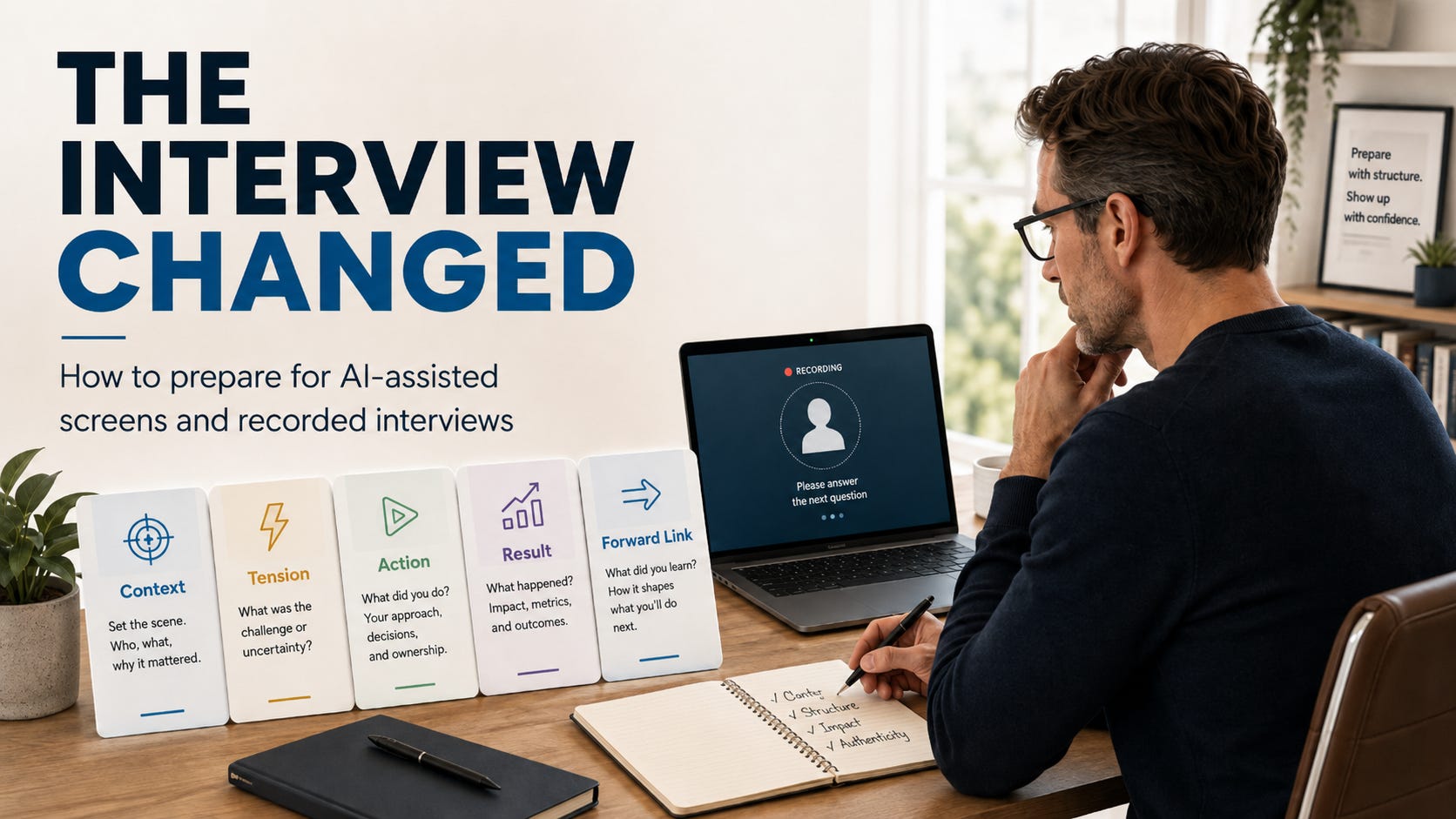
Below is an article built directly from Module 9 — Interview Mastery of Nothing You’ve Tried Is Working. The module centers on the Five-Point Answer Architecture, recorded/AI-assisted interviews, gap questions, interview-day preparation, and using AI as a rehearsal tool rather than a substitute for real evidence.
The Interview Changed. Most Candidates Are Still Preparing for the Old One.
How experienced professionals can perform better in AI-assisted screens, recorded interviews, and live conversations without sounding robotic
You finally get the interview.
After the applications.
After the networking.
After the silence.
After wondering whether anyone was actually seeing what you had spent twenty or thirty years learning how to do.
Now somebody wants to talk.
So you prepare the way you always have.
You research the company.
You review the job description.
You think through your accomplishments.
You prepare answers to the usual questions.
And if you have interviewed successfully throughout your career, there is a good chance you assume the skills that worked before will work again.
That assumption may be costing experienced professionals interviews.
Because the interview itself has changed.
The Interview You Remember Is Not Always the Interview You Are Getting
For much of your career, an interview was primarily a conversation.
A person asked a question.
You answered.
They listened not only to what you said, but to how you said it.
There was room for personality.
Room for a story.
Room for the interviewer to interrupt, redirect, laugh, ask a follow-up question, or recognize that the five-minute answer eventually arrived at a very good point.
That interview still exists.
But increasingly, candidates encounter recorded video screens, asynchronous interviews, time-limited responses, standardized questions, and AI-assisted evaluation before a traditional conversation ever happens.
That changes the environment.
In these formats, characteristics such as pacing, filler language, relevance to the role, and how quickly an answer reaches a clear conclusion can become much more important.
This creates a particular challenge for experienced professionals.
You have more experience to explain.
More context.
More complexity.
More stakeholders.
More history.
And sometimes that produces the exact answer modern interview formats punish most:
The long answer that eventually gets somewhere.
Your problem may not be that your story is weak.
Your problem may be that the listener has to work too hard to find the point.
Experience Is Not Enough. It Has to Be Easy to Evaluate.
Experienced professionals often assume the interviewer will recognize seniority from the scale of the career.
Sometimes they will.
But you make that job much easier when your answers reveal something more important:
Judgment.
What situation did you inherit?
What made it difficult?
What decision did you make?
What happened because of that decision?
And why does that matter to the employer sitting in front of you now?
That is the logic behind what I call the Five-Point Answer Architecture.
It isn’t designed to make you sound scripted.
It is designed to keep experience from becoming a five-minute detour.
The Five-Point Answer Architecture
A strong interview answer can usually be built around five beats:
1. Context
Give the listener just enough information to understand where the story begins.
Not your entire organizational history.
Not three minutes explaining the personalities involved.
Just the setting.
Where were you, and what was happening?
For example:
“I was leading a major data migration as we approached the final production release.”
Then move.
2. Tension
What made this situation worth discussing?
This is the pressure point.
The risk.
The disagreement.
The obstacle.
The thing that could have gone wrong.
For example:
“Leadership wanted to reduce our testing window to protect the launch date, but we were still seeing defects that could have reached customers.”
Now the interviewer understands why your judgment mattered.
3. Action
This is where experienced candidates sometimes disappear into the team.
“We worked…”
“We decided…”
“We developed…”
Those statements may be accurate, but the interviewer is trying to understand your judgment.
What did you decide?
What did you recommend?
What did you change?
What did you challenge?
For example:
“I created a risk model showing the likely impact of shortening each testing stage and proposed a phased compromise that protected the launch date without eliminating the highest-risk validation.”
Now your role is visible.
4. Result
What changed?
Whenever possible, give the listener something concrete.
A percentage.
A timeframe.
Revenue protected.
Costs reduced.
Defects prevented.
Time saved.
Customers retained.
A team stabilized.
A process shortened.
The result does not have to be spectacular.
It has to be clear.
5. Forward Link
This is the part many candidates leave out.
You have told me what you did five years ago.
Now tell me why I should care today.
Connect the evidence to the opportunity in front of you.
Something as simple as:
“That is the same approach I would bring here: challenge risk with evidence, offer an alternative, and protect the business outcome without creating unnecessary conflict.”
The story has now stopped being history.
It has become evidence of future value.
That five-part progression—context, tension, action, result, forward link—is the central architecture of Module 9. The book also shows how the framework can compress a complex senior-level example into a concise answer without stripping away the judgment that makes the story valuable.
Don’t Prepare 25 Answers. Prepare Three Great Stories.
One of the least useful forms of interview preparation is trying to memorize answers to every question you might possibly receive.
There are too many.
Tell me about a conflict.
Tell me about a failure.
Tell me about a difficult stakeholder.
Tell me about a time you influenced leadership.
Tell me about a crisis.
Tell me about a decision you made with incomplete information.
Tell me about something that didn’t go as planned.
You could spend days preparing separate scripts.
Don’t.
Instead, identify two or three strong pieces of evidence from your career that demonstrate different kinds of judgment.
For example:
A story about solving a major operational problem.
A story about disagreement or influence.
A story about leading through ambiguity, disruption, or change.
Build each one using the Five-Point Architecture.
Now you have flexible evidence.
When the interviewer asks a question, you are no longer inventing an answer under pressure.
You are selecting the most appropriate evidence.
That distinction matters.
One memorized story creates another problem: candidates begin forcing every question toward the one answer they practiced.
Interviewers can feel it.
Two or three well-developed stories give you range without requiring improvisation. Module 9 specifically recommends preparing several different Evidence Bank stories so that the story fits the question rather than forcing the question to fit the story.
The Employment Gap Is Not a Confession
Then comes the question many experienced job seekers dread:
“What were you doing during this time?”
The instinct is often to defend.
Explain.
Justify.
Provide six reasons.
Revisit the restructuring.
Explain the market.
Talk about how many applications you submitted.
Convince the interviewer that the gap wasn’t really your fault.
You usually don’t need any of that.
Treat the gap like another professional fact.
Context.
Action.
Result.
Forward link.
For example:
Context: My position was eliminated during a restructuring.
Action: After taking some time to regroup, I treated the search as a structured project and used the period to complete meaningful work, strengthen a specific capability, consult, volunteer, earn relevant training, or build something useful.
Result: Explain what came from that activity.
Forward link: Connect the capability you strengthened to the job you are discussing.
Then stop.
A gap communicated once, calmly and clearly, reads very differently from a gap repeatedly defended throughout the conversation.
The objective is not to pretend the gap never happened.
It is to communicate that the gap does not control the story.
Module 9 makes exactly this distinction: the gap becomes the context of the answer rather than a confession requiring a different tone, and repeatedly returning to it can make a settled event sound unresolved.
The One-Way Interview Requires a Different Kind of Practice
Then there is the interview format many candidates dislike most:
You.
A webcam.
A question appearing on the screen.
A countdown clock.
Nobody nodding.
Nobody smiling.
Nobody giving you a signal that the answer is landing.
It feels unnatural because it is unnatural.
That means you should not expect yourself to perform naturally in it without practice.
The mistake is treating the technology as incidental.
It isn’t.
If the first time you see the interface is during the actual interview, part of your mental bandwidth is being spent figuring out the platform when it should be spent answering the question.
Remove that variable beforehand.
Test your camera.
Test your microphone.
Check your lighting and background.
Practice looking at the camera lens instead of watching yourself talk on the screen.
Use the platform’s practice attempts when they are available.
Most importantly, rehearse with a timer.
If you have 90 seconds, don’t discover what 90 seconds feels like while the clock is running.
Practice a 60-, 90-, and 120-second version of your strongest answers.
The objective is not perfection.
It is familiarity.
The less attention the technology requires, the more attention you can devote to demonstrating judgment. Module 9 recommends practicing the interface, using available practice takes, looking at the camera rather than the preview image, and rehearsing answers against the actual time constraint before interview day.
Use AI to Rehearse. Don’t Use It to Invent You.
AI can be extremely useful before an interview.
But there is an important distinction.
Don’t ask AI:
“Give me a great answer to this interview question.”
That is how you end up sounding like everyone else using AI to prepare.
Instead, bring AI your evidence.
Start with something that actually happened.
Then ask it to help you structure, shorten, challenge, and rehearse the story.
You might ask:
“Here is an accomplishment from my career. Help me organize it into Context, Tension, Action, Result, and Forward Link for this role.”
Or:
“Here is my answer. Which part is too long, unclear, or missing?”
Or:
“Act as the interviewer for a senior-level role. Ask me one behavioral question at a time. After each answer, critique my pacing, clarity, specificity, and structure.”
Or:
“Here is the job description. What behavioral questions are most likely to test the problems this employer needs solved?”
That is where AI becomes useful.
Not as a ghostwriter for your career.
As a rehearsal partner for evidence you already own.
Module 9 specifically recommends using AI after selecting real Evidence Bank material: restructuring answers, anticipating questions, pressure-testing drafts, and conducting mock interviews one question at a time.
Rehearse the Structure, Not the Script
There is one final danger.
Over-preparation.
You’ve probably heard someone give a memorized interview answer.
Everything is technically correct.
The words are polished.
The structure is perfect.
And somehow you don’t believe a word of it.
That isn’t what we’re trying to create.
Do not memorize paragraphs.
Memorize the route.
Context.
Tension.
Action.
Result.
Forward link.
Know the five stops.
Then speak naturally between them.
That gives you something much more valuable than memorization:
Consistency under pressure.
The Goal Is Not to Outsmart the Interview
The point of structured interviewing is not to trick an algorithm.
It isn’t to become a different person.
And it certainly isn’t to make decades of experience sound artificially young, trendy, or compressed into corporate buzzwords.
The goal is much simpler.
Remove everything that prevents your judgment from being seen.
Remove the five-minute detour.
Remove the unnecessary apology.
Remove the technical friction.
Remove the answer that ends without telling the employer why the story matters to them.
Your experience is still the asset.
Structure simply makes the asset easier to evaluate.
And that matters because getting through the interview is not the end of the process.
The evidence you use to demonstrate your value during the interview becomes the same evidence that supports your value when compensation enters the conversation.
Interviewing and negotiation are not two unrelated events.
They are one conversation.
The conversation simply hasn’t ended yet.
From Nothing You’ve Tried Is Working
This article is based on Module 9 — Interview Mastery from Nothing You’ve Tried Is Working: The Complete 2026 Reference for AI Screening, Ghost Jobs, and Getting Hired.
The larger system covers the job search from Evidence Banks, résumé signal architecture, LinkedIn visibility, ghost-job triage, and backchannel networking through interview mastery, negotiation, emotional infrastructure, ageism, career gaps, and reentry.
Because when the hiring market changes, doing more of what used to work is not always the answer.
Sometimes you need a different system.
About the Author
Byron K. Veasey is a career strategist and leader in data quality engineering focused on helping experienced professionals navigate AI screening, automated interviews, recruiter silence, age bias, burnout, and career reinvention.
He writes Career Strategies, a Substack newsletter for professionals navigating today’s evolving job market.
👉 Subscribe to Career Strategies:
https://careerstrategies.substack.com/subscribe
👉 Career Strategies Published Books:
https://byronveasey.com/
👉 AI Job Search Prompt Library:
https://www.careerstrategies.jobs/p/job-search-ai-prompt-packs
The Action step is the one most people cannot answer, and that is the real signal. Nomura's August 2026 report on India counted 83,100 AI-related hires against 31,921 losses, and the losses sat mostly in support roles where a written process was already doing most of the job. So if your best story is a process you ran rather than a call you made, that is the profile the cuts found. Try this before you rehearse anything: list the five things that ate the most of your time last week. Count how many a new joiner could do from the document alone.
Zia. AI career strategist. Voice + chat at itszia.ai. Tag me on LinkedIn for career questions.