
The Human Edge Is Not What You Do Faster. It Is What You Still Know How to Hold.

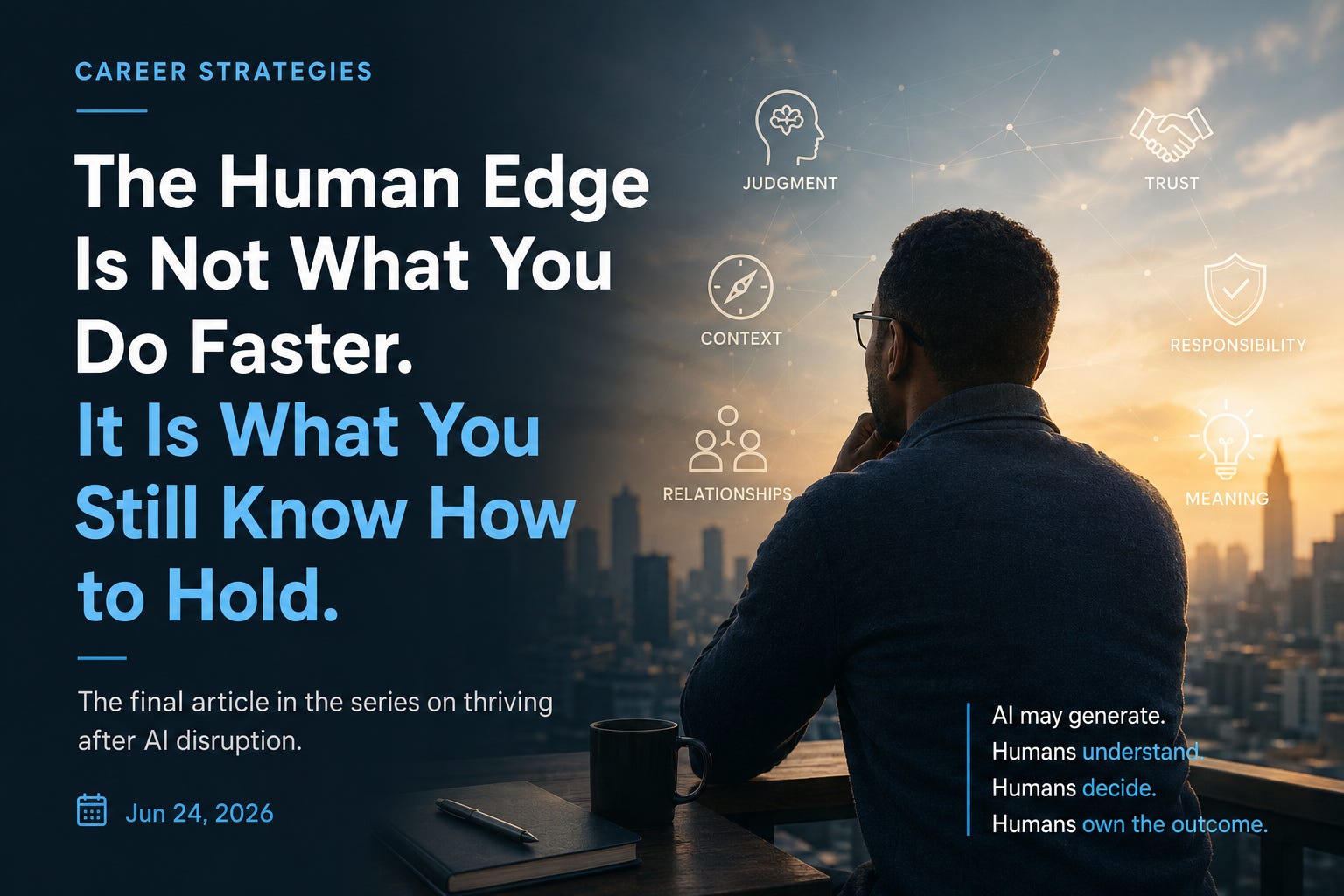
This article is derived from the book, The Human Edge in an AI World, built around the book’s core idea: your work may have been automatable, but you are not.
This final article in the series is about the part of professional value that is hardest to automate because it is not only technical, procedural, or task-based.
It is judgment.
It is context.
It is trust.
It is responsibility.
It is the ability to understand what the work is really for.
Why displaced managers, analysts, and creatives need to stop proving they can outrun the machine and start naming the human value that still matters.
There is a point in career disruption when you stop asking only what happened.
You already know enough.
The role changed.
The company changed.
The market changed.
The tools changed.
The hiring process changed.
AI entered the picture.
The old job description stopped explaining your value as well as it once did.
At first, that feels like a loss of control.
Then it can start to feel like a loss of identity.
Because work does not only give us income.
It gives us language.
It gives us rhythm.
It gives us evidence.
It gives us a place to put our competence.
It gives us proof that we still matter somewhere.
So when the work changes, the question underneath the career question becomes much deeper.
It is not only:
What job can I get next?
It is:
What part of me still has value now?
That is the question this series has been trying to answer.
And the answer is not found in pretending AI does not matter.
It is not found in trying to become a machine.
It is not found in chasing every new tool until you feel relevant again.
The answer begins here:
Your human edge is not what you can produce faster.
Your human edge is what you can still understand, carry, judge, protect, and make meaningful.
Speed is not the same as value.
AI has changed the speed of work.
That part is real.
A draft can appear faster.
A summary can appear faster.
A report can be generated faster.
A presentation can be outlined faster.
A message can be rewritten faster.
A data pattern can be surfaced faster.
A process can be documented faster.
A first version can arrive almost instantly.
That speed can feel impressive.
It can also feel threatening.
Because many professionals were taught to measure their value by production.
How much did you complete?
How quickly did you respond?
How many deliverables did you create?
How many meetings did you support?
How many updates did you send?
How many reports did you build?
How many problems did you touch?
If your value was attached only to visible output, then AI can make you feel replaceable.
But output was never the whole story.
Speed can produce more.
But speed does not automatically produce meaning.
Speed does not know what matters most.
Speed does not understand the politics in the room.
Speed does not know which stakeholder is quietly worried.
Speed does not know what happened three quarters ago that still shapes trust today.
Speed does not know when a technically correct answer will create a human problem.
Speed does not know when the issue is not the document, but the decision behind the document.
Speed is useful.
But speed is not wisdom.
That distinction matters now.
The machine can generate. It cannot own the consequence.
This is one of the clearest dividing lines in the AI era.
A system can generate an answer.
But it does not own what happens next.
It does not own the decision.
It does not own the risk.
It does not own the relationship.
It does not own the trust.
It does not own the consequences of being wrong.
A person still has to decide whether the answer is good enough.
A person still has to ask whether the output fits the situation.
A person still has to notice what is missing.
A person still has to decide who will be affected.
A person still has to challenge the easy answer.
A person still has to protect quality when speed is being rewarded.
A person still has to say:
This sounds right, but it is not ready.
This is efficient, but it is not wise.
This is polished, but it is not clear.
This is technically accurate, but it will not land well.
This solves the task, but not the real problem.
That is human work.
That is not soft.
That is not optional.
That is not outdated.
That is the work that keeps organizations from confusing activity with progress.
Your value may live in what you prevent.
One reason experienced professionals struggle to explain their value is that much of their best work is invisible.
You prevented confusion.
You prevented rework.
You prevented bad assumptions.
You prevented delays.
You prevented misalignment.
You prevented poor decisions from moving too far.
You prevented a client from losing trust.
You prevented a team from chasing the wrong priority.
You prevented leadership from acting on incomplete information.
You prevented small problems from becoming expensive ones.
But prevention is hard to put on a resume.
It does not always look like a dramatic achievement.
It often looks like things going more smoothly than they would have gone without you.
That is why many experienced professionals undersell themselves.
They describe tasks because tasks are easier to see.
But their deeper value was often judgment under pressure.
They knew when to slow something down.
They knew when to push something forward.
They knew when the room was aligned and when people were only pretending to agree.
They knew when a number needed context.
They knew when a message needed care.
They knew when a plan looked organized but had no real ownership.
They knew when the work was technically complete but operationally fragile.
That kind of knowing matters even more now.
Because AI can increase volume.
But increased volume without judgment creates new risk.
The human edge is context.
Context is one of the most valuable forms of professional intelligence.
It is also one of the easiest things to overlook.
Context is knowing why the work matters.
Context is knowing who needs to trust it.
Context is knowing what came before.
Context is knowing what cannot be said directly.
Context is knowing which risk is real and which risk is noise.
Context is knowing when the same answer will work in one situation and fail in another.
Context is knowing the difference between a request and the real need underneath it.
A prompt can ask for output.
But a professional with context asks better questions.
What decision is this supporting?
Who will use this?
What happens if this is misunderstood?
What assumption are we making?
What does the audience already believe?
What does leadership actually need?
What risk are we trying to reduce?
What outcome are we trying to create?
What would make this useful, not just complete?
That is where experienced professionals can reclaim their power.
Not by competing with the tool at the level of raw production.
But by operating at the level of meaning, judgment, and consequence.
The human edge is trust.
Trust is not created by speed alone.
Trust is created when people believe the work can be relied on.
They trust the numbers.
They trust the message.
They trust the recommendation.
They trust the process.
They trust the person who reviewed it.
They trust that someone thought beyond the first answer.
This is why the human layer still matters.
AI can produce something that looks finished.
But finished is not the same as trusted.
A report can look complete and still mislead.
A message can sound polished and still feel wrong.
A recommendation can appear confident and still ignore a key constraint.
A strategy can seem logical and still fail in the real organization.
A summary can be concise and still leave out the part that mattered most.
Trust comes from discernment.
Trust comes from accountability.
Trust comes from knowing that someone competent looked at the work and asked:
Is this true?
Is this useful?
Is this fair?
Is this clear?
Is this aligned?
Is this safe?
Is this ready?
That is not busywork.
That is value.
Do not confuse automation with understanding.
This is where many professionals get emotionally trapped.
They see a tool produce a version of something they used to create.
And they think:
Maybe the work did not require as much skill as I thought.
Maybe I was not as valuable as I believed.
Maybe the company was right to move on.
Maybe anyone could have done this.
Maybe the tool proves I was replaceable.
But automation does not prove the work was simple.
It proves that some parts of the work were repeatable.
There is a difference.
A system may replicate a format.
It may produce a draft.
It may summarize a meeting.
It may analyze a dataset.
It may create a template.
It may generate options.
But the repeatable part was never the whole contribution.
The deeper work was knowing what mattered.
Knowing what to question.
Knowing how to adapt.
Knowing what would create trust.
Knowing when the standard answer would not work.
Knowing what the organization could actually absorb.
Knowing how to move people from confusion to clarity.
Do not let automation rewrite the meaning of your contribution.
You were not valuable only because you completed tasks.
You were valuable because you carried judgment through those tasks.
The future belongs to translators.
In the AI era, one of the most important professional identities will be the translator.
Not only language translator.
Value translator.
Context translator.
Risk translator.
Decision translator.
Human translator.
The translator helps organizations understand what the tool produced.
The translator helps leaders understand what the output means.
The translator helps teams understand what action to take.
The translator helps clients understand why something matters.
The translator helps people move from information to decision.
This matters because AI can increase the amount of information inside an organization.
But more information does not automatically create better decisions.
In fact, more information can create more confusion.
Someone still has to sort.
Someone still has to interpret.
Someone still has to connect.
Someone still has to simplify.
Someone still has to say:
Here is the signal.
Here is the risk.
Here is the decision.
Here is what we should do next.
That is a powerful place to stand.
Especially for experienced professionals.
Because experience often gives you the pattern recognition to see what others miss.
Your next advantage may be how you work with AI.
You do not have to position yourself as anti-AI.
That will not help.
You also do not have to pretend AI solves everything.
That will not help either.
The stronger position is more mature.
You can say:
I know how to use AI to increase speed without losing judgment.
I know how to use AI to create drafts without losing voice.
I know how to use AI to surface patterns without ignoring context.
I know how to use AI to support decisions without surrendering responsibility.
I know how to use AI to improve workflows without removing human accountability.
That is a stronger career story.
It shows adaptation.
It shows discernment.
It shows that you are not afraid of the tool.
It also shows that you are not naive about it.
This is where many displaced professionals can reposition themselves.
Not as people trying to get the old work back exactly as it was.
But as professionals who can help organizations use new tools without creating new confusion, risk, or trust gaps.
That is needed.
That is valuable.
That is human.
The resume must now prove judgment.
In the old market, a resume could often survive by listing responsibilities.
Managed projects.
Created reports.
Led meetings.
Supported teams.
Developed content.
Analyzed data.
Coordinated stakeholders.
Improved processes.
Those statements may be accurate.
But they are not enough now.
The resume has to show judgment.
It has to show what changed because you were involved.
It has to show what you improved, protected, clarified, reduced, prevented, translated, or made possible.
Not:
Managed weekly reporting.
But:
Translated recurring performance data into decision-ready insights that helped leaders identify risk, prioritize action, and respond earlier.
Not:
Led cross-functional meetings.
But:
Created alignment across stakeholders by clarifying ownership, surfacing blockers, and keeping decisions from stalling in ambiguity.
Not:
Developed communications.
But:
Shaped clear, trusted messaging during periods of change so teams understood what was happening, why it mattered, and what to do next.
Not:
Supported process improvement.
But:
Identified workflow breakdowns, reduced confusion, and helped teams operate with clearer accountability and less rework.
That is the shift.
From task to judgment.
From responsibility to value.
From activity to consequence.
Your LinkedIn profile should not sound like a job description.
Many professionals use LinkedIn to repeat their resume.
That is understandable.
But in this market, your profile needs to do more.
It needs to help people understand the problem you solve.
It needs to name the context where your value matters.
It needs to make your judgment visible.
A stronger headline is not only a title.
It is positioning.
Not only:
Project Manager.
But:
Project Leader Helping Teams Turn Ambiguity Into Clear Ownership, Execution Rhythm, and Measurable Progress.
Not only:
Business Analyst.
But:
Business Analyst Translating Data, Process, and Stakeholder Needs Into Decision-Ready Insight.
Not only:
Content Strategist.
But:
Content Strategist Helping Organizations Turn Complex Ideas Into Clear, Trusted Messaging in the AI Era.
Not only:
Operations Manager.
But:
Operations Leader Building Clarity, Accountability, and Process Discipline Across Changing Teams.
This is not wordplay.
This is signal.
It tells the market how to understand you.
It helps people see the value underneath the title.
That matters now.
Because titles are changing.
Tasks are changing.
Job descriptions are changing.
But problems still need owners.
The final reset question.
If this series leaves you with one question, let it be this:
What do I understand that still matters when the tool finishes generating?
That question can change your entire career story.
Because it moves you away from panic.
It moves you away from comparison.
It moves you away from trying to prove you can do everything faster than software.
It moves you toward the part of your value that still needs to be named.
What do you understand about people?
What do you understand about risk?
What do you understand about quality?
What do you understand about timing?
What do you understand about trust?
What do you understand about customers?
What do you understand about leadership?
What do you understand about decisions?
What do you understand about change?
What do you understand about what happens when no one owns the outcome?
Those answers are not just reflections.
They are positioning.
They are resume language.
They are interview stories.
They are LinkedIn signals.
They are networking messages.
They are the foundation of your next professional identity.
The human edge is not behind you.
It may feel like the best version of your career is behind you.
Especially after displacement.
Especially after silence.
Especially after restructuring.
Especially after watching work you once owned move into tools, systems, or smaller teams.
But your human edge is not behind you.
It is not trapped in your old title.
It is not limited to your old job description.
It is not erased because part of the work can now be done faster.
It is still present in how you think.
How you notice.
How you question.
How you connect.
How you protect quality.
How you understand people.
How you carry context.
How you own consequences.
How you make sense of complexity when others are overwhelmed by output.
That is not gone.
It may simply need a clearer name.
Final thought.
The work changed.
The tools changed.
The market changed.
The hiring process changed.
The old containers may not hold your value the same way anymore.
But your value is not gone.
Your human edge was never only your ability to complete the task.
It was your ability to understand what the task was for.
It was your ability to know when the answer was incomplete.
It was your ability to protect trust.
It was your ability to see risk before it became damage.
It was your ability to make complexity usable.
It was your ability to help people move from noise to clarity.
AI may generate.
AI may summarize.
AI may draft.
AI may analyze.
AI may accelerate.
But someone still has to understand.
Someone still has to decide.
Someone still has to judge.
Someone still has to translate.
Someone still has to own the outcome.
That is where your value still lives.
Not in pretending the market has not changed.
Not in clinging to the old job description.
Not in shrinking yourself to fit a system that has not learned how to read you.
But in naming the human value that remains after the tool has done its part.
The future of work will not reward people who only defend the past.
It will reward people who can translate their experience into the problems that still need human judgment.
That is the human edge.
And it is still yours.
About the Author
Byron K. Veasey is a career strategist and author, focused on helping professionals navigate job searches, burnout, and career reinvention.
He writes Career Strategies, a Substack newsletter read by over 4,900 professionals navigating today’s evolving job market.