
The Hiring Manager Is Not Only Evaluating You. They Are Protecting Themselves.

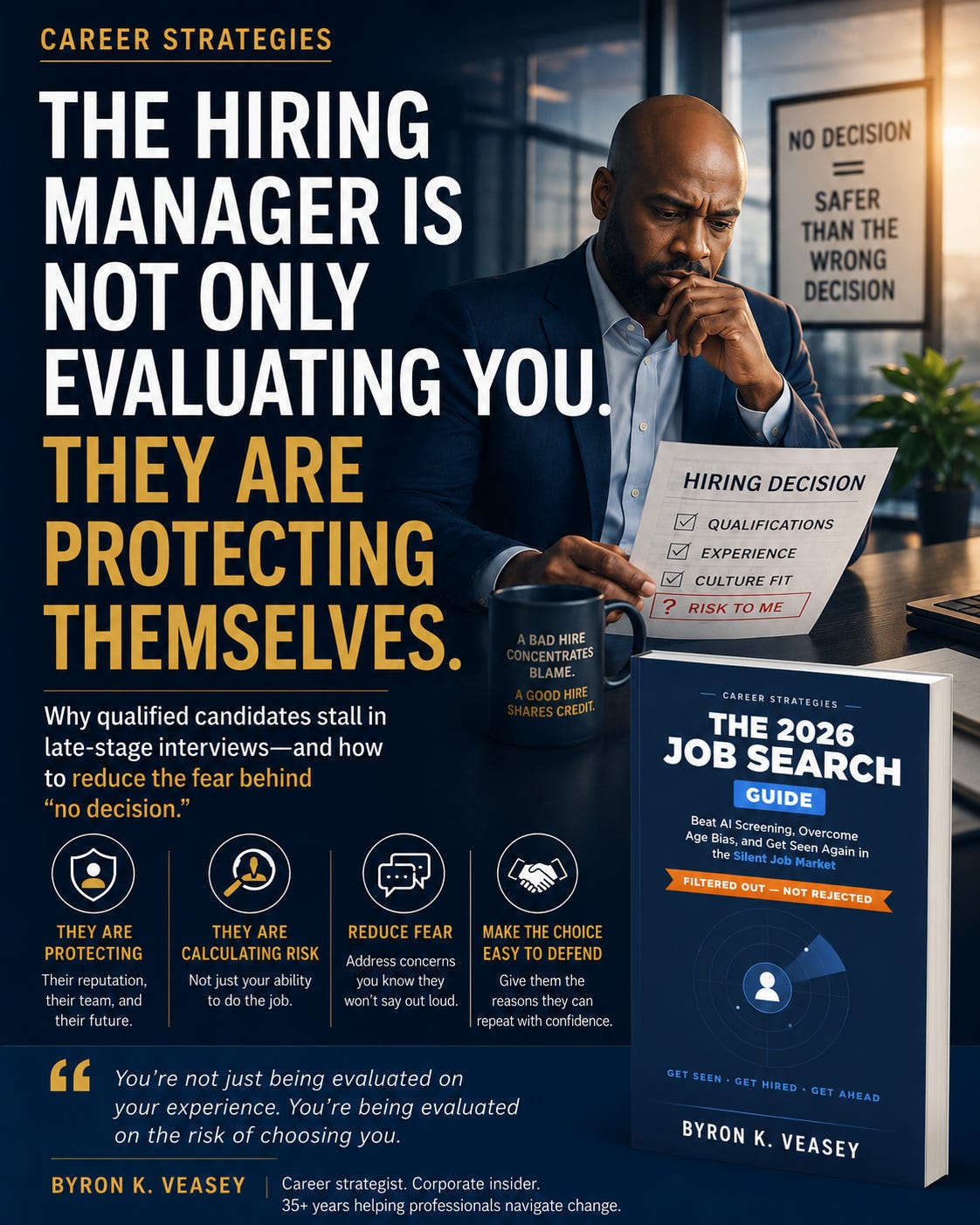
Why qualified candidates stall in late-stage interviews—and how to reduce the fear behind “no decision”
This article is adapted from Chapter 3, “The Psychology of the 2026 Hiring Manager,” in The 2026 Career Strategies Job Search Guide: Beat AI Screening, Overcome Age Bias, and Rebuild Career Momentum After 40 by Byron K. Veasey. The chapter examines why cautious organizations often delay a strong candidate rather than risk making the wrong senior-level hire.
A hiring manager finishes the fourth round of interviews with a candidate everyone seems to like.
The experience is relevant.
The answers are strong.
The references are likely to check out.
The candidate has already met the manager, two future peers, a senior executive, and someone from human resources.
Nothing significant remains unexplored.
The hiring manager opens a new document to begin preparing the offer.
Then closes it.
She decides she wants one more conversation.
There is no clearly defined question the extra interview needs to answer.
No missing qualification.
No obvious concern.
Just a feeling that the decision should not be made yet.
From the candidate’s side, the pause feels confusing.
You begin reviewing every answer.
Maybe you spoke too much.
Maybe the executive did not connect with you.
Maybe they found someone younger.
Maybe they think your salary is too high.
Maybe the company was never serious.
Those explanations are possible.
But another explanation is often operating underneath the process:
The hiring manager is not trying to decide whether you are qualified.
They are trying to become certain that choosing you will not hurt them.
That is a different evaluation.
And it explains more of the modern hiring process than most candidates realize.
A Good Hire Produces Shared Credit
When a new employee succeeds, several people can claim part of the outcome.
The recruiter found the candidate.
The interview panel evaluated well.
The onboarding team created a smooth transition.
The manager provided the right support.
The team welcomed the new person.
The company’s culture helped them succeed.
The market timing was favorable.
Success spreads credit across the organization.
No single person necessarily becomes known as the one who made the brilliant hiring decision.
The new employee simply becomes part of the team.
The organization moves on.
That is what should happen.
But it creates an important imbalance.
The professional upside for the hiring manager is often modest.
A successful hire is expected.
It may be appreciated.
It is rarely treated as extraordinary.
A Bad Hire Concentrates Blame
When a hire fails, the attribution changes quickly.
Who championed this person?
Who ignored the warning signs?
Who approved the salary?
Who insisted they were the right fit?
Who wrote the business case?
Who brought this person into the organization?
The recruiter may share some criticism.
The panel may be questioned.
But the hiring manager usually remains the visible owner of the decision.
The book describes this imbalance directly: successful hires generate shared credit, while failed hires concentrate blame on the person who supported and approved the candidate. That asymmetry encourages managers to slow down, add review layers, and delay when certainty is incomplete.
This is the hidden psychology behind many prolonged hiring processes.
The manager is not only evaluating whether you can perform.
They are calculating what happens to them if you do not.
“No Decision” Often Feels Safer Than the Wrong Decision
An unfilled role can create problems.
Projects may slow down.
Team members may carry more work.
Deadlines may stretch.
The manager may have to explain why the search is still open.
But an open position is usually interpreted as an organizational challenge.
A failed hire is interpreted as a judgment failure.
That distinction matters.
Delay is frustrating.
But delay is defensible.
A manager can say:
“We wanted to make sure we had the right fit.”
“The panel needed more time.”
“We decided to assess additional candidates.”
“The role is being refined.”
“Leadership requested another review.”
Each explanation sounds cautious and responsible.
A hiring mistake is harder to reframe.
If the person leaves within six months, disrupts the team, misses key deliverables, or creates political conflict, the manager may carry that decision into future performance discussions.
That is why waiting can feel rational from inside the organization even when it feels dysfunctional from outside it.
The book’s central argument in Chapter 3 is that delay carries less personal risk than a visibly unsuccessful hire, so uncertainty often produces another interview instead of an offer.
The vacancy costs the organization.
The bad hire can cost the manager.
People respond more strongly to the risk that feels personal.
The Interview Is Running on Two Tracks
Most candidates believe an interview is evaluating one central question:
Can this person do the job?
That is the official track.
It includes:
skills
experience
accomplishments
industry knowledge
leadership background
technical capability
communication
problem-solving
Those things matter.
But a second track is often running at the same time:
What happens to me if this person does not work out?
That hidden track includes questions such as:
Will this person disrupt my existing team?
Will they challenge me publicly?
Will they become dissatisfied with the role?
Are they expecting more authority than I can give them?
Will they leave when something better appears?
Will their compensation create internal tension?
Can they operate inside our culture?
Will they adapt to our constraints?
Will senior leadership support my decision?
Can I defend this hire if someone objects?
Candidates prepare extensively for the first track.
They often ignore the second.
That is one reason a highly qualified candidate can leave an interview feeling successful and still stall.
You proved you could do the work.
You may not have reduced the fear attached to hiring you.
Senior-Level Candidates Carry More Perceived Risk
The more senior the role, the more consequential the decision appears.
A senior hire may influence:
strategy
budgets
team structure
vendor relationships
political alignment
executive priorities
organizational culture
major transformation programs
other hiring decisions
The person is not merely joining the system.
They may change it.
That creates upside.
It also creates exposure.
A weak junior hire may require coaching.
A weak executive hire can destabilize an entire function.
A senior professional may also arrive with strong opinions, an established leadership style, high compensation expectations, and a clear view of what should change.
Those qualities may be exactly what the organization needs.
They can also make the hiring manager nervous.
The manager may wonder:
Will this person respect the existing team?
Will they try to move too quickly?
Will they view me as less experienced?
Will they bypass me to build executive relationships?
Will they become frustrated by our pace?
Will they expose problems I have learned to manage quietly?
Will they expect resources that do not exist?
Will they accept the role and then decide it is beneath them?
These concerns are rarely stated directly.
They appear as vague questions about fit.
“Culture Fit” Often Means “Will This Person Create Friction?”
Culture fit can sound like a neutral criterion.
Sometimes it is.
Organizations do have real working norms.
Communication styles differ.
Decision-making structures matter.
Some environments are highly collaborative.
Others are hierarchical.
Some move quickly.
Others require consensus.
A candidate who succeeds in one may struggle in another.
But “culture fit” can also become a container for unspoken fear.
It may mean:
Will this person challenge the way we work?
Will they make the existing team uncomfortable?
Will their confidence feel threatening?
Will they expect a level of authority we are not ready to provide?
Will their style expose weaknesses in the current leadership structure?
The candidate may hear:
“We are not sure you would fit our culture.”
But the underlying concern may be:
“We are not sure we know how to absorb someone with your experience.”
That is particularly common when the candidate has:
held a larger title
managed a bigger team
worked for more recognized companies
earned more compensation
led broader transformations
operated close to executive leadership
spent many years in the field
The experience that qualifies you can also increase perceived risk.
Being “Overqualified” Is Often a Risk Label
Candidates tend to hear “overqualified” as criticism of experience.
It rarely means the experience lacks value.
It often means the organization cannot resolve a risk calculation.
They may be asking:
Will this person stay?
Will they be satisfied?
Will they accept direction?
Will they expect a faster promotion?
Will they become bored?
Will they leave as soon as the market improves?
Will their salary expectations rise after they join?
Will the team feel intimidated?
Will the manager struggle to lead them?
These questions are not always fair.
But they are real.
Responding by minimizing your experience usually does not solve the problem.
It can make you appear less credible.
The better approach is to explain how your experience will function inside the role.
Not merely what you have done.
How you will operate here.
Qualifications Do Not Automatically Create Safety
Imagine two candidates.
Candidate A has the stronger résumé.
More years.
A larger scope.
More recognizable companies.
Higher-level accomplishments.
Candidate B has somewhat less experience but speaks with unusual clarity about the company’s situation.
Candidate B explains:
how they would enter the role
what they would learn before changing anything
how they would work with the existing team
which risks they would assess first
how they would communicate with the manager
what they would avoid doing too quickly
how they have adapted in unfamiliar environments before
Candidate A looks more impressive.
Candidate B may feel safer.
In a risk-averse market, safer can win.
That does not mean credentials no longer matter.
It means credentials alone do not complete the decision.
The hiring manager must be able to imagine you succeeding inside their specific environment without creating unacceptable disruption.
Stop Trying to Be the Most Impressive Candidate
Experienced professionals often enter an interview determined to prove the full scale of their careers.
That makes sense.
You want the company to understand your value.
So you describe:
The largest team.
The biggest transformation.
The highest budget.
The most complex challenge.
The senior leaders you advised.
The crises you handled.
The results you produced.
Each example may be excellent.
But a long sequence of high-level accomplishments can accidentally increase the hiring manager’s anxiety.
They may begin wondering:
Is our role large enough?
Will this person accept our constraints?
Will they be patient?
Will they expect more influence than we can provide?
Could they do my job?
Are they using this position as a bridge?
The solution is not to hide your achievements.
It is to connect them to the role in a way that lowers risk.
For example:
“I have led larger programs, but what attracts me here is not scale for its own sake. It is the opportunity to solve this particular operating problem. I have worked in environments where I had to make progress without a large team or unlimited authority, and that is the experience I would bring here.”
Now the achievement has context.
You are not merely demonstrating status.
You are explaining relevance.
The Hiring Manager Needs Language They Can Repeat
A hiring decision is rarely made by one person alone.
Even when one manager owns the role, they often have to explain the candidate to:
their boss
human resources
finance
future peers
an executive sponsor
other members of the interview panel
That means your value proposition must be portable.
The manager needs to be able to say:
“This person understands the exact problem we are trying to solve.”
“They have done this in a similarly constrained environment.”
“They know how to work with an established team.”
“They will not need a year to understand the politics.”
“They have handled the level of ambiguity we are facing.”
“They are senior, but they are not coming in to take over everything.”
“They have thought carefully about why this role makes sense.”
A generic statement such as “strong strategic leader” is hard to defend.
A specific, low-risk argument is easier.
You are helping the hiring manager build the internal case.
Start Reducing Risk Before the Interview
De-risking should begin in your résumé, LinkedIn profile, and outreach.
Your materials should not make the hiring manager build the connection between your past and their present.
Do that work for them.
Use the language of their environment.
Identify the problem implied by the job description.
Connect your experience to that problem.
Explain how you have handled similar constraints.
The book recommends framing your materials around what the organization needs done rather than expecting the reader to translate accomplishments from another setting. When the hiring manager thinks, “This person already understands our situation,” perceived risk begins dropping before the first conversation.
Compare these two summaries.
Accomplishment-centered
“Senior operations leader with more than twenty years of experience driving transformation, operational excellence, strategic growth, and enterprise-wide change.”
Risk-reducing
“Operations leader experienced in stabilizing complex functions during restructuring, clarifying ownership across competing teams, and improving execution without disrupting critical day-to-day delivery.”
The first establishes seniority.
The second helps the reader imagine a safe and useful application of that seniority.
Show That You Understand Their Constraints
Hiring managers become more confident when candidates demonstrate contextual fluency.
That means understanding that the organization may be dealing with:
limited budget
internal resistance
weak executive alignment
an exhausted team
unclear authority
competing priorities
legacy systems
regulatory pressure
restructuring
recent leadership turnover
failed previous initiatives
A weak candidate talks only about what they accomplished elsewhere.
A strong candidate connects those accomplishments to the conditions likely to exist here.
For example:
“I noticed the role owns transformation but appears to depend on several functions that do not report directly to it. In my previous role, I had a similar authority gap. The first step was not launching a larger program. It was creating a shared decision structure so teams knew what they owned and where escalation belonged.”
That answer does several things.
It shows you read carefully.
It reveals judgment.
It acknowledges organizational reality.
It suggests you will not arrive with an abstract playbook.
And it reduces the fear that your experience will be rigid or disconnected from context.
Do Not Wait for Them to Name the Concern
Hiring managers frequently avoid stating their real concerns directly.
They may ask:
“How would you adjust to a smaller organization?”
“What are you looking for at this stage of your career?”
“How do you work with established teams?”
“What would keep you engaged in this role?”
“How hands-on are you willing to be?”
“How do you feel about the compensation range?”
“Would you be comfortable reporting to someone with a different background?”
These questions are not casual.
They are risk probes.
The strongest candidates answer the concern underneath the wording.
Question
“What interests you about moving from a larger company to our environment?”
Surface-level answer
“I am excited by the opportunity and believe my skills are transferable.”
De-risking answer
“The scale is different, but the problems are familiar. What appeals to me is the ability to work closer to the decisions and the team executing them. I am not expecting the same resources or structure I had previously. In fact, some of my best work happened when I had to create clarity without relying on a large support system.”
The second answer reduces multiple concerns at once:
expectations
adaptability
resources
motivation
satisfaction
Address Seniority Friction Directly
When your experience is significantly deeper than the role requires, do not pretend the concern does not exist.
You can name it without sounding defensive.
For example:
“I understand that my background may raise a question about whether I would be comfortable operating within the existing leadership structure. I have worked with leaders who had different levels of experience and different areas of authority. My approach is to be clear about the role I was hired to play, contribute judgment without taking over, and build trust before trying to influence beyond my scope.”
That is more reassuring than:
“I am a team player.”
Generic reassurance carries little evidence.
A specific operating philosophy creates confidence.
The book advises candidates to respond to seniority concerns by describing how they have collaborated with peers and existing teams in real situations, rather than relying on broad claims about fit.
Signal Compensation Flexibility Without Discounting Yourself
Compensation is another area where risk calculations remain unspoken.
The company may assume your past salary is above the range.
They may fear you will accept reluctantly.
They may expect you to leave if a better offer appears.
Reducing that concern does not require immediately lowering your value.
It requires clarity.
For example:
“I am evaluating the full scope of the opportunity—the mandate, team, decision authority, expectations, and total package. I understand that this role may be structured differently from my previous one. I would rather discuss the range openly than allow assumptions about my background to eliminate a conversation that may make sense for both sides.”
That answer communicates realism.
It does not make a concession before one is necessary.
It opens the subject without sounding evasive.
Prove Adaptability With Evidence
Experienced professionals are often advised to say they are adaptable.
Hiring managers hear that word constantly.
It becomes credible only when supported by a specific transition.
Describe:
an unfamiliar industry you entered
a new technology you learned
a smaller or larger organization you joined
a culture different from your previous one
a role where your authority changed
a time you adjusted your leadership style
a situation where your initial approach did not work
Then explain what you changed.
For example:
“When I moved from a highly structured financial-services environment into a smaller operating model, I initially brought too much process too quickly. I learned that the team needed visible wins before it would trust a broader framework. I reduced the first phase, focused on one high-risk workflow, and used that result to earn support for the larger change.”
That answer is powerful because it includes adjustment.
You are not claiming effortless adaptability.
You are demonstrating that you notice, learn, and change.
Show How You Enter Before Explaining What You Will Change
Senior candidates often prepare a ninety-day vision.
That can be useful.
But transformation language delivered too early can raise concern.
The hiring manager may hear:
This person has already decided what is wrong.
They have not met the team.
They do not understand the politics.
They may move faster than the organization can absorb.
A safer answer begins with entry.
For example:
“My first priority would be understanding what the organization has already tried, where decisions currently stall, and which relationships the role depends on. I would not assume that a visible problem is the actual problem. By the end of the first thirty days, I would want a clear view of the operating constraints before recommending major changes.”
This demonstrates discipline.
It shows you are not arriving with a prepackaged solution.
You respect context before intervention.
That lowers fear.
Use Judgment Stories, Not Just Success Stories
Hiring managers are trying to predict how you will behave when the answer is unclear.
A success story proves that something worked.
A judgment story reveals how you thought.
The strongest examples include:
incomplete information
competing priorities
real constraints
disagreement
risk
a decision
consequences
Instead of saying:
“We successfully completed the transformation.”
Explain:
what made the situation uncertain
what alternatives existed
what you believed others were missing
how you weighed the risk
what you chose
what happened
The manager is not only listening for the result.
They are evaluating whether your reasoning feels trustworthy.
Calm Confidence Reduces More Risk Than Aggressive Certainty
Some candidates respond to a difficult market by trying to sound extremely confident.
They make larger claims.
Speak in absolutes.
Present every decision as obvious.
Avoid mentioning uncertainty.
This can backfire.
Experienced hiring managers know that serious work contains ambiguity.
A candidate who never acknowledges trade-offs may feel less credible.
Steady confidence sounds different.
It says:
“I have handled this class of problem before.”
“I know what I would examine first.”
“I would need to understand this condition before deciding.”
“Here is the risk I would watch.”
“Here is what I would not change too quickly.”
That tone communicates experience without performance.
The book describes the strongest signal in a fear-based market as steady confidence grounded in contextual fluency, judgment, and the ability to integrate without unnecessary disruption.
The Candidate Who Feels Easy to Defend Often Wins
A hiring manager must eventually place their reputation behind someone.
The winning candidate is not always the one with the most accomplishments.
It may be the person the manager can recommend without hesitation.
The person whose story is easy to explain.
Whose motivation makes sense.
Whose expectations appear aligned.
Whose experience feels useful rather than threatening.
Whose references are likely to reinforce the same message.
Whose operating style seems compatible with the existing environment.
Whose risks have been discussed instead of ignored.
This does not mean you should make yourself smaller.
It means you should make the decision easier.
Build a De-Risking Map
Before your next interview, identify the concerns your background may trigger.
Do not assume the company will state them.
Create two columns.
Likely hesitation
Examples:
culture fit
too senior
compensation
long-term interest
industry transition
pace of adaptation
managing a smaller team
working with fewer resources
conflict with current leadership
recent employment gap
willingness to be hands-on
Your de-risking response
For each concern, prepare:
one clear acknowledgment
one relevant example
one statement of how you would operate here
The book includes a De-Risking Response Worksheet built around this exact exercise: likely hesitation paired with a specific, concrete response prepared before the interview.
The purpose is not to sound rehearsed.
It is to avoid becoming defensive when the concern appears indirectly.
This Week’s Practice: Prepare Four Risk-Reducing Answers
Write one response for each of these areas.
1. Why this role makes sense now
Do not only explain why you like the company.
Explain why the role fits your current direction and why you are likely to remain engaged.
2. How you enter a new environment
Describe how you learn the context, build trust, and avoid forcing change too quickly.
3. How your seniority helps without creating friction
Show how you contribute judgment while respecting existing authority, relationships, and team dynamics.
4. What makes you adaptable
Use one specific example in which you adjusted your approach after entering an unfamiliar environment.
Keep each response between sixty and ninety seconds.
Then remove any sentence that sounds like a generic claim.
Replace:
“I am highly adaptable.”
With evidence.
Replace:
“I work well with everyone.”
With behavior.
Replace:
“I am not concerned about title.”
With a clear explanation of what actually motivates you.
Replace:
“I would be a great fit.”
With a description of why choosing you reduces risk.
The Question Beneath Every Interview
The hiring manager may ask:
“Tell me about yourself.”
“What is your leadership style?”
“Why do you want this role?”
“How do you manage conflict?”
“What are your salary expectations?”
But beneath many of those questions is one deeper calculation:
Can I trust this person enough to place my reputation behind the decision?
Your qualifications get you into the conversation.
Your ability to reduce fear often determines whether the conversation closes.
Do not respond by hiding your experience.
Do not shrink the achievements.
Do not pretend the concern is irrational.
Translate your experience into reassurance.
Show that you understand the environment.
Demonstrate how you enter.
Explain how you make decisions.
Address the risk before it grows in silence.
Give the hiring manager language they can carry into the internal discussion.
You are not trying to appear harmless.
You are showing that your strength is usable.
That your judgment is contextual.
That your seniority will create stability rather than disruption.
That hiring you is not a leap.
It is a decision they can defend.
Final Thought
A prolonged interview process does not always mean the company doubts your ability.
Sometimes it means your ability is clear, but the perceived risk is unresolved.
That is frustrating.
But it is also actionable.
You cannot eliminate every fear inside a cautious organization.
You can make the choice easier to understand.
Easier to explain.
Easier to support.
The strongest candidate in 2026 is not always the one who creates the most excitement.
It is often the one who creates the least hesitation.
About the Author
Byron K. Veasey, MBA, MMgt, is a career strategist, author, and data quality engineering leader focused on helping mid-career and senior professionals navigate AI screening, recruiter silence, age bias, layoffs, prolonged hiring processes, and career reinvention.
He is the founder of Career Strategies and brings more than 35 years of corporate experience across organizations including Deloitte, AT&T, KPMG, Arthur Andersen, and Morgan Stanley. His work combines practical hiring strategy with systems for protecting confidence and professional identity throughout a long search.
👉 Subscribe to Career Strategies