
The Higher You Rise, the Less Truth Reaches You

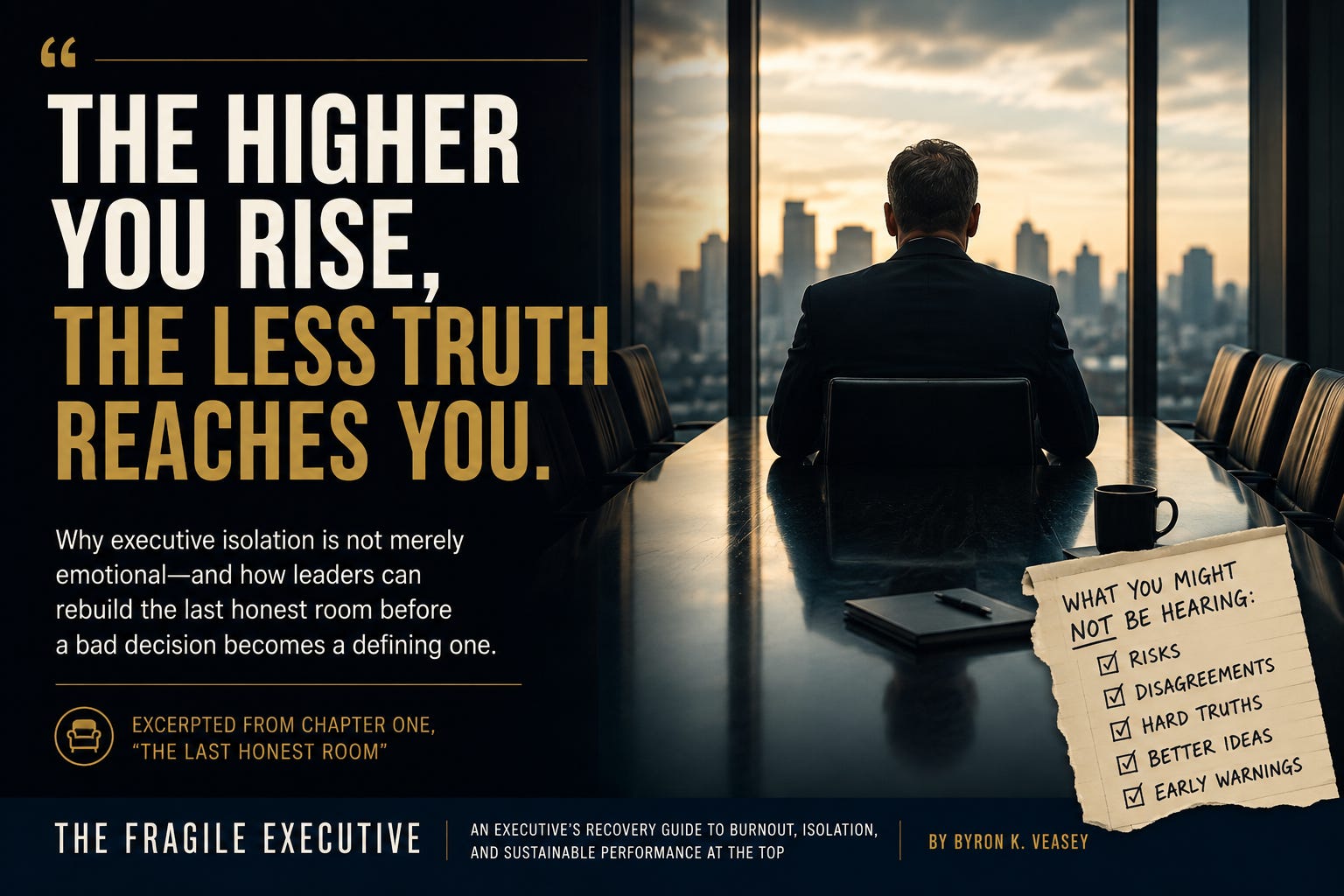
Why executive isolation is not merely emotional—and how leaders can rebuild the last honest room before a bad decision becomes a defining one
Preview text: Power does not merely change how people treat you. It changes the information they are willing to give you.
Adapted from Chapter One, “The Last Honest Room,” in The Fragile Executive: An Executive’s Recovery Guide to Burnout, Isolation, and Sustainable Performance at the Top.
The meeting went well.
Your presentation was clear. The numbers supported the recommendation. The executive team asked intelligent questions, but no one raised a serious objection.
A few people nodded.
Someone said, “This makes sense.”
Someone else added, “I think we’re aligned.”
You left the room believing the strategy had survived scrutiny.
But perhaps it had not been scrutinized at all.
Perhaps the people around the table saw the weaknesses.
One person questioned the financial assumptions. Another worried that the implementation timeline was unrealistic. Someone else suspected that your enthusiasm for the idea had moved beyond conviction and into attachment.
They did not lie to you.
They simply edited themselves.
They softened their concerns, shortened their questions, and decided that this was not the meeting in which to become the person standing between the leader and the outcome the leader appeared to want.
You heard consensus.
What you may have received was compliance.
That distinction becomes more dangerous the higher you rise.
Power Changes Information Before It Reaches You
Executives often assume that greater authority gives them greater access to the truth.
In one sense, it does.
More reports reach you. More people brief you. More data lands on your desk. You become one of the most information-rich people in the organization.
But power also changes that information before you receive it.
The people speaking to you are not only thinking about what is true.
They are calculating what it might cost them to say it.
You influence compensation.
You approve projects.
You shape promotions.
You decide which initiatives survive a budget review and which departments absorb the next reduction.
That reality creates what I call the truth tax: the personal and professional cost someone believes they may pay for delivering an unwelcome message to a powerful person.
The tax rises with authority.
A colleague may disagree openly with another colleague. That same person may become more diplomatic with a director, more cautious with a vice president, and almost silent with the chief executive.
The truth does not always disappear completely.
More often, it arrives rounded at the edges.
The warning becomes an observation.
The objection becomes a question.
The question becomes a carefully phrased suggestion.
By the time it reaches the top, the information may still be technically accurate while no longer being strong enough to change the decision.
This is why the absence of disagreement should never automatically be interpreted as evidence of exceptional leadership.
The disagreement may not have stopped because you became better.
It may have stopped because you became more powerful.
It Is Not Just Loneliness. It Is Blindness.
Executive isolation is often described as an emotional problem.
We say leadership is lonely.
We encourage senior leaders to build friendships, attend peer dinners, or spend more time connecting with others.
Connection matters.
But loneliness is only part of the problem.
At the executive level, isolation can become an information failure.
You carry knowledge you cannot freely share:
An acquisition under consideration
A confidential performance matter
A coming restructuring
An unresolved legal risk
A financial result that has not yet been announced
Healthy relationships depend partly on reciprocity. One person shares something real, and the other responds with equal honesty.
Executives cannot always reciprocate.
Confidentiality creates a wall.
Employees feel it even when they do not know what is behind it. They become careful about what they disclose because the relationship no longer feels fully symmetrical.
On one side, employees filter what they tell you.
On the other, confidentiality limits what you can tell them.
The result is a leadership seat structurally designed to restrict candor.
That is why executive isolation should not be dismissed as a soft issue requiring greater resilience.
It is a data-quality problem.
Loneliness is the feeling the problem produces.
Blindness is the operational risk underneath it.
When Information Falls, Certainty Can Rise
The most dangerous consequence of filtered information is not confusion.
It is certainty.
Most leaders calibrate their confidence partly through resistance.
Someone challenges the assumptions.
A trusted colleague exposes a weakness.
A team member asks the question that forces everyone to reconsider the plan.
Pushback gives confidence something to push against.
When the pushback disappears, confidence can continue rising without correction.
The strategy appears stronger because fewer people challenge it.
The forecast appears more dependable because the uncomfortable assumptions remain unspoken.
The acquisition appears more attractive because the people who see the risks have learned to present them carefully—or not at all.
You feel increasingly certain at the same time that the quality of your information is declining.
That gap is where expensive decisions live.
Not the obviously reckless decisions.
The ones you enter calmly, professionally, and confidently because the room gave you no visible reason to stop.
A year later, the organization may be absorbing:
A failed transformation
A costly write-down
The preventable departure of key talent
A strategy the market never wanted
Then comes the wounded question:
Why didn’t anyone tell me?
The uncomfortable answer may be that people had been learning for years that telling you did not pay.
An Open Door Does Not Solve a Structural Problem
Many good leaders recognize this risk and respond sincerely.
“My door is always open.”
“I want honest feedback.”
“Tell me when I’m wrong.”
Those statements are better than hostility.
But they do not remove the truth tax.
You still control resources, reputations, opportunities, and careers.
Being approachable does not make the power difference disappear.
An open-door policy also places the burden on the person with less power. It asks that person to find the courage to enter, challenge the leader, and trust that there will be no consequences.
That is not a reliable information system.
Approachability asks for courage, but authority is one of the forces suppressing that courage.
You cannot depend on individual bravery to correct a distortion created by the structure itself.
The answer is not simply to become warmer.
The answer is to build an architecture in which candor becomes easier, safer, and expected.
Rebuild the Last Honest Room
Executives need several independent channels through which the truth can still reach them.
1. Find a Peer Who Owes You Nothing
You need at least one person outside your authority.
This may be another executive in a noncompeting organization, a member of a carefully selected peer forum, or a leader who has operated at a comparable level.
The value is not merely friendship.
It is symmetry.
A genuine peer cannot be promoted by you.
You cannot cancel their project, reduce their budget, or influence their next performance review.
The professional risk of disagreeing with you is dramatically lower.
That allows the conversation to move beyond encouragement.
A useful peer does not only ask how you are doing.
They ask what you may be missing.
They can recognize the pressure of the seat without automatically validating every decision made from it.
Make the conversation recurring.
A monthly meeting that has existed for two years will still be there during the quarter when you are most tempted to isolate yourself.
An occasional conversation is easy to cancel precisely when it becomes most necessary.
2. Hire a Paid Truth-Teller
Executives may also need a coach, advisor, counselor, or therapist whose professional responsibility includes saying what no one inside the organization will say.
The right person is not paid to admire you.
They are paid to notice you.
They observe patterns across decisions.
They recognize when exhaustion is beginning to shape judgment.
They challenge the story you are telling yourself before that story becomes organizational strategy.
Hire for candor rather than comfort.
A professional who reflects your brilliance back to you may feel supportive, but they are not correcting the information problem.
Bring them a decision you feel confident about.
Ask them to identify the flaw.
Then watch what happens.
Someone who cannot challenge you may be a mirror, not an instrument.
3. Make Dissent a Role
Inside the organization, do not leave disagreement dependent on personal bravery.
Assign it.
For important decisions, designate someone to argue the opposing case. Rotate the responsibility so one employee does not become permanently labeled as negative or resistant.
Use a pre-mortem.
Before approving a major initiative, ask the team to imagine that it is one year later and the initiative has failed badly.
Then ask:
What happened?
That framing changes the task.
Employees are no longer being asked to confront the executive who supports the proposal.
They are being asked to explain a hypothetical failure.
The risk becomes the assignment.
The person questioning your assumptions is not obstructing the decision. They are performing the role you explicitly gave them.
Dissent must be engineered and protected rather than left to individual courage.
Protect the First Person Who Tells You the Truth
Creating these channels is not enough.
People will watch what you do when someone actually uses them.
Do you become visibly colder?
Do you interrupt?
Do you immediately explain why the person misunderstood the situation?
Does the person who challenged you later lose access, opportunity, or influence?
One defensive reaction can teach an entire room that your invitation was not genuine.
The reverse is also true.
Thank someone publicly for raising a difficult concern.
Take notes instead of preparing a rebuttal.
Ask follow-up questions.
When the information justifies it, visibly adjust the decision.
Nothing proves that truth is safe more effectively than watching a leader change course because someone delivered it.
Your reaction becomes organizational evidence.
Stop Asking Questions That Request Agreement
Leaders also need to examine how they ask for feedback.
Questions such as these are rarely neutral:
“Does that make sense?”
“We’re aligned, right?”
“Is everyone comfortable with this?”
They are requests for confirmation disguised as inquiries.
Ask questions that make disagreement easier:
What would have to be true for this decision to be a mistake?
What is the strongest case against this proposal?
Where are our assumptions weakest?
Who is likely to disagree with this but has not said so yet?
What are you not telling me because you believe I do not want to hear it?
Where am I wrong? I’m asking because I cannot see this clearly from my chair.
Then wait.
Do not rescue the room from silence.
The discomfort of the pause may be the space in which the honest answer is forming.
Build the System Before the Crisis
Candor becomes hardest to deliver when it becomes most valuable.
During a bad quarter, a public controversy, an acquisition, or a bet-the-company decision, the perceived cost of challenging the executive increases.
People become more concerned about stability, loyalty, and their own futures.
That is the worst time to begin searching for honest counsel.
A peer relationship cannot become deeply trustworthy overnight.
A new coach does not yet know your baseline well enough to recognize when pressure is distorting your behavior.
A team that has never practiced dissent will not suddenly believe it is safe because the stakes have become enormous.
Build in calm what you will need in the storm.
The leaders who navigate their hardest periods are rarely those who discovered honest counsel during the crisis.
They are the ones who installed it earlier, when it seemed unnecessary and was easiest to postpone.
The Silence Is Not Proof That You Have Arrived
Think back to the last time someone told you something you genuinely did not want to hear.
Not a carefully managed disagreement.
Not a board member fulfilling a governance responsibility.
A person who knew you well enough to say:
You are avoiding this.
Your judgment is being affected.
The room did not agree with you.
You have changed.
When did that last happen?
If the answer is difficult to remember, do not interpret the silence as proof that you no longer need correction.
The silence may be the operating environment your authority has created.
The executives who last are not those who require less truth than everyone else.
They are the ones who understand that the seat will gradually restrict their access to it.
They create independent channels.
They protect the people who challenge them.
They refuse to mistake agreement for accuracy.
You do not need to surrender your authority.
You need to stop expecting authority to deliver unfiltered truth on its own.
You do not have to become a different person.
You have to build a room in which the truth can still reach the person you already are.
About the Book
The Fragile Executive is a recovery-and-durability guide for leaders operating under the isolation, visibility, and decision pressure of the top seat.
The book examines the disappearance of candor, the cost of performing invincibility, decision-making on an empty tank, executive disclosure, identity fusion, succession, and the systems leaders need to sustain both their performance and themselves.
The Fragile Executive
An Executive’s Recovery Guide to Burnout, Isolation, and Sustainable Performance at the Top
By Byron K. Veasey
Join the Conversation
When was the last time someone in your professional life told you something you genuinely did not want to hear?
And what did your reaction teach them about whether they should ever do it again?
Leave your perspective in the comments.
About the Author
Byron K. Veasey is a career strategist and leader in data quality engineering focused on helping experienced professionals navigate AI screening, automated interviews, recruiter silence, age bias, burnout, and career reinvention.
He writes Career Strategies, a Substack newsletter read by over 5,000 professionals navigating today’s evolving job market.
👉 Subscribe to Career Strategies