
The Higher You Go, the Less Private Your Bad Day Becomes

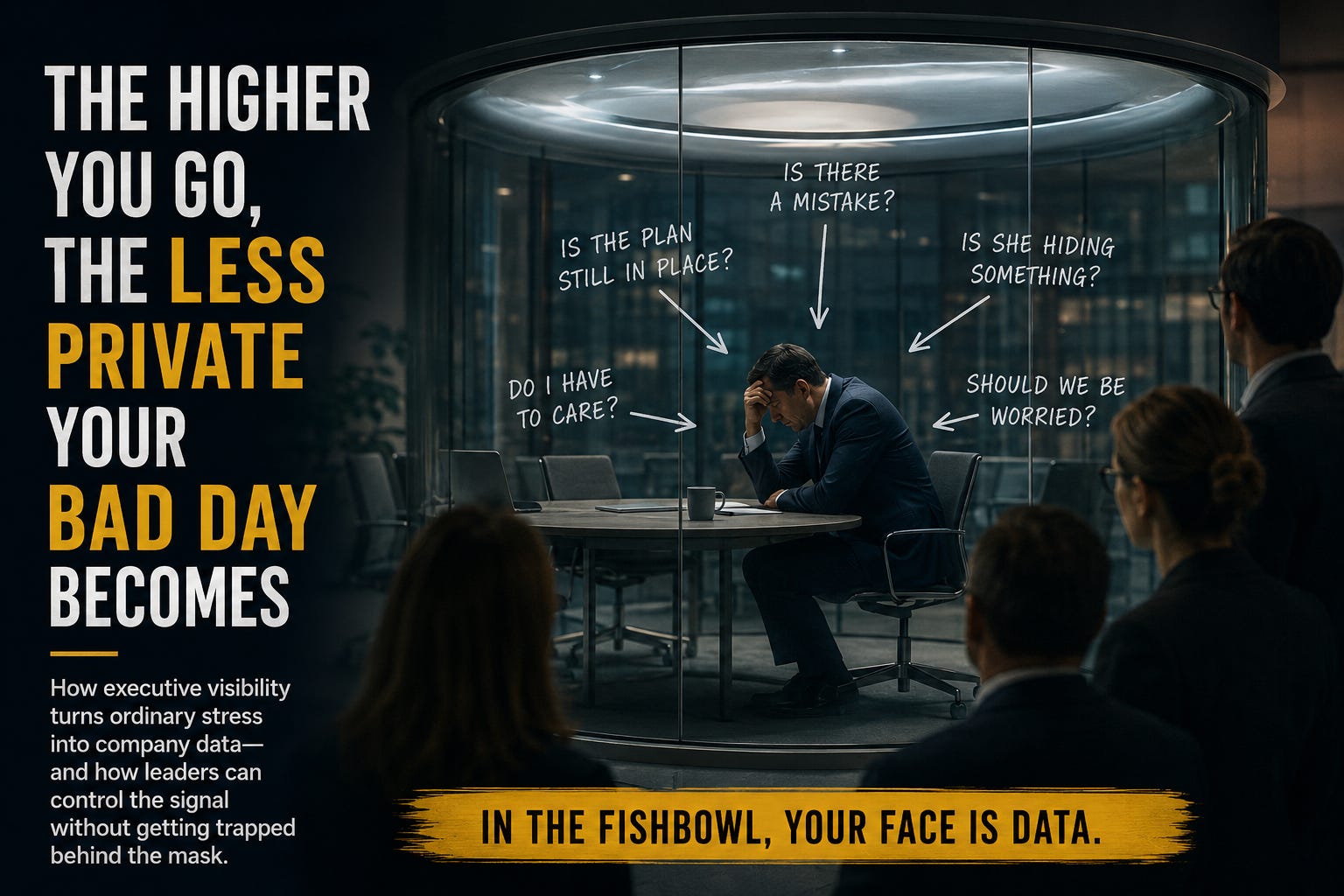
How executive visibility turns ordinary stress into company data—and how leaders can control the signal without getting trapped behind the mask
Excerpted and adapted from Chapter Two, “The Fishbowl,” of The Fragile Executive: An Executive’s Recovery Guide to Burnout, Isolation, and Sustainable Performance at the Top by Byron K. Veasey.
You thought the meeting was over.
The last person had left.
The door was closed.
For three seconds, you were no longer sitting in the executive chair.
Your shoulders dropped.
Your expression changed.
You looked down at the table and finally allowed yourself to look as tired as you actually felt.
Then the door opened.
Someone had forgotten a laptop.
They stepped back into the room.
And they saw you.
Not the version of you who had just led the meeting.
The other version.
The tired one.
Nothing dramatic happened.
No awkward conversation.
They probably grabbed the laptop, apologized, and walked out.
But you noticed the way they looked at you.
And almost immediately, you were performing again.
A little more energy in the hallway.
A friendly comment to someone.
Maybe an optimistic message sent later that afternoon.
All because someone saw your face for three seconds.
It sounds absurd when you describe it that way.
But absurdity is sometimes part of the job at the top.
Because eventually, your face is no longer just your face.
It becomes data.
Your Private State Is No Longer Entirely Private
At lower levels of an organization, you can have a bad Tuesday.
You slept poorly.
You argued with your spouse.
Your child is sick.
Your back hurts.
You are exhausted.
You drink bad coffee, keep your head down, do your work, and get through the day.
Most people are unlikely to make a corporate forecast based on your expression.
Executive leadership is different.
The higher you rise, the more people begin using you to interpret what is happening around them.
Your team watches your emotional state.
Other executives watch your confidence.
Your board watches for stability.
Employees watch your language.
Analysts and investors may watch your posture, tone, public behavior, and choice of words.
Everyone is trying to answer questions they may never ask you directly:
Is something wrong?
Does she know something we don’t?
Is the strategy still intact?
Should I be worried?
This is why executive visibility becomes more than attention.
It becomes an information system.
I call this condition the fishbowl: the reality that other people observe, interpret, and sometimes act upon a leader’s private state.
And here is what makes the fishbowl dangerous:
The audience rarely knows the source of the signal.
They only see the signal.
You know you slept four hours.
They see fear.
You know you had a difficult conversation before the meeting.
They see uncertainty.
You know you are simply tired.
They see trouble.
That distinction matters.
Because people do not like unexplained signals.
When information is missing, they create explanations.
And the story they create is often worse than the truth.
How One Bad Morning Becomes an Organizational Event
A bad morning can begin writing its own story.
You are tired.
So your answers become shorter.
Your voice becomes flatter.
You sit differently in the meeting.
You cancel an event you would normally attend.
People notice.
They just do not know why.
Someone thinks:
Something must be wrong.
Then their behavior changes.
A normally direct report becomes cautious.
Another leader escalates a problem they would normally handle themselves.
Someone asks whether the quarter is still on track.
Someone else quietly wonders whether layoffs are coming.
Now the room is anxious.
The anxiety creates more questions.
More meetings.
More discussion.
More requests for reassurance.
You were already exhausted.
Now you are exhausted and managing everyone else’s reaction to your exhaustion.
Which makes you look even more exhausted.
A beautiful little system.
If your goal were to ruin three days with one bad night of sleep, it would be remarkably efficient.
That is the fishbowl loop:
Private strain creates a signal.
The audience interprets the signal.
Their behavior changes.
Their changed behavior adds more strain.
The increased strain produces an even stronger signal.
And suddenly, the bad day begins reproducing itself.
People are not irrational.
They are doing what human beings do when information is incomplete.
They fill the gap.
The Other Failure Mode: Becoming Invincible
Once executives realize they are being watched, many reach the same conclusion:
Fine.
Then I won’t show anything.
No fatigue.
No fear.
No frustration.
No cracks.
Problem solved.
Except now you have built a pressure cooker.
This is the second failure mode of executive visibility.
You seal everything inside.
From the outside, it may look impressive.
The quarter misses expectations.
Stay calm.
The product fails.
Stay calm.
An activist investor appears.
Stay calm.
A senior executive leaves.
Stay calm.
People may even compliment you.
“Nothing bothers her.”
“He’s always consistent.”
“She never seems rattled.”
It sounds like praise.
It can also describe a terrible operating system.
Because the internal state did not disappear.
You simply eliminated all the places where it was allowed to exist.
The body still carries it.
The mind still carries it.
Your relationships begin absorbing pieces of it.
Eventually, the pressure finds another exit.
Your patience shortens.
Your sleep deteriorates.
Your judgment becomes less reliable.
You snap at someone over something trivial.
Or one Monday morning, you realize you simply cannot keep going.
And the organization says:
“We had no idea.”
Of course they didn’t.
You spent years making sure they couldn’t.
The appearance of stability created through complete concealment is not always resilience.
Sometimes it is simply delayed failure.
“Just Be Authentic” Is Not the Answer
There is another popular response to this problem:
Be authentic.
The idea is appealing.
It feels compassionate.
Modern.
Certainly more humane than “emotionally suppress yourself until retirement.”
But taken literally, it can become dangerous advice for an executive.
Because authenticity without judgment can turn your internal weather into everyone else’s weather.
Imagine the morning of a layoff.
You are eliminating positions.
People are frightened.
You are deeply disappointed by what is happening.
Maybe you are frightened too.
Should the room see your humanity?
Yes.
Should the room be required to contain your anxiety?
No.
Those are different things.
People need truthful information.
They need presence.
They need clarity.
They need to understand what is happening.
They do not need the person holding the floor to emotionally collapse and hand responsibility for that collapse to them.
You might say:
“This is painful. People we care about are affected by these decisions. Here is what is changing, why the decision was made, and what happens next.”
That can be completely authentic.
You do not also have to say:
“And privately, I am terrified, exhausted, and questioning half the decisions that brought us here.”
That may also be true.
It simply belongs somewhere else.
There Is a Third Option
Leaders often believe they have two choices:
Hide everything.
Or reveal everything.
There is a third option.
Intentional signaling.
Choosing your signal is not the same thing as deception.
A signal becomes dishonest when it contradicts reality.
If you know the business is in serious trouble and you are telling everyone everything is fantastic, that is not leadership.
That is deception.
But deciding which truthful information belongs with which audience is different.
You already do this in other parts of life.
A parent may be worried about money without giving a seven-year-old a detailed presentation on household cash flow.
A surgeon can acknowledge that an operation is difficult while maintaining steady hands.
A pilot can feel concern while still giving passengers calm, accurate information.
Responsibility changes the definition of useful honesty.
The same principle applies to executives.
Your stakeholders generally need the truth about the things that affect them.
They do not need unrestricted access to every emotion you experience while carrying that truth.
The goal is not:
Hide your state.
The goal is:
Steer your state.
That difference matters.
Because when emotion has an appropriate outlet, it no longer has to be either broadcast or buried.
Different Audiences Need Different Versions of the Truth
Part of what makes the fishbowl exhausting is that executives begin acting as though everyone is the same audience.
They aren’t.
Think about executive visibility in rings.
The Market and Public
This is the outer ring.
They usually receive the most condensed signal.
Accuracy matters.
Consistency matters.
Words matter enormously.
The Board
The board needs considerably more information, particularly around risk, strategy, performance, and uncertainty.
The Executive Team
Your executive team needs enough reality to operate effectively.
They should understand problems.
They should understand uncertainty.
But they should not have to carry your unmanaged fear in order to do their jobs.
Your Direct Team
This group often needs more context, proximity, and human presence.
They may see more of what is happening because they are working with you more closely.
Backstage
And somewhere near the center, something completely different needs to exist.
A place where you stop managing the signal.
A real backstage.
That distinction is essential because one level of openness does not work for every audience.
If you speak to the market the way you speak to your closest friend, you may have a governance problem.
If you speak to your closest friend the way you speak on an earnings call, you may have a life problem.
Yet many executives gradually make exactly that mistake.
They are “on” everywhere.
Boardroom.
Office.
Car.
Kitchen.
Bedroom.
Weekend.
Vacation.
Same face.
Same person.
Same answer:
“I’m good.”
Eventually, the sentence becomes almost funny.
Because everyone except the speaker may already know it is not true.
Every Executive Needs a Place to Shake
This may be the most important point.
You need a backstage.
Not another networking dinner.
Not another person impressed by your title.
Not another room where you are expected to be insightful, interesting, strategic, or helpful.
A real backstage.
A place where your bad day does not affect the stock price.
Where your frustration does not make employees wonder whether their jobs are safe.
Where admitting uncertainty does not become tomorrow morning’s corporate rumor.
That person might be:
A trusted peer.
A coach.
A counselor.
A spouse or partner who is genuinely outside the organizational machinery.
Someone who can hear:
“I don’t know if I can keep doing this.”
…and not convert that sentence into organizational data.
That relationship serves two purposes.
First, it gives the strain somewhere to go.
Second, it gives you an honest mirror.
Because when you spend all day appearing steady, something strange can happen.
You stop realizing how tired you are.
You become extremely good at convincing other people.
Eventually, you begin convincing yourself.
Someone backstage can look at you and say:
“You’ve been telling me for three weeks that you’re fine. Your behavior says otherwise.”
Annoying?
Absolutely.
Useful?
Very.
Leadership does not disappear backstage.
Backstage is one of the things that makes leadership sustainable.
Learn Your First Leak
Most leaders have a tell.
Something changes before they consciously admit they are depleted.
Maybe your emails get shorter.
Maybe your sense of humor disappears.
Maybe every question suddenly annoys you.
Maybe you begin moving meetings around.
Maybe you stop calling people.
Maybe your calendar becomes chaotic.
Maybe every problem begins receiving the same response:
“Just handle it.”
None of these automatically means there is a major problem.
But they are useful signals.
Instead of asking:
Do I feel exhausted?
Ask:
What changes first when I am empty?
Because feelings are easy to negotiate with.
Signals are harder.
You can tell yourself you are fine.
Your sent folder may disagree.
You can insist that nothing has changed.
Fourteen clipped emails and three canceled dinners may have another opinion.
Knowing your first tell gives you an early-warning system.
The Five-Minute Signal Check
Three times a week, take five minutes and ask yourself three questions.
1. What signal did I give off that I did not intend to give?
Think about:
The sharp email.
The flat meeting.
The moment your face answered before you did.
2. What is my tell trying to tell me?
Has your tone changed?
Has your patience shortened?
Has your calendar changed?
Are you withdrawing?
Are you becoming unusually controlling?
3. Where did the strain actually go this week?
This one can be uncomfortable.
Sometimes “I handled it” really means:
I put it inside my body and then kept doing Zoom calls.
That is not processing.
That is storage.
If the answer to “Where did the strain go?” is nowhere, and you have just had an unusually difficult week, you have learned something important.
There is pressure accumulating in the system.
These questions take five minutes.
But over time, they can make the difference between managing the fishbowl and allowing the fishbowl to manage you.
Sometimes One Sentence Is Enough
Not every leaked signal requires a major conversation.
Sometimes a little context closes the information gap.
You notice that your team is interpreting your exhaustion as concern about the business.
You can simply say:
“I haven’t been getting enough sleep this week. The work itself is in good shape.”
Done.
No dramatic disclosure.
No emotional unloading.
No mystery for the room to solve.
You simply removed the vacuum in which speculation grows.
That is intentional signaling.
You Cannot Escape the Fishbowl
That may be the least comforting truth.
The position creates visibility.
People will watch.
They will interpret.
Sometimes they will interpret correctly.
Sometimes they will not.
Sometimes your feelings will become information you never intended to send.
You cannot eliminate that completely.
But you can stop pretending there are only two choices:
Reveal everything.
Or reveal nothing.
There is another way.
Separate your state from your signal.
Give the room the information that is relevant, useful, and truthful for that room.
Then give everything else a legitimate destination.
That was never really the problem with looking tired after the meeting.
The problem was believing there was nowhere you were allowed to look tired.
So if you are leading from inside the fishbowl, begin with one question:
Where am I allowed to flinch?
If you immediately know the answer, protect that place.
If you do not have an answer, build one.
At the top, your bad day may never be completely private.
But it does not have to become everyone else’s bad day.
The goal is not to become unreadable.
The goal is to become intentional.
To understand what the room needs.
To remain honest about what you are carrying.
And to have enough discipline to recognize that those two things do not always belong in the same room.
This is the second installment in a series inspired by The Fragile Executive: An Executive’s Recovery Guide to Burnout, Isolation, and Sustainable Performance at the Top.
About the Author
Byron K. Veasey is a career strategist and leader in data quality engineering focused on helping experienced professionals navigate AI screening, automated interviews, recruiter silence, age bias, burnout, and career reinvention.
He writes Career Strategies, a Substack newsletter read by over 5,000 professionals navigating today’s evolving job market.
👉 Subscribe to Career Strategies