
The Hidden Cost of Hope in a Long Job Search

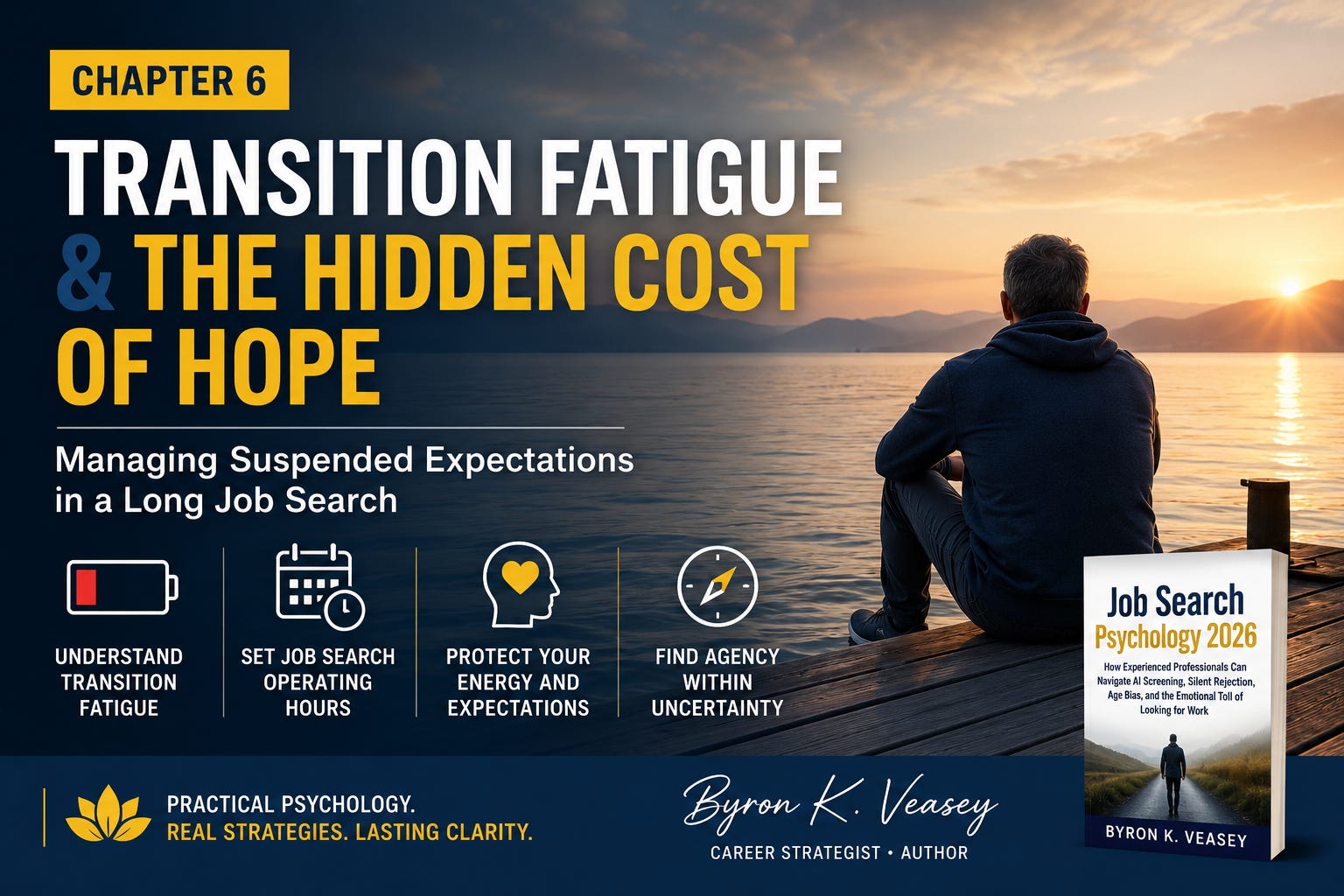
This article is based on Chapter 6 of Job Search Psychology 2026: How Experienced Professionals Can Navigate AI Screening, Silent Rejection, Age Bias, and the Emotional Toll of Looking for Work. Chapter 6 focuses on transition fatigue, suspended expectations, job search operating hours, and finding agency inside uncertainty.
You are tired.
But not in the normal way.
Not the tired that comes after a long workday.
Not the tired that comes after a hard interview.
Not the tired that comes after sending ten applications, rewriting your resume again, or preparing for a conversation that required every ounce of professionalism you had left.
This is different.
This is the tired that comes from waiting.
The tired that settles in when nothing happened today, and somehow the nothing still drained you.
No rejection.
No update.
No interview.
No decision.
No new information.
Just another day suspended between possibility and silence.
And that is what makes it so confusing.
You did not do much.
So why are you exhausted?
You opened your inbox.
Nothing.
You checked the job board.
Same roles.
You refreshed the application portal.
Still “under review.”
You replayed the interview from last week.
Still no answer.
You told yourself not to think about it.
Then thought about it all day.
You tried to stay hopeful.
Then felt foolish for hoping.
You tried to detach.
Then worried that detaching meant giving up.
You tried to keep moving.
Then wondered whether movement mattered.
By evening, you are not just tired.
You are emotionally worn thin.
And because there is no clear event to point to, you start blaming yourself.
Maybe I am too sensitive.
Maybe I am not disciplined enough.
Maybe I need to be more positive.
Maybe I should be doing more.
Maybe I am losing momentum.
Maybe I am not built for this market.
But sometimes the issue is not that you lack resilience.
Sometimes the issue is that the job search has placed you in a state your nervous system was never designed to live inside indefinitely.
You are not just searching.
You are waiting without closure.
You are hoping without evidence.
You are preparing without a date.
You are staying ready for a door that may or may not open.
That has a cost.
And most job search advice does not name it.
Waiting Can Hurt More Than Rejection
A rejection at least gives you an ending.
It may sting.
It may frustrate you.
It may disappoint you.
But it closes the loop.
You know the answer.
You can grieve it, process it, adjust, and move on.
Silence does something different.
Silence keeps the loop open.
It leaves your mind searching for meaning.
Did they see my application?
Did I say something wrong?
Are they still interviewing?
Did the role get paused?
Was I too expensive?
Was I too experienced?
Was I filtered out?
Should I follow up?
Should I wait?
Should I move on?
Should I still hope?
That last question is the one that costs the most.
Because hope, in a long job search, is not always light.
Sometimes hope is labor.
Sometimes hope is emotional work.
Sometimes hope means keeping part of yourself open to a possibility that keeps refusing to answer.
And every open loop draws energy.
Every unfinished possibility takes up space.
Every “maybe” requires maintenance.
You may think you are doing nothing while you wait.
But your nervous system is not doing nothing.
It is tracking.
Scanning.
Bracing.
Anticipating.
Rehearsing.
Protecting.
Preparing.
That is why a quiet day can leave you so depleted.
The job search did not ask much of your calendar.
But it asked a lot of your internal system.
Transition Fatigue Is Not Burnout
Burnout usually comes from too much output for too long.
Too many demands.
Too little recovery.
Too much pressure.
Too little control.
Too many responsibilities.
Too little replenishment.
Transition fatigue is different.
It does not come only from doing too much.
It comes from staying suspended too long.
It comes from living in a hallway between what ended and what has not yet begun.
It comes from trying to remain psychologically available for a future that refuses to take shape.
You are no longer fully in the old chapter.
But you are not yet securely in the new one.
You are between identities.
Between routines.
Between answers.
Between versions of yourself.
And that in-between space is not neutral.
It has weight.
You may not have a job to go to.
But you still have pressure.
You may not have a manager assigning tasks.
But you still have expectations.
You may not have meetings all day.
But you still have mental load.
You may not be clocking in.
But your mind is still on duty.
That is transition fatigue.
It is the fatigue of uncertainty without relief.
It is the fatigue of suspended expectations.
It is the fatigue of trying to stay ready while not knowing what you are getting ready for.
The Emotional Labor of Staying Ready
Long job searches create a strange emotional assignment:
Stay hopeful, but do not get attached.
Stay available, but do not obsess.
Stay confident, but be realistic.
Stay active, but do not burn out.
Stay patient, but do not become passive.
Stay ready, but do not know when readiness will be required.
That is a lot to ask of a person.
Especially an experienced professional who is used to being effective.
You are used to effort producing movement.
You solve the problem.
You run the meeting.
You manage the risk.
You lead the team.
You fix the process.
You make the decision.
You move things forward.
But the job search often does not respond to competence that way.
You can do the right things and still hear nothing.
You can tailor the resume and still disappear.
You can interview well and still wait three weeks.
You can network thoughtfully and still get vague replies.
You can be qualified and still not be selected.
The hardest part is not only the lack of control.
It is the requirement to keep showing up as if control might return at any moment.
That is emotional labor.
You have to regulate disappointment before the next application.
You have to restore confidence before the next conversation.
You have to sound clear and composed while feeling uncertain.
You have to explain your story while privately wondering whether the market believes it.
You have to keep your professional identity intact while the outside world gives you less and less evidence that it sees you.
That is why “just keep going” is not enough.
Because what looks like persistence from the outside may feel like emotional erosion from the inside.
Hope Needs Boundaries
Hope is important.
But unbounded hope can become exhausting.
When every application remains emotionally open, when every interview becomes the possible turning point, when every silence becomes something to decode, hope stops feeling like fuel.
It becomes surveillance.
You monitor everything.
The inbox.
The phone.
The portal.
The recruiter’s tone.
The hiring manager’s last sentence.
The LinkedIn activity.
The job posting status.
The calendar.
The imagined timeline.
And because the search can technically update at any time, your mind starts acting as if you must be available all the time.
That is how the job search becomes a 24-hour psychological shift.
You may only apply for two hours.
But you think about it for twelve.
You may only check your email five times.
But your body is waiting for it all day.
You may tell yourself you are resting.
But part of you is still listening for the next signal.
That is not rest.
That is standby mode.
And standby mode still consumes energy.
Hope without boundaries keeps you on call for a life that has not arrived yet.
You Need Job Search Operating Hours
One of the most practical ways to protect yourself is to stop letting the job search occupy the whole day.
The search needs operating hours.
A beginning.
An ending.
A defined container.
Not because you are less serious.
Because you are serious enough to make the search sustainable.
Choose when the search is open.
Then choose when it is closed.
During open hours, you work.
You apply.
You follow up.
You tailor the resume.
You research roles.
You reach out.
You prepare.
You track.
You do the work with focus.
But when the search is closed, it is closed.
No refreshing.
No casual checking.
No “just one more look.”
No late-night portal visits.
No half-resting while still scanning.
The search is shut for the day.
Like an office after hours.
This may feel uncomfortable at first.
The anxious part of you will object.
What if something comes in?
What if I miss an opportunity?
What if they email tonight?
What if fast response matters?
But most of the time, that fear is not strategy.
It is hypervigilance.
The systems that are filtering, delaying, pausing, and ghosting candidates are not rewarding you for being emotionally available at 10:43 p.m.
They are not measuring your worth by how quickly you refresh.
They do not know that you sacrificed your evening.
They do not know that you stayed anxious for them.
The cost is yours.
And the benefit is usually imagined.
An opportunity worth pursuing will still be there when your search opens again.
But the energy you lose by staying on duty all night may not return so easily.
Schedule the Worry
This may sound strange, but worry needs a container too.
If you do not give worry a place to go, it will go everywhere.
It will show up while you are eating.
While you are trying to sleep.
While you are talking to family.
While you are watching a movie.
While you are supposedly taking a break.
While you are driving.
While you are trying to pray, think, rest, or feel like a person again.
The mind keeps returning to the search because it believes the worry is protecting you.
So do not try to eliminate it.
Schedule it.
Give yourself fifteen or twenty minutes a day for job search worry.
During that time, let the fears come.
Write them down.
Name them.
Let the anxious mind speak.
What if this takes longer than I can afford?
What if my experience is being counted against me?
What if I have to take something below my level?
What if I never get back to where I was?
What if the market has changed too much?
What if I am invisible now?
Do not shame the questions.
Give them a room.
Then close the room.
When worry shows up outside that window, you can say:
Not now. I will meet you at five.
That sentence matters.
You are not suppressing the fear.
You are creating order.
You are telling your nervous system that the worry will be heard, but it will not be allowed to run the whole day.
That is agency.
Not control over the market.
Control over the container.
Create a Shutdown Ritual
The job search needs an ending each day.
Not just because the work is done.
Because your body needs to know the work is done.
Without a ritual, the search stays open in the background.
The laptop may be closed.
But the loop remains active.
So build a small shutdown ritual.
Nothing dramatic.
Nothing complicated.
At the end of your search hours, write tomorrow’s first task on a note.
Close the laptop.
Take three long exhales.
Say, out loud if needed:
The search is closed for today.
Then do something that marks the transition.
Step outside.
Make coffee.
Take a walk.
Start dinner.
Put music on.
Call someone.
Read something unrelated to the job market.
Your body needs a signal that you are no longer in candidate mode.
Because if you do not close the search deliberately, the search will follow you everywhere.
Agency Does Not Mean Certainty
A long job search can make you feel powerless because so many outcomes are outside your control.
You cannot control whether the recruiter replies.
You cannot control whether the budget changes.
You cannot control whether the hiring manager pauses the role.
You cannot control whether the ATS ranks your resume correctly.
You cannot control whether someone reads your experience with imagination or bias.
You cannot control whether a company is truly hiring or simply collecting applicants.
That lack of control is real.
But lack of control over the outcome is not the same as lack of agency.
Agency is smaller than control.
But it is still powerful.
Agency is choosing your operating hours.
Agency is deciding when the search is closed.
Agency is tracking your actions instead of refreshing for outcomes.
Agency is following up once, professionally, and then releasing the loop.
Agency is building a competence bank so silence does not become your only evidence.
Agency is preparing for interviews without turning every possible question into a threat.
Agency is saying:
I cannot force the market to answer today.
But I can decide how much of myself I give to its silence.
That is not passive.
That is mature.
That is how you remain intact in a system that keeps withholding closure.
Stop Measuring the Day by Whether the Market Responded
One of the most damaging habits in a long search is letting the market decide whether the day counted.
No response means the day failed.
No interview means nothing moved.
No offer means you are still stuck.
No update means you are behind.
But that measurement system will break you.
Because it makes your emotional state dependent on variables you do not control.
You need a different scoreboard.
Did you complete the application block you set?
Did you follow up where follow-up made sense?
Did you stop when your operating hours ended?
Did you protect one part of your day from the search?
Did you catch one self-blaming thought before it became a spiral?
Did you document one piece of evidence from your career?
Did you reach out without apologizing for existing?
Did you rest without checking the portal?
Those count.
Not because they replace the need for employment.
They do not.
You need income.
You need opportunity.
You need movement.
But while the market is unresolved, you still need ways to measure progress that do not depend entirely on the market’s willingness to respond.
Otherwise, every silent day becomes proof of failure.
And that is not accurate.
A silent day can still be a disciplined day.
A quiet inbox can still be a day where you protected your capacity.
No update can still be a day where you practiced agency.
The market may not have moved.
But you did.
Do Not Let the Search Steal the Whole Self
The longer the search goes on, the easier it becomes to shrink your identity down to one question:
Am I hired yet?
That question starts following you everywhere.
At the grocery store.
At church.
At dinner.
On walks.
In conversations.
In the mirror.
You stop being a whole person living through a difficult transition.
You become a candidate waiting for a verdict.
That is dangerous.
Because the job search is something you are doing.
It is not who you are.
You are still a person with history.
Relationships.
Judgment.
Humor.
Memory.
Skill.
Taste.
Faith.
Standards.
A body.
A life.
A story larger than this season.
The search may be urgent.
But it cannot be allowed to become total.
You need places where you are not performing employability.
You need conversations where you are not explaining your status.
You need routines that are not optimized for the market.
You need small reminders that you still exist outside the hiring process.
Not as avoidance.
As protection.
Because the search can take a long time.
And you cannot hand it the entire self while you wait.
The Hidden Cost of Hope
Hope sounds gentle.
But in a long job search, hope can become complicated.
Hope lifts you.
Then exposes you.
Hope opens a door.
Then leaves you standing there when no one answers.
Hope helps you apply.
Then makes the silence hurt more.
Hope gives you energy before the interview.
Then makes the waiting afterward feel unbearable.
So some people stop hoping.
Not because they are negative.
Because hoping has started to feel unsafe.
They tell themselves:
Do not get excited.
Do not expect anything.
Do not care too much.
Do not imagine the offer.
Do not picture relief.
Do not let yourself want it.
This is understandable.
But it can harden into numbness.
And numbness protects you from disappointment by also cutting you off from possibility.
The answer is not to force yourself into loud optimism.
The answer is bounded hope.
Hope with edges.
Hope that says:
I can want this without making it my only proof of worth.
I can prepare without emotionally moving into the outcome.
I can be interested without becoming consumed.
I can care without surrendering my stability.
I can hope and still close the laptop.
That is the kind of hope a long search requires.
Not fragile hope.
Not desperate hope.
Not fantasy hope.
Disciplined hope.
Hope that can breathe.
Hope that does not require you to stay on duty all night.
The Search Is Open. The Search Is Closed.
This may become one of the most important practices you build.
The search is open.
The search is closed.
Open means focused action.
Closed means real recovery.
Open means you do the work.
Closed means you return to yourself.
Open means you engage the market.
Closed means the market no longer gets access to your nervous system for the day.
You will not do this perfectly.
You will check sometimes.
You will reopen the loop sometimes.
You will forget the boundary.
You will justify one more search.
You will tell yourself it only takes a second.
And then you will notice.
Then you will close it again.
That is the practice.
Not perfection.
Return.
You Are Allowed to Be a Person While You Search
The job search will try to convince you that everything must wait until the offer comes.
Peace can wait.
Rest can wait.
Joy can wait.
Confidence can wait.
Structure can wait.
Life can wait.
But if the search takes months, that means your life is placed on hold for months.
And if the market remains uncertain, you may keep postponing your humanity for a system that has no urgency about you.
Do not do that.
You are allowed to live while unresolved.
You are allowed to rest before the offer.
You are allowed to laugh before the callback.
You are allowed to have dinner without checking email.
You are allowed to spend an evening as a person, not a candidate.
You are allowed to protect your mind before the market gives you permission.
Because the goal is not only to get hired.
The goal is to arrive at the next role with enough of yourself still intact to enter it well.
Managing Suspended Expectations
A long job search asks you to live inside suspended expectations.
Something might happen.
But not yet.
A role might open.
But not yet.
A recruiter might respond.
But not yet.
An interview might convert.
But not yet.
An offer might come.
But not yet.
That “not yet” becomes a room you live in.
And if you are not careful, it will become the whole house.
So build structure inside it.
Operating hours.
Scheduled worry.
Shutdown rituals.
Evidence banks.
Bounded hope.
Internal scoreboards.
Small anchors.
Daily moments where the search does not get to define you.
These are not small things.
They are how you survive a season with no clear endpoint.
They are how you keep the search from becoming a psychological weather system that follows you into every room.
They are how you stop confusing waiting with doing nothing.
They are how you protect the part of you that still has to live, think, decide, and believe while the market remains unresolved.
The Waiting Is Real Work
No one sees this part.
They see the applications.
The interviews.
The networking.
The resume changes.
The LinkedIn updates.
They do not see the emotional labor underneath.
The restraint it takes not to spiral.
The discipline it takes not to refresh.
The courage it takes to hope again.
The wisdom it takes to stop for the day.
The self-respect it takes to measure progress internally when the outside world refuses to answer.
The patience it takes to remain steady without closure.
That is work.
Invisible work.
But real work.
And if you are in that work right now, hear this clearly:
You are not weak because waiting is exhausting.
You are not failing because silence is heavy.
You are not undisciplined because uncertainty drains you.
You are not negative because hope feels complicated.
You are not behind because you need boundaries around the search.
You are a human being trying to remain whole inside a system that keeps asking you to stay available without giving you answers.
That requires care.
Not more self-blame.
Close the Search for Today
There will be more to do tomorrow.
Another application.
Another follow-up.
Another revision.
Another conversation.
Another role to evaluate.
Another silence to manage.
But not everything has to be carried tonight.
Tonight, the search can close.
Not because you have given up.
Because you are preserving the person who has to continue.
Close the laptop.
Write tomorrow’s first task.
Take the breath.
Let the day end.
You are allowed to stop being a candidate for the evening.
You are allowed to return to your life.
You are allowed to practice hope without letting it consume you.
The waiting is real.
The uncertainty is real.
The fatigue is real.
But so is your agency.
The market may not answer today.
You can still decide what time the search closes.
And sometimes that is where steadiness begins.
This article is based on Chapter 6 of Job Search Psychology 2026: How Experienced Professionals Can Navigate AI Screening, Silent Rejection, Age Bias, and the Emotional Toll of Looking for Work. If you are trying to navigate a long search without letting silence, AI screening, and suspended expectations erode your confidence, this book was written for you.
About the Author
Byron K. Veasey is a career strategist and leader in data quality engineering focused on helping professionals navigate job searches, burnout, and career reinvention.
He writes Career Strategies, a Substack newsletter read by over 4,900 professionals navigating today’s evolving job market.
👉 Subscribe to Career Strategies