

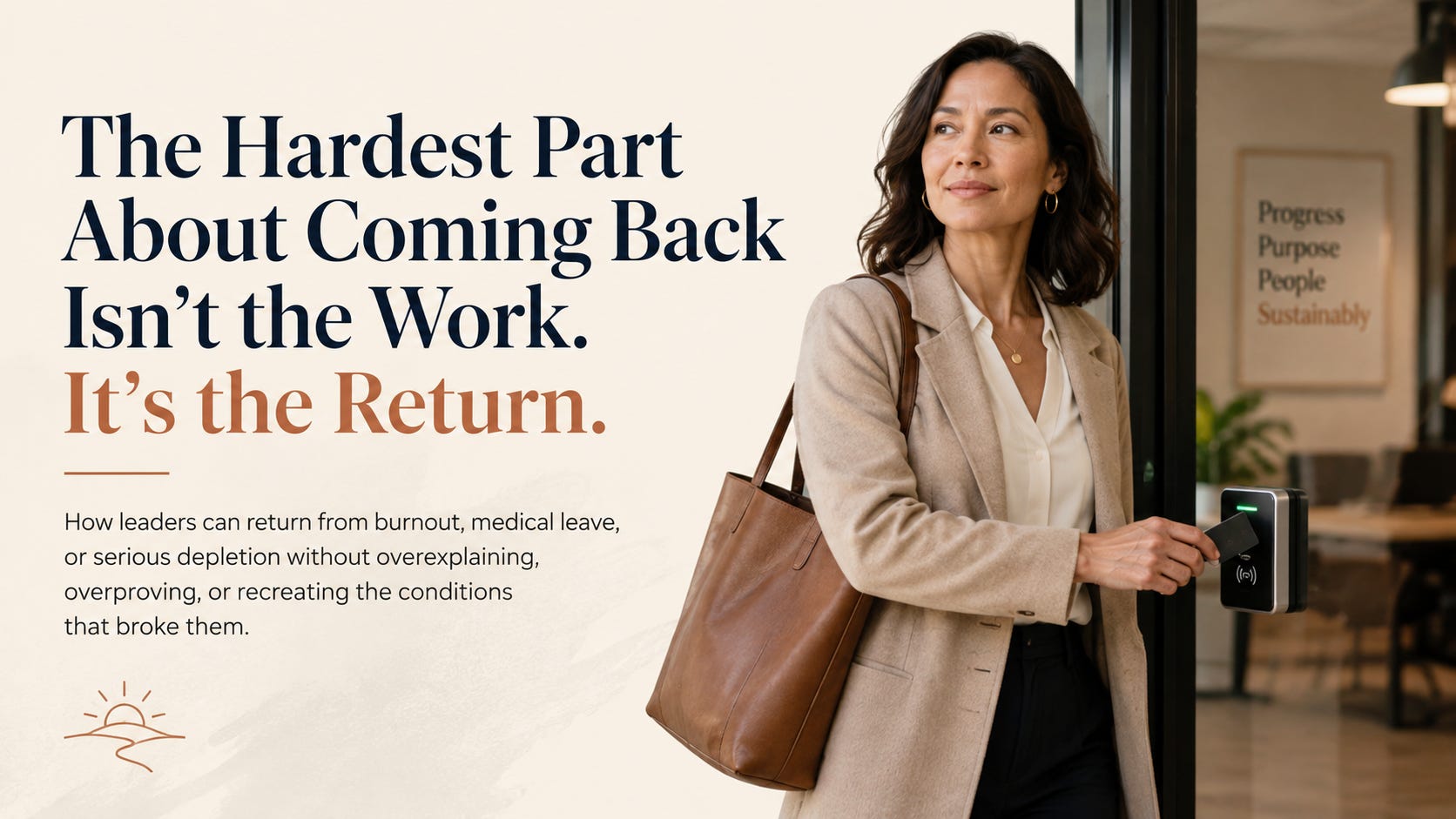
How leaders can return from burnout, medical leave, or serious depletion without overexplaining, overproving, or recreating the conditions that broke them
Adapted from Chapter 2, “The Return,” in Leading While Healing: A Manager’s Recovery Guide to Rebuilding Energy, Boundaries, and Sustainable Leadership After Burnout by Byron K. Veasey.
The badge still works.
Your email account is waiting.
Your name is still on the org chart.
Your calendar starts filling up almost immediately.
From the organization’s point of view, you’re back.
But you know something everyone else may not fully understand:
Returning to work does not mean you are fully recovered.
That gap is where many leaders get into trouble.
They come back after burnout, medical leave, a personal crisis, or a period of serious depletion and assume the goal is to get everything back to normal as quickly as possible.
And they often walk through the door carrying an invisible assignment:
Let everyone know I’m okay.
That assignment can become more dangerous than the work itself.
The return is its own leadership phase. You are physically present again, but the deeper work of recovery may still be underway. You are leading visibly while healing privately.
That is not something to improvise.
It needs an operating plan.
Your First Decision Isn’t What to Do. It’s What to Say.
One of the strangest parts of returning is realizing that everyone seems to know something happened, but very few people know exactly what.
Then come the questions.
“Everything okay?”
“How are you feeling?”
“What happened?”
Most of the time, those questions are well-intentioned.
But when you have just returned, even a friendly question can create pressure to explain more than you intended.
Chapter 2 calls this the disclosure reflex: the urge to give up privacy simply to make an uncomfortable moment end.
You start talking.
Then you keep talking.
You explain why you were gone. What happened. How bad things became. What the doctor said. What you were going through.
Five minutes later, the conversation is over.
But now information you can never retrieve is circulating in the workplace.
A better approach is to decide your disclosure strategy before you return.
Different audiences need different information.
HR or occupational health may need information related to your formal return, restrictions, documentation, or accommodations.
Your manager needs operational information: what you can carry, what you cannot yet carry, what your ramp-up looks like, and when you will reassess.
Your team and peers usually need much less. They need to know you are back, how the work will operate, and what they can expect from you.
Your boss does not need your entire personal story to understand your operating plan.
Your team does not need your diagnosis to know whether Thursday’s meeting is still happening.
And your coworkers do not automatically gain access to your most vulnerable experiences simply because they care about you.
Privacy is not dishonesty. Privacy is a boundary.
If formal leave, workplace accommodations, or disability protections are involved, your specific rights and responsibilities will depend on your circumstances and location. HR, occupational health, your clinician, or qualified legal counsel can help you understand what applies to your situation.
Don’t Plan a Dramatic Comeback. Build a Ramp.
The second mistake happens almost immediately.
You return and try to prove nothing has changed.
Eight-hour day.
Full calendar.
Back-to-back meetings.
Every project reclaimed.
Every email answered.
Every decision accelerated.
By Friday, everyone may be impressed.
By the following week, your body is reminding you why you left.
An injured athlete would never approach rehabilitation this way. Nobody expects a runner returning from injury to immediately reproduce their maximum workload.
Yet experienced professionals do the workplace equivalent all the time.
The better model is a phased return.
That may mean fewer hours, a lighter portfolio, fewer meetings, protected focus time, temporary delegation, or other short-term adjustments that allow your capacity to increase over time instead of being tested all at once.
What might that look like?
Perhaps the first two weeks include shorter hours.
Maybe meetings are capped instead of stacked from morning through afternoon.
Perhaps one major project stays delegated for another month.
Maybe a difficult conversation is followed by recovery time instead of six more meetings.
The details will vary.
The principle does not:
Increase your load based on evidence, not optimism.
This matters especially for high performers because feeling a little better can easily be mistaken for being fully recovered.
You have one good Tuesday and decide the old you has returned.
Then you schedule Wednesday as though Tuesday proved something.
It didn’t.
Recovery is not demonstrated by what you can survive once. It is demonstrated by what you can sustain repeatedly.
Your First Weeks Back Are Not for Catching Up
Then you open the inbox.
Hundreds of unread messages.
Projects changed.
Decisions were made without you.
Someone else assumed responsibilities you once owned.
There is an almost irresistible urge to reconstruct everything.
Don’t.
The first job of your first weeks back is not catching up.
It is landing.
Landing means returning at a sustainable altitude, reestablishing reliability, and resisting the temptation to recreate the exact conditions that depleted you.
A useful way to approach the work waiting for you is to divide it into three groups:
1. Reclaim
Take back the work that genuinely requires your authority, expertise, relationships, or decision-making.
Not everything.
Only what truly needs you.
2. Leave Delegated
Someone may have taken over part of your workload and discovered they are very good at it.
This can be uncomfortable.
Do they still need me?
Did this person become more valuable while I was gone?
What happens if leadership discovers the team can operate without me?
That discomfort can create a powerful urge to take everything back.
But consider what that communicates.
Someone stepped up while you were gone.
They performed well.
They developed new capability.
Then you returned and immediately removed the responsibility they had earned.
That does not encourage leadership.
It discourages it.
If the delegation worked, consider leaving some of it in place.
Your team functioning without your constant presence is not evidence that you became unnecessary.
It may be evidence that you built something stronger than you realized.
3. Drop
Some work disappeared while you were gone.
And nothing happened.
That tells you something.
Not everything you were carrying needed to be carried.
Your absence may have accidentally exposed work that existed because someone had always done it—not because the organization actually needed it.
Do not automatically bring it back.
The Most Dangerous Trap Is Overproving
At some point during the first few weeks, another thought may appear:
I have to prove I’m really back.
This is where recovery can quietly turn into relapse.
You arrive earlier.
Answer faster.
Volunteer more.
Stay later.
Become hyper-responsive.
Start saying yes before the question has even been finished.
You may believe you are demonstrating commitment.
You may actually be demonstrating fear.
This is overproving: attempting to show that you are healthy by recreating the behaviors that helped make you unhealthy in the first place.
There is a better way to rebuild confidence in your leadership.
Do not maximize activity.
Make completion visible.
Choose one or two meaningful things you can execute extremely well within your current capacity.
Unstick a decision.
Resolve a persistent problem.
Repair an important client relationship.
Deliver a clear recommendation leadership has been waiting for.
Then finish it.
Well.
Reliably.
Without drama.
Credibility is built on evidence of delivery, not evidence of exhaustion.
One meaningful piece of completed work can rebuild more trust than three weeks of frantic activity.
That is a very different definition of:
Let everyone know I’m back.
Someone Carried Your Weight While You Were Gone
There is another conversation that deserves special attention.
Find the person who covered for you.
Not the whole team.
That person.
Maybe a deputy ran your meetings.
A peer absorbed your escalations.
A direct report performed responsibilities well above their level.
A colleague protected an important client relationship.
Thank them specifically.
Not:
“Thanks for holding down the fort.”
Tell them what you saw.
Tell them what they carried.
Tell them you understand that it cost them something.
And then resist the urge to take away every piece of authority they gained while you were gone.
If someone grew during your absence, do not automatically push them back into their old box the moment you return.
Let them keep some of the growth they earned where it makes sense.
Your absence may have accidentally revealed your bench.
Don’t destroy the discovery.
You Probably Don’t Need a Comeback Speech
Leaders often feel pressure to address the team.
Explain what happened.
Thank everyone.
Reassure people.
Declare a fresh start.
Tie everything together with the perfect message.
Most of the time, you do not need it.
You cannot turn your authority back on with a speech.
It returns through a pattern.
You show up prepared.
You make the decision you said you would make.
You follow up when you promised.
You respond steadily.
You keep commitments.
You manage the work.
One ordinary act follows another.
Then something changes.
People stop wondering whether you are really back.
They simply start working with you again.
Presence is rebuilt through pattern, not proclamation.
You do not have to chase every rumor.
You do not have to correct every assumption.
You do not have to manage every interpretation of your absence.
Give people enough consistent, ordinary evidence of who you are now, and eventually the story begins correcting itself.
You Are Not Coming Back Empty-Handed
Burnout, leave, disruption, or collapse can make a leader feel as though they are returning with something missing.
But there is another way to understand what happened.
You now know where your limits are.
You know what chronic overextension feels like before it becomes obvious to everyone else.
You know which warning signs you ignored.
You know what happens when boundaries disappear.
You know what sustained depletion does to judgment, patience, energy, and leadership presence.
That knowledge was expensive.
But it is still knowledge.
The experience does not have to become evidence that you are fragile.
It can become evidence that you understand leadership failure modes from the inside.
That may make you better at recognizing them in yourself.
And better at recognizing them in the people you lead.
The Goal Is Not to Become the Old You Again
You do not have to return as the person you were before.
In fact, that may be the wrong objective entirely.
The goal is not:
Get back to the old me as quickly as possible.
The better question is:
How do I build a version of my leadership that can actually last?
That may mean:
A lighter calendar.
A clearer boundary.
More delegation.
Fewer heroic rescues.
A slower ramp.
A more deliberate yes.
And occasionally, a confident no.
The organization may want the old rhythm back.
Your recovery may require something better.
Because the most successful return is not the one where everyone says:
“Wow. It’s like you never left.”
It is the one where, six months later, you are still there.
Still leading.
Still effective.
Still trusted.
And no longer destroying yourself to prove that you deserve to be.
About Leading While Healing
Leading While Healing: A Manager’s Recovery Guide to Rebuilding Energy, Boundaries, and Sustainable Leadership After Burnout focuses on the operational side of recovery: how to manage the department, the team, expectations, and workload while your own capacity is still rebuilding.
Chapter 2 includes a Phased Return Plan designed to help leaders think through hours, scope, meeting limits, accommodations, support, and the first credibility wins of re-entry.
The objective isn’t to come back quickly.
It’s to come back in a way that lasts.
About the Author
Byron K. Veasey is a career strategist and leader in data quality engineering focused on helping experienced professionals navigate AI screening, automated interviews, recruiter silence, age bias, burnout, and career reinvention.
He writes Career Strategies, a Substack newsletter read by over 5,000 professionals navigating today’s evolving job market.
👉 Subscribe to Career Strategies