
The Data Leadership Job You Accepted No Longer Exists

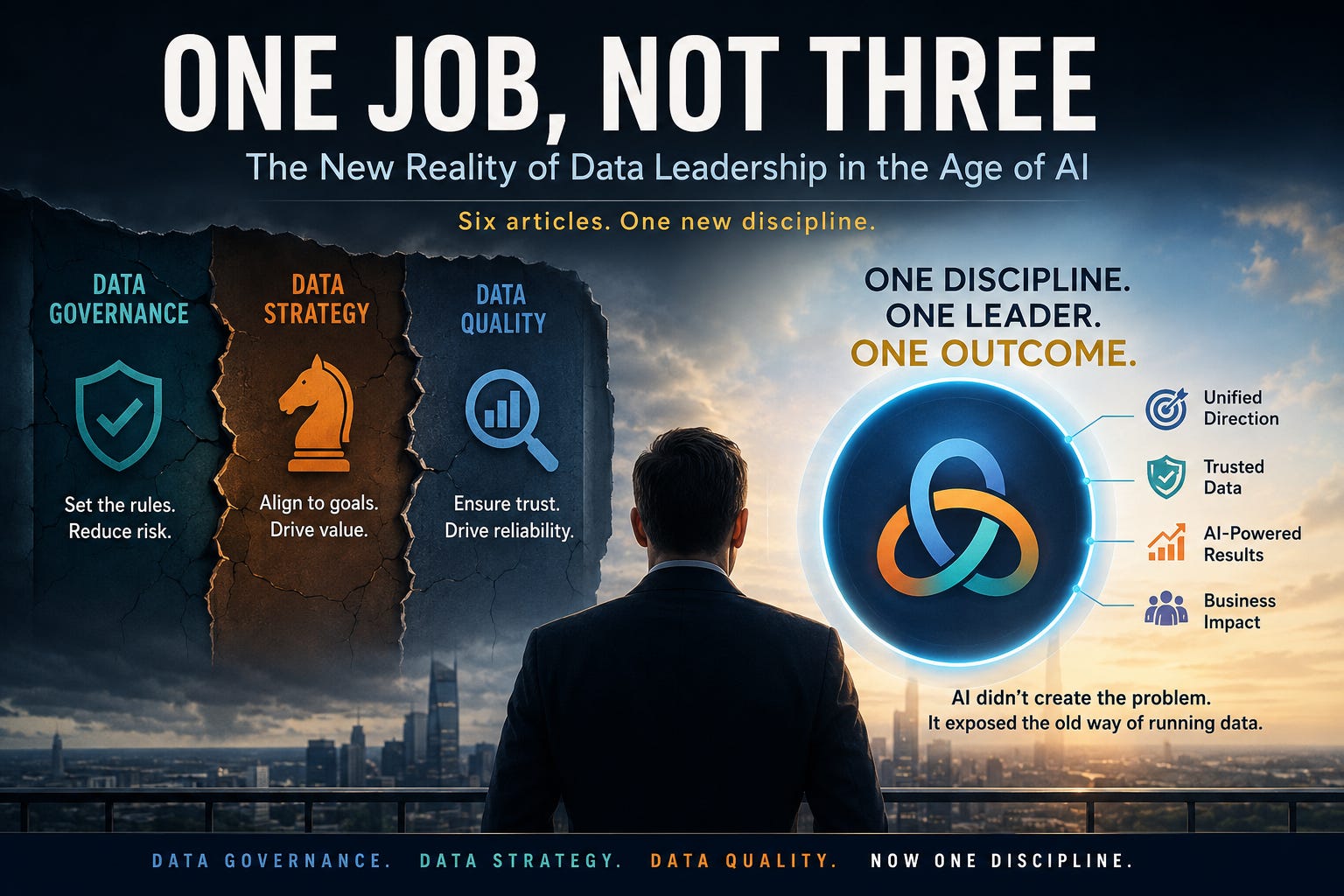
Why the modern data leader is being held accountable for three jobs with the authority and resources of one
Article 1 of the six-part series, One Job, Not Three: The New Reality of Data Leadership in the Age of AI.
This article is adapted from One Job, Not Three: How AI Collapsed Data Governance, Data Strategy, and Data Quality Into a Single Discipline.
You were hired to govern data.
Then the CEO asked you to make the company AI-ready.
The compliance mandate did not disappear.
The growth mandate was simply added on top of it.
No one formally changed your job description. No one rebuilt the reporting structure beneath you. No one doubled the budget, added the necessary headcount, or clarified which executive would make the final decision when speed and control came into conflict.
The organization simply began expecting a different job from the one you accepted.
For many data leaders, that realization does not arrive during onboarding.
It arrives months later, after the first failed initiative, the first hostile steering committee meeting, or the first moment when someone asks why an AI program is moving too slowly—and someone else asks why it was allowed to move so quickly.
By then, the leader is already carrying the contradiction.
Two messages, four minutes apart
Imagine a data leader six weeks into a new role.
She opens her inbox and finds two messages sitting four minutes apart.
The first contains the data governance charter her predecessor created. It has not been updated since the last reorganization. Several names are wrong. Some of the teams referenced in it no longer exist. Almost no one has opened it in more than a year.
The second message is from the CEO.
The question is direct:
What will it take to make the company AI-ready before the next board meeting?
The governance charter describes one job.
The CEO’s message describes another.
The first asks the leader to establish ownership, enforce standards, reduce risk, document controls, and prevent the organization from using data irresponsibly.
The second asks the same leader to accelerate experimentation, identify high-value use cases, support autonomous systems, produce measurable returns, and move before competitors do.
Both expectations are reasonable when viewed separately.
The problem is that they are no longer separate.
They now belong to the same person.
That person is expected to protect the organization from moving too quickly and also from moving too slowly.
And she is often expected to do both with a budget designed for the earlier, narrower version of the role.
The thirty-month chair
The average tenure of a Chief Data Officer is often measured in months rather than in long executive cycles. The book describes a seat in which average tenure is approximately thirty months, with more than half of leaders serving fewer than three years.
When a role turns over that frequently, the simplest explanation is that organizations keep selecting the wrong people.
Perhaps the executive was too technical.
Perhaps she did not understand the business.
Perhaps he lacked influence.
She could build a governance framework but could not create momentum.
He could speak to the board but could not build the operational foundation beneath the vision.
Some of those explanations may be true in individual cases.
But when the same pattern repeats across industries, companies, and leadership teams, it becomes harder to call it a series of isolated hiring mistakes.
At some point, you have to examine the chair.
You can often improve a hiring problem by using a clearer job description, a better search process, stronger interviews, or more experienced candidates.
A structural problem survives all four.
Organizations have spent years refining the search for data leaders while leaving the underlying contradictions of the role largely untouched.
The title changes.
The salary increases.
A new executive arrives.
The authority gap remains.
A job that quietly multiplied
Data governance, data strategy, and data quality have always been connected.
But they were not always treated as one continuous discipline.
Governance established the rules.
Who owns the data?
Who may access it?
Which uses are permitted?
What must be retained, protected, documented, or restricted?
Strategy determined direction.
Which capabilities should the company build?
Where should it invest?
Which data initiatives support growth, efficiency, customer experience, or competitive advantage?
Quality handled the difficult daily work of keeping those ambitions honest.
Are the records accurate?
Are the pipelines working?
Are definitions consistent?
Can the numbers be trusted?
Historically, these functions could operate on different schedules.
A governance council might meet quarterly.
A strategic roadmap might be reviewed annually.
A data quality audit might run monthly.
That separation was imperfect, but it was workable because the distance between a bad data decision and its consequences was often long enough for a human being to intervene.
A flawed record might affect a report.
An analyst might spot the anomaly.
A reconciliation process might catch the mismatch.
A manager might question the number before acting on it.
AI has compressed that timeline.
An automated system can read a record, reason over it, make a recommendation, communicate with a customer, adjust a price, or trigger another workflow in seconds.
Governance, strategy, and quality can no longer wait for separate meetings.
They collide at the moment the machine acts.
From gatekeeper to growth driver
The modern data leadership role began largely as a defensive function.
The leader’s responsibility was to protect.
Protect the company from unreliable reporting.
Protect sensitive information from improper access.
Protect the organization from regulatory findings.
Protect executives from presenting numbers that could not be defended.
Success often meant that nothing visibly went wrong.
The audit was clean.
The controls worked.
The incident was prevented.
The number could be traced.
The policy was followed.
Then AI changed the executive conversation.
The same leader who had been rewarded for slowing questionable activity was suddenly expected to accelerate experimentation.
The person who had spent years asking, “Should we use this data?” was now being asked, “Why are we not using it faster?”
The gatekeeper became a growth driver.
But the gatekeeper responsibilities remained.
The leader now has to say:
Yes, we can move forward with AI.
And:
No, the data is not yet reliable enough to scale safely.
Those statements can both be true.
But they are difficult to deliver in the same meeting without appearing indecisive, resistant, or contradictory.
The leader is not necessarily confused.
The mandate is.
Two opposing definitions of success
A defensive function and a growth function reward different behaviors.
The defensive mandate says:
Slow down.
Validate.
Document.
Control access.
Escalate uncertainty.
Do not approve what cannot be defended.
The growth mandate says:
Move quickly.
Experiment.
Reduce friction.
Capture opportunity.
Demonstrate value.
Do not let competitors establish an advantage first.
Neither mandate is wrong.
The problem begins when the organization expects both to be the leader’s highest priority at the same time.
When the data leader emphasizes control, the business may describe governance as a bottleneck.
When the leader emphasizes speed, risk and compliance teams may say the organization is moving without sufficient evidence.
When the AI program underperforms, leaders may ask why data quality was not resolved first.
When data quality work delays the program, they may ask why the data organization cannot move with greater urgency.
The executive is expected to absorb these opposing incentives personally.
That is not integration.
It is unresolved organizational design disguised as leadership accountability.
Why the data leader becomes the scapegoat
When an AI initiative fails, several causes are usually present.
The use case may have been poorly defined.
The success metric may have been vague.
The model may not have been tested under real production conditions.
The rollout may have skipped change management.
The timeline may have been compressed to satisfy an executive promise.
Employees may not have trusted the new process.
The underlying data may have been incomplete, inconsistent, or outdated.
Most of these causes are distributed across the organization.
No single executive owns the rushed timeline.
No single department owns the vague success metric.
No one person owns the collective decision to underfund adoption.
But data quality usually has a name attached to it.
That name belongs to the data leader.
The postmortem may begin as an honest attempt to understand what happened. But diffuse problems are difficult to resolve in a meeting.
A named problem is easier.
The model did not produce the expected result because the data was unreliable.
The data leader owns data quality.
The story is complete.
This does not require deliberate scapegoating.
It is often a structural reflex.
The organization gravitates toward the explanation with the clearest owner, even when that explanation represents only one part of the failure.
The person sitting at the intersection of governance, strategy, quality, and AI becomes responsible for every crack between them.
Accountability without matching authority
This is the contradiction many data leaders struggle to describe without sounding defensive.
They are accountable for outcomes they do not have the authority to produce.
They may be expected to improve data quality without the power to compel a business unit to correct its source data.
They may be responsible for governance without the authority to stop an executive-sponsored initiative.
They may be expected to establish enterprise definitions while separate business units continue using their own metrics.
They may be responsible for AI readiness while infrastructure, model development, cybersecurity, legal review, and workforce adoption report to different leaders.
They can identify the problem.
They can document it.
They can raise it in every steering committee meeting.
But they cannot always close it, because the decision required to close it belongs to someone else.
This is the point at which a capable leader may begin interpreting structural resistance as a personal failure.
Perhaps I need to communicate more clearly.
Perhaps I need to build stronger relationships.
Perhaps I need a better framework.
Perhaps I have not demonstrated enough value.
Those improvements may help.
Skill matters.
Political awareness matters.
Executive communication matters.
The ability to influence across functions matters.
But no amount of personal effectiveness manufactures authority the organization has never granted.
A highly skilled leader may survive an underpowered role longer.
That does not make the role stable.
The job description caught up before the organization did
Many companies have already changed the title.
Director of Data Governance becomes Director of Data Strategy and Governance.
Chief Data Officer becomes Chief Data and Analytics Officer.
Data leadership absorbs AI enablement, responsible AI, model governance, or transformation.
The words expand because the mandate has expanded.
But titles are easier to update than organizations.
The job description may now mention innovation, monetization, AI, customer value, regulatory compliance, data ownership, quality, literacy, platform modernization, and business transformation.
The reporting lines beneath the role may still reflect the old model.
The stewardship team is underfunded.
Data quality sits several layers down.
AI strategy reports elsewhere.
Business data owners remain voluntary participants.
Cloud platforms are controlled by separate technology groups.
Success is measured through outcomes the leader can influence but cannot directly control.
The organization has acknowledged the new job linguistically.
It has not fully supported it operationally.
This is not an argument for avoiding the role
Organizations need strong data leadership more than ever.
AI increases the value of trustworthy data, clear ownership, reliable definitions, visible lineage, and coordinated decision-making.
The answer is not to abandon the chair.
The answer is to see its actual shape before sitting down.
A leader who understands the structural problem can begin asking different questions.
Not only:
What does the organization want me to accomplish?
But:
What authority will accompany that accountability?
Not only:
Which initiatives are on the roadmap?
But:
Who can make binding decisions when governance, quality, strategy, and speed conflict?
Not only:
How large is the team?
But:
Which functions must cooperate, and what happens when they do not?
Not only:
How will my performance be measured?
But:
Do I control the conditions required to produce those results?
These are not signs of reluctance.
They are signs that the leader understands the job that actually exists.
The first question every data leader should ask
Before accepting the role—or before entering the next planning cycle—ask:
What am I being held accountable for that I do not currently have the authority to change?
Write down the answers.
Do not keep them as a vague sense of frustration.
Name them specifically.
You are accountable for enterprise data quality, but source-system owners are not required to remediate defects.
You are accountable for AI governance, but AI investments can be approved without your participation.
You are accountable for trusted reporting, but business units maintain competing definitions of critical metrics.
You are accountable for regulatory evidence, but lineage documentation is incomplete and platform ownership is fragmented.
You are accountable for AI value, but adoption and change management sit outside your budget.
Once the gaps are visible, they can become the subject of an executive decision.
Some authority can be negotiated.
Some accountability can be redistributed.
Some expectations can be narrowed.
Some risks can at least be documented before they become part of a postmortem.
What cannot remain invisible is the assumption that the leader has full control over outcomes simply because the leader’s name appears beside them on the org chart.
The chair was never redesigned
Many data leaders are not failing because they lack intelligence, discipline, technical knowledge, or business judgment.
They are operating inside a role that expanded faster than the organization supporting it.
Governance did not disappear when strategy arrived.
Strategy did not become easier when AI arrived.
Quality did not become less important when systems began acting autonomously.
The three disciplines became more dependent on one another at precisely the moment the organization needed them to move faster.
The title may still describe one job.
The day-to-day reality contains three.
And increasingly, it contains a fourth: AI leadership.
The leader is not failing the chair.
The chair was never redesigned for the job it now contains.
Recognizing that does not remove the pressure.
But it changes the next move.
Because once you stop treating the contradiction as a private leadership weakness, you can begin turning it into an organizational decision.
And that is where the rebuild starts.
In Article 2, we will examine what happens when bad data moves at AI speed—and why “garbage in, garbage out” has become an enterprise-scale risk rather than an old technical warning.
Read the book: One Job, Not Three: How AI Collapsed Data Governance, Data Strategy, and Data Quality Into a Single Discipline
For data leaders: What outcome are you currently expected to own without having the authority to control the conditions behind it?
About the Author
Byron K. Veasey is a career strategist and leader in data quality engineering focused on helping professionals navigate job searches, burnout, and career reinvention.
He writes Career Strategies, a Substack newsletter read by over 4,900 professionals navigating today’s evolving job market.
👉 Subscribe to Career Strategies