

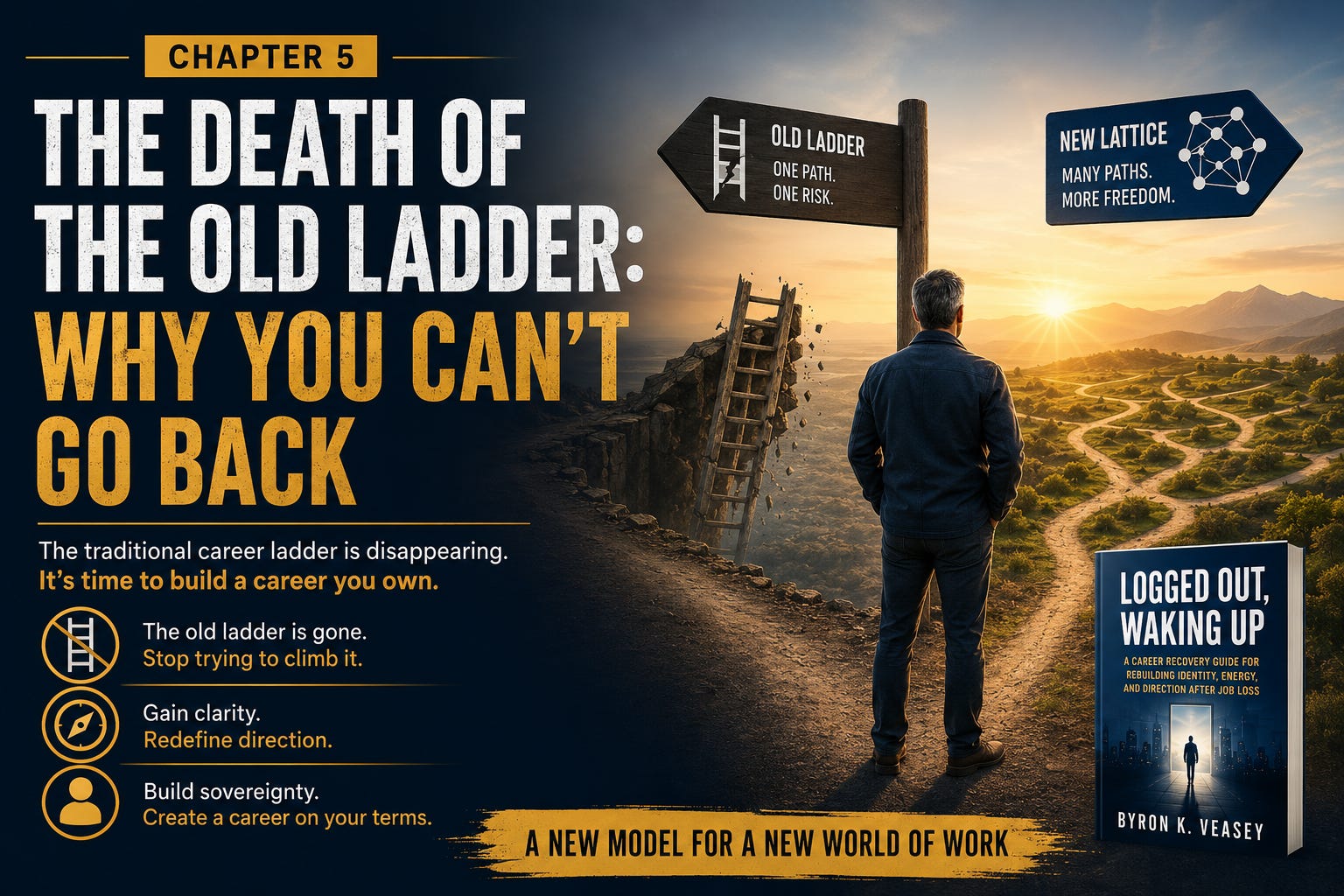
Why experienced professionals may need to stop recreating the career they lost—and start building one that cannot be taken away so easily
Adapted from Chapter 5, “The Death of the Old Ladder: Why You Can’t Go Back,” in Logged Out, Waking Up: A Career Recovery Guide for Rebuilding Identity, Energy, and Direction After Job Loss.
For most of your career, you were taught a simple model.
Work hard.
Become good at what you do.
Take on more responsibility.
Get promoted.
Move from manager to senior manager.
Director to senior director.
Vice president to senior vice president.
Keep climbing.
The assumption underneath the entire system was that upward movement created security.
Every promotion seemed to prove that the strategy was working.
Every bigger title suggested that you had become more valuable.
Every increase in salary made the next rung feel safer than the one below it.
So you kept climbing.
Then something strange happened.
While you were climbing the ladder, the ladder itself started disappearing.
Not dramatically.
Not all at once.
A rung disappeared here.
A management layer disappeared there.
A reorganization combined two functions.
A platform automated work that once required a team.
A restructuring moved responsibilities into another department.
A role that had existed for fifteen years suddenly became “no longer aligned with the operating model.”
And eventually, you discovered something many experienced professionals are discovering now:
You were still climbing a structure that the organization had already begun dismantling.
Chapter 5 of Logged Out, Waking Up calls this The Death of the Old Ladder. The traditional career model—one organization, a predictable promotion path, increasingly senior titles, and security earned through performance—is becoming harder to rely on as organizations flatten, automate work, consolidate functions, and redesign roles.
The difficult part is not merely accepting that your last job ended.
It is accepting that going back may not be the answer.
The Career Contract Changed While You Were Still Working
For decades, there was an implicit agreement between experienced professionals and their employers.
It was never written into the employment contract, but almost everyone understood it.
The deal went something like this:
Perform well.
Stay current.
Be loyal.
Take on more responsibility.
Help the organization succeed.
And in return, the organization would provide some reasonable degree of stability.
Maybe not lifetime employment.
But something close enough that a serious professional could build a life around it.
A mortgage.
Retirement planning.
College tuition.
Healthcare.
A professional identity.
A long-term career path.
That arrangement was always more fragile than it appeared.
Now the fragility is difficult to ignore.
AI is accelerating changes in how professional work gets performed. Automation is absorbing pieces of jobs that once justified entire teams. Organizations are flattening layers, consolidating responsibilities, and changing positions faster than traditional career paths were designed to accommodate.
The result is not necessarily that human expertise has stopped mattering.
Quite the opposite.
Judgment matters.
Context matters.
Experience matters.
Pattern recognition matters.
Leadership matters.
But the corporate container that once held those capabilities is changing.
And that changes the career strategy.
The Dangerous Fantasy of Going Back
After a layoff, restructuring, or corporate exit, one thought is almost irresistible:
I just need to find what I had before.
Another Director position.
Another Vice President role.
Another large company.
Another respected organization.
Another compensation package.
Another team.
Another badge.
Another place where everything feels familiar again.
It sounds reasonable.
You know how to operate in that environment.
You know the language.
You understand the politics.
You know how to lead meetings, manage stakeholders, navigate budgets, present to executives, and survive the performance cycle.
So the obvious recovery strategy appears to be:
Rebuild the old career somewhere else.
But Chapter 5 raises a more uncomfortable possibility.
What if the career you are trying to recreate was already becoming unstable before you lost it?
The book calls accepting this reality The Courage of No Return.
It means recognizing that the familiar structure you want to return to may no longer exist in the sturdy form you remember—and may never have been quite as secure as it felt while the paycheck was still arriving.
That realization hurts.
It can also be extraordinarily clarifying.
Security Had a Price
Corporate employment gives us a great deal.
But it also asks us to surrender things we rarely put on a spreadsheet.
Think about what your previous employer controlled.
Your schedule.
Your priorities.
Your performance metrics.
Your access to information.
Your decision-making authority.
Your professional title.
Your compensation structure.
Your calendar.
Your organizational visibility.
Often, even your social network.
For years, those things may have felt like infrastructure.
Then the job ended.
Suddenly you discovered that the infrastructure never belonged to you.
Your professional community may have lived inside the company’s Teams channels.
Your authority may have lived inside the org chart.
Your credibility may have been reinforced by the company name underneath your LinkedIn headline.
Your daily rhythm may have been controlled by someone else’s calendar.
Your access to information may have disappeared the moment your credentials were revoked.
As Chapter 5 puts it conceptually, much of your professional structure was sitting on someone else’s system. The company retained the infrastructure; you left carrying only what was genuinely portable—your skills, judgment, relationships, values, and experience.
That is an uncomfortable audit.
But it leads to an important question:
If the old structure could disappear that quickly, why would your goal be to rebuild exactly the same structure somewhere else?
One Employer Was Always a Single Point of Failure
This is the part many experienced professionals do not recognize until after the system fails.
The traditional career ladder creates concentration risk.
One salary.
One employer.
One title.
One professional identity.
One organizational network.
One benefits structure.
One source of validation.
One institution controlling an enormous percentage of your economic and professional life.
When everything is working, that concentration looks like stability.
When the job disappears, it suddenly looks very different.
It looks like a single point of failure.
That is the deeper lesson of the ladder.
The problem was not that you failed to climb high enough.
The problem may have been that you placed too much weight on a structure that could be removed without your permission.
Stop Asking: “How Do I Get Back?”
This is one of the hardest mental shifts in career recovery.
The first question after job loss is usually:
How do I get back to where I was?
But that question assumes where you were is still where you should be going.
Chapter 5 proposes a different operating question.
The old question was essentially:
How do I secure my position?
The new question becomes:
How do I create sovereignty?
In the book, sovereignty means creating more of your value, income, meaning, and professional direction through assets and systems you have greater control over, rather than allowing one employer to determine all of them.
That does not necessarily mean quitting corporate employment.
It does not mean everyone should become an entrepreneur.
It does not mean abandoning a successful career.
It means changing the architecture underneath it.
You may still have a job.
But the job no longer has to be the entire structure.
The New Career May Look Messier
This is where experienced professionals sometimes resist.
The ladder was easy to explain.
Director.
Senior Director.
Vice President.
The next version of work may not fit quite so neatly into one line.
It could include:
A primary role.
Advisory work.
Consulting.
Teaching.
Writing.
Speaking.
Contract projects.
A digital product.
A small business.
Board work.
Mentoring.
Independent intellectual property.
A professional community that belongs to you rather than your employer.
Three of those things may produce income.
Two may build relationships.
One may become valuable five years from now.
Together they form something very different from a ladder.
Chapter 5 introduces this shift visually as the ladder versus the lattice: instead of one narrow upward path with a single point of failure, the emerging model can involve multiple connected nodes, relationships, capabilities, and sources of value.
Later in the book, that idea becomes the Portfolio Lattice.
But the first step is psychological.
You have to give yourself permission to stop making the old structure your definition of success.
Permission to Build Something New
There is a moment that often arrives during career recovery.
It may not feel dramatic.
You notice that a conversation about your future lasts longer than a conversation about what happened.
You wake up thinking about an idea instead of replaying the termination meeting.
You start researching something because you are curious, not because a recruiter told you it would make you employable.
You sketch out a consulting idea.
You think about teaching.
You reconnect with someone outside your former industry.
You begin imagining professional possibilities that do not come with your old title.
Those moments matter.
They are signs that recovery is beginning to turn into design.
The book describes this transition as moving from grieving the specific job to recognizing that the larger loss was also the old belief that the job had to be the whole structure.
That distinction changes what comes next.
Because once you stop trying to resurrect exactly what you lost, you can start asking:
What would I build if I did not have to recreate my old career?
From Security to Sovereignty
Imagine designing your next professional chapter under one assumption:
No single employer will ever again control all of my income, identity, professional relationships, and daily structure.
What would change?
Maybe you would continue working full time—but deliberately build relationships outside the company.
Maybe you would create intellectual property around something you know deeply.
Maybe you would teach.
Maybe you would write.
Maybe you would build a small consulting practice alongside employment.
Maybe you would become more intentional about maintaining professional relationships that survive employer changes.
Maybe you would stop measuring career success exclusively through title progression.
Maybe your next chapter would involve several smaller commitments instead of one enormous commitment.
That is the shift from career security to career sovereignty.
Security asks:
How do I make this organization keep me?
Sovereignty asks:
How do I build enough professional value that no single organization gets to define whether I remain valuable?
Those are radically different questions.
“I Just Kept Climbing Because I Didn’t Know What Else to Do”
Chapter 5 tells the story of Grace, an experienced insurance professional who had spent eighteen years working toward a vice president title.
She had done everything the traditional model told her to do.
Promotion after promotion.
More responsibility.
More organizational investment.
Then restructuring flattened her management layer as automation changed the work underneath it.
What she eventually recognized was that she had already seen warning signs.
She had watched middle layers disappear.
She had watched automation change the function.
She had watched colleagues get squeezed out.
Part of her knew the ladder was becoming unstable.
But she kept climbing because climbing was the only career strategy she had ever been given.
Her breakthrough came when she stopped looking for an identical version of the career she had lost and began imagining several smaller commitments rather than another all-or-nothing bet on one title.
That may be the real challenge facing many experienced professionals.
We spent decades learning how to climb.
Very few of us were taught how to build.
Your Security vs. Sovereignty Audit
Here is a useful exercise from Chapter 5.
Think about your most recent role.
Ask yourself:
What did I trade for security?
Control of my schedule?
Control of my priorities?
Freedom to define success?
Ownership of my professional network?
Time?
Energy?
The ability to pursue other interests?
Control over my professional identity?
Then ask:
Was the trade worth it?
Not whether it was foolish.
Not whether you regret your career.
Simply whether you would make exactly the same exchange again.
Then complete two sentences:
My old operating question was:
How do I secure my position by ____________________?
And:
My new operating question is:
How do I create sovereignty by ____________________?
Finally, ask the hardest question:
What would I build differently if I knew that no single employer would ever again hold this much of my income, identity, network, or daily structure?
That question can change the trajectory of the next ten years.
The chapter’s full Security vs. Sovereignty Audit is designed to surface exactly this trade and prepare the reader for building the Portfolio Lattice later in the book.
You Do Not Have to Destroy the Old Career
This is not an argument against employment.
It is an argument against dependence disguised as security.
You can still become a Director.
You can still accept the VP role.
You can still lead a team.
You can still work for a Fortune 500 company.
You can still pursue promotions.
But the relationship changes.
The company becomes part of your professional ecosystem.
It does not become the ecosystem itself.
Your identity exists beyond the badge.
Your relationships exist beyond Teams.
Your expertise exists beyond the job description.
Your reputation exists beyond the company brand.
Your ability to create value exists beyond the position.
And ideally, over time, some portion of your economic life exists beyond the paycheck.
That is a fundamentally different way of thinking about a career.
The Ladder Was Simple. The Future May Be Stronger.
The ladder gave us clarity.
There was always another rung.
But simplicity was also its weakness.
One direction.
One structure.
One primary institution.
One point of failure.
The alternative may look less tidy.
It may be harder to explain at dinner parties.
It may not produce the impressive title as quickly.
It may require experimentation.
Some pieces may fail.
Others may grow unexpectedly.
But there is something powerful about constructing a professional life that does not collapse because one organization changes its strategy.
The goal is no longer simply to climb higher.
The goal is to become harder to erase.
The Courage of No Return
Job loss naturally creates a desire for restoration.
You want the paycheck back.
The routine back.
The confidence back.
The status back.
The professional certainty back.
But recovery does not always mean restoration.
Sometimes recovery means accepting that the system you are trying to return to is the system that taught you to place too much of yourself inside something you never controlled.
That is the courage of no return.
Not bitterness.
Not withdrawal.
Not giving up.
Recognition.
The ladder is gone.
And perhaps that is not the end of your career.
Perhaps it is the first time you have been given permission to stop climbing someone else’s structure and begin building your own.
What you build next does not have to resemble what came before.
It does not have to impress everyone.
It does not have to fit cleanly into an org chart.
It just has to work for the life you are trying to create.
Continue the Journey
📘 Logged Out, Waking Up: A Career Recovery Guide for Rebuilding Identity, Energy, and Direction After Job Loss
By Byron K. Veasey
If job loss has left you trying to rebuild more than a résumé, this book explores the deeper process of recovering identity, energy, direction, and professional independence after the organization disappears.
👉 Available on Amazon:
https://www.amazon.com/dp/B0GPPVZV3G
The company may have removed your rung from the ladder.
That does not mean you have nowhere left to go.
It may mean it is time to stop climbing—and start building.
About the Author
Byron K. Veasey is a career strategist and leader in data quality engineering focused on helping experienced professionals navigate AI screening, automated interviews, recruiter silence, age bias, burnout, and career reinvention.
He writes Career Strategies, a Substack newsletter for professionals navigating today’s evolving job market.
👉 Subscribe to Career Strategies:
https://careerstrategies.substack.com/subscribe
👉 Career Strategies Published Books:
https://byronveasey.com/
👉 AI Job Search Prompt Library:
https://www.careerstrategies.jobs/p/job-search-ai-prompt-packs
The sovereignty idea travels, but the mechanics do not.
Most salaried contracts in India carry an exclusivity clause, and Wipro fired 300 people for moonlighting in 2022 after its chairman called it cheating in public. So building a second thing alongside the job carries a termination risk here that it does not carry in the US.
What I see working instead is portable proof that breaks no contract: public writing, open work, a network that lives outside the company Teams account.
Which parts of the lattice have you seen people build without touching a second income?
Zia. itszia.ai. On LinkedIn too, tag me when career-decision threads come up.