
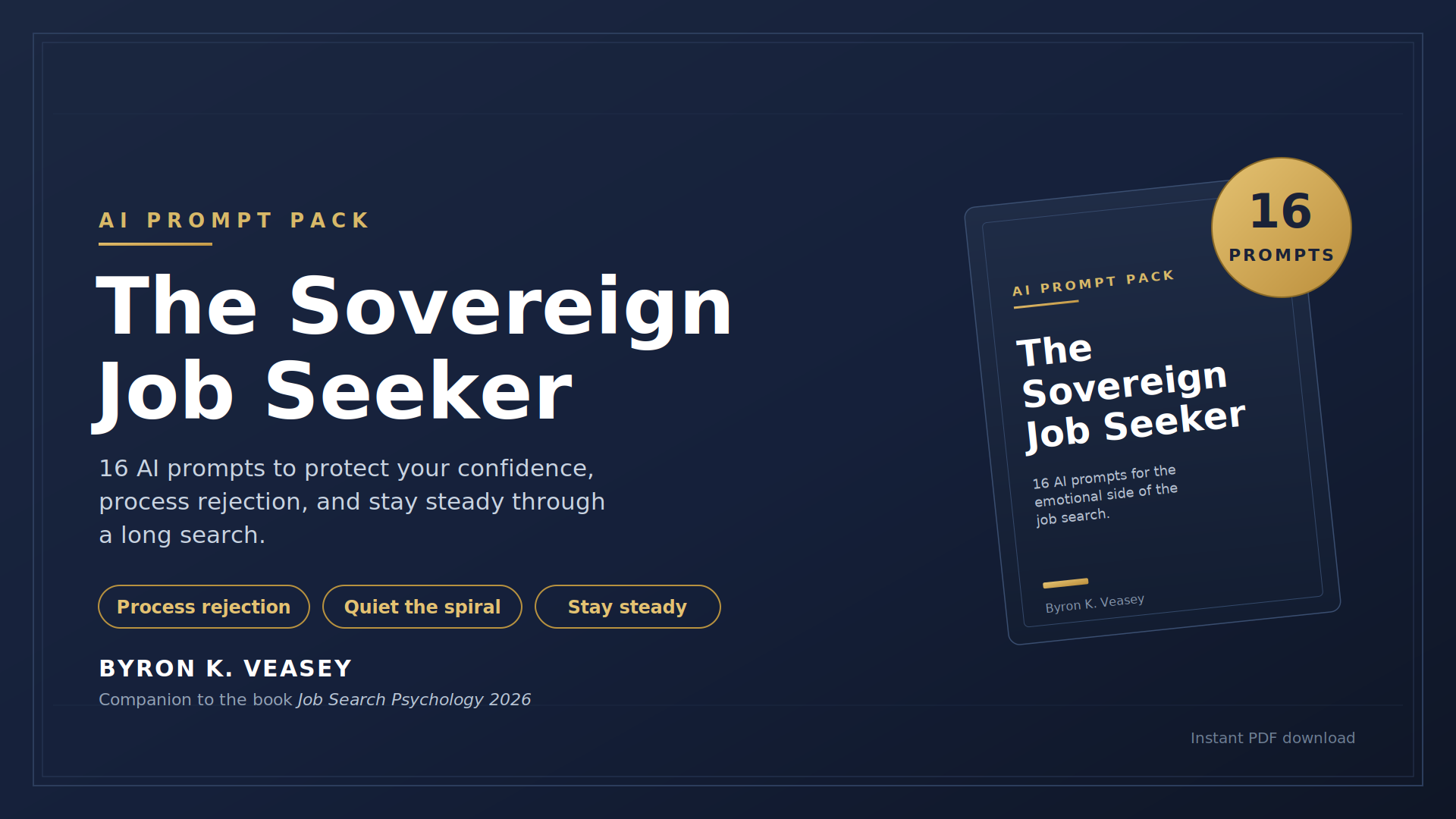
The Sovereign Job Seeker: The AI Prompt Pack for Job Seekers Who Are Tired of Feeling Like the Problem

Most job-search advice still assumes the problem is effort.
Apply more.
Rewrite your résumé.
Network harder.
Fix your LinkedIn headline.
Use better keywords.
Beat the ATS.
And to be clear, some of that work matters. In this market, your résumé still needs to speak the language of the role. Your LinkedIn profile still needs to be clear. Your applications still need to be targeted. Your interview answers still need to connect your experience to the employer’s problem.
But there is another part of the job search that most advice barely touches.
The part that happens after the application disappears.
The part that happens when the recruiter goes quiet.
The part that happens when you make it to the final round and still get a vague rejection.
The part that happens when you have years of experience, real accomplishments, strong references, and a track record you can prove — but the market keeps responding with silence.
That is where the damage often begins.
Not because one rejection destroys you.
Because repeated silence starts to rewrite the way you see yourself.
You stop asking, “Was this role funded?”
You start asking, “Am I still valuable?”
You stop asking, “Was there an internal candidate?”
You start asking, “Is my experience outdated?”
You stop asking, “Did the system even read my application?”
You start asking, “What is wrong with me?”
That is why I created The Sovereign Job Seeker AI Prompt Pack.
You can get the prompt pack here:
The Sovereign Job Seeker AI Prompt Pack
It is a companion tool to my book:
This prompt pack is not another résumé hack.
It is not another generic list of prompts to make you sound polished.
It is not another tool that tells you to optimize your way out of a broken hiring market.
It is built for the emotional and psychological reality of searching for work in 2026.
It is for the job seeker who is not just trying to get seen.
It is for the job seeker trying not to disappear from themselves.
The missing layer in most job-search tools
Most AI job-search tools focus on external performance.
They help you write a résumé.
They help you draft a cover letter.
They help you prepare for interviews.
They help you summarize your accomplishments.
They help you match keywords.
Those things are useful.
But they do not address what happens when the search becomes long enough, quiet enough, and confusing enough that your confidence starts leaking out of you.
That is the missing layer.
A long job search does not only test your strategy.
It tests your identity.
It tests your nervous system.
It tests your ability to stay grounded when the market gives you no feedback.
It tests your ability to separate a single hiring outcome from your entire professional worth.
It tests your ability to keep speaking about yourself accurately when rejection has trained you to shrink.
And that is where many experienced professionals are struggling right now.
They are not failing because they lack talent.
They are not failing because they have nothing to offer.
They are not failing because they forgot how to work.
They are navigating a hiring market shaped by AI screening, ATS filters, ghost postings, delayed decisions, risk-averse companies, recruiter overload, and silence that often has nothing to do with their actual value.
But the silence still feels personal.
The prompt pack was created for that space.
The space between effort and response.
The space between applying and hearing nothing.
The space between knowing your value and wondering why the market is not reflecting it back.
What “sovereign” means in a job search
The word sovereign matters.
A sovereign job seeker is not someone who never gets discouraged.
A sovereign job seeker is not someone who pretends rejection does not hurt.
A sovereign job seeker is not someone who performs confidence every hour of the day.
A sovereign job seeker is someone who stops letting the market become the sole authority over their identity.
That is the real shift.
The market can decide whether to call you.
The market can decide whether to move you forward.
The market can decide whether to make an offer.
But the market does not get to decide whether your experience still matters.
It does not get to decide whether your career was real.
It does not get to decide whether your skills disappeared.
It does not get to decide whether your professional value is intact.
That is the purpose of The Sovereign Job Seeker AI Prompt Pack.
It helps you create a structure around the moments when the job search tries to take over your inner life.
Not with empty positivity.
Not with fake affirmations.
Not with “everything happens for a reason.”
But with grounded, specific, evidence-based prompts that help you return to what is true.
The benefit is not just better AI output
The obvious benefit of an AI prompt pack is that it gives you better responses from ChatGPT, Claude, Gemini, or whatever tool you use.
But that is not the deeper benefit here.
The deeper benefit is that the prompts help interrupt the emotional patterns that make a long search harder than it already is.
When rejection lands too hard, the pack gives you The Rejection Decode.
That prompt helps you separate the facts of one outcome from the global story you may be telling about your worth.
Because one rejection is one data point.
It is not a biography.
It is not a verdict.
It is not proof that your career has lost meaning.
When an employer disappears, the pack gives you The Ghosting Reframe.
That prompt helps you close the loop mentally when the hiring process refuses to close it for you.
Because ghosting is one of the cruelest parts of the modern job search.
There is no clean ending.
No explanation.
No feedback.
No sentence that allows your brain to move on.
So your mind keeps refreshing.
Your inbox.
Your memory.
Your hope.
The prompt helps you name the system-level reasons silence happens, decide whether a follow-up makes sense, and stop treating non-response as a personal verdict.
That matters.
Because inbox refreshing is not a strategy.
It is often anxiety looking for evidence.
This pack protects your professional identity
One of the most useful prompts in the pack is The Identity Anchor.
That prompt asks you to return to your actual track record:
Roles.
Years.
Things you have built.
Things you have led.
Things you have fixed.
Skills colleagues relied on you for.
It then helps reflect that evidence back in plain language.
Not inflated language.
Not marketing language.
Not language that turns you into a brochure.
Just accurate language.
That is important because a long job search can distort memory.
You can have twenty years of contribution behind you and still feel like the last six months of silence are the only evidence that matters.
That is how discouragement works.
It narrows the frame.
It makes the current market feel more truthful than your lived record.
The Identity Anchor pushes back.
It reminds you that your professional self was not invented by the last employer who failed to respond.
Your identity has evidence.
And in a long search, you need to return to that evidence on purpose.
This is also one of the core ideas inside Job Search Psychology 2026.
Your professional identity cannot depend entirely on whether a hiring system validates you this week.
The full book goes deeper into the psychology of silent rejection, AI screening, age bias, emotional fatigue, and the internal work required to keep your sense of self intact during the search.
You can read the book here:
Job Search Psychology 2026 on Amazon
It helps you stop shrinking your language
Another powerful part of the pack is The Language Repair Audit.
This is one of the most practical prompts because stress changes how people talk about themselves.
You start saying:
“I kind of helped with…”
“I was involved in…”
“I supported…”
“I think I may have…”
“I just wanted to reach out…”
“Sorry to bother you…”
At first, those phrases seem harmless.
But over time, they shave authority off your own story.
You may be describing real leadership, real outcomes, and real expertise in language that makes you sound unsure of things you actually know.
The Language Repair Audit does not tell you to exaggerate.
That is not the point.
The point is precision.
If you led it, say you led it.
If you built it, say you built it.
If you improved it, say you improved it.
If you owned the outcome, do not describe yourself like you were standing nearby.
This is one of the biggest benefits of using AI well in a job search.
AI can help you hear the parts of your language where discouragement has made you smaller.
Not louder.
Not fake.
Just accurate again.
It gives you a way to regulate before high-stakes moments
The job search is not only intellectual.
It is physical.
Your body reacts to uncertainty.
Your nervous system reacts to interviews.
Your chest tightens.
Your thoughts race.
Your mind goes blank.
You reread the job description ten times and suddenly forget your own accomplishments.
That is why The Pre-Interview Regulation Protocol is included.
This prompt is not about memorizing a better answer.
It is about getting your system steady before you walk into the conversation.
That matters because many job seekers do not underperform in interviews because they are unqualified.
They underperform because the stakes have become so high that their body reads the conversation like a threat.
The prompt helps you slow down.
Ground yourself.
Reframe the interview as a two-way fit assessment, not a tribunal.
Return to a few true statements about your value.
And enter the conversation with more access to the person you actually are.
That is not soft.
That is strategy.
A regulated candidate communicates more clearly than a frantic one.
It helps you protect your energy
One of the strongest ideas behind the prompt pack is emotional overdraft.
A long job search costs energy.
Not just time.
Energy.
Every application costs something.
Every silence costs something.
Every interview costs something.
Every rejection costs something.
Every “just checking in” email costs something.
Every hour on LinkedIn watching other people announce wins costs something.
The problem is that most job seekers only track external activity.
How many jobs did I apply to?
How many messages did I send?
How many interviews did I get?
But they do not track depletion.
That is why the pack includes The Emotional Overdraft Check.
This prompt treats job searching as emotional labor with a real energy budget.
It asks how much time you spent searching, how depleted you feel, what drained you most, and what restored you.
Then it helps you set sustainable operating hours.
That is a major shift.
Because many job seekers are trying to prove they are serious by staying in search mode all day.
But being constantly available to the search does not make you more effective.
It often makes you more depleted.
And a depleted searcher does not write better messages.
A depleted searcher does not interview better.
A depleted searcher does not make better decisions.
Rest is not laziness.
In a long search, rest is part of the operating system.
It helps experienced professionals deal with the “overqualified” trap
For experienced professionals, one of the most painful parts of the current market is watching depth get reframed as risk.
You spent years building judgment, leadership, pattern recognition, and technical or functional expertise.
Then suddenly, that experience is treated like a problem.
You are told you are “overqualified.”
You are told the team is looking for someone more “hands-on.”
You are told they are worried you will not be challenged.
You are told you may not be a “fit.”
Sometimes this is about compensation.
Sometimes it is about retention concerns.
Sometimes it is about ego.
Sometimes it is age bias wearing neutral language.
The pack includes The Overqualified Reframe for this reason.
It helps you separate what may be a fixable signal from what may be bias you do not need to internalize.
It helps you address the employer’s underlying concern without apologizing for your career.
That distinction matters.
You may need to frame your experience differently.
You may need to connect your depth to the exact level of the role.
You may need to reassure an employer that you are choosing the position intentionally.
But you do not need to pretend your experience is a liability.
You do not need to shrink to make someone else comfortable.
And you do not need to absorb coded bias as personal decline.
It helps you make better decisions when an offer finally comes
After a long search, almost any offer can feel like rescue.
That is dangerous.
Not because you should reject every imperfect opportunity.
But because relief is not the same as fit.
When you have been waiting, worrying, applying, interviewing, and trying to stay steady for months, the possibility of ending the search can become intoxicating.
You may be tempted to ignore red flags.
You may be tempted to accept less than you know you should.
You may be tempted to call fear wisdom.
That is why the pack includes The Offer-Decision Filter.
This prompt helps you evaluate an offer against your own standards, not just against your exhaustion.
It asks what is good about the offer.
What gives you pause?
What you genuinely want.
What merely feels like rescue.
What questions need to be answered?
What your non-negotiables are.
This is where the idea of sovereignty becomes practical.
A sovereign decision is not always a no.
Sometimes the right move is yes.
Sometimes the right move is negotiate.
Sometimes the right move is pause.
Sometimes the right move is walk away.
The point is not to make a fearless decision.
The point is to make a decision from your standards instead of your panic.
This is not therapy, and it is not pretending to be
One of the things I appreciate about this prompt pack is that it does not pretend AI is therapy.
It is not.
A prompt cannot replace professional care.
A chatbot cannot carry what a trained therapist, counselor, doctor, or trusted support system may need to help you carry.
But there is a useful space between “do nothing” and “pretend AI can solve everything.”
That is where this pack lives.
It supports the ordinary stress, discouragement, self-doubt, and emotional fatigue that come with a hard job search.
It helps you process moments that might otherwise spiral.
It helps you organize your thoughts.
It helps you slow down before responding.
It helps you protect your language, your energy, and your sense of self.
That is not a cure.
It is a tool.
And in the current job market, job seekers need tools that support more than résumé optimization.
They need tools that help them stay human.
The real benefit: staying steady while things remain unresolved
The job search creates a specific kind of suffering because so much remains unresolved.
You do not know who saw your résumé.
You do not know why the interview stalled.
You do not know whether the posting was real.
You do not know whether the company changed direction.
You do not know whether the recruiter forgot, moved on, or never had real authority.
You do not know whether the silence means no, maybe, later, or nothing at all.
Most people try to solve that uncertainty by doing more.
More applications.
More refreshing.
More tweaking.
More checking.
More comparing.
More worrying.
But sometimes the most important move is not acceleration.
Sometimes it is regulation.
Sometimes it is clarity.
Occasionally it is protecting your hope from roles that were never real.
Sometimes it is closing the laptop.
Sometimes it is refusing to let a broken process become the narrator of your worth.
That is what The Sovereign Job Seeker AI Prompt Pack is really about.
It gives job seekers a way to use AI not just to perform better, but to stay intact.
To decode rejection.
To reframe ghosting.
To anchor identity.
To repair language.
To interrupt spirals.
To protect energy.
To handle comparison.
To evaluate offers.
To make decisions with more clarity and less desperation.
And maybe most importantly, to stop using the market’s silence as proof that something is wrong with them.
Get the prompt pack and book
If the job search has started to feel personal, this prompt pack was built for you.
It gives you 16 AI prompts you can use in the exact moments when the search starts to affect your confidence, identity, language, energy, and decision-making.
You can get it here:
The Sovereign Job Seeker AI Prompt Pack
And if you want the deeper framework behind the prompts, the full book is here:
You are not the problem.
But you do need a system that protects you while you search.
Not just a system for getting through ATS filters.
A system for getting through the emotional reality of a market that often gives qualified people no response at all.
That is the promise of this prompt pack.
Not certainty.
Not instant results.
Not a shortcut around the difficulty of the search.
Something better.
A way to remain steady when the outcome is still unknown.
A way to keep your professional identity from being rewritten by silence.
A way to stay sovereign in a market that keeps trying to make you feel powerless.
And for many job seekers right now, that may be the tool they need most.
About the Author
Byron K. Veasey is a career strategist and leader in data quality engineering focused on helping professionals navigate job searches, burnout, and career reinvention.
He writes Career Strategies, a Substack newsletter read by over 4,900 professionals navigating today’s evolving job market.
👉 Subscribe to Career Strategies