

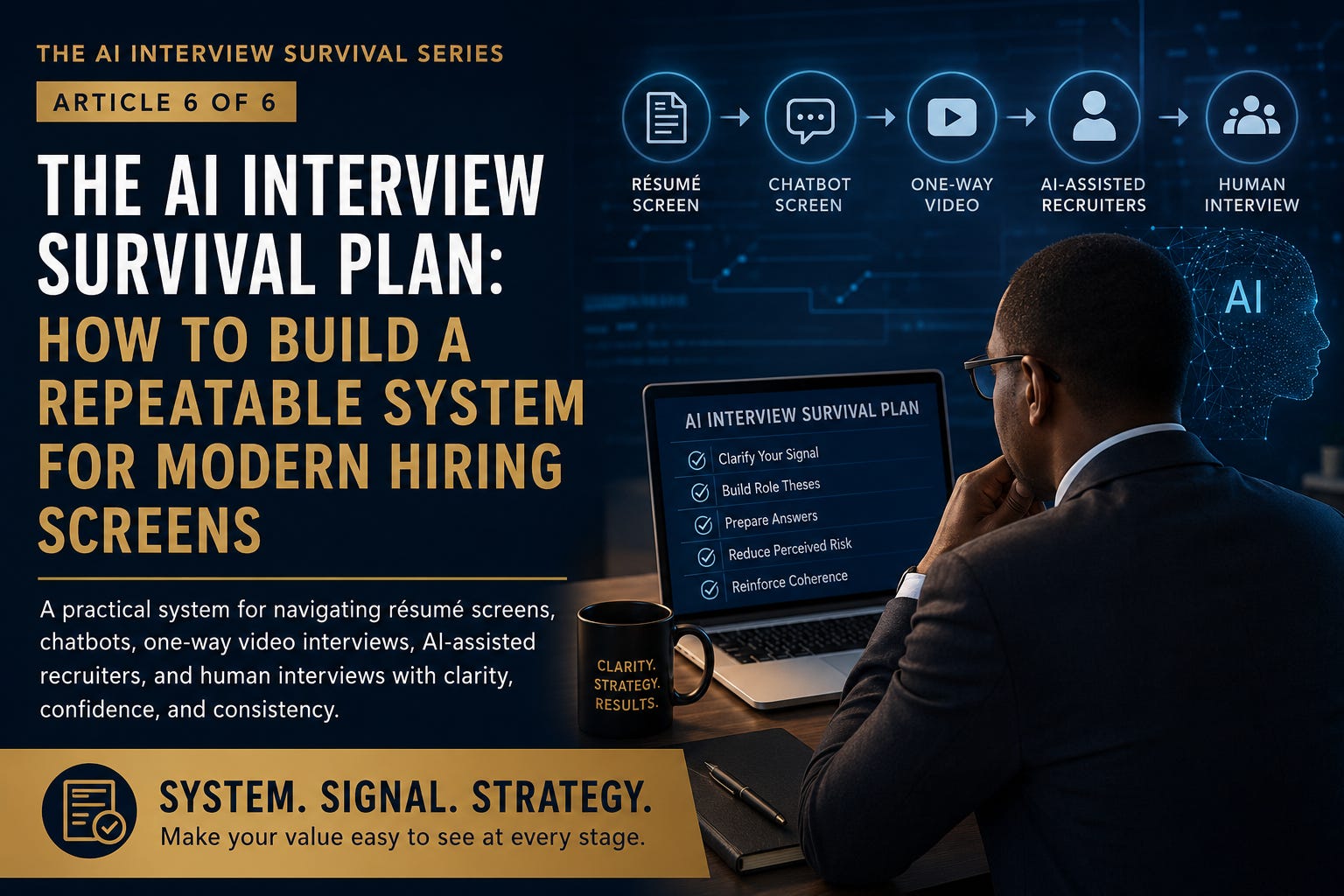
The AI Interview Survival Series
Article 6 of 6
This series is from the book, The AI Interview Survival Guide: How to Beat Automated Screens, One-Way Video Interviews, and AI-Assisted Recruiters in the Modern Job Market
In Article 5, we looked at AI-assisted recruiters.
We established that the recruiter may be human.
But the funnel is not.
Your résumé may already have been parsed.
Your answers may already have been stored.
Your video interview may already have been transcribed.
Your profile may already have been compared against the job description.
By the time a recruiter speaks with you, the system may have already shaped the conversation.
That means modern interviewing is no longer just about answering questions well.
It is about keeping your signal intact across every stage.
Article 6 brings the entire series together.
Because the modern job search does not reward random preparation.
It rewards repeatable systems.
The candidates who survive AI hiring screens are not always the most polished.
They are not always the loudest.
They are not always the ones with the longest résumés.
They are often the ones who prepare consistently, communicate clearly, and make their relevance easy to recognize.
That is the AI interview survival plan.
Not panic.
Not performance.
Not trying to sound perfect.
A system.
The Modern Hiring Process Is a Sequence of Screens
The first mistake many candidates make is treating each stage as separate.
Résumé.
Application.
Chatbot.
Assessment.
One-way video.
Recruiter screen.
Hiring manager interview.
Final panel.
Follow-up.
Most candidates prepare for each one in isolation.
They rewrite the résumé.
Then they improvise the chatbot.
Then they panic before the video interview.
Then they overexplain to the recruiter.
Then they try to “be themselves” with the hiring manager.
The problem is not effort.
The problem is fragmentation.
Modern hiring systems evaluate you across a sequence.
Each stage creates a signal.
Each signal either reinforces the last one or weakens it.
If your résumé says one thing, your LinkedIn says another, your chatbot answers sound generic, your video interview feels unfocused, and your recruiter screen introduces a new story, the system does not see depth.
It sees inconsistency.
That is dangerous.
Because inconsistency creates uncertainty.
And uncertainty slows hiring down.
Your goal is not to become scripted.
Your goal is to become coherent.
Coherence Is the New Interview Advantage
Coherence means the employer can understand who you are, what you do, why you fit, and how your experience connects to the role.
Not after thirty minutes.
Not after three interviews.
Quickly.
Clearly.
Repeatedly.
A coherent candidate has a through-line.
Their résumé supports it.
Their LinkedIn reinforces it.
Their interview answers clarify it.
Their examples prove it.
Their follow-up repeats it.
This does not mean saying the same sentence over and over.
It means creating a consistent pattern.
For example:
“My background is strongest at the intersection of data quality, operational improvement, and cross-functional leadership.”
That idea can show up in different ways.
On the résumé, it appears through accomplishments.
On LinkedIn, it appears in the headline and about section.
In the chatbot screen, it appears through keyword-aligned answers.
In the video interview, it appears through concise examples.
In the recruiter conversation, it appears as a clear positioning statement.
In the hiring manager interview, it appears through proof.
That is coherence.
And in a system built to compress candidates, coherence helps your value survive.
Build Your Core Signal Before You Apply
Most candidates start with the job posting.
Then they scramble.
They try to tailor everything from scratch.
They rewrite their résumé.
They adjust their LinkedIn.
They guess what the employer wants.
They create answers under pressure.
That approach creates exhaustion.
A better approach starts before the application.
Build your core signal first.
Your core signal answers four questions:
What kind of problems do you solve?
Who do you solve them for?
What outcomes do you create?
Why does your experience matter now?
For example:
“I help organizations improve data reliability, operational visibility, and cross-functional execution by identifying recurring issues, strengthening controls, and aligning stakeholders around practical solutions.”
That is not a biography.
It is a signal.
It tells the market how to understand you.
Once you have that signal, you can adapt it to different roles.
But you are no longer reinventing yourself every time.
You are translating from a stable center.
That matters.
Because the AI hiring process rewards clarity.
Create a Role Thesis for Every Target Job
A role thesis is your explanation of why the role makes sense for you.
It is not just:
“I am interested in this opportunity.”
That is too vague.
A role thesis connects the employer’s needs to your experience.
It sounds like this:
“This role appears to require someone who can improve reporting reliability, work across stakeholders, identify recurring operational issues, and create better visibility for decision-makers. That matches my background in data quality, governance, issue resolution, and cross-functional leadership.”
That answer does three things.
It shows you understand the role.
It shows you understand yourself.
It gives the employer language to use when discussing you.
Every serious application should have a role thesis.
Not a long essay.
Just a clear explanation of fit.
This role needs this.
I have done that.
Here is the proof.
That is the structure.
Build an Interview Answer Bank
Do not wait until the interview is scheduled to prepare.
Build your answer bank before you need it.
Most interviews ask variations of the same questions:
Tell me about yourself.
Why are you interested?
Walk me through your background.
What makes you a strong fit?
Tell me about a challenge.
Tell me about a conflict.
Tell me about a time you led through ambiguity.
Tell me about a mistake.
Why are you leaving?
Why this role?
Why now?
What are your salary expectations?
How do you handle pressure?
Where do you want to grow?
These questions should not surprise you.
The problem is that most candidates answer them fresh every time.
That creates inconsistency.
Instead, build a bank of prepared examples.
Not memorized scripts.
Prepared examples.
Each example should include:
Situation.
Problem.
Action.
Result.
Lesson.
Keep them short.
Keep them clear.
Keep them connected to the role.
A strong answer bank lowers anxiety because you are not starting from zero.
You are selecting from prepared material.
That is different.
Preparation is not pretending.
Preparation is reducing cognitive load so your real judgment can show up.
Prepare for Strength Questions and Risk Questions
Every candidate prepares for strength questions.
Fewer prepare for risk questions.
But risk questions matter more than most people realize.
A recruiter or hiring manager may wonder:
Are you too senior?
Are you too broad?
Are you too expensive?
Are you making a pivot?
Do you really want this role?
Will you stay?
Can you communicate clearly?
Can you operate at the right level?
Do you understand the work?
Can your background be summarized?
These concerns may not be asked directly.
But they often shape the conversation.
That is why you need risk-reducing answers.
If you seem overqualified, explain intentionality.
If your background seems broad, explain the through-line.
If you have a gap, explain readiness.
If you are changing direction, explain continuity.
If your résumé looks complex, simplify the pattern.
Do not apologize for your career.
Clarify it.
The goal is not to defend yourself.
The goal is to reduce uncertainty.
Practice Translating, Not Just Talking
Many experienced professionals have deep expertise.
But deep expertise does not automatically translate well.
Especially in compressed hiring screens.
You may understand the complexity of your work.
The recruiter may not.
The AI system definitely may not.
The hiring manager may care more about outcomes than details.
That means you need translation.
Translation turns experience into meaning.
Instead of saying:
“I worked on governance workflows and remediation tracking.”
Say:
“I helped the organization identify recurring issues, clarify ownership, and track progress so leaders had better visibility into what was being fixed and where risk remained.”
Instead of saying:
“I led cross-functional meetings.”
Say:
“I brought business, technology, and operations teams together to resolve issues that were slowing execution and creating reporting risk.”
Instead of saying:
“I managed data quality.”
Say:
“I improved trust in reporting by helping teams find root causes, strengthen controls, and reduce recurring defects.”
Translation makes your value portable.
And portable value moves forward.
Create a Pre-Interview Checklist
Before every interview, review the same checklist.
Do not rely on mood.
Do not rely on memory.
Use a system.
Your checklist should include:
The role thesis.
Three strongest proof points.
Two likely risk questions.
Three examples tied to the job description.
The company’s current priorities.
The job description keywords.
Your salary range.
Your questions for the recruiter or hiring manager.
Your closing statement.
Your follow-up note framework.
This may sound simple.
That is the point.
Simple systems reduce stress.
Stress makes candidates ramble.
Stress makes candidates overexplain.
Stress makes candidates forget their strongest examples.
A checklist brings you back to the signal.
Build a One-Minute Positioning Statement
Every candidate needs a one-minute answer to:
“Tell me about yourself.”
Not a life story.
Not a chronological tour.
Not a résumé reading.
A positioning statement.
Use this structure:
Present identity.
Relevant experience.
Proof of impact.
Current direction.
For example:
“My background is in data quality, governance, and operational improvement. I’ve spent much of my career helping organizations improve reporting reliability, reduce recurring issues, and create stronger visibility for business leaders. My work has often involved partnering across business, technology, and operations teams to clarify problems, strengthen controls, and improve execution. At this stage, I’m focused on roles where I can use that experience to help teams make better decisions through more reliable data and stronger cross-functional alignment.”
That answer is clear.
It is recruiter-friendly.
It is system-friendly.
It gives the listener a frame.
That is what the opening answer should do.
Build a Two-Minute Proof Story
You also need a stronger proof story.
This is the example you use when someone asks:
“Can you give me an example?”
Choose one story that shows your highest-value pattern.
Not your most complicated project.
Not your most impressive title.
Your clearest proof.
Use this structure:
There was a recurring problem.
It created business risk or operational friction.
I helped clarify the issue.
I aligned the right people.
I created structure.
The result improved visibility, reliability, speed, quality, cost, or decision-making.
The story should be easy to understand.
If the listener cannot repeat it, it is too complicated.
Your proof story should make your value obvious.
Not because you claimed it.
Because the example demonstrated it.
Prepare for One-Way Video Differently
One-way video interviews require a different kind of preparation.
There is no conversation.
No warmth.
No feedback.
No chance to adjust.
That means your answers must be structured from the beginning.
Use short openings.
Give one example.
End cleanly.
Do not trail off.
Do not keep talking because silence feels uncomfortable.
In one-way video, silence is part of the format.
Your job is not to fill it.
Your job is to deliver a complete answer.
Before recording, prepare three things:
Your positioning statement.
Three role-specific examples.
A closing sentence.
For example:
“That is why I see this role as a strong match for my background in data quality, operational improvement, and cross-functional execution.”
A clean ending matters.
The system may transcribe you.
A human may review you.
Either way, your answer needs structure.
Prepare for Chatbot Screens With Discipline
Chatbot screens feel casual.
They are not.
They may ask about experience, salary, location, availability, certifications, work authorization, tools, and preferences.
Answer clearly.
Use job description language when truthful.
Do not overexplain.
Do not joke.
Do not write vague answers.
Do not say “see résumé.”
The chatbot is not there to appreciate nuance.
It is there to capture structured information.
Give it structured information.
If the role asks for stakeholder management, use that phrase if it fits.
If the role asks for reporting reliability, mention reporting reliability.
If the role asks for operational improvement, say operational improvement.
This is not keyword stuffing.
It is alignment.
The system cannot infer what you do not say.
Keep a Job Search Evidence Bank
A long job search can distort memory.
After enough silence, even strong professionals forget what they have accomplished.
That is why you need an evidence bank.
Your evidence bank should include:
Major wins.
Projects completed.
Problems solved.
Metrics improved.
Teams supported.
Stakeholders influenced.
Processes strengthened.
Risks reduced.
Systems improved.
Feedback received.
Moments of resilience.
This is not just for confidence.
It is for interviews.
When you are tired, you need proof available.
Not buried in memory.
Not dependent on mood.
Not dependent on whether the market responded this week.
An evidence bank helps you answer from reality instead of discouragement.
Because silence can make you feel like you have no value.
Evidence reminds you that you do.
Track Patterns After Every Interview
After every interview, write down what happened.
Not emotionally.
Structurally.
What questions were asked?
Where did you answer well?
Where did you ramble?
What seemed unclear?
What did they repeat?
What concerns did they raise?
What language did they use?
What examples landed?
What should you improve before the next interview?
This turns every interview into data.
Without tracking, candidates repeat mistakes.
They give the same vague answer.
They overexplain the same transition.
They miss the same opportunity to clarify fit.
They leave the same risk unresolved.
Tracking helps you improve.
It also gives you a sense of agency.
You are not just waiting.
You are learning.
Your Follow-Up Should Reinforce the Signal
A follow-up note should not be generic.
It should reinforce alignment.
For example:
“Thank you for speaking with me today. I appreciated learning more about the team’s focus on improving reporting reliability, stakeholder alignment, and operational visibility. Our conversation reinforced my interest because those priorities closely match my background in data quality, governance, issue resolution, and cross-functional improvement. I would welcome the opportunity to continue the conversation.”
That note is short.
But it does work.
It thanks them.
It restates the role’s needs.
It restates your fit.
It gives them language to remember.
That is what follow-up should do.
Not flatter.
Not beg.
Reinforce.
The Survival Plan Is Built on Five Practices
The AI interview survival plan comes down to five practices.
First, clarify your signal.
Know the problems you solve and the outcomes you create.
Second, build role theses.
Do not apply without knowing why the role makes sense.
Third, prepare reusable answer banks.
Do not improvise your identity under pressure.
Fourth, reduce perceived risk.
Answer the concerns behind the questions.
Fifth, reinforce coherence after every interaction.
Make your value easier to see at each stage.
That is the plan.
Not because hiring is simple.
Because hiring has become fragmented.
Your system has to create continuity where the process creates compression.
You Are Not Trying to Beat AI
This is important.
The goal is not to beat AI.
The goal is to become legible inside a hiring process shaped by AI.
That means using clearer language.
Better structure.
Stronger proof.
More consistent positioning.
Sharper examples.
Cleaner follow-up.
AI did not eliminate the need for human judgment.
But it changed what human judgment sees first.
It changed how candidates are filtered.
It changed how stories are compressed.
It changed how relevance is surfaced.
So the modern candidate has to prepare differently.
Not desperately.
Strategically.
Final Note: The Market Cannot Respond to What It Cannot See
Many experienced professionals are not failing because they lack value.
They are struggling because their value is not traveling clearly through the system.
Their résumé is too broad.
Their LinkedIn is too general.
Their interview answers are too long.
Their examples are too buried.
Their transitions are too unexplained.
Their signal is too inconsistent.
That can be fixed.
Not overnight.
But systematically.
The modern hiring process rewards clarity.
It rewards coherence.
It rewards proof.
It rewards candidates who can make their relevance easy to recognize.
That does not mean reducing yourself.
It means translating yourself.
Your experience still matters.
Your judgment still matters.
Your story still matters.
But in an AI-shaped hiring system, your story has to survive compression.
That is the work.
Signal before story.
Clarity before complexity.
Proof before persuasion.
Coherence before chemistry.
And strategy before exhaustion.
The job search is hard enough.
Do not enter it without a system.
About the Author
Byron K. Veasey is a career strategist and leader in data quality engineering focused on helping professionals navigate job searches, burnout, and career reinvention.
He writes Career Strategies, a Substack newsletter read by over 4,900 professionals navigating today’s evolving job market.
👉 Subscribe to Career Strategies
🎙️ Listen to the Podcasts
👉 Career Strategies Amazon Books
👉 eBook Library of Success
Article 6's signal-integrity frame is right; the upstream gate undercovered in 2026 is the pre-screen that decides whether your signal reaches an interview at all. topcv.io 2026: 75% of resumes ATS-rejected before a human reads them. ResuTrack 2026: 2-3% application-to-interview, roughly 42 applications per interview. uppl.ai: the average senior resume is missing 52% of the target-JD substrate keywords. The Indian architect who learned to write outcomes for the human reader gets filtered at the 300-second pre-screen by a semantic model wanting Kafka 3.x, OpenTelemetry, OWASP ASVS 4.0, not 'scaled the platform 10x.' Article 7 question: how does signal-integrity craft change when the first reader is a keyword-substrate model, not a human?
Zia. itszia.ai