

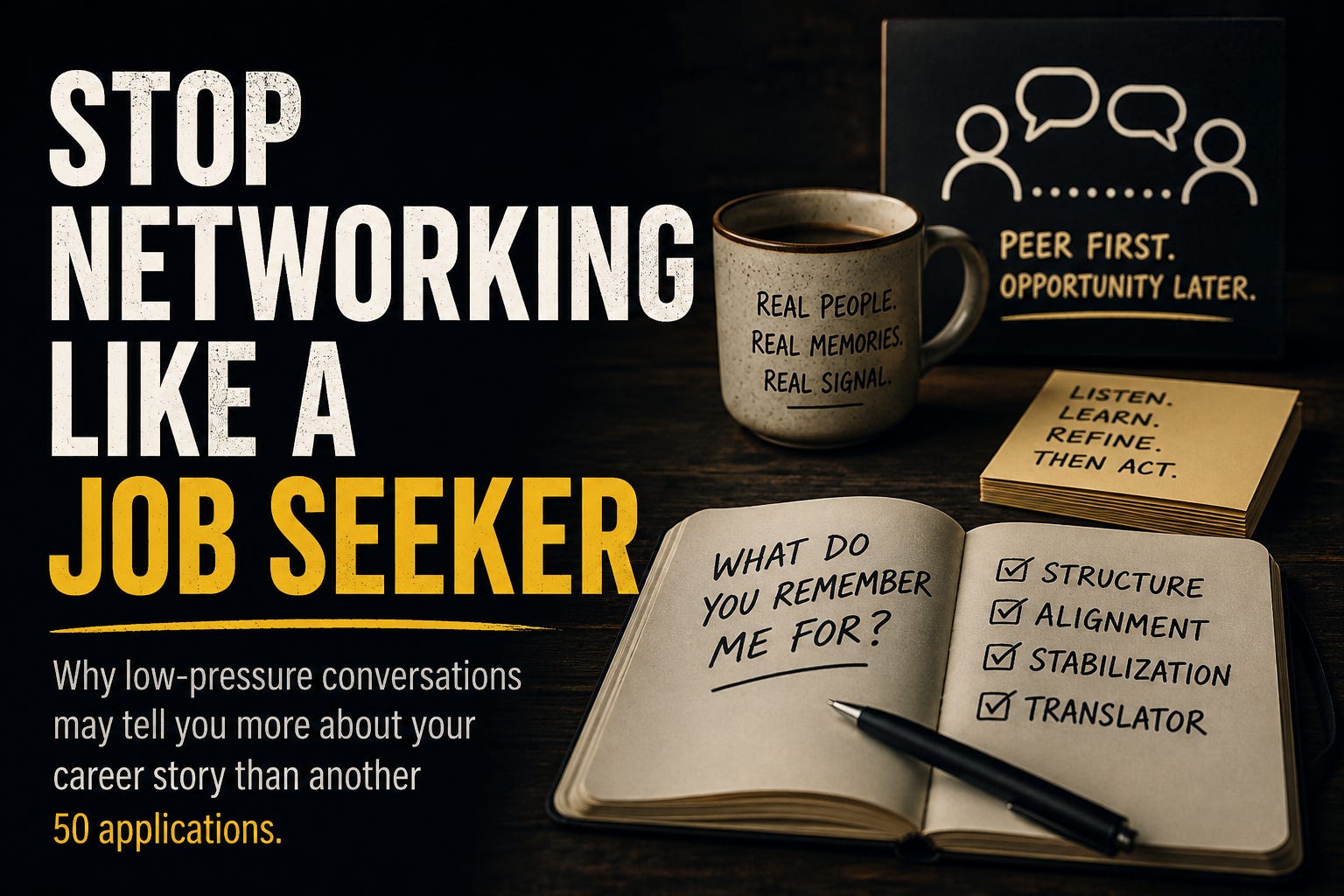
Why low-pressure conversations may tell you more about your career story than another 50 applications
📘 This article is based on Chapter 3, “Scripting Oxygen: Verbatim Outreach Tactics,” from Fired, Ghosted, Invisible: Beat AI Screening, Navigate Age Bias, and Reclaim Career Traction in the Silent Job Market by Byron K. Veasey.
There is a point in a long job search when even the word networking begins to feel exhausting.
You have already heard the advice.
Reach out to former colleagues.
Reconnect with your network.
Ask for introductions.
Tell people you are looking.
Set up coffee chats.
Let everyone know how they can help.
The advice sounds reasonable.
But when you have spent months dealing with rejection, silence, disappearing recruiters, and applications that seem to go nowhere, networking can start to feel like another place where you are being evaluated.
Every message suddenly carries weight.
Will they respond?
Will they think I only contacted them because I need something?
Should I attach my résumé?
Should I explain what happened?
Should I ask whether their company is hiring?
What if they ignore me?
And so a simple message to someone you once worked beside becomes a 45-minute writing exercise.
Then you don’t send it.
Chapter 3 of Fired, Ghosted, Invisible approaches this problem differently.
The objective is not initially to network for a job.
The objective is to test your professional story in a low-risk environment.
That distinction changes everything.
Before You Ask the Market to Hire You, Find Out Whether Your Story Lands
By this stage of the process, you may already have begun rebuilding your professional evidence.
You have accomplishments.
Projects.
Numbers.
Results.
You may even have created the Function Log discussed in Chapter 2.
But there is still an unanswered question:
Does the way I now describe myself match how other people experienced me?
That cannot be answered entirely from inside your own head.
A résumé can tell you what you want to emphasize.
Your Function Log can tell you what actually happened.
But other people can tell you what they remember.
And those are not always the same thing.
That is where peer-level outreach becomes useful.
Not as a job-seeking transaction.
As a diagnostic.
The book calls this process Narrative Testing: sending small, low-stakes signals into your professional environment to see which parts of your story produce recognition.
Think of it as pre-market testing for your career narrative.
Before you take the story into an interview, recruiter conversation, LinkedIn post, or networking event, you test it with people who actually saw you work.
The Biggest Networking Mistake: Every Message Becomes an Ask
Most job seekers have been taught to make networking productive.
So the message quickly becomes:
I’m currently exploring new opportunities.
Here’s my résumé.
Please let me know if your company is hiring.
I’d appreciate any introductions.
Keep me in mind if you hear of anything.
None of those requests is inherently wrong.
But they create a transaction.
You become the person who needs something.
The other person becomes the person who may or may not be able to provide it.
Suddenly the relationship has pressure.
And pressure changes behavior.
The recipient may genuinely like you and still not know how to help.
They may think:
I don’t know of an opening.
I don’t know who to introduce them to.
I don’t have time to review this résumé right now.
I’ll respond later.
Later becomes next week.
Next week becomes never.
Then you experience the silence as another rejection.
Chapter 3 recommends removing that pressure at the beginning.
No résumé.
No referral request.
No “let me know if you hear of anything.”
No employment ask at all.
Instead, you open the relationship as a peer.
That is a very different psychological position.
Message One Has One Job: Open the Channel
The first outreach should be almost boring.
You’re reconnecting around shared history.
Something like:
Hey [Name] — I was thinking about our time working on [project/company]. Wanted to see how you’re doing. How are things going with [specific thing relevant to them]?
That’s it.
Not:
“I’m looking.”
Not:
“Can you help?”
Not:
“Can we schedule 30 minutes?”
Not:
“Here’s my résumé.”
Just contact.
The goal is not to move your career forward in one message.
The goal is to reopen a human channel.
This keeps you in what I think of as the peer frame.
You’re not approaching someone as a candidate asking a gatekeeper for access.
You’re approaching someone as a professional who shared work with another professional.
That matters.
Then Comes the More Valuable Question
If the person replies and a conversation develops, there is a second step.
You don’t immediately pivot to:
“So, are you hiring?”
Instead, you test your narrative.
You might say:
I’ve been doing some thinking about what I want to focus on next, especially around [area of expertise]. I’ve been revisiting the work we did on [project]. If someone asked you what I contributed there, how would you describe it?
Now something interesting can happen.
They may say:
“You were the person who kept the whole implementation organized.”
But your résumé emphasizes project reporting.
They may say:
“You were the one who translated what technology was doing into language leadership could actually understand.”
But you have been positioning yourself primarily as a technical specialist.
They may say:
“Whenever something broke across teams, you were the one people called.”
You may have thought your value was the system you managed.
They remember the problem you solved.
That information is extremely valuable.
Chapter 3 explains that this kind of response lets you compare your internal professional story against external perception without entering a formal hiring process.
You aren’t asking:
Will you hire me?
You’re asking:
What did you see when you worked with me?
Other People May Remember Your Value Better Than You Do
One of the themes running through Fired, Ghosted, Invisible is that prolonged silence can distort professional self-perception.
You remember the rejection.
They remember the launch.
You remember getting laid off.
They remember the crisis you fixed.
You remember the résumé gap.
They remember that when the project was falling apart, you were the person holding it together.
That is why peer language is so useful.
It comes from outside your current emotional state.
And sometimes the other person’s description reveals an accomplishment or strength that never made it into your Function Log at all.
When that happens, don’t dismiss it.
Record it.
Chapter 3 recommends preserving the other person’s language because their phrasing may communicate your contribution more clearly than the language you have been struggling to create yourself.
This is one reason experienced professionals should be careful about building their entire career narrative alone.
You lived the work from the inside.
Other people experienced your impact from the outside.
Both perspectives matter.
One Unanswered Message Is Not Market Research
There is another important rule.
If someone doesn’t reply, do not immediately conclude:
My network is gone.
Nobody cares.
I must have burned that bridge.
People don’t remember me.
I’m professionally invisible.
One unanswered message is almost useless as data.
People miss messages.
They get busy.
They change platforms.
They read something while standing in an airport.
They intend to respond.
They forget.
Chapter 3 treats an individual non-response as noise rather than a meaningful verdict. The recommended approach is to note it and move on rather than launching a second message designed to force a response.
This is particularly important after months of job-search silence.
Your brain is already looking for confirmation that something is wrong.
Do not feed it bad data.
Don’t Turn “How Are You?” Into a Career Autopsy
Someone responds.
Then they ask:
“How have you been?”
This is where another trap appears.
You have spent months holding everything in.
Suddenly someone from your professional past is listening.
So out comes everything.
The layoff.
The reorganization.
The recruiter who disappeared.
The applications.
The financial pressure.
The age concern.
The frustration.
The bad interview.
The unfairness.
There may absolutely be people with whom you should have those conversations.
But narrative testing has a different purpose.
Chapter 3 recommends maintaining a brief, forward-facing response that acknowledges transition without turning the exchange into a complete explanation of what went wrong.
Something like:
I’m recalibrating a bit and being more deliberate about what I want to focus on next rather than jumping at the first thing available.
Then return the conversation to them.
Notice what that communicates.
You’re not pretending nothing happened.
But you’re also not presenting yourself primarily as someone waiting to be rescued.
You are still making choices.
“I Don’t Have Anything for You” Does Not Mean What You Think It Means
Sometimes the other person may misunderstand your outreach anyway.
You haven’t asked for a job, but they say:
“I wish I could help, but I don’t know of anything right now.”
That sentence can hit hard.
But examine what it actually tells you.
It does not tell you:
You aren’t employable.
Your skills are outdated.
Your career is over.
Your network doesn’t value you.
You will never find another role.
It tells you exactly one thing:
This individual does not currently know of an opportunity that fits you.
That is all.
The chapter frames this as a single reading from one point in a much larger network—not a referendum on your career.
A simple response is enough:
Totally understand. I wasn’t reaching out for that—I genuinely wanted to reconnect. Good to hear from you.
No defensiveness.
No correction essay.
No résumé attachment.
No desperate pivot.
You preserve the relationship and move on.
You Are Not Begging. You Are Running Diagnostics.
This may be the most important mindset shift in the chapter.
During this phase:
You are not networking.
You are gathering signal.
You are asking:
Does my story match how people remember me?
Which accomplishments stayed in other people’s memories?
What words do they use?
Do multiple people describe me similarly?
That makes every conversation less emotionally expensive.
You’re no longer waiting for one person to unlock your future.
You’re collecting observations.
The chapter identifies three useful outcomes when you compare peer feedback with your Function Log:
Their description matches your evidence.
Your narrative is probably tracking reality.They remember something you undervalued or forgot.
Add it to the Function Log and preserve their wording.They describe something completely different from the professional story you’re trying to tell.
That may mean your narrative needs refinement—or that your preferred positioning doesn’t match the evidence other people observed.
All three outcomes are useful.
Even disagreement is data.
Three Conversations Can Tell You More Than 100 Applications
Imagine speaking with three former colleagues independently.
Person one says:
“You were always the one who could take a chaotic project and create structure.”
Person two says:
“What I remember is that you could get business and technology teams aligned when nobody was talking to each other.”
Person three says:
“You were usually brought in when something had become messy and needed stabilization.”
Now you have something.
Not a slogan invented during a personal-branding exercise.
Not an adjective you chose because it sounded good on LinkedIn.
Patterned external evidence.
Chapter 3 recommends gathering roughly three to five peer reflections and looking for recurring themes. When similar contributions appear more than once, they become stronger candidates for the center of your professional narrative.
This is how positioning can emerge naturally.
Not:
“What should my personal brand be?”
But:
“What do people consistently remember me doing?”
That is a much stronger question.
Keep Their Exact Words
One worked example in the chapter illustrates this perfectly.
A former peer remembers the professional as the person who kept vendor handoffs from falling apart.
The original Function Log contained evidence related to vendor renegotiation—but not the handoff coordination that the colleague remembered.
That new observation goes into the log.
Not rewritten into corporate language.
Preserved as closely as possible to the way the other person described it.
Why?
Because sometimes your colleagues have better language for your value than you do.
Especially when you have spent months questioning it.
Your Story Is Ready When It Becomes Boring
This is one of my favorite ideas in Chapter 3.
How do you know when your professional narrative is ready for higher-stakes use?
Not when it sounds exciting.
Not when it feels inspirational.
Not when you’ve memorized a perfect elevator pitch.
It is ready when you can say it without emotional charge.
You know what you did.
You know what you’re known for.
You know what you want to do next.
And you don’t need ten minutes of backstory to explain why.
The chapter describes this as the point when the career narrative stops functioning like an identity wound and starts functioning like a professional tool.
That’s powerful.
Your story should eventually become something you can pick up and use.
Not something you reopen every time someone asks:
“So, tell me about yourself.”
Validate Before You Go Back Into the Market
Before the narrative is used in recruiter calls, interviews, public LinkedIn activity, or higher-stakes networking, Chapter 3 recommends what it calls pre-market validation.
The idea is simple.
Your story should have three qualities:
It has outside confirmation.
At least several people who saw your work recognize the core themes.
You can tell it without emotional flooding.
You don’t have to defend every career decision while explaining what you’re good at.
Some of the language comes from external observation.
You’re not relying entirely on self-assessment during a period when your self-assessment may still be unstable.
That gives you something many job seekers don’t have:
A professional narrative that has already survived contact with other humans before it reaches an interviewer.
The Two-Message Ceiling
There is one final constraint.
Don’t rediscover networking and suddenly message 47 people.
The chapter deliberately limits outreach.
During this phase:
Maximum: two messages per week.
That’s not a productivity failure.
It is the design.
A burst of twenty messages can create a burst of hope.
Then if responses don’t arrive quickly enough, the emotional crash can be worse than where you started.
The system is designed to avoid that boom-and-bust cycle.
Two people.
Low pressure.
Small data set.
Repeat.
If you don’t have the capacity that week, send none.
Nothing expires because you waited seven days.
A Simple Outreach Protocol
For the next several weeks, try this:
Message 1: Reconnect around shared history. No career ask.
Wait for a natural response.
Message 2: Ask how they remember your contribution to something you worked on together.
Then record:
What did they say?
What words did they use?
Did their description match your Function Log?
Did they remember something you forgot?
What patterns appear across several people?
And most importantly:
Do not turn the interaction into an employment transaction unless the conversation naturally moves there later.
The goal is signal.
Not rescue.
You May Not Need a Bigger Network
One of the assumptions behind modern job-search advice is that the answer to silence is more.
More connections.
More LinkedIn activity.
More outreach.
More applications.
More coffee chats.
But sometimes the problem isn’t the size of your network.
It is that you haven’t yet learned how to use the network as a feedback system.
Your former colleagues contain information about you.
They remember how you operated under pressure.
What problems came to you.
What people trusted you with.
What changed when you entered the room.
What they relied on you for.
Those memories are career evidence.
And unlike another automated rejection email, they can actually help you understand how your professional value registers outside your own head.
Before You Ask for an Opportunity, Test the Signal
The silent job market creates a dangerous temptation.
Because the formal market isn’t responding, every human contact begins to feel like it must produce something.
A referral.
An introduction.
An interview.
A lead.
A job.
But that makes every interaction too expensive.
Start smaller.
Open the channel.
Recover the relationship.
Test the story.
Listen carefully.
Record what comes back.
Look for patterns.
Then refine.
You don’t need every former colleague to become a recruiter for you.
You need a few of them to remind you, accurately, of what happened when you worked together.
Because before the market can recognize your value, you need a professional story strong enough to carry it.
And sometimes the best way to build that story is to stop asking people for opportunities—
and start asking them what they remember.
📘 This article is based on Chapter 3, “Scripting Oxygen: Verbatim Outreach Tactics,” from Fired, Ghosted, Invisible: Beat AI Screening, Navigate Age Bias, and Reclaim Career Traction in the Silent Job Market by Byron K. Veasey.
The protocol is deliberately small: low-frequency outreach, no initial professional ask, and external signal used to refine the story before taking it into higher-stakes environments.
About the Author
Byron K. Veasey is a career strategist and leader in data quality engineering focused on helping experienced professionals navigate AI screening, automated interviews, recruiter silence, age bias, burnout, and career reinvention.
He writes Career Strategies, a Substack newsletter for professionals navigating today’s evolving job market.
👉 Subscribe to Career Strategies:
https://careerstrategies.substack.com/subscribe
👉 Career Strategies Published Books:
https://byronveasey.com/
👉 AI Job Search Prompt Library:
https://www.careerstrategies.jobs/p/job-search-ai-prompt-packs