

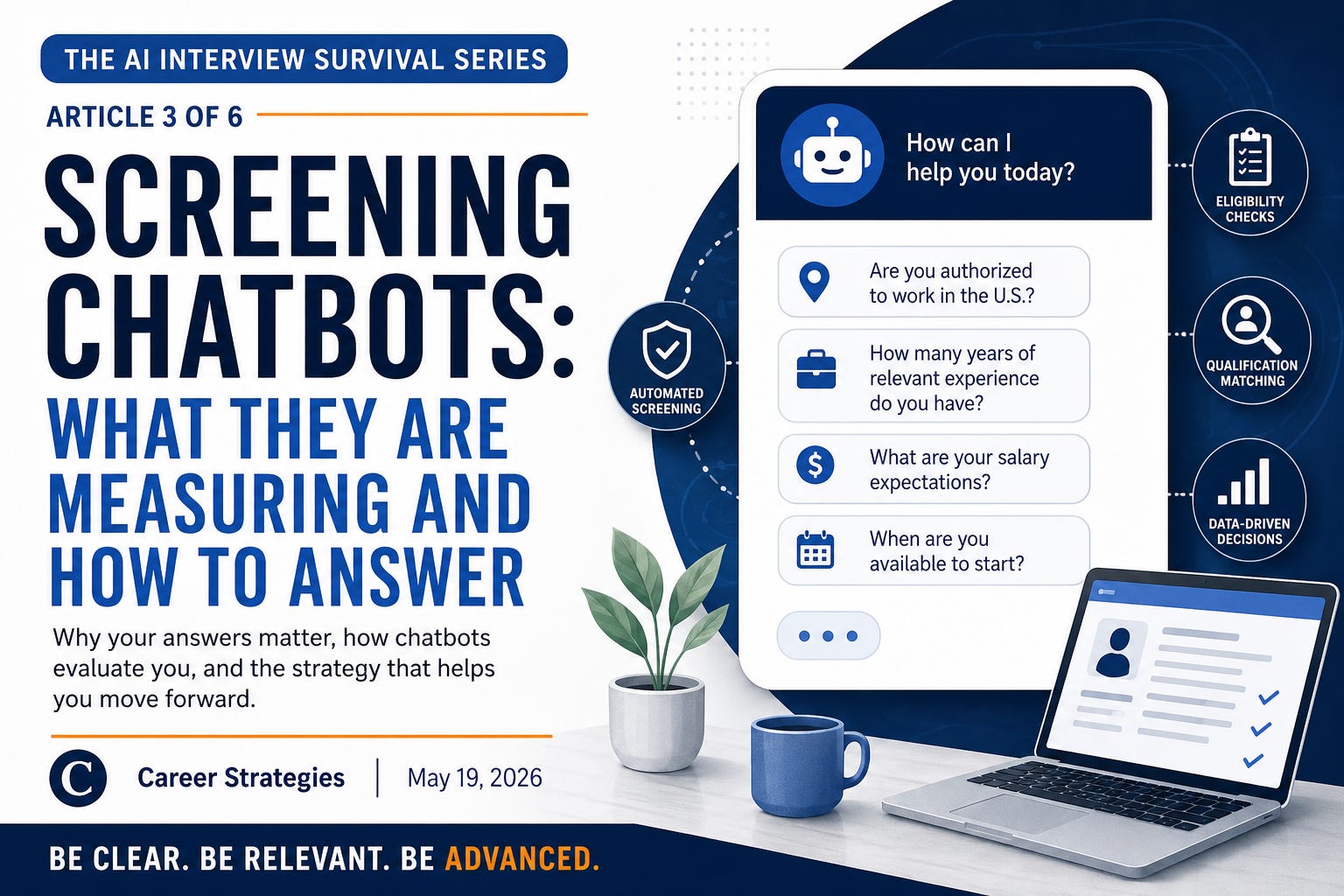
The AI Interview Survival Series
Article 3 of 6
This series is from the book, The AI Interview Survival Guide: How to Beat Automated Screens, One-Way Video Interviews, and AI-Assisted Recruiters in the Modern Job Market
This book is free from May 19 to 23, 2026. All we ask is to please write an honest review.
https://www.amazon.com/review/create-review/?ie=UTF8&channel=glance-detail&asin=B0H235C1G9
In Article 2, we looked at one of the most misunderstood gates in modern hiring: the résumé scan.
We established that your résumé is no longer just a career document.
It is a data object.
Before a human can be persuaded by your experience, the system has to recognize your relevance.
Article 3 goes to the next layer.
Because once your résumé survives the first screen, you may not move directly to a recruiter.
You may move to a chatbot.
A small box opens on the career site.
It asks if you are authorized to work in the country.
It asks how many years of experience you have.
It asks whether you have used a specific platform.
It asks about salary expectations.
It asks if you are willing to relocate.
It asks when you can start.
It asks questions that feel simple.
But behind those simple questions, another evaluation is happening.
And many qualified candidates do not realize they are still being screened.
Not interviewed.
Screened.
The chatbot is not trying to understand your full story.
It is trying to reduce uncertainty quickly.
That distinction matters.
Because when candidates treat a screening chatbot like a casual form, they often answer too loosely, too vaguely, or too quickly.
And in the modern hiring process, vague answers create risk.
Risk gets filtered.
Clarity moves forward.
The Chatbot Is Not a Recruiter
This is where many candidates misunderstand the interaction.
A screening chatbot may feel conversational.
It may use friendly language.
It may say things like:
“Great, thanks!”
“Tell us a little more.”
“Almost done.”
“Just a few more questions.”
That language can make the experience feel informal.
But the function is not informal.
The chatbot is collecting structured information.
It may be confirming basic qualifications.
It may be looking for knockout answers.
It may be routing you to the correct recruiter workflow.
It may be scoring your responses against required criteria.
It may be feeding your answers into a larger applicant tracking system.
It may be helping the employer decide whether you should be advanced, held, rejected, or deprioritized.
The chatbot is not asking questions because it is curious.
It is asking questions because the hiring system needs data.
And that data has consequences.
What Screening Chatbots Are Actually Measuring
Most screening chatbots are not evaluating your brilliance.
They are evaluating fit against predefined conditions.
That usually includes several categories.
1. Basic Eligibility
These are the obvious questions.
Are you legally authorized to work?
Do you require sponsorship?
Are you located in the required geography?
Are you willing to work the required schedule?
Are you open to the role type?
Can you meet travel expectations?
Are you able to work onsite, hybrid, or remote as required?
These questions may feel administrative.
But they can remove you from the process immediately.
This is not the place to be casual, unclear, or strategic in a way that creates confusion.
If the question asks whether you can work hybrid three days per week, do not answer with a paragraph about preferring flexibility.
Answer the question clearly.
If the question asks about sponsorship, do not write something vague like, “I am open to discussing options.”
Answer accurately.
Eligibility questions are often binary.
The system is looking for clean classification.
2. Minimum Qualifications
These questions usually focus on years of experience, required tools, certifications, industries, or role-specific exposure.
For example:
“How many years of experience do you have with project management?”
“Have you worked with Salesforce?”
“Do you have experience managing cross-functional teams?”
“Have you used SQL in a professional setting?”
“Do you have experience with enterprise data governance?”
“Have you led implementation projects?”
The danger is not only being unqualified.
The danger is under-answering.
Experienced professionals often downplay their experience because they are trying to be precise.
They say:
“Some exposure.”
“A little.”
“Not directly.”
“Adjacent experience.”
“I have worked around that.”
Sometimes that honesty is appropriate.
But sometimes it creates weak signal when the candidate actually has relevant experience.
If you have used a tool, led the function, managed the process, or owned a related outcome, say so clearly.
Do not inflate.
But do not hide behind modesty.
A chatbot cannot interpret humility.
It can only process the answer you give.
3. Role Alignment
Some chatbot questions are designed to understand whether your background matches the role family.
These questions may sound broad:
“Tell us about your relevant experience.”
“Why are you interested in this role?”
“What makes you a good fit?”
“Describe your experience in this area.”
“What type of work are you looking for?”
This is where many candidates lose the thread.
They answer like they are writing a mini biography.
They talk about their career journey.
They mention several different directions.
They try to show they are flexible.
They explain too much.
But the chatbot is not built to appreciate the full complexity of your career.
It is looking for alignment.
Your answer needs to make the match obvious.
A strong chatbot answer usually does three things:
Names the target role or function.
Mentions the most relevant experience.
Connects that experience to the employer’s problem.
For example:
“I bring 10+ years of experience leading data quality, governance, and operational improvement initiatives across enterprise environments. My background aligns with this role because I have built controls, improved reporting reliability, partnered with stakeholders, and reduced recurring data issues through structured root-cause analysis.”
That answer is clear.
It gives the system keywords.
It gives the recruiter a usable summary.
It does not ramble.
It does not force the employer to interpret your relevance.
The Biggest Mistake: Answering Like a Human Will Read Everything
A human might eventually read your chatbot responses.
But you should not assume the first reader is human.
The system may scan for keywords.
It may categorize your response.
It may compare your answer against role requirements.
It may flag certain terms.
It may summarize your response for a recruiter.
It may simply store the answer and attach it to your application.
This means your answer needs to work in two directions at once.
It needs to be natural enough for a human.
It needs to be structured enough for a system.
That is the new communication challenge.
You are not writing poetry.
You are not writing your life story.
You are translating your experience into clear hiring signals.
How to Answer Chatbot Questions Without Sounding Robotic
There is a balance.
You do not want answers that sound like keyword-stuffed nonsense.
You also do not want answers so vague that the system cannot classify you.
The best approach is structured human language.
Use complete sentences.
Include the role’s language.
Mention specific tools, functions, outcomes, or environments.
Keep the answer focused.
Avoid overexplaining.
Avoid cleverness.
Avoid sarcasm.
Avoid emotional language.
Avoid saying “see résumé.”
The chatbot is part of the evaluation.
Treat every answer as searchable data.
For example:
Weak answer:
“I have done a lot of this kind of work in different roles and feel confident I could handle the position.”
Stronger answer:
“I have led cross-functional process improvement and data governance initiatives involving stakeholder management, issue resolution, executive reporting, and operational controls. My experience includes improving data quality, reducing recurring reporting defects, and creating clearer visibility for business leaders.”
The second answer is not robotic.
It is specific.
Specificity is what survives automated screening.
Salary Questions Require Discipline
Salary questions are one of the most sensitive chatbot screens.
Candidates often panic here.
They worry that if they answer too high, they will be eliminated.
They worry that if they answer too low, they will underprice themselves.
They worry that if they dodge the question, the system will reject them.
There is no perfect universal answer because compensation strategy depends on the role, market, your leverage, and the employer’s process.
But there is one principle that matters:
Do not create unnecessary disqualification.
If the chatbot requires a numeric answer, use a range that is grounded in the market and consistent with your minimum acceptable compensation.
If the chatbot allows text, you can answer with flexibility while still providing direction.
For example:
“My target range is $120,000 to $140,000 depending on total compensation, scope, benefits, and growth opportunity.”
Or:
“I am targeting compensation aligned with the role’s scope and market range, and I am open to discussing total compensation.”
The goal is not to negotiate through the chatbot.
The goal is to avoid closing the door before a real conversation begins.
The “Years of Experience” Trap
This is another place where candidates accidentally weaken themselves.
A chatbot asks:
“How many years of experience do you have in data analysis?”
You have 15 years of leadership experience, but only five years where “data analysis” was part of your title.
So you answer five.
But the role may be asking about functional exposure, not title history.
If you have used analysis, reporting, governance, dashboards, metrics, or operational insights across multiple roles, your answer may need to reflect that broader experience accurately.
This does not mean exaggerating.
It means understanding the question.
Years of experience are often a proxy for exposure, not a perfect measurement of job title.
If the system asks for a number, answer truthfully based on relevant experience.
If the system allows explanation, clarify.
For example:
“I have 10+ years of relevant experience using data analysis, reporting, metrics, and operational insights to support decision-making, including five years with direct ownership of dashboarding and reporting processes.”
That answer is both truthful and strategic.
It avoids underselling.
It also gives the system more to work with.
Experienced Professionals Must Translate, Not Apologize
Many mid-career and senior professionals get uncomfortable in chatbot screens because the questions feel too narrow.
The system asks about a tool.
But your value is judgment.
The system asks about a keyword.
But your value is leadership.
The system asks about years of experience.
But your value is pattern recognition.
The system asks about a certification.
But your value is execution under pressure.
This can feel insulting.
But the emotional reaction does not help.
The chatbot is not designed to understand the full dignity of your career.
It is designed to create a clean sorting path.
So your job is not to apologize for being more experienced than the question allows.
Your job is to translate.
If the question asks about stakeholder management, do not say:
“I have worked with people at all levels.”
Say:
“I have led stakeholder management across business, technology, vendor, and executive teams to align priorities, resolve issues, and deliver enterprise initiatives.”
If the question asks about process improvement, do not say:
“I have always been involved in making things better.”
Say:
“I have led process improvement initiatives that reduced delays, strengthened controls, improved reporting accuracy, and increased operational visibility.”
If the question asks about leadership, do not say:
“I am a strong leader.”
Say:
“I have led cross-functional teams through transformation, issue resolution, workflow improvement, and executive-facing delivery.”
Translation is not manipulation.
It is clarity.
Do Not Let the Chatbot Pull You Into Weak Language
Some chatbot questions are written poorly.
They may be vague.
They may use narrow language.
They may ask about one tool when the role clearly involves a broader capability.
They may force you into short fields.
They may not give you space to explain.
When that happens, stay clear and focused.
Use the strongest truthful language available.
Avoid phrases that weaken your answer unnecessarily:
“I think…”
“I guess…”
“Probably…”
“Kind of…”
“Somewhat…”
“Not sure if this counts…”
“I haven’t officially…”
“I only…”
“I just…”
These phrases may sound humble to a human.
To a system, they are noise.
To a recruiter, they create doubt.
You can be honest without sounding uncertain.
Instead of:
“I haven’t officially been a data governance manager, but I have helped with some governance-related work.”
Write:
“I have led data governance-related work including data quality controls, issue tracking, stakeholder alignment, reporting standards, and remediation processes.”
That is stronger.
It is also more accurate if that is what you actually did.
The Chatbot Is Looking for Disqualifiers
This is uncomfortable but important.
Screening chatbots often exist to reduce volume.
The employer may have hundreds or thousands of applicants.
The system is helping narrow the field.
That means some questions are not designed to discover your full potential.
They are designed to find reasons you do not match.
Location mismatch.
Salary mismatch.
Work authorization mismatch.
Insufficient required experience.
Missing certification.
Schedule conflict.
Unclear availability.
Weak role alignment.
Inconsistent answer.
This is why your responses need to be clean.
Not desperate.
Not inflated.
Clean.
Every answer should reduce uncertainty.
A good screening answer tells the employer:
This person understands the role.
This person meets the requirement.
This person can communicate clearly.
This person is not creating avoidable risk.
This person is worth advancing.
That is the purpose of the screen.
A Practical Chatbot Answer Framework
Before answering any chatbot question, pause and ask:
What is this question really measuring?
Then answer in a way that gives the system a clear signal.
Use this simple framework:
Direct Answer + Relevant Proof + Role Language
For example:
Question: “Do you have experience managing cross-functional teams?”
Weak answer:
“Yes, I have worked with many teams.”
Stronger answer:
“Yes. I have managed cross-functional teams across business, technology, operations, and vendor groups to deliver process improvement, reporting, governance, and transformation initiatives.”
Question: “Describe your experience with data quality.”
Weak answer:
“I have worked with data in several roles.”
Stronger answer:
“I have experience improving data quality through root-cause analysis, data controls, issue remediation, stakeholder governance, reporting validation, and executive visibility into recurring defects.”
Question: “Why are you interested in this role?”
Weak answer:
“I am looking for a new opportunity where I can use my skills.”
Stronger answer:
“This role aligns with my background in enterprise data quality, governance, and operational improvement. I am interested because the position appears focused on improving reliability, visibility, and business trust in data-driven processes.”
The stronger answers do not just respond.
They position.
Keep a Chatbot Response Bank
One of the smartest things candidates can do is prepare common responses before applying.
Do not wait until you are tired, frustrated, or rushing through an application at 11:30 p.m.
Create a response bank for questions like:
Tell us about your relevant experience.
Why are you interested in this role?
What makes you a strong fit?
Describe your leadership experience.
Describe your experience with this function.
What tools have you used?
What type of role are you targeting?
What are your salary expectations?
When are you available to start?
Your response bank should include versions for each role family you are targeting.
If you are applying for data governance roles, have a data governance version.
If you are applying for program management roles, have a program management version.
If you are applying for operations leadership roles, have an operations version.
This prevents panic-answering.
It also keeps your signal consistent across résumé, chatbot, recruiter screen, and interview.
Consistency builds trust.
The Real Goal Is Not to Impress the Bot
The goal is not to charm a chatbot.
The goal is to avoid being misunderstood by one.
That requires a different mindset.
Do not treat chatbot questions as administrative clutter.
Do not rush through them.
Do not answer casually.
Do not assume your résumé will explain everything later.
Do not write paragraphs that bury the strongest signal.
Do not hide relevant experience behind vague language.
The chatbot screen is part of the hiring funnel.
And in a crowded market, every part of the funnel matters.
What to Fix Before Your Next Chatbot Screen
Before you answer, check four things.
1. Does my answer clearly match the role?
If the role is about data governance, use data governance language.
If the role is about program delivery, use program delivery language.
If the role is about operations leadership, use operations leadership language.
Do not make the system guess.
2. Does my answer include proof?
A claim is weaker than evidence.
Use scope, tools, outcomes, teams, functions, and measurable results when possible.
3. Does my answer reduce risk?
Employers are screening for uncertainty.
Clear answers help you move forward.
Confusing answers slow you down.
4. Does my answer sound like the same candidate as my résumé?
Your résumé, LinkedIn profile, chatbot responses, and recruiter conversation should tell one coherent story.
If each layer sounds different, trust weakens.
The Modern Screen Rewards Clarity
This is the larger lesson.
In the modern job search, you are not only competing on experience.
You are competing on legibility.
Can the system understand you?
Can the recruiter summarize you?
Can the hiring manager see the match quickly?
Can your answers survive compression?
Can your value be recognized before someone loses attention?
That is what screening chatbots reveal.
They reward candidates who can translate experience into clear, structured, role-specific language.
They punish candidates who rely on implication.
And experienced professionals often rely too much on implication.
They assume the employer will connect the dots.
But modern hiring does not reward hidden value.
It rewards visible signal.
“The system cannot advance what it cannot classify.”
That may feel cold.
But it is useful.
Because once you understand what the screen is measuring, you can stop answering like a passive applicant and start answering like a clear, credible match.
A Note on Why This Matters Now
The chatbot is not the enemy.
But it is not neutral either.
It reflects the employer’s need to process volume, reduce uncertainty, and make faster sorting decisions.
That means your answers need to be intentional.
Not over-polished.
Not fake.
Intentional.
The candidates who move forward are not always the most qualified in the deepest sense.
They are often the candidates whose qualifications are easiest to recognize at each stage of the process.
This is why chatbot strategy matters.
Because silence does not always mean you were rejected by a person.
Sometimes it means your answers never created enough signal to reach one.
Article 4 publishes next: One-Way Video Interviews: How to Sound Human When the System Feels Cold.
About the Author
Byron K. Veasey is a career strategist and leader in data quality engineering focused on helping professionals navigate job searches, burnout, and career reinvention.
He writes Career Strategies, a Substack newsletter read by over 4,900 professionals navigating today’s evolving job market.
👉 Subscribe to Career Strategies
🎙️ Listen to the Podcasts
👉 Career Strategies Amazon Books
👉 eBook Library of Success