

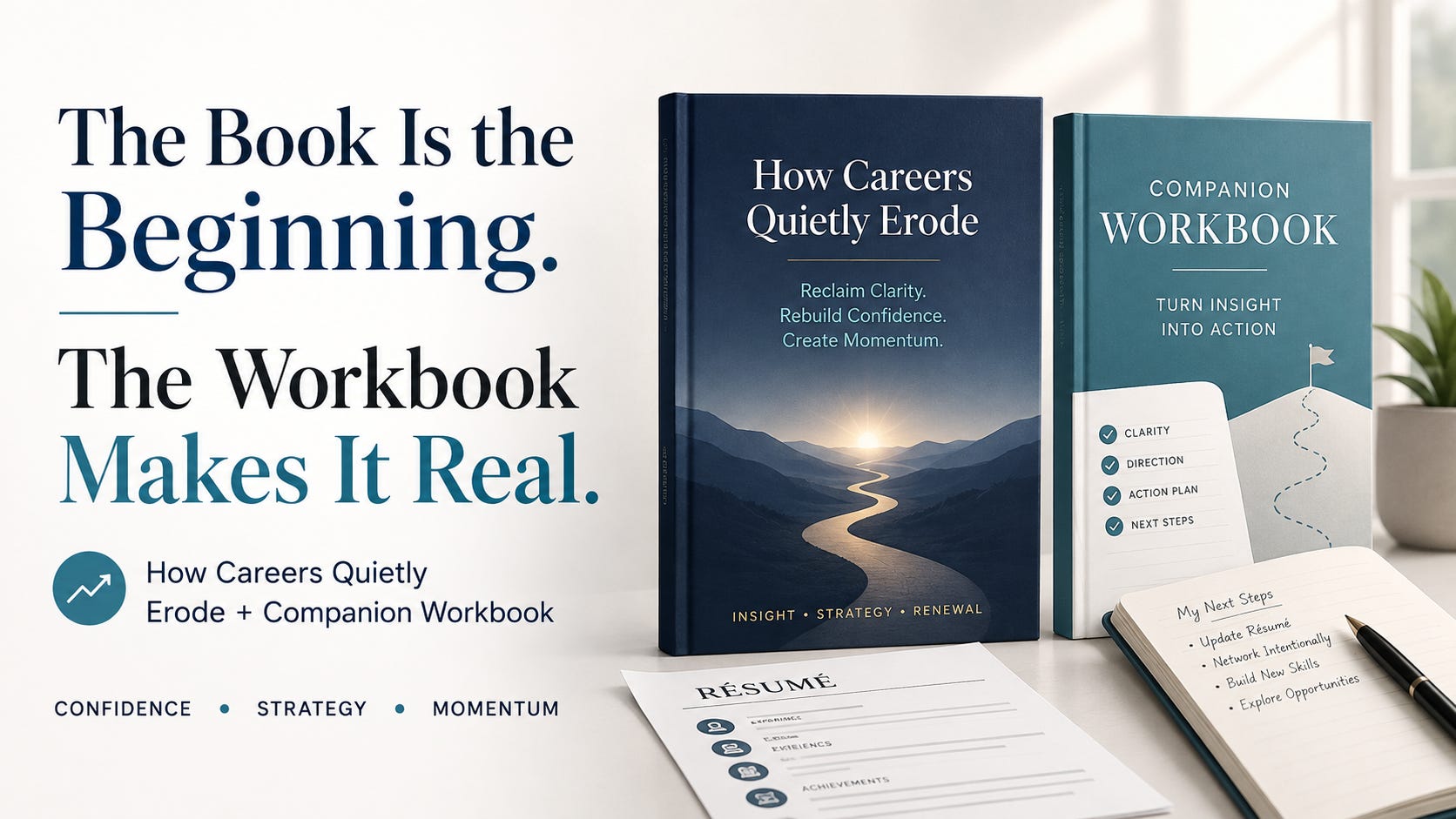
Why How Careers Quietly Erode and its Companion Workbook work better together
Most careers do not fall apart in one dramatic moment.
They erode.
Quietly.
A recruiter does not respond.
An application disappears into an automated system.
An interview that seemed promising goes silent.
You update your résumé again.
You rewrite your LinkedIn profile.
You lower your expectations slightly.
You apply to a role beneath your previous level because you tell yourself you are being “realistic.”
Then one day, the problem is no longer simply that the job search is difficult.
You are beginning to question yourself.
That is the problem How Careers Quietly Erode: A Career Recovery System for Experienced Professionals — Confidence, Strategy, and Momentum in an Automated Hiring Market was written to address.
But understanding what is happening is only part of recovery.
Eventually, insight has to become action.
That is why I created How Careers Quietly Erode: A Companion Workbook.
The two books serve different purposes.
The main book helps you understand the erosion.
The workbook helps you reverse it.
Used together, they become something more useful than another career book sitting on a shelf.
They become a working career recovery system.
The Job Search Can Change You Before You Realize It
Experienced professionals often enter a career transition carrying years—or decades—of evidence.
You have led teams.
Solved problems.
Managed crises.
Delivered projects.
Advised executives.
Improved processes.
Built systems.
Saved money.
Generated revenue.
Mentored people.
Made decisions when the answer was not obvious.
Your professional history contains enormous amounts of evidence about what you can do.
Then the modern hiring market gives you a strange new form of feedback:
Silence.
Automated rejection.
Ghosting.
Delayed decisions.
One-way interviews.
Applicant tracking systems.
AI screening.
Job postings with hundreds of applicants.
Positions that disappear before anyone seems to be hired.
And because the market rarely explains what happened, experienced professionals frequently begin supplying their own explanations.
Maybe my experience is too old.
Maybe I am overqualified.
Maybe employers think I am too expensive.
Maybe I have fallen behind.
Maybe the market no longer values what I know.
Maybe I am not as competitive as I thought.
That is how career erosion becomes dangerous.
The external problem slowly becomes an internal conclusion.
Book One: Understand What Is Happening
How Careers Quietly Erode begins by changing the diagnosis.
Instead of immediately asking:
“What is wrong with my résumé?”
the book asks a broader question:
“What has this process been doing to you?”
That distinction matters.
Because sometimes the problem is tactical.
Your positioning may be unclear.
Your résumé may not communicate outcomes.
Your LinkedIn profile may not create the right professional signal.
Your target market may be too broad.
Your networking strategy may be too passive.
Those problems require strategy.
But sometimes something else has happened.
Months of uncertainty have begun affecting your confidence, judgment, energy, identity, and willingness to take professional risks.
You stop applying for certain positions before employers can reject you.
You soften your accomplishments.
You become hesitant about compensation.
You describe leadership as participation.
You stop reaching out to people because you do not want to explain your situation again.
You become more reactive to every email and more discouraged by every day without one.
The book gives language to those experiences so you can separate what the market is doing from what the market is teaching you to believe about yourself.
That is the first benefit of the main book:
It helps you see the pattern.
And once you can see the pattern, you can begin changing it.
The Three-Part Recovery: Confidence, Strategy, and Momentum
Career recovery cannot be built on motivation alone.
Motivation changes from day to day.
One morning you feel ready to conquer the market.
Three automated rejection emails later, you feel entirely different.
That is why the recovery system centers on three areas:
Confidence
Not artificial positivity.
Not standing in front of the mirror repeating that you are successful.
Career confidence needs evidence.
You need to reconnect with the decisions you made, problems you solved, outcomes you produced, people you influenced, and capabilities you continue to demonstrate.
The objective is to stop allowing today’s hiring silence to outweigh twenty years of professional evidence.
Strategy
Applying harder is not necessarily applying smarter.
An experienced professional needs clarity around questions such as:
What roles am I actually targeting?
What problems am I positioned to solve?
How does my experience translate into today’s market?
What does my résumé signal?
What does my LinkedIn profile signal?
What skills need updating?
Where should networking fit?
Where am I spending energy without creating leverage?
Strategy reduces random activity.
Instead of treating the job search as an endless stream of applications, you begin treating it as a system.
Momentum
Momentum matters because career recovery cannot remain theoretical.
You eventually need movement.
One conversation.
One résumé improvement.
One new contact.
One application worth sending.
One accomplishment documented.
One interview improvement.
One skill strengthened.
One decision made.
Small actions accumulate.
That is how a stalled career begins moving again.
And that is exactly where the companion workbook becomes important.
Book Two: Turn Insight Into Action
Reading can produce clarity.
Writing produces confrontation.
There is a significant difference between reading:
“Your professional value has not disappeared.”
and sitting down with a page that asks you to identify the evidence.
There is a difference between understanding that your positioning may need improvement and actually writing the sentence that explains the business problem you solve.
There is a difference between knowing you should network more strategically and identifying the people you will contact.
There is a difference between thinking you need momentum and deciding what action you will take this week.
That is the role of How Careers Quietly Erode: A Companion Workbook.
The workbook moves you from:
I understand this
to:
I am doing something with this.
The Book Gives You the Map. The Workbook Makes You Mark Your Location.
Imagine trying to navigate somewhere unfamiliar.
A map is valuable.
It shows you where the roads go.
It identifies obstacles.
It helps you understand the territory.
But the map becomes considerably more useful when you can answer:
Where am I right now?
That is what the workbook adds.
As you move through the ideas in the main book, the companion resource creates space to examine your own career.
Not a hypothetical career.
Yours.
Your confidence.
Your professional evidence.
Your positioning.
Your search habits.
Your network.
Your target roles.
Your momentum.
Your next move.
Career advice becomes far more powerful when you stop consuming it and begin applying it.
Read a Section. Then Work the Section.
One of the best ways to use the two books is not to finish the main book and then start the workbook months later.
Use them together.
Read.
Reflect.
Write.
Act.
Then move forward.
For example, after reading about confidence erosion, resist the temptation to simply say:
“That sounds like me.”
Open the workbook.
Begin documenting the evidence that the market has caused you to overlook.
What did you accomplish?
What problems did people trust you to solve?
What difficult decisions did you make?
Where did your judgment create value?
What capabilities are you still demonstrating today?
Put the evidence somewhere outside your head.
Now you have something you can return to when silence begins rewriting your career story.
Stop Letting Your Résumé Be the Only Record of Your Career
Most professionals have a résumé.
Far fewer have a genuine record of their professional evidence.
That distinction becomes important during a difficult transition.
A résumé is designed for employers.
Your recovery record is designed for you.
Your résumé may contain:
Led enterprise transformation resulting in measurable operational improvements.
Your deeper evidence record remembers:
Why the situation was difficult.
What everyone else initially misunderstood.
What decision you made.
What resistance you encountered.
What changed because of your involvement.
What the experience taught you.
Those details rebuild something more valuable than a bullet point.
They rebuild your ability to speak naturally and confidently about what you have done.
And that affects everything downstream:
Résumés.
LinkedIn profiles.
Networking conversations.
Interviews.
Salary discussions.
Executive presence.
Career decisions.
The Combination Helps You Move From Emotional Reaction to Strategic Response
A prolonged job search can make every event feel urgent.
A rejection arrives.
Change the résumé.
A recruiter does not answer.
Apply to ten more positions.
An interview stalls.
Lower the salary expectation.
A younger candidate gets the role.
Start questioning whether your experience is hurting you.
The workbook creates space between the event and the reaction.
Instead of immediately responding emotionally, you can examine what actually happened.
What do I know?
What am I assuming?
What is within my control?
What requires a change?
What does not require a change?
What evidence do I have?
What is the next reasonable action?
That pause can protect you from making permanent career decisions based on temporary discouragement.
The Combination Creates Accountability Without Punishment
Most job-search accountability is built around volume.
How many jobs did you apply to?
How many networking messages did you send?
How many hours did you spend searching?
Those numbers can be useful.
But activity is not the same as progress.
A better question may be:
Did I strengthen my professional signal this week?
Did I have one meaningful conversation?
Did I identify better-fit opportunities?
Did I communicate my value more clearly?
Did I document evidence of capability?
Did I make one decision that reduced uncertainty?
Did I move forward without allowing panic to choose the direction?
That is a very different kind of accountability.
It measures movement rather than punishment.
Who Should Use the Book and Workbook Together?
The combination was designed especially for the experienced professional who recognizes some version of this story.
You have significant experience but feel increasingly invisible.
You have been laid off and are struggling to regain momentum.
You are employed but sense your career has quietly stalled.
You are applying repeatedly without getting the response your background should reasonably generate.
You are beginning to question whether your experience is still an advantage.
You know you need a strategy but are exhausted by endless job-search advice.
You have changed your résumé multiple times without knowing whether the résumé is actually the problem.
You need more than motivation.
You need structure.
And most importantly, you need a system that recognizes something many job-search resources miss:
Career transition is both strategic and personal.
You cannot completely separate the résumé from the person writing it.
You cannot completely separate interview performance from months of rejection preceding the interview.
You cannot completely separate networking confidence from professional identity.
And you cannot completely separate momentum from your belief that taking another step is worth the effort.
One Without the Other Still Helps. Together, They Create a System.
You can absolutely read How Careers Quietly Erode by itself.
It will help you recognize what has happened, understand the forces affecting experienced professionals, and think differently about career recovery.
You can also use the companion workbook as a structured place to work through your transition.
But the greatest value comes from combining them.
The book explains.
The workbook asks.
The book provides perspective.
The workbook demands reflection.
The book gives you the framework.
The workbook helps you personalize it.
The book helps restore clarity.
The workbook turns clarity into action.
The book shows you the road back to momentum.
The workbook helps you start walking it.
That is the difference between reading about career recovery and participating in your own.
Your Career Needs More Than Another Application
There comes a point when sending another résumé is not enough.
Another application will not automatically restore confidence.
Another résumé revision will not automatically clarify your direction.
Another hour scrolling job boards will not automatically create momentum.
Sometimes the next step is not more activity.
It is better diagnosis.
Better evidence.
Better positioning.
Better decisions.
Better structure.
And then deliberate action.
That is what these two books are designed to provide together.
Confidence.
So the market does not become the only voice defining your value.
Strategy.
So you stop confusing activity with progress.
Momentum.
So career recovery eventually becomes career movement.
Your next chapter does not have to begin with a dramatic breakthrough.
It may begin much more quietly.
One page.
One honest answer.
One piece of evidence.
One conversation.
One strategic decision.
One next move.
And then another.
Start With the Book. Work Through the Recovery.
📘 How Careers Quietly Erode: A Career Recovery System for Experienced Professionals — Confidence, Strategy, and Momentum in an Automated Hiring Market
View How Careers Quietly Erode on Amazon
📕 How Careers Quietly Erode: A Companion Workbook
View the Companion Workbook on Amazon
Read the framework. Work the framework. Rebuild the momentum.
About the Author
Byron K. Veasey is a career strategist and leader in data quality engineering focused on helping experienced professionals navigate AI screening, automated interviews, recruiter silence, age bias, burnout, and career reinvention.
He writes Career Strategies, a Substack newsletter read by over 5,000 professionals navigating today’s evolving job market.
👉 Subscribe to Career Strategies