
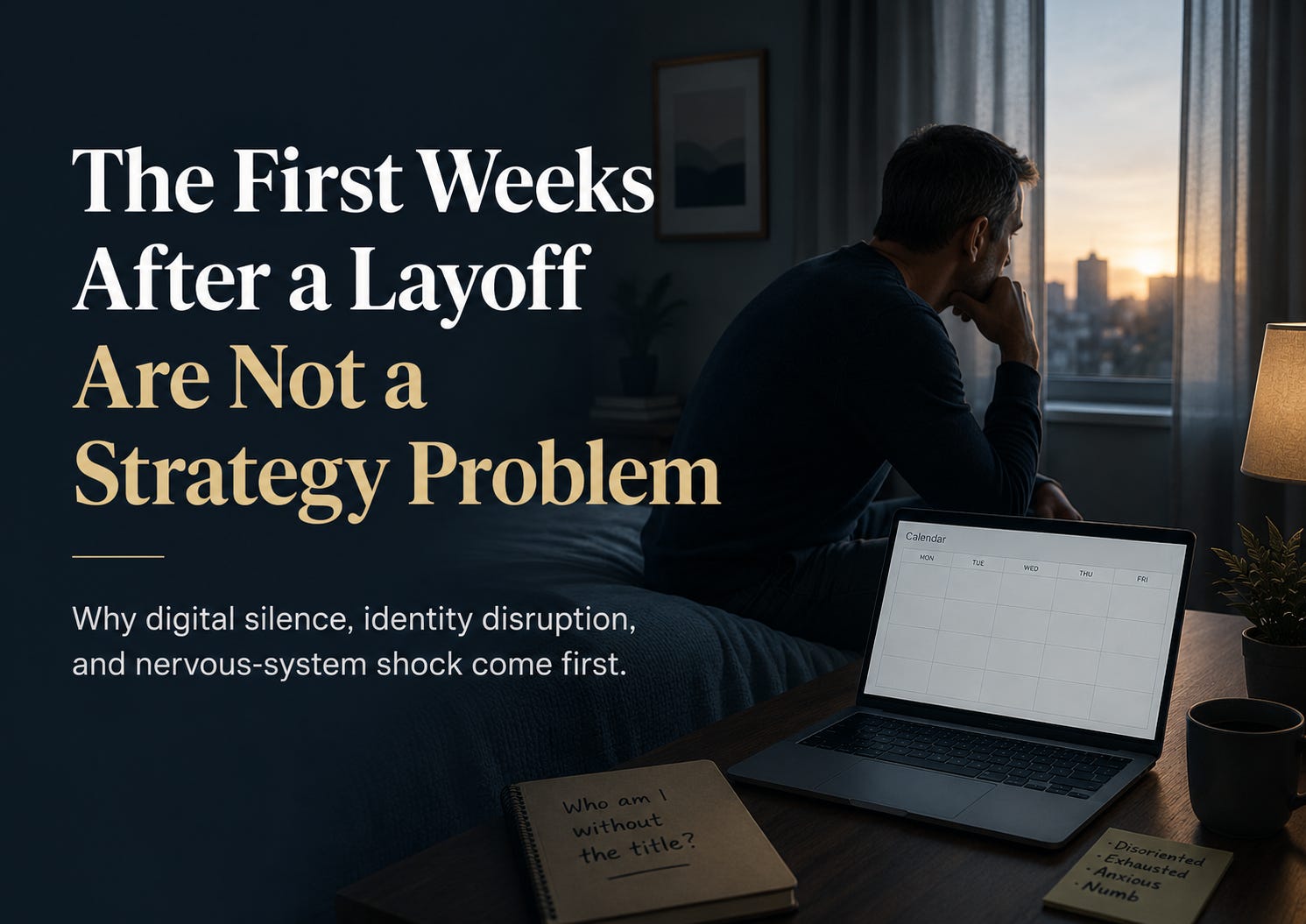
Article 1: The First Weeks After a Layoff Are Not a Strategy Problem

Four-Part Article Series
This series follows the book’s central movement from survival, through recovery, and ultimately toward professional sovereignty—a working life grounded in capabilities and values rather than dependence on one organization.
The First Weeks After a Layoff Are Not a Strategy Problem
Why digital silence, identity disruption, and nervous-system shock must be understood before the job search begins.When the Title Disappears, Your Identity Has to Speak for Itself
How professional status becomes fused with personal worth—and how to recover the person beneath the role.Recovery Is Not Falling Behind
Why grief, deliberate pauses, financial clarity, and identity archaeology are necessary parts of rebuilding.Build What Cannot Be Revoked
How to move beyond positional job security and create professional sovereignty through intellectual property, relationships, visibility, and distributed income.
Why digital silence, identity disruption, and nervous-system shock must be understood before the job search begins
Article 1 of 4 in the series
Offboarded: Rebuilding After the Corporate Exit
Adapted from Offboarded: Rebuilding Identity, Purpose, and Career After Layoff, Restructuring, or Corporate Exit by Byron K. Veasey.
You wake before sunrise and reach for your phone.
Your hand moves toward the work app before you are fully conscious.
For years, that small movement was the beginning of your day. You checked the overnight messages. Scanned the calendar. Looked for the red notification that told you something needed your attention.
But now the app does not open.
Your workspace is gone.
The team is still working. The dashboards are still refreshing. The meetings are still happening.
You are simply no longer inside them.
This is one of the first shocks of being offboarded: the company can remove your access in minutes, but your mind and body do not disconnect on the same schedule.
Your calendar may be empty.
Your nervous system is not.
The Speed of the Erasure Changes the Experience
A career can take twenty years to build.
A digital identity can disappear in five minutes.
One moment, your name is attached to projects, decisions, meetings, documents, budgets, and teams. The next moment, permissions are removed, recurring meetings vanish, and the systems you helped create continue without recognizing you.
From the organization’s perspective, this is responsible security and operational continuity.
From the employee’s perspective, it can feel like an entire professional existence has been erased before there was time to understand that it was ending.
The work remains.
The institution remains.
The person who performed the work is suddenly outside the system.
That speed matters.
A physical departure once had visible markers. You packed an office. Returned equipment. Said goodbye to colleagues. Watched people gather around a conference-room table for a farewell lunch.
Digital offboarding offers little ceremony.
The meeting ends.
The screen closes.
The access disappears.
The book describes this unsettling imbalance clearly: it can take years to become deeply embedded in an organization, yet automated processes can remove that access in minutes. The speed of the removal does not prove that you contributed little. In many cases, it reveals how fully your knowledge and work had already been absorbed into the organization.
The company removed your access. It did not remove your capability.
But in the first few days, those two things can feel dangerously similar.
Job Loss and Identity Severance Are Not the Same
Most career advice treats a layoff as a practical interruption.
You lost a paycheck.
You need health insurance.
You need to update your résumé, refresh LinkedIn, contact your network, and begin applying.
Those needs are real.
But they are not the entire experience.
Job loss is the visible event.
Identity severance is the deeper rupture.
Identity severance happens when your title was not merely a description of your work. It was the answer you gave when someone asked who you were.
It happens when your calendar provided the structure of your days.
It happens when your team gave you community, your responsibilities gave you purpose, and your badge provided a quiet daily confirmation that you belonged somewhere.
When all of that disappears at once, the loss is not confined to employment.
You may suddenly find ordinary questions difficult.
“What do you do?”
“What are you working on?”
“What comes next?”
Questions that once had automatic answers now feel like demands for an identity you have not yet rebuilt.
You may feel embarrassed when you hesitate.
You may begin explaining the restructuring to people who never asked for an explanation.
You may tell everyone that you are excited about the future while privately struggling to get through an empty Tuesday afternoon.
That does not mean you are weak.
It means the role was carrying more psychological and social weight than you realized.
The book distinguishes practical job loss from the deeper experience of losing the title, calendar, community, and institutional confirmation that said, I am recognized. I belong. I matter here.
Until that distinction is understood, career tactics often land on unstable ground.
You can optimize a LinkedIn profile and still feel invisible.
You can attend a networking event and still feel like an impostor.
You can apply for ten jobs and feel worse afterward because every application quietly reminds you that you no longer occupy the role that once validated your professional identity.
External action matters.
But external action needs internal ground on which to land.
Your Body Is Still Reporting to the Old Job
The first few weeks after a corporate exit can be filled with strange reactions.
You wake at the time you used to wake for work.
Your shoulders tighten on Sunday evening.
You feel restless at the hour when your weekly leadership meeting used to begin.
Your phone vibrates because of a weather alert, but your body reacts as though a production emergency has arrived.
You mentally prepare for conversations that are no longer yours to have.
You wonder what your former team is discussing.
You think about the project you were supposed to complete next quarter.
You may even feel guilty for resting, despite having nowhere you are required to be.
These reactions can be confusing because your conscious mind knows the job is over.
Your conditioned routines have not caught up.
For years, your brain learned to anticipate a dense stream of information: messages, metrics, problems, decisions, escalations, and deadlines. Those inputs helped orient your day and confirm your usefulness.
Then the supply stopped.
The quiet that follows does not always feel peaceful.
It can feel like absence.
The book calls attention to this “information withdrawal”: the mind keeps scanning for signals from a workplace environment that no longer responds.
That is why someone who once managed complex teams and high-stakes decisions can suddenly struggle to decide what to do with an ordinary morning.
You have not lost your intelligence.
You have lost the operating environment around which much of that intelligence was organized.
Why Immediate Hustle Can Backfire
The standard advice after a layoff is nearly always the same:
Update everything.
Start networking.
Apply immediately.
Create a schedule.
Stay positive.
Keep moving.
There may be a time for each of those actions.
But the first days after a corporate exit are not always that time.
Most career advice begins with the assumption that you are emotionally and cognitively ready to execute a strategy. It skips over the rupture and moves directly to the résumé, elevator pitch, networking plan, and application targets.
The advice may be reasonable.
The timing may not be.
When your sleep is fractured, your confidence is shaken, and your professional identity feels unstable, forcing yourself into immediate performance can produce several problems.
You rewrite your résumé from a position of diminished confidence.
You accept the first version of your career story because you are afraid of the blank space.
You reach out to your network before you know what you are asking for.
You interpret every unanswered message as additional evidence that you have become irrelevant.
You confuse activity with recovery.
And because you are technically “doing the right things,” you may blame yourself when those things do not immediately create momentum.
The problem is not always insufficient effort.
Sometimes the person doing the work has not yet recovered enough stability to evaluate the work clearly.
The book challenges the assumption that every corporate exit should immediately become a logistics project. Strategy comes later, once the neurological, psychological, and social effects of the disruption have been taken seriously.
You cannot build a clear strategy while treating your own disorientation as a performance failure.
The First Task Is Stabilization
Stabilization does not mean withdrawing from the world indefinitely.
It does not mean ignoring finances.
It does not mean abandoning the job search.
It means recognizing the order in which rebuilding must occur.
Before you construct the next professional chapter, you need enough internal stability to make decisions that are not entirely controlled by fear.
That may begin with four simple moves.
Inventory the ghosts
Look at the apps, devices, calendars, bookmarks, and routines connected to your former workplace.
Notice what each one represented beyond its practical function.
The messaging app may have told you that people needed you.
The calendar may have provided structure.
The dashboard may have confirmed that you understood what was happening.
Removing these remnants is not simply digital housekeeping. It is a conscious acknowledgment that the environment has ended.
Give your mind different input
A mind accustomed to processing large amounts of information does not instantly become comfortable with silence.
Read about something outside your former organization.
Listen to a thoughtful conversation unrelated to your job search.
Return to an interest that was repeatedly pushed aside by corporate urgency.
You are not trying to replace your old role in a day. You are reminding your mind that the former company was not the only source of meaningful information.
Let the body come down
Walk without turning the walk into a performance metric.
Stretch the parts of your body that spent years braced in front of a screen.
Sit outside.
Rest without producing evidence that the rest was useful.
The goal is not productivity.
The goal is to help your body recognize that it no longer has to respond to emergencies that belong to someone else.
Spend a little time in unfilled silence
This may be the most difficult step.
No résumé.
No LinkedIn.
No television playing in the background.
No frantic attempt to convert the layoff into an inspiring reinvention story.
Just enough quiet to notice what is present.
Anger.
Relief.
Grief.
Fear.
Exhaustion.
Perhaps even a small feeling of freedom that you are afraid to admit.
The book’s 24-hour digital-detox framework moves through these stages: identifying the remaining workplace triggers, supplying healthier information, moving stress through the body, and spending time in unmediated quiet. It is presented not as a cure, but as an interruption of the old scanning cycle.
You Are Not Behind
The fear begins quickly.
Every day you are not applying feels like lost ground.
Every week away from work appears to widen the gap.
Every former colleague’s promotion looks like evidence that everyone else is moving while you are standing still.
But recovery is not the absence of progress.
Recovery is part of the work.
You are learning to separate your value from an institution that once reflected it back to you.
You are discovering which relationships existed beyond proximity.
You are identifying the capabilities that left the company with you.
You are beginning to understand what the role gave you, what it cost you, and what you no longer want to surrender to the next organization.
That is not inactivity.
It is preparation for a more honest strategy.
The first phase of the book’s Sovereignty Arc is survival: understanding digital erasure, identity fracture, and the biological crash before attempting to fix everything. The purpose is not to remain in survival, but to stop fighting your own response long enough to stabilize the ground beneath you.
You will update the résumé.
You will reconnect with people.
You will examine the market.
You will decide whether you want another version of the role you lost or something built differently.
But first, you have to stop interpreting the immediate aftermath as evidence that you are failing at transition.
You are not failing.
You are adjusting to a rupture that happened faster than a human identity can reorganize itself.
A Question to Sit With
Before asking, “What job should I pursue next?” ask a more precise question:
What did I actually lose besides the job?
Was it the title?
The structure?
The team?
The income?
The authority?
The future you believed you were building?
The daily confirmation that your judgment mattered?
Name the loss as accurately as you can.
You cannot recover what you refuse to identify.
And you cannot decide what to rebuild until you know which parts of the old structure were truly yours—and which parts disappeared because they were always owned by the institution.
The first weeks after a layoff are not primarily a strategy problem.
They are the beginning of separating the person from the system that once told the person who to be.
That separation hurts.
It is also where professional sovereignty begins.
About the Author
Byron K. Veasey is a career strategist and leader in data quality engineering focused on helping professionals navigate job searches, burnout, and career reinvention.
He writes Career Strategies, a Substack newsletter read by over 4,900 professionals navigating today’s evolving job market.
👉 Subscribe to Career Strategies