
Nothing You’ve Tried Is Working—Because the Job Search Changed

You did not suddenly become less qualified. You are competing inside a system that no longer responds to effort the way it once did.
You updated your résumé.
You rewrote your LinkedIn profile.
You applied to more jobs.
You customized cover letters, contacted recruiters, attended networking events, and followed every piece of advice you were given.
Then you waited.
And waited.
Most of the time, nothing happened.
No interview.
No rejection.
No explanation.
There is not even enough feedback to indicate what changes are needed.
Eventually, the silence begins to create a dangerous conclusion:
Maybe I am the problem.
Maybe my experience is no longer relevant.
Maybe I have been out of the market too long.
Maybe employers think I am too old, too expensive, too specialized, or too far removed from what companies need now.
But there is another possibility—one that experienced professionals are rarely encouraged to consider:
Nothing you have tried is working because the system you were taught to navigate no longer exists.
The job search did not just get harder
It became quieter.
In the old job market, effort usually created some kind of response.
You submitted an application and received a rejection.
You contacted a recruiter and received an answer.
You interviewed and learned whether the employer was interested.
The outcome was not always what you wanted, but there was usually some form of reflection. You could see how the market was responding to you.
Today, much of that reflection has disappeared.
You may apply for a role and never know whether the position was actively being filled.
You may be qualified but filtered out before a hiring manager ever encounters your name.
You may have twenty years of experience but lose visibility because your résumé does not use the language an automated system expects.
You may be rejected because your background appears too senior, too broad, or too expensive—even when no one has asked what you are actually seeking.
The modern job search contains fewer conversations and more invisible decisions.
That distinction matters.
When a human being says no, you can process the rejection.
When a system says nothing, you are left to invent an explanation.
And most people invent one that blames themselves.
Activity is not the same as traction
One of the most damaging ideas in job-search culture is that more activity will eventually produce better results.
Apply to more positions.
Send more messages.
Post more frequently.
Change your résumé again.
Add another certification.
Expand your search until nearly any job becomes acceptable.
This approach feels responsible because it keeps you busy.
But busyness can conceal a strategy that is not producing traction.
There is an important difference between movement and progress.
Movement is submitting another application.
Progress is learning which applications have a realistic path to a decision-maker.
Movement is adding more keywords to your résumé.
Progress is translating your experience into evidence that both screening systems and hiring leaders can understand.
Movement is connecting with hundreds of strangers.
Progress is building a smaller number of relevant relationships around a clearly defined professional direction.
Movement can exhaust you while leaving the underlying problem untouched.
That is why trying harder often fails.
You are increasing the volume of the same signal without checking whether it is being received correctly.
Your experience is not the problem
Your experience may be substantial.
But experience does not explain itself.
A hiring manager may not immediately understand how something you accomplished fifteen years ago applies to the problem the company needs solved today.
A recruiter may see several different roles and struggle to determine which position you are targeting now.
An automated screening system may not recognize an achievement because it is written in language that does not match the employer’s requirements.
This is not necessarily an experience problem.
It is often an interpretation problem.
The market is not asking only:
What have you done?
It is also asking:
Can I quickly understand why what you have done matters here?
Experienced professionals frequently assume their résumé should tell their entire career story.
But the modern hiring process does not reward the most complete story.
It rewards the clearest relevant signal.
That means you do not need to diminish your experience.
You need to translate it.
You need to show the connection between your history and the employer’s immediate problem.
You need to make your value easier to recognize before someone decides that your background is too complicated, too senior, or too different from the profile they expected.
Stop applying harder
A better job search begins with a different question.
Instead of asking:
How can I submit more applications?
Ask:
How can I become more visible to the right employers?
That shift changes everything.
It changes the roles you pursue.
It changes the evidence you emphasize.
It changes the people you contact.
It changes the language on your résumé and LinkedIn profile.
It changes how you prepare for interviews.
It also changes how you interpret silence.
Silence stops becoming a verdict on your professional worth.
It becomes information about the effectiveness of your current strategy.
Perhaps the role was never truly open.
Perhaps the application channel was overloaded.
Perhaps your positioning was too broad.
Perhaps your experience was not connected clearly enough to the employer’s priorities.
Perhaps you relied on an application when the real path into the organization required a relationship.
These are strategic problems.
Strategic problems can be diagnosed and corrected.
Your worth cannot—and should not—be recalculated every time an employer fails to respond.
The search should not break you
The prolonged job search creates more than a financial challenge.
It can destabilize your sense of identity.
Work once gave you structure, feedback, professional relationships, status, and evidence that your abilities mattered.
When those signals disappear, the job search can become the only place you look for validation.
Every application begins to carry too much emotional weight.
Every unanswered message feels personal.
Every week without progress appears to confirm that something has been lost.
That is why job seekers need more than tactics.
They need emotional infrastructure.
They need boundaries around how many hours they search.
They need a way to measure progress beyond interviews and offers.
They need evidence that they are still learning, contributing, connecting, and functioning—even when the market remains silent.
You cannot build a sustainable search by treating yourself like a machine that should produce unlimited applications without becoming discouraged.
Burnout does not make you more competitive.
It makes every decision harder.
It makes you more likely to apply indiscriminately, rewrite everything impulsively, accept poor treatment, or abandon a sound strategy before it has time to work.
Protecting yourself is not separate from the search.
It is part of the strategy.
What has to change now
The modern job seeker needs a new operating system.
One built around clarity rather than volume.
Evidence rather than vague claims.
Targeting rather than broadcasting.
Relationships rather than total dependence on application portals.
Iteration rather than constant reinvention.
Boundaries rather than unlimited effort.
That means defining the problems you are best positioned to solve.
It means building an evidence bank of accomplishments, outcomes, decisions, and transformations from your career.
It means translating those examples into the language used by the employers you want to reach.
It means identifying opportunities where your background is an advantage—not merely hoping someone will eventually recognize it.
It means evaluating job postings before investing hours in them.
It means activating conversations beyond the application process.
And it means protecting enough confidence and energy to remain effective throughout the search.
None of this guarantees an immediate offer.
But it replaces random effort with deliberate action.
That is the beginning of traction.
Why I wrote this book
I wrote Nothing You’ve Tried Is Working for the professional who has already tried the obvious advice.
The person who does not need another lecture about working harder.
The person who has real experience but cannot understand why employers are not responding to it.
The person who is beginning to confuse market silence with personal failure.
The person who needs a practical system for navigating AI screening, ghost jobs, unclear hiring processes, and the emotional toll of waiting.
This is not a book about pretending the market is fair.
It is not a collection of motivational slogans.
It is a reference for understanding the system that exists now and building a job-search strategy that can function inside it.
You do not have to read it from beginning to end before taking action.
Begin with the problem affecting you most.
Clarify your target.
Rebuild your professional signal.
Document your evidence.
Evaluate opportunities more carefully.
Strengthen your access to human conversations.
Protect yourself from a search that can consume every hour and redefine how you see yourself.
The goal is not to become busier.
The goal is to become more deliberate.
A free copy for the next five days
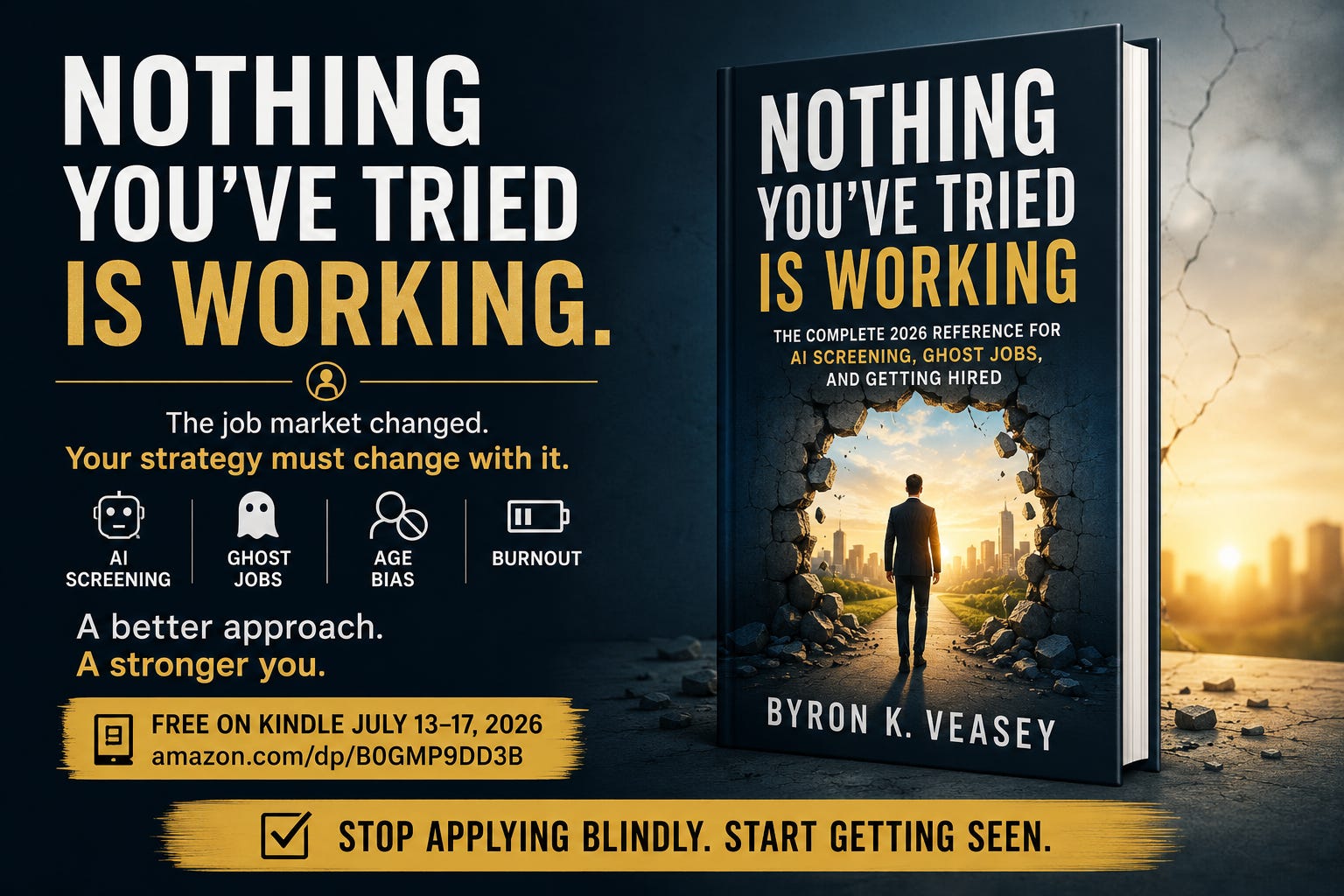
From July 13 through July 17, 2026, the Kindle edition of Nothing You’ve Tried Is Working is available as a free download on Amazon.
I am making it free because too many experienced professionals are blaming themselves for a hiring system they were never taught to navigate.
Download the book.
Choose the section that matches where you are right now.
And begin replacing scattered effort with clarity, evidence, and a strategy designed for the market that actually exists.
Nothing you’ve tried is working.
But that does not mean nothing will work.
It means it is time to stop applying the same broken strategies more forcefully.
Download the Kindle edition free through July 17:
https://www.amazon.com/dp/B0GMP9DD3B
Nothing You’ve Tried Is Working: The Complete 2026 Reference for AI Screening, Ghost Jobs, and Getting Hired
By Byron K. Veasey
About the Author
Byron K. Veasey is a career strategist and leader in data quality engineering focused on helping professionals navigate job searches, burnout, and career reinvention.
He writes Career Strategies, a Substack newsletter read by over 4,900 professionals navigating today’s evolving job market.
👉 Subscribe to Career Strategies