

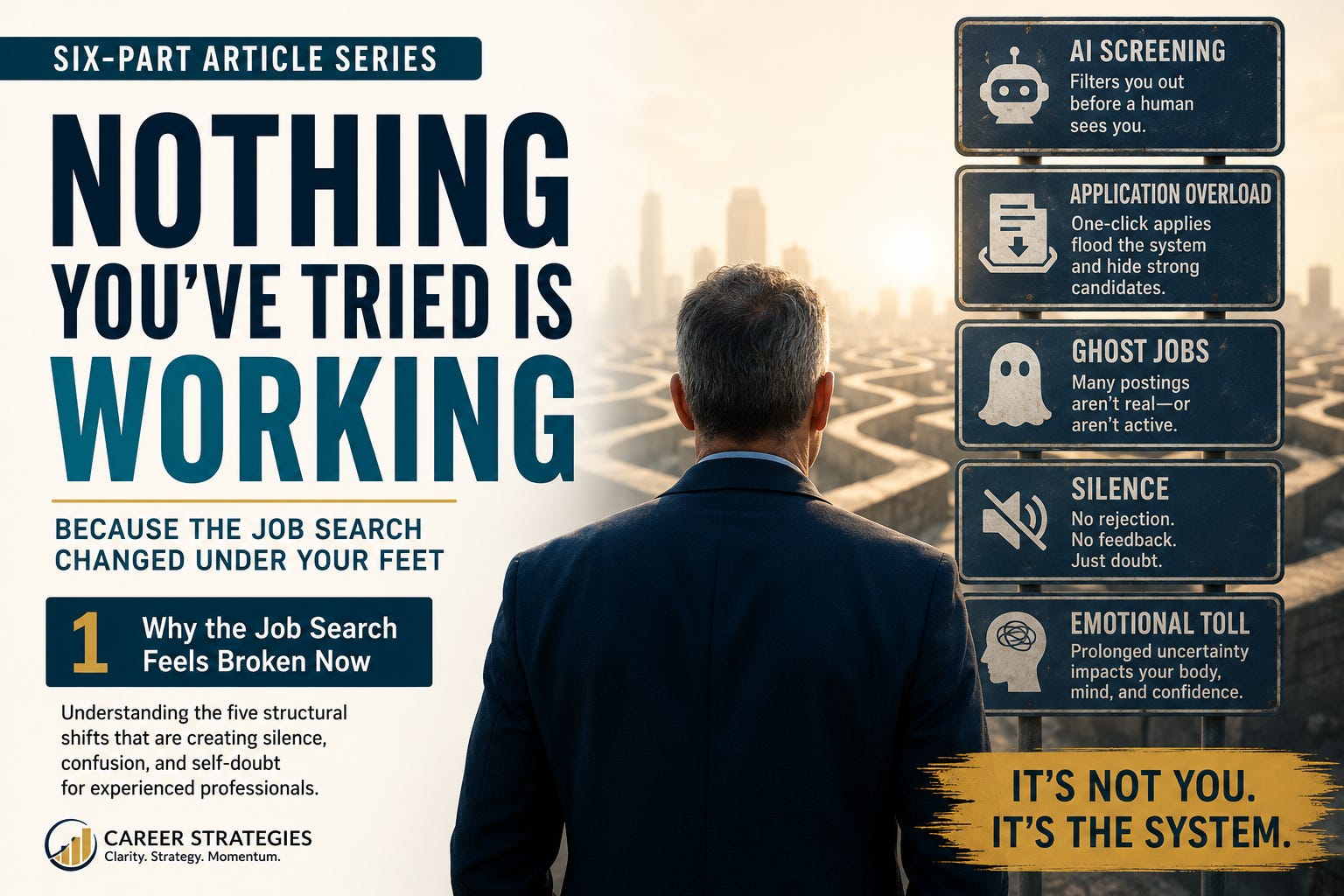
This article is adapted from Nothing You’ve Tried Is Working: The Complete 2026 Reference for AI Screening, Ghost Jobs, and Getting Hired. The book is built as a practical reference for experienced professionals navigating AI screening, ghost jobs, application silence, interview stalls, age bias, and the emotional strain of searching in a market that no longer responds the way it used to.
👉 Book link: https://www.amazon.com/dp/B0GMP9DD3B
You keep doing what you were told to do.
You update the resume.
You tailor the application.
You rewrite the summary.
You adjust the keywords.
You network.
You apply again.
You wait.
Then nothing happens.
Not a rejection.
Not a conversation.
Not a meaningful response.
Just silence.
At first, you explain it rationally.
The market is slow.
Recruiters are overwhelmed.
Budgets are frozen.
Companies are cautious.
Then weeks become months, and the explanation starts to change.
Maybe my resume is not strong enough.
Maybe my experience is outdated.
Maybe I waited too long.
Maybe I am too senior.
Maybe I am too expensive.
Maybe the market is telling me something true about myself.
That is where the damage begins.
Because the silence of this market does not come as silence.
It arrives as a question about your worth.
And if you sit with that question long enough, without a system for interpreting what is actually happening, you can start mistaking a broken hiring process for an honest assessment of your value.
It is not.
The Job Search Did Not Just Get Harder
Most professionals are still being given advice built for an older version of the market.
Apply more.
Network more.
Rewrite your resume.
Stay positive.
Follow up.
Be patient.
None of that advice is automatically wrong.
The problem is that it is incomplete.
It assumes the job search is still mainly a human process with some technology around the edges. It assumes that if you are qualified, persistent, and polished enough, your application will eventually reach someone capable of recognizing what you bring.
That assumption is no longer safe.
The modern job search is not just more competitive.
It is structurally different.
The system changed underneath the candidate, and many experienced professionals are still being told to solve a structural problem with personal effort.
That is why the search feels so confusing.
You are not just competing against other candidates.
You are competing against filters, ranking models, application floods, ghost postings, recruiter bandwidth, risk-averse hiring teams, and systems that often decide who gets seen before anyone has the chance to understand the full shape of your experience.
You may be doing real work.
You may be qualified.
You may be a strong fit.
And still, the process may never give your materials the kind of human attention you assume they are receiving.
That is not a small change.
That is the whole game shifting.
The First Change Is Mechanical
For most of your career, hiring technology was assistive.
It helped sort.
It helped store.
It helped recruiters manage volume.
But there was still a basic assumption underneath the process: at some point, a human being would look at your background and make sense of it.
That mattered.
A human could understand a lateral move.
A human could recognize transferable judgment.
A human could see that a title did not capture the scope of the work.
A human could understand that your career had range because you were trusted with complicated problems, not because you were unfocused.
But in today’s hiring environment, the system often acts before the human does.
Your resume may be scored, filtered, ranked, or deprioritized before a recruiter ever sees it.
That means the first audience for your career story may not be a person.
It may be a system looking for alignment.
It is not asking, “Is this person capable?”
It is asking, “Does this profile match the pattern we were told to prioritize?”
Those are not the same question.
And that difference matters deeply for experienced professionals.
Because experienced professionals often have careers that are richer than they are linear.
They have moved across functions.
They have solved messy problems.
They have taken on stretch assignments.
They have shifted industries.
They have survived reorganizations.
They have led through ambiguity.
They have built judgment that does not always fit neatly into a keyword field.
A human reader might see that as maturity.
A screening system may see it as inconsistency.
A human reader might understand that breadth is value.
A screening system may struggle to place it.
A human reader might infer seniority from the complexity of the work.
A screening system may only score what is clearly named, structured, repeated, and aligned.
That is why a strong background can still disappear.
Not because it lacks value.
Because the value has not been translated into the language the system is built to recognize.
The Second Change Is Volume
One-click applications changed candidate behavior.
That sounds obvious, but the consequences are bigger than most people realize.
When applying took effort, applicant pools had friction built into them.
People paused.
They read more closely.
They decided whether the role was worth the time.
Now, hundreds of applications can hit a posting quickly, sometimes from people who are not close fits, sometimes from people testing the market, sometimes from people applying because the process is easy enough to try.
That volume affects everyone.
It affects recruiters.
It affects hiring managers.
It affects screening thresholds.
It affects how quickly postings become overwhelmed.
And it affects how silence should be interpreted.
In an older market, silence after a thoughtful application could reasonably feel like feedback.
Maybe they read it and passed.
Maybe the fit was not strong enough.
Maybe someone else had more relevant experience.
That was painful, but at least it felt like a process occurred.
Now, silence may mean something very different.
It may mean the role was flooded.
It may mean the system ranked other profiles higher.
It may mean the posting was never fully active.
It may mean the hiring team paused.
It may mean an internal candidate already existed.
It may mean the recruiter never reached your application at all.
It may mean nothing about your ability.
But because the candidate receives the same output — silence — the mind fills in the blank.
And the explanation it often chooses is the most personal one.
The Third Change Is Psychological
For much of a professional career, the market functions like a mirror.
You work, and something reflects back.
A raise.
A promotion.
A recruiter message.
A performance review.
A colleague asking for your judgment.
A manager trusting you with a difficult problem.
A team depending on your leadership.
You may not think of those moments as emotional infrastructure, but they are.
They tell you that your work is visible.
They tell you that your contribution registers.
They tell you that your professional identity still has weight in the world.
Then the job search begins, and that mirror disappears.
You send out the same competence.
The same history.
The same judgment.
The same work ethic.
But nothing reflects back.
No answer.
No explanation.
No signal.
No context.
And when a person who has spent years being useful suddenly receives no confirmation that their usefulness is still visible, the silence does not stay neutral.
It starts to sound like a verdict.
This is one of the cruelest parts of the modern search.
The market does not simply deny people jobs.
It denies them feedback.
And without feedback, professionals begin manufacturing explanations out of anxiety.
They read silence as rejection.
They read delay as disinterest.
They read no response as proof that they have lost relevance.
But silence is not always a mirror.
Sometimes it is the absence of a mirror.
That distinction can protect you.
Because if the market is not accurately reflecting your value, then you cannot let the silence become the primary source of your self-assessment.
You need another system.
You need evidence.
You need structure.
You need a way to separate what is happening in the market from what is true about you.
The Fourth Change Is Biological
This part is often ignored because job-search advice likes to pretend candidates are machines.
Optimize the resume.
Update the profile.
Send the message.
Track the applications.
Prepare for interviews.
Repeat.
But a long job search does not happen only on a spreadsheet.
It happens in the body.
It happens when you wake up and check your phone before you are fully awake.
It happens when you feel a drop in your stomach after refreshing your inbox.
It happens when an ordinary errand feels irresponsible because some part of you believes you should be applying instead.
It happens when LinkedIn starts to feel like a room where everyone else is moving forward and you are watching through the glass.
It happens when the question “Any luck yet?” feels heavier than the person asking it understands.
The job search activates threat.
Not metaphorically.
Physically.
Professional disconnection can feel like danger because work is not just income. It is rhythm, belonging, identity, social confirmation, structure, and future orientation.
When that disappears, the nervous system does not politely say, “This is a temporary career transition.”
It scans for risk.
It looks for signs.
It treats uncertainty as something that must be solved.
That is why the search can feel exhausting even on days when you did not do much.
You are not only applying.
You are monitoring.
You are waiting.
You are interpreting.
You are bracing.
You are managing the emotional cost of ambiguity.
And ambiguity is expensive.
This Is Why More Effort Alone Does Not Fix It
When nothing is working, the instinct is to increase effort.
More applications.
More resume versions.
More networking messages.
More job boards.
More tabs open.
More late nights.
More urgency.
But if the problem is structural, more effort can become a trap.
More applications into weak postings do not create traction.
More resume edits without a clear evidence strategy do not create signal.
More networking without a clear positioning statement does not create opportunity.
More checking does not create answers.
More urgency does not create control.
At a certain point, effort without diagnosis becomes depletion.
That is why the first step is not to blame yourself.
It is to name the system you are actually in.
You are not searching in the same market that existed ten years ago.
You are not even searching in the same market that existed before AI screening became more common, before ghost postings became part of the landscape, before application volume exploded, before recruiters were buried under more noise than they could reasonably interpret.
You are searching in a market where being qualified is necessary but not always sufficient.
You need to be legible.
You need to be findable.
You need to be specific.
You need to protect your energy from dead-end activity.
You need to rebuild confidence from evidence rather than waiting for the market to hand it back.
That is not pessimism.
That is strategy.
What This Means for Experienced Professionals
Experienced professionals are especially vulnerable to this moment because so much of their value is contextual.
They know how to read a room.
They know how to stabilize a team.
They know how to make judgment calls when the data is incomplete.
They know how to prevent problems that less experienced people only recognize after the damage is visible.
They know how to manage risk.
They know how to translate ambiguity into action.
But many of those strengths do not automatically show up in a screening environment.
A system cannot assume your judgment.
It cannot infer your impact from your title.
It cannot fill in the story behind a vague bullet.
It cannot understand that the most valuable thing you did was prevent a failure that never made it into the metrics.
So the burden shifts.
Not the burden of proving your worth as a human being.
The burden of translating your value into visible evidence.
That is different.
One is identity.
The other is communication.
The modern job search punishes candidates who confuse the two.
When your materials fail to land, it does not automatically mean your career lacks value.
It may mean the value has not been converted into the right kind of signal.
That is fixable.
But only after you stop treating silence as truth.
The New Starting Point
The old starting point was:
“What is wrong with my resume?”
The better starting point is:
“What part of the system am I trying to solve?”
Because those are different questions.
If the issue is AI screening, you need signal architecture.
If the issue is application volume, you need better targeting.
If the issue is ghost jobs, you need triage.
If the issue is unclear positioning, you need an evidence bank.
If the issue is emotional exhaustion, you need boundaries and nervous-system recovery.
If the issue is confidence erosion, you need practiced confidence instead of mood-based confidence.
The mistake is treating every problem as a resume problem.
The resume matters.
But it is not the whole search.
It is one artifact inside a much larger system.
And if the system has changed, your strategy has to change with it.
You Are Not the Problem. But Your Strategy May Be Outdated.
That sentence matters.
Because too much career advice swings between two extremes.
One extreme tells job seekers they are doing everything wrong.
The other tells them they are perfect and the market is simply unfair.
Neither position is useful by itself.
The more honest answer is this:
You may be highly capable.
You may have real experience.
You may have a strong career behind you.
And still, your current strategy may not be built for the market you are facing now.
That does not make you the problem.
It gives you a place to start.
You can rebuild the strategy.
You can translate your experience into evidence.
You can stop applying blindly.
You can learn to identify low-probability postings.
You can strengthen your LinkedIn signal.
You can prepare for interviews around proof rather than performance.
You can negotiate from evidence instead of gratitude.
You can protect your mind while the process unfolds.
But first, you have to stop accepting the market’s silence as a complete and accurate story.
It is not.
What Feels Like Failure May Be a Collision
This is the core truth of the modern search:
What feels like failure is often a collision between your experience and a hiring environment that no longer works the way it used to.
You are bringing a career built in one system into a market operating by another.
That mismatch can feel humiliating.
It can make you question your relevance.
It can make you wonder whether all those years still count.
They do.
But they have to be translated differently now.
The work is not to become younger.
It is not to erase your experience.
It is not to pretend you are less senior than you are.
It is not to chase every posting that appears.
It is not to hand your confidence over to an inbox that was never designed to protect it.
The work is to build a modern search system around the value you already carry.
That starts with understanding the environment clearly.
Not emotionally.
Clearly.
The job search changed under your feet.
Now the strategy has to change under your control.
Status Upgrade
Stop asking, “Why is nothing working?”
Start asking, “What changed, and what system do I need now?”
Because the answer is not more panic.
It is not more random effort.
It is not more self-blame.
It is a clearer operating system for a market that no longer rewards the old one.
Coming Next in the Series
Article 2: Your Experience Is Real — But Your Evidence Is Weak
The next article will focus on one of the most expensive mistakes experienced professionals make in the modern search: describing responsibility when the market is looking for evidence.
Because your resume may be accurate.
It may also be underselling you.
And in an AI-filtered market, what is not clearly evidenced often does not exist.
About the Author
Byron K. Veasey is a career strategist and leader in data quality engineering focused on helping professionals navigate job searches, burnout, and career reinvention.
He writes Career Strategies, a Substack newsletter read by over 4,900 professionals navigating today’s evolving job market.
👉 Subscribe to Career Strategies