

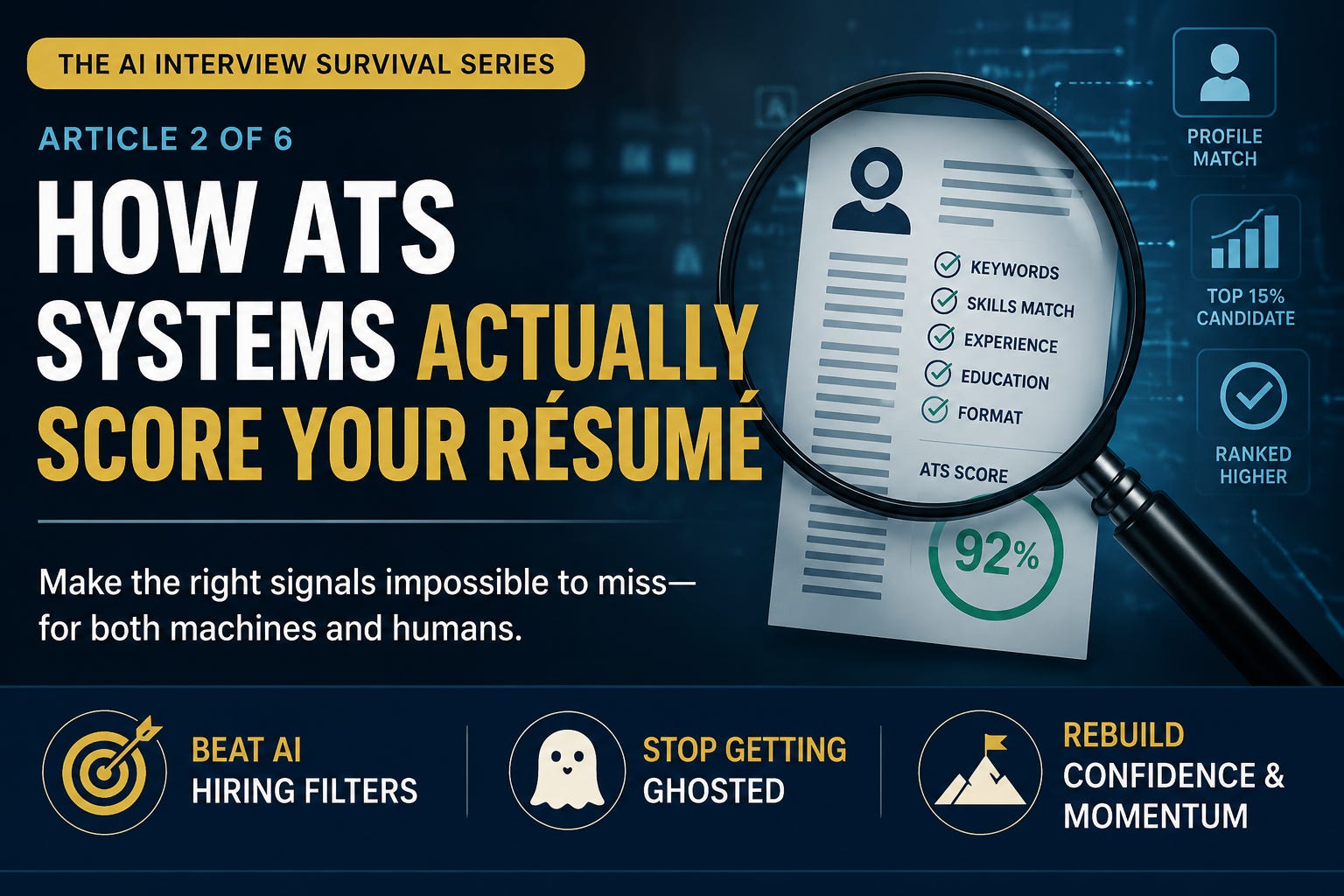
The AI Interview Survival Series
Article 2 of 6
This series is from the book, The AI Interview Survival Guide: How to Beat Automated Screens, One-Way Video Interviews, and AI-Assisted Recruiters in the Modern Job Market
In Article 1, we established the central truth of the modern job search: the interview often begins before a human ever meets you. The system may already be evaluating, sorting, scoring, and deprioritizing your candidacy before the first recruiter call appears on your calendar.
Article 2 goes one layer deeper.
Because for most candidates, the first interview is not a conversation.
It is the résumé scan.
You found a role that looked almost perfectly aligned.
The title made sense.
The responsibilities matched your experience.
The company was in your lane.
The compensation looked reasonable.
The description used language you recognized from work you had already done.
So you opened your résumé.
You changed the summary.
You adjusted a few bullets.
You added keywords from the posting.
You checked for typos.
You uploaded the file.
You hit submit.
Then the familiar silence arrived.
No recruiter.
No rejection.
No interview.
No explanation.
Just the quiet machinery of modern hiring doing what it does best: processing people without telling them how they were processed.
And somewhere in that silence, you started asking the wrong question.
Was I not qualified?
A better question is this:
Did the system understand that I was qualified?
Those are not the same thing.
Your Résumé Is No Longer Just a Career Document
For decades, candidates thought of the résumé as a persuasive document.
It was supposed to tell your story.
Show your progression.
Summarize your experience.
Demonstrate your value.
Create enough interest for a recruiter to call.
That is still true.
But it is no longer the whole truth.
In 2026, your résumé is also a data object.
Before it persuades a human, it must survive a machine. Before it creates interest, it must be parsed. Before it communicates judgment, leadership, credibility, and experience, it must be converted into structured information inside an Applicant Tracking System.
That system is not reading your résumé the way a thoughtful recruiter reads.
It is not admiring your career arc.
It is not weighing the difficulty of your decisions.
It is not understanding the politics you navigated.
It is not sensing the leadership maturity behind your achievements.
It is not giving you credit for being versatile, resilient, or experienced.
It is extracting.
Titles.
Dates.
Skills.
Keywords.
Employers.
Education.
Certifications.
Tools.
Responsibilities.
Recency.
Formatting.
Pattern match.
The system is not asking, “Is this person capable?”
It is asking, “Can I classify this person quickly?”
That is the first hidden danger.
A strong career can become weak signal if the résumé does not translate it clearly.
How ATS Systems Actually Evaluate You
Applicant Tracking Systems vary by company, vendor, configuration, recruiter behavior, and hiring workflow. Not every system works exactly the same way. Some are simple storage and workflow tools. Some include ranking features. Some integrate with AI sourcing, matching, or screening tools. Some depend heavily on recruiter search behavior.
But across modern hiring systems, the same basic logic appears again and again.
The system tries to determine whether your résumé appears relevant to the role.
It does that by examining several signals.
1. Keyword Alignment
This is the part most candidates know about, but often misunderstand.
Keyword alignment does not mean stuffing the résumé with every phrase from the job description. That can make your résumé awkward, inflated, and difficult for a human to trust.
Keyword alignment means your résumé uses the language of the role closely enough that the system can connect your experience to the position.
If the job description says “data governance,” but your résumé only says “improved enterprise reporting discipline,” the human reader may understand the connection.
The system may not.
If the posting says “stakeholder management,” but your résumé says “partnered cross-functionally to align priorities,” the idea may be similar.
The match may still be weaker.
If the posting says “Salesforce,” “Workday,” “SQL,” “Power BI,” “Python,” “Agile,” “risk management,” “change management,” or “vendor management,” and those exact terms are absent or buried, the system may not infer them from context.
Machines are improving. But you should never rely on a hiring system to generously interpret your résumé.
Your job is to make the relevant match obvious.
Not exaggerated.
Not fake.
Obvious.
2. Role-Title Similarity
This is where many experienced professionals get filtered out.
Your official title may not match the title you are applying for.
You may have been called a “Senior Manager,” but the role is looking for a “Director.”
You may have been called a “Program Lead,” but the role is looking for a “Product Manager.”
You may have been called a “Consultant,” but the work was really transformation leadership.
You may have been called “Operations,” but the role is really process improvement, analytics, and governance.
Humans can understand title variation.
Systems often look for recognizable patterns.
If your target role is “Data Quality Manager” and your résumé never clearly signals data quality, governance, controls, monitoring, issue resolution, or stakeholder accountability, the system may not know where to place you.
If your career has been broad, hybrid, senior, or nonlinear, you must create clarity.
That does not mean changing your job titles dishonestly.
It means using your headline, summary, skills section, and bullet language to connect your actual experience to the role language the system expects.
For example:
Weak signal:
Senior Leader with broad experience in enterprise transformation
Stronger signal:
Data Quality and Governance Leader | Enterprise Data Controls | Monitoring, Issue Resolution, Stakeholder Alignment
The second version gives the system something to classify.
It also gives the recruiter a faster story to repeat.
3. Skills Extraction
ATS systems often extract skills from your résumé and compare them against the role description.
This is why a clean skills section matters.
Not because skills alone get you hired.
Because skills help the system understand what world you belong to.
The problem is that many experienced professionals either overload this section or underuse it.
They list too many generic strengths:
Leadership
Communication
Problem-solving
Teamwork
Strategy
Collaboration
Those are not useless, but they are not enough.
The system needs concrete signals.
Tools.
Methods.
Functions.
Domains.
Regulatory environments.
Platforms.
Frameworks.
Business processes.
Technical competencies.
A better skills section might include:
Data Quality Management
Data Governance
Root Cause Analysis
Stakeholder Management
SQL
Databricks
Power BI
Process Improvement
Risk Controls
Executive Reporting
Vendor Management
Agile Delivery
Change Management
The goal is not to create a keyword dump.
The goal is to create a clean map.
When a recruiter searches the system later, your résumé needs to surface.
That means the terms they search must appear in your document in a way that is truthful, relevant, and easy to parse.
4. Formatting Compliance
This is the least glamorous part of résumé strategy.
It is also one of the most costly.
A résumé can look beautiful to a human and fail structurally inside an ATS.
Columns may scramble.
Text boxes may be skipped.
Icons may not parse.
Headers may confuse the system.
Graphics may disappear.
Tables may distort.
PDF formatting may behave inconsistently depending on the platform.
Creative templates may bury the very information the system needs.
This is one reason candidates often feel betrayed by the process.
They invest in design.
The system rewards clarity.
For ATS submissions, your résumé should be boring in the right ways.
Clear headings.
Simple structure.
Standard section names.
Consistent dates.
Readable fonts.
No essential information trapped in images, icons, sidebars, or complex tables.
A résumé can still be polished.
But polish should never interfere with parsing.
If the system cannot extract your experience correctly, your design becomes a liability.
The ATS Does Not Reject You the Way a Human Rejects You
This is important.
When candidates hear “ATS,” they often imagine a machine making a final judgment.
Sometimes automated filtering is harsh. Sometimes knockout questions remove candidates instantly. Sometimes ranking systems push profiles so far down the list that they are functionally invisible.
But the deeper issue is not always rejection.
It is visibility.
Your résumé may be in the system but not surfaced.
It may be parsed but poorly classified.
It may be relevant but ranked low.
It may pass the filter but not appear in recruiter search results.
It may sit in a database no one gets to because too many candidates scored higher on obvious signals.
From the outside, all of this feels the same.
Silence.
This is why the job search can become psychologically damaging. You experience silence as personal rejection when it may actually be technical invisibility.
The system did not necessarily decide you were unworthy.
It may have failed to understand you.
That is still a problem.
But it is a different problem.
And different problems require different strategies.
Senior Professionals Have a Specific ATS Problem
Experienced professionals often assume their depth will speak for itself.
It does not.
Depth can actually become harder for the system to process.
A senior career often includes:
Multiple functions
Several industries
Leadership roles with broad scope
Consulting or advisory work
Transformation initiatives
Titles that changed across companies
Legacy tools mixed with modern platforms
Strategic work that is harder to summarize in keywords
Results that depend on context
To a human, this may look impressive.
To a system, it can look unfocused.
This is why many experienced candidates get trapped in a painful contradiction.
They are overqualified in reality but under-legible in the system.
They have done the work.
But the résumé does not make the match simple enough.
The modern résumé must answer two questions at once:
For the system:
Can this person be categorized as relevant?
For the human:
Can this person be trusted to solve the problem?
Most résumés only answer the second question.
In 2026, that is not enough.
The Résumé Has to Translate Value Into Evidence
One of the biggest résumé mistakes is describing responsibilities without proving impact.
A responsibility tells the reader what you were supposed to do.
Evidence shows what changed because you were there.
Compare these two bullets:
Responsibility-based:
Responsible for managing cross-functional teams and improving operational processes.
Evidence-based:
Led cross-functional process improvement initiative that reduced reporting delays by 32% and improved executive visibility into operational risk.
The second bullet is stronger for both humans and machines.
It includes role action.
It includes function.
It includes measurable outcome.
It includes business relevance.
It includes searchable terms.
It gives a recruiter language to use when presenting you.
The best résumé bullets do not simply list what you did.
They convert your work into structured evidence.
A useful formula:
Action + Function + Method + Result
For example:
Led enterprise data quality remediation effort using root-cause analysis and stakeholder governance, reducing recurring reporting defects by 41%.
Built executive dashboard process in Power BI to improve visibility into operational performance, shortening monthly review preparation by five business days.
Managed vendor implementation across business and technology teams, improving adoption of new workflow controls and reducing escalation volume.
These bullets work because they are specific.
They also survive machine review better because they contain recognizable terms tied to the target role.
The system sees relevance.
The human sees credibility.
That is the goal.
Stop Writing for Your Entire Career. Start Writing for the Role in Front of You.
A common mistake among experienced professionals is trying to preserve the full richness of their background in every résumé.
They want the reader to see all of it.
The leadership.
The strategy.
The operations.
The people management.
The technical exposure.
The consulting experience.
The crisis management.
The transformation work.
The years of judgment.
But the résumé is not an archive.
It is a targeting document.
The purpose is not to show everything you have done.
The purpose is to make the right match impossible to miss.
That means every version of your résumé should be shaped around the role family you are pursuing.
If you are applying for data governance roles, lead with governance, controls, data quality, risk reduction, and stakeholder accountability.
If you are applying for program management roles, lead with delivery, cross-functional coordination, timeline recovery, executive reporting, and issue resolution.
If you are applying for operations leadership roles, lead with process improvement, performance metrics, team leadership, cost reduction, and execution discipline.
If you are applying for career transition roles, translate your old domain into the new domain’s language.
The more experienced you are, the more editing discipline you need.
A résumé that tries to prove everything often signals nothing clearly.
The ATS-Friendly Résumé Is Not a Weak Résumé
Some candidates resist ATS optimization because they believe it makes the résumé robotic.
That fear is understandable.
Bad ATS optimization does make a résumé robotic.
Keyword stuffing is robotic.
Generic skills lists are robotic.
Inflated summaries are robotic.
Copying the job description is robotic.
Turning every bullet into buzzwords is robotic.
But strong ATS optimization does the opposite.
It clarifies.
It forces you to name your value.
It makes your experience easier to understand.
It aligns your language with the market.
It removes unnecessary friction.
It helps both the machine and the human see why you belong in the process.
The goal is not to write for robots.
The goal is to stop making humans work so hard to understand you after the robot has already ranked you.
That distinction matters.
A Practical ATS Fix Before Your Next Application
Before you submit another résumé, run this simple review.
Take the job description and identify:
The target title
The top five responsibilities
The required skills
The preferred tools or systems
The repeated keywords
The business problem the role is trying to solve
Then review your résumé and ask:
Does my headline clearly match the role family?
Does my summary use the language of the target position?
Are the most important keywords present naturally?
Are my strongest relevant achievements on page one?
Can the system parse my dates, titles, employers, and skills easily?
Do my bullets show evidence, not just responsibility?
Does this résumé make me look focused for this role?
If the answer is no, do not submit yet.
Not because you are unqualified.
Because qualification that is not translated becomes invisible.
The Real Work Is Signal Translation
This is the shift experienced professionals have to make.
Your résumé is not just a history of work.
It is a signal translation tool.
It translates your experience into machine-readable terms.
It translates your judgment into recruiter-readable evidence.
It translates your past into the employer’s present problem.
It translates complexity into clarity.
It translates capability into relevance.
That is what gets you through the first gate.
Not because the ATS is smarter than you.
Because the ATS is narrower than you.
It only sees what your résumé is structured to show.
“The system cannot reward what it cannot recognize.”
What to Fix First
Do not start with the font.
Start with the target.
A modern résumé should make these four things clear within seconds:
1. What role you are targeting
The reader should not have to infer your direction from your history.
2. What problems you solve
Your résumé should connect your experience to current employer pain.
3. What proof you have
Use numbers, outcomes, scale, scope, and specific examples.
4. Why you are relevant now
Make sure your language reflects the market you are entering, not only the jobs you held years ago.
This is especially important for professionals navigating age bias, career disruption, or long searches.
The system does not need your entire biography.
It needs a clear signal.
A Note on Why This Matters Now
The résumé did not become less important.
It became more technical.
It has to perform before multiple audiences: the parser, the ranking system, the recruiter search, the AI-assisted screening layer, and finally the human decision-maker.
That does not mean you should become cynical.
It means you should become precise.
The modern job search rewards candidates who can convert experience into evidence and evidence into signal.
That is not manipulation.
That is communication under new conditions.
Qualified professionals are not losing opportunities only because they lack skills. Many are losing opportunities because their skills are not visible in the format the hiring system now requires.
This is why résumé strategy can no longer be treated as cosmetic.
It is infrastructure.
And when the infrastructure is weak, even strong candidates disappear.
Article 3 publishes next: Screening Chatbots: What They Are Measuring and How to Answer.
About the Author
Byron K. Veasey is a career strategist and leader in data quality engineering focused on helping professionals navigate job searches, burnout, and career reinvention.
He writes Career Strategies, a newsletter read by over 4,800 professionals navigating today’s evolving job market.
👉 Subscribe to Career Strategies
🎙️ Listen to the Podcasts
👉 Career Strategies Amazon Books
👉 eBook Library of Success