

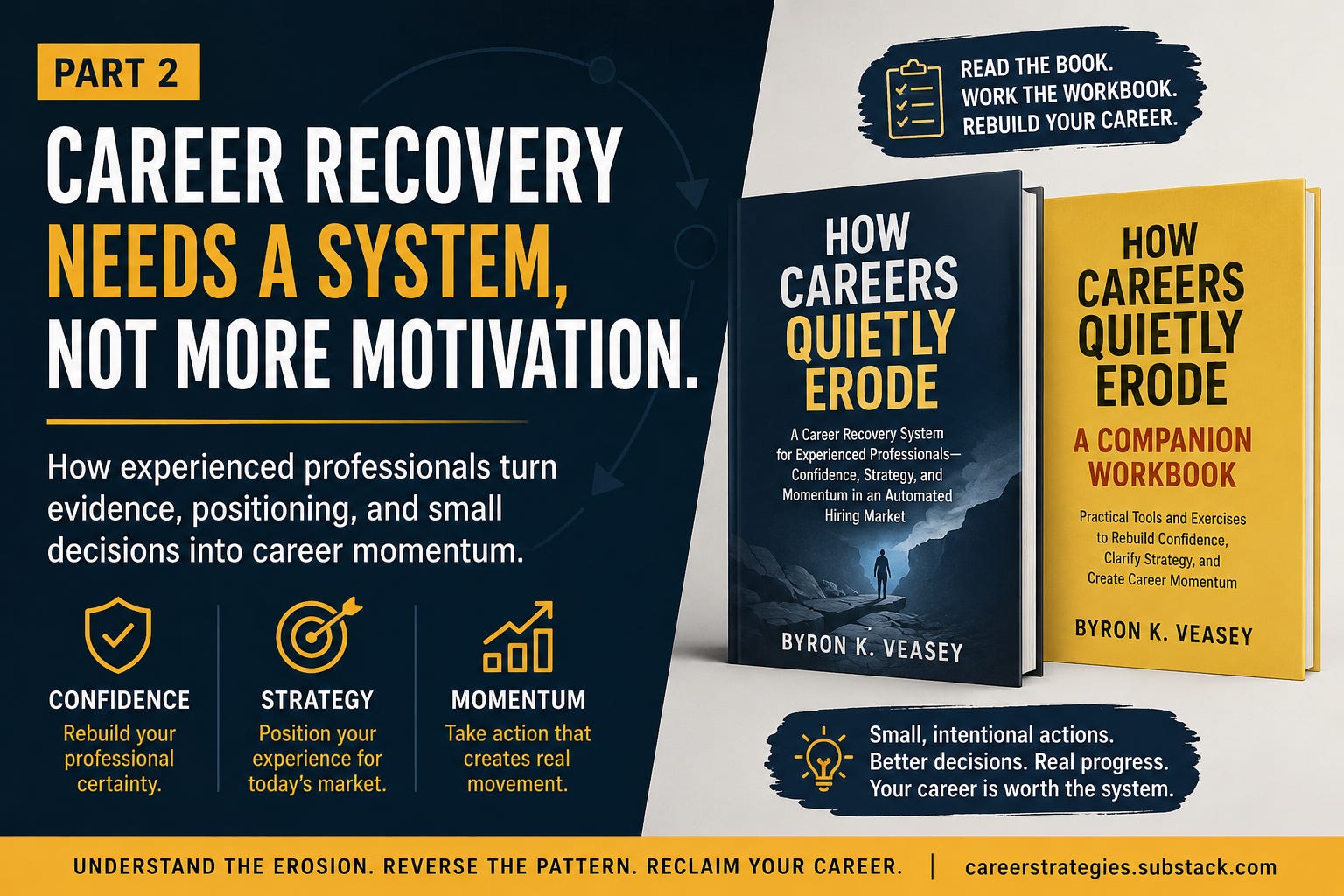
Part 2: How experienced professionals turn evidence, positioning, and small decisions into career momentum
In Part 1, I wrote about why How Careers Quietly Erode and its companion workbook are more powerful when used together.
The central idea was simple:
The book helps you understand the erosion.
The workbook helps you reverse it.
Together, they create a working career recovery system built around confidence, strategy, and momentum.
But there is another part of career recovery that deserves more attention.
Because even after you understand what has happened…
Even after you recognize that months of silence have affected your confidence…
Even after you realize your résumé may not be the entire problem…
You still have to answer a harder question:
What do I do differently on Monday morning?
That is where recovery either becomes practical—
or remains another good idea.
You Probably Do Not Need More Motivation
Experienced professionals are rarely lacking information.
You already know you should network.
You know your résumé needs measurable accomplishments.
You know LinkedIn matters.
You know you should prepare for interviews.
You know you should keep your skills current.
You know consistency matters.
The problem is not usually that someone forgot to tell you to keep trying.
The problem is that prolonged uncertainty makes it increasingly difficult to determine where your effort should go.
Monday morning arrives.
You open LinkedIn.
You check your email.
Nothing.
You check the job boards.
Twenty-seven new positions appear.
Maybe three look promising.
You open one.
Four hundred people have already clicked Apply.
You modify your résumé.
Again.
You send the application.
Then you find another position.
Modify the résumé again.
Another application.
Another recruiter message.
Another hour researching companies.
Another hour wondering whether you should change your headline.
Another afternoon disappears.
You were busy.
But were you moving?
That is the distinction career recovery requires.
Activity consumes time.
A system creates direction.
The Modern Job Search Creates Too Many Decisions
One reason experienced professionals become exhausted is rarely discussed.
The modern job search contains an enormous number of tiny decisions.
Should I apply?
Should I change this résumé bullet?
Should I remove older experience?
Should I mention my leadership background?
Should I lower my salary expectation?
Should I contact the recruiter?
Should I follow up?
Should I wait?
Should I learn another technology?
Should I apply to a lower-level position?
Should I change industries?
Should I post on LinkedIn?
Should I tell people I am unemployed?
Should I pay someone to rewrite my résumé?
Should I apply directly?
Should I use Easy Apply?
Should I keep trying for leadership roles?
Should I pivot completely?
One decision is manageable.
Hundreds of them, made repeatedly while dealing with rejection and financial uncertainty, become exhausting.
Eventually you begin making decisions based on emotion instead of strategy.
A bad morning changes your target market.
A rejection changes your compensation expectations.
A quiet week changes your opinion of your career.
One recruiter comment causes you to rewrite your entire professional story.
This is exactly why career recovery needs an operating system.
You need a way to make decisions before discouragement starts making them for you.
The First Rule: Separate Evidence From Emotion
Suppose you apply to twelve positions and receive no interviews.
Your emotional conclusion might be:
My experience is no longer valuable.
But that is not evidence.
That is an interpretation.
The evidence is:
You submitted twelve applications.
You received no interviews.
Now the strategic questions begin.
Were the roles actually aligned?
Did your résumé clearly communicate the problems you solve?
Were you applying through channels where you had any relationship advantage?
Were the positions active?
Was your experience positioned in language the market currently recognizes?
Did your résumé make your level of contribution obvious?
Were you targeting one coherent professional identity—or several unrelated ones?
Those questions lead somewhere.
“Nobody wants me” does not.
One of the most important recovery skills is learning to separate:
What happened
from
What you decided it means.
A recruiter disappears after promising an update.
What happened?
The recruiter stopped communicating.
What does it mean?
You do not know yet.
A company rejects your application three hours after submission.
What happened?
Your application was rejected quickly.
What does it mean?
Perhaps screening criteria eliminated you.
Perhaps the position had an internal candidate.
Perhaps compensation was mismatched.
Perhaps the résumé did not establish fit.
Perhaps the job was nearly filled.
Perhaps your application never reached a human being.
You may eventually identify a pattern worth correcting.
But you do not need to turn incomplete information into a verdict about your professional worth.
That distinction protects confidence.
And protecting confidence improves decision quality.
Build a Professional Evidence Bank
One of the most dangerous effects of a prolonged job search is memory distortion.
You remember the rejection from Tuesday.
You forget the transformation project you led eight years ago.
You remember the recruiter who ghosted you.
You forget the executive who trusted your judgment during a crisis.
You remember the company that told you they selected someone else.
You forget the teams that depended on you.
The market is providing fresh information every day.
Your career evidence may be twenty years old.
Fresh information feels more powerful.
That does not make it more accurate.
This is why every experienced professional should maintain something deeper than a résumé.
Call it an evidence bank.
A career ledger.
A professional proof file.
The name does not matter.
What matters is that you begin capturing evidence such as:
What problems did I solve?
What became better because I was involved?
What did people repeatedly ask me to handle?
Where did I improve quality?
Where did I reduce cost?
Where did I increase revenue?
Where did I prevent risk?
Where did I make complexity easier to manage?
Where did I build something that lasted after I left?
Where did my judgment matter?
Who became more effective because I coached or led them?
What difficult situation did I navigate successfully?
What did I learn that someone with five years of experience probably has not encountered yet?
That evidence does more than make you feel better.
It becomes raw material.
For your résumé.
For LinkedIn.
For networking.
For interviews.
For salary conversations.
For consulting opportunities.
For career pivots.
For deciding what roles actually deserve your attention.
Part 1 described the difference between a résumé and a deeper recovery record: the résumé is designed for employers, while the recovery record preserves the context, decisions, resistance, lessons, and results behind your accomplishments.
That deeper evidence matters because you cannot market value you have forgotten.
Evidence Has to Become Positioning
But evidence by itself is not enough.
You may have an extraordinary career history and still struggle in today’s market if employers cannot quickly understand what that history means for them.
This is where many experienced professionals get trapped.
They communicate chronology.
Employers are looking for relevance.
Your résumé says:
Twenty years of experience.
Multiple leadership positions.
Large projects.
Major organizations.
Many technologies.
Broad responsibilities.
But the employer is asking:
What problem can this person solve here?
That question should influence nearly every element of your career strategy.
Your headline.
Your summary.
Your résumé.
Your interview introduction.
Your networking conversations.
Even the jobs you choose to pursue.
Instead of leading with:
I have 20+ years of experience across multiple industries...
try thinking:
What recurring business problem have those twenty years taught me to solve unusually well?
That is a different question.
And it creates a different professional signal.
Experience Is Not the Positioning
Experienced professionals often assume experience sells itself.
It does not.
Experience is inventory.
Positioning tells the market what the inventory is worth.
Consider two professionals.
Both have spent twenty years working in operations.
The first says:
Senior operations leader with 20 years of progressive experience.
The second communicates:
I help organizations stabilize complex operations, reduce execution gaps, and build repeatable processes during periods of growth and change.
Same career.
Different signal.
One describes history.
The other describes utility.
Today’s hiring market increasingly rewards professionals who can translate their background into a clear business outcome.
That becomes especially important for people whose careers have crossed multiple technologies, companies, industries, or leadership levels.
Your experience may make perfect sense to you.
It does not automatically make sense to someone scanning your profile for fifteen seconds.
Your job is to create the bridge.
Stop Asking Only, “What Jobs Can I Get?”
Career erosion can quietly reduce the ambition of your questions.
At first you ask:
What kind of work do I want to do next?
After enough rejection, the question changes.
What jobs can I get?
Then:
Who might take me?
That progression matters.
Because career recovery requires reclaiming some degree of choice.
That does not mean ignoring market realities.
Financial pressure is real.
Age bias is real.
AI screening is real.
Industry contraction is real.
Layoffs are real.
Sometimes you absolutely take the best reasonable opportunity available.
But there is still value in asking:
What problems do I solve best?
Where does my experience create leverage?
Which environments benefit from my judgment?
What level of responsibility fits my capabilities?
Which industries can use my transferable experience?
What work do I no longer want to do?
Which compromises am I willing to make?
Which ones would create another problem six months from now?
Those questions shift you from desperation toward strategy.
Not instantly.
Not perfectly.
But deliberately.
Use a Weekly Recovery Cycle
A career recovery system does not have to be complicated.
In fact, complicated systems usually collapse during stressful periods.
Try organizing the week around four movements:
1. Evidence
Capture something that proves your professional value.
An accomplishment.
A difficult decision.
A transformation.
A problem solved.
A testimonial.
A metric.
A leadership example.
A technical challenge.
An operational improvement.
Do not rely on memory.
Write it down.
2. Positioning
Take one piece of that evidence and improve how you communicate it.
Turn a responsibility into an outcome.
Strengthen one résumé bullet.
Improve one LinkedIn section.
Clarify one interview story.
Rewrite your professional introduction.
Identify the business problem behind an accomplishment.
You do not need to rebuild everything every week.
Improve one signal.
3. Connection
Career recovery cannot occur entirely through applicant tracking systems.
Talk to someone.
A former colleague.
A recruiter.
A former manager.
A peer.
Someone at a target company.
A professional association contact.
Someone whose work interests you.
Not every conversation needs to contain:
“Do you know of any jobs?”
That question can make networking feel transactional.
Try:
“I’m exploring where my background in ___ creates the strongest value right now. I’d be interested in your perspective on what you’re seeing.”
Now you are creating a professional conversation.
Conversations create information.
Information improves strategy.
Strategy improves targeting.
Targeting improves the quality of your activity.
4. Movement
Finish the week by asking:
What moved?
Not:
How many hours did I spend?
Not:
How many applications did I submit?
Ask:
Did I clarify my direction?
Did I improve my market signal?
Did I learn something useful about my target market?
Did I strengthen a professional relationship?
Did I identify an opportunity worth pursuing?
Did I communicate my value more effectively?
Did I capture evidence I had forgotten?
Did I make a decision I had been avoiding?
Did I get closer to understanding where I fit?
The original recovery framework emphasizes that activity and progress are not the same thing and proposes measuring whether you strengthened your signal, had meaningful conversations, identified better-fit opportunities, communicated your value more clearly, and made decisions that reduced uncertainty.
That is a much healthier definition of a productive week.
Five Good Applications Can Be Better Than Fifty Panic Applications
Volume has become one of the default measurements of job-search effort.
Applied to 20 jobs today.
Applied to 50 this week.
Submitted 300 applications.
But application volume can become a form of emotional anesthesia.
It feels productive.
It creates the temporary relief of saying:
At least I am doing something.
Sometimes volume is necessary.
But there is a difference between scale and panic.
A strong application should ideally answer several questions.
Is this role genuinely aligned with my background?
Can I identify the problem the company is hiring someone to solve?
Does my résumé demonstrate evidence relevant to that problem?
Can I explain why this move makes sense?
Do I have any connection path into the company?
Would I actually accept the position under reasonable circumstances?
If most of the answers are no, the application may simply be consuming recovery energy.
The objective is not to become less active.
It is to become more intentional.
Protect Your Identity From the Hiring Process
There is another reason the recovery system matters.
Job searching creates a dangerous fusion:
Your job search starts becoming your identity.
When things go well:
I am competitive.
When things go badly:
I am obsolete.
Interview invitation:
I still have value.
Automated rejection:
Maybe I do not.
Recruiter response:
I still matter.
Ghosting:
Maybe I have disappeared.
That is too much power to give a hiring process.
You need parts of your week that produce evidence independent of whether an employer responds.
Learn something.
Build something.
Teach something.
Write something.
Help someone.
Reconnect with someone.
Finish something you have postponed.
Strengthen a skill.
Improve your health.
Work on a personal project.
Volunteer your expertise.
Your professional identity should be larger than your application dashboard.
Because when every measure of progress depends on someone else’s decision, confidence becomes almost impossible to stabilize.
The Goal Is Not Confidence Before Action
People often assume the sequence works like this:
First I regain confidence.
Then I start networking.
Then I pursue better positions.
Then I interview strongly.
Career recovery often works in the opposite direction.
You document evidence.
Confidence improves slightly.
You improve your positioning.
Confidence improves slightly.
You have a strong professional conversation.
Confidence improves slightly.
You tell an interview story well.
Confidence improves slightly.
Someone responds positively to your expertise.
Confidence improves slightly.
You make one decision from strategy instead of fear.
Confidence improves slightly.
Eventually you realize:
I am moving differently.
Confidence is often not the prerequisite.
It is the result of repeated evidence and movement.
Small Wins Are Not Small When You Have Been Stalled
One of the mistakes experienced professionals make is refusing to count progress unless it results in an offer.
That creates an impossible emotional system.
Offer = success.
Everything else = failure.
But career recovery contains milestones long before the offer.
You finally identify your target role.
That matters.
You stop applying below your level simply because you are discouraged.
That matters.
You explain your value clearly to someone.
That matters.
A former colleague introduces you to someone.
That matters.
A recruiter reaches out because of your positioning.
That matters.
You handle an interview question better than you did last month.
That matters.
You rediscover an accomplishment you had forgotten.
That matters.
You decide what kind of work you do not want anymore.
That matters.
You send a networking message you had been avoiding for two weeks.
That matters.
Small wins are evidence that the system is moving.
Do not dismiss them because they are not yet the final outcome.
Review the System Before You Rewrite Yourself
After a difficult week, resist the urge to change everything.
Do not immediately decide:
My résumé is terrible.
My field is dead.
I am too old.
I need another certification.
I need to change industries.
I need to remove half my experience.
I should accept significantly less money.
Instead, conduct a review.
What happened?
What did I learn?
What generated response?
What produced nothing?
Where did people seem interested?
Where was there confusion?
What patterns are emerging?
What am I assuming without evidence?
What experiment should I run next?
That last question is particularly important.
Not:
What should I permanently change about myself?
But:
What should I test next?
Maybe you test a narrower résumé.
Maybe you test a different headline.
Maybe you contact hiring managers instead of relying entirely on applications.
Maybe you emphasize a different strength.
Maybe you explore an adjacent industry.
Maybe you conduct five informational conversations before making a larger career pivot.
Experiments produce information.
Panic produces overcorrection.
Your Career Is Not Asking You to Start Over
Many experienced professionals describe career disruption using one phrase:
“I feel like I am starting over.”
But most of the time, you are not.
You are starting from experience.
There is a difference.
You may need to reposition it.
Update it.
Translate it.
Package it differently.
Add new capabilities.
Remove outdated assumptions.
Build relationships in a different market.
Learn how today’s hiring systems operate.
But your career did not disappear because a recruiter failed to reply.
Your judgment did not disappear because an applicant tracking system rejected a résumé.
Your leadership experience did not disappear because a company chose someone younger.
Your accomplishments did not disappear because you have been unemployed for six months.
The work now is to reconnect that evidence to a market that may no longer recognize it automatically.
That is career recovery.
The Career Recovery Loop
If you remember nothing else, remember this:
Evidence creates confidence.
Confidence improves positioning.
Positioning improves conversations.
Conversations create information and opportunities.
Information improves decisions.
Better decisions create movement.
Movement creates new evidence.
And the cycle begins again.
That is a much stronger operating system than:
Apply.
Wait.
Refresh inbox.
Get discouraged.
Rewrite résumé.
Apply again.
Career recovery becomes possible when your next move no longer depends entirely on how you feel that morning.
You have a framework.
You have evidence.
You have questions.
You have a process.
And slowly, the hiring market stops being the only thing determining whether you believe your career is moving forward.
You Do Not Need a Dramatic Breakthrough This Week
You may not receive the offer this week.
The recruiter may not call.
The perfect opening may not appear.
The hiring manager may still take longer than promised.
But something can still move.
Document one accomplishment.
Clarify one target.
Improve one professional signal.
Contact one person.
Have one useful conversation.
Send one high-quality application.
Practice one difficult interview answer.
Learn one thing about your market.
Make one decision you have been postponing.
Then do it again next week.
Career recovery rarely looks dramatic while it is happening.
Often it looks like small, deliberate decisions repeated long enough for direction to return.
And direction matters.
Because once you know where you are going, you no longer need every application to reassure you that you still have value.
You already have the evidence.
Now you are learning how to put it back to work.
Continue the Recovery
📘 How Careers Quietly Erode: A Career Recovery System for Experienced Professionals — Confidence, Strategy, and Momentum in an Automated Hiring Market
View How Careers Quietly Erode on Amazon
📕 How Careers Quietly Erode: A Companion Workbook
View the Companion Workbook on Amazon
Read the framework. Work the framework. Rebuild the momentum.
About the Author
Byron K. Veasey is a career strategist and leader in data quality engineering focused on helping experienced professionals navigate AI screening, automated interviews, recruiter silence, age bias, burnout, and career reinvention.
He writes Career Strategies, a Substack newsletter for professionals navigating today’s rapidly changing job market.
👉 Subscribe to Career Strategies