
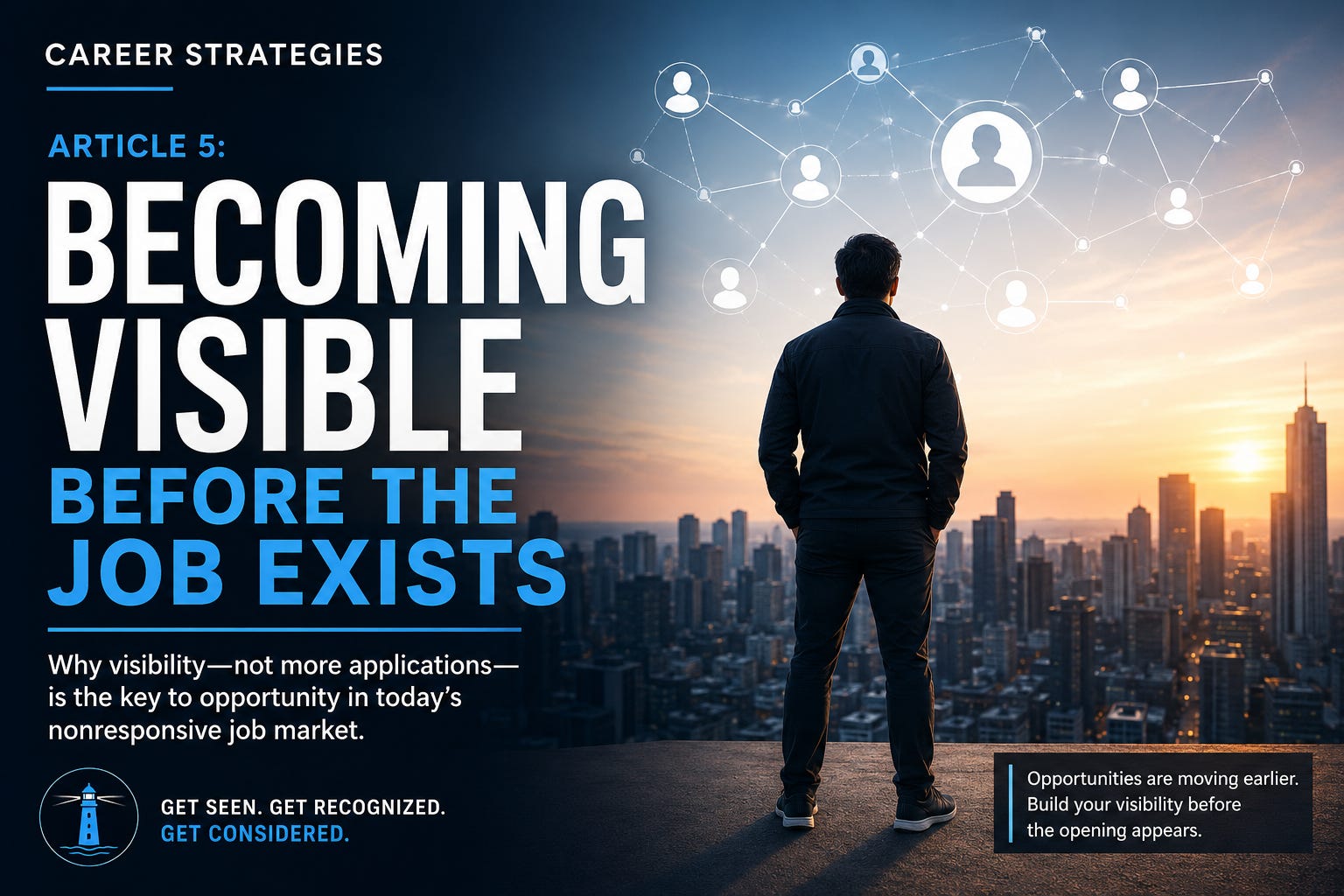
Article 5: Becoming Visible Before the Job Exists

The Depleted Candidate: Rebuilding Yourself in a Job Market That Doesn’t Respond
Six dispatches for professionals rebuilding after the floor dropped out
Based on The Depleted Candidate: How to Stop Executing While Depleted — and the Framework That Actually Works
This book is free from May 3 to May 7, 2026. All we ask is that you leave an honest review.
The front door still exists.
It’s just no longer where most opportunities move first.
The Old Mental Model
Most professionals were taught a simple equation:
Job posted → Apply → Interview → Offer
And for years, that model mostly worked.
Not perfectly.
But predictably enough to build a career around it.
So when the market stops responding, the assumption becomes:
“I must not be competitive anymore.”
But that’s not what changed.
The hiring architecture changed.
The Quiet Shift Happening Underneath Everything
Most hiring doesn’t begin with a public posting anymore.
It begins earlier.
Smaller.
Quieter.
A manager mentions a problem internally.
A leader asks someone they trust for recommendations.
A contractor becomes a full-time hire before the role is posted publicly.
An internal candidate is already favored before applications open.
By the time the listing appears—
the search may already be halfway over.
And yet most professionals are still treating the posting itself like the starting line.
It isn’t.
It’s often the final administrative step.
The Visibility Problem Nobody Explains Clearly
This is where many experienced professionals break psychologically.
Because they confuse invisibility with rejection.
But those are not the same thing.
Rejection means you were evaluated and declined.
Invisibility means the system never meaningfully processed you at all.
And in today’s market—
that distinction matters.
Because modern hiring systems increasingly prioritize:
Recognition
Familiarity
Signal clarity
Perceived relevance
Existing trust pathways
Not just raw qualifications.
Why Strong Candidates Get Filtered Out Quietly
You can be highly capable—
and still difficult for the market to interpret.
Especially if:
Your experience spans multiple functions
Your accomplishments are operational instead of flashy
Your resume describes responsibilities instead of transformed outcomes
Your online presence doesn’t clearly communicate your current value
The market does not reward hidden competence.
It rewards legible competence.
That feels unfair.
Because it is.
But understanding the system matters more than resenting it.
The Mistake Most Professionals Make
Once applications stop working, many people react by increasing volume.
More resumes.
More platforms.
More applications.
But volume without signal clarity usually produces:
More silence
More exhaustion
More self-doubt
Because the issue often isn’t effort.
It’s interpretation.
AI Doesn’t Judge You. It Interprets You.
That distinction changes everything.
Most professionals assume hiring systems are asking:
“Is this person talented?”
But the first layer of filtering is usually asking something simpler:
“Can this person be categorized quickly?”
If the answer is unclear—
your experience becomes friction instead of advantage.
This is why people with twenty years of meaningful work can lose to candidates with cleaner signal packaging.
Not because they’re stronger.
Because they’re easier to process.
The Shift From Applying to Signaling
At some point, the strategy must evolve.
You stop asking:
“How many applications did I send?”
And start asking:
“What signal is the market receiving from me consistently?”
Because visibility is not self-promotion.
It is translation.
Your LinkedIn profile becomes infrastructure.
Your writing becomes evidence.
Your conversations become positioning.
Your network becomes interpretation support.
The goal is no longer just to search for jobs.
It’s to become recognizable before the opening appears.
Why Weak Ties Matter More Than Constant Networking
Most opportunities do not come from your closest relationships.
They come from dormant relationships.
Former colleagues.
People who vaguely remember your work.
Someone who saw your thinking six months ago.
Someone who hears your name twice in the same month.
This is why strategic visibility compounds.
Not because every post leads to a job.
But because repeated signal reduces uncertainty.
And uncertainty is what hiring systems are designed to avoid.
The New Career Reality Most People Resist
You cannot rely exclusively on formal applications anymore.
Not because you failed.
Because the market fragmented.
The professionals adapting fastest are building:
Direct visibility
Recognizable expertise
Small trust ecosystems
Portable reputation
Clear positioning around outcomes
They are becoming easier to understand before they become available to hire.
That changes the entire trajectory of a search.
The Internal Resistance That Shows Up Here
Visibility feels uncomfortable for many professionals.
Especially high performers.
Because they associate visibility with:
Ego
Self-promotion
Performance
Attention-seeking
But invisibility carries a cost too.
If nobody can interpret your value—
the market defaults to uncertainty.
And uncertainty delays decisions.
The Reframe That Changes Everything
Visibility is not vanity.
It is professional infrastructure.
It is the bridge between your capability—
and the market’s ability to recognize it.
Without that bridge, even strong professionals disappear into silence.
Status Upgrade
Stop trying to prove your worth through volume.
Start increasing the clarity of your signal.
Hope Anchor
You are not failing because you lost value.
You are struggling because the market can no longer infer value automatically.
That means your task is not reinvention.
It is translation.
What Comes Next
In the final article, we move beyond survival entirely—
into how to build a professional identity that no longer collapses every time the market changes.
Final Line
The opportunity often starts moving before the job ever appears.
The professionals who adapt learn how to become visible before the opening exists.
About the Author
Byron K. Veasey is a career strategist and leader in data quality engineering focused on helping professionals navigate job searches, burnout, and career reinvention.
He writes Career Strategies, a newsletter read by over 4,600 professionals navigating today’s evolving job market.
👉 Subscribe to Career Strategies
The “invisibility vs. rejection” point really lands. A lot of strong professionals keep trying to prove they are qualified, when the real issue is that the market cannot quickly understand what to do with them. That is especially true for people with broad, cross-functional careers.