
Article 6: The Professional Identity That Doesn’t Collapse When the Market Does

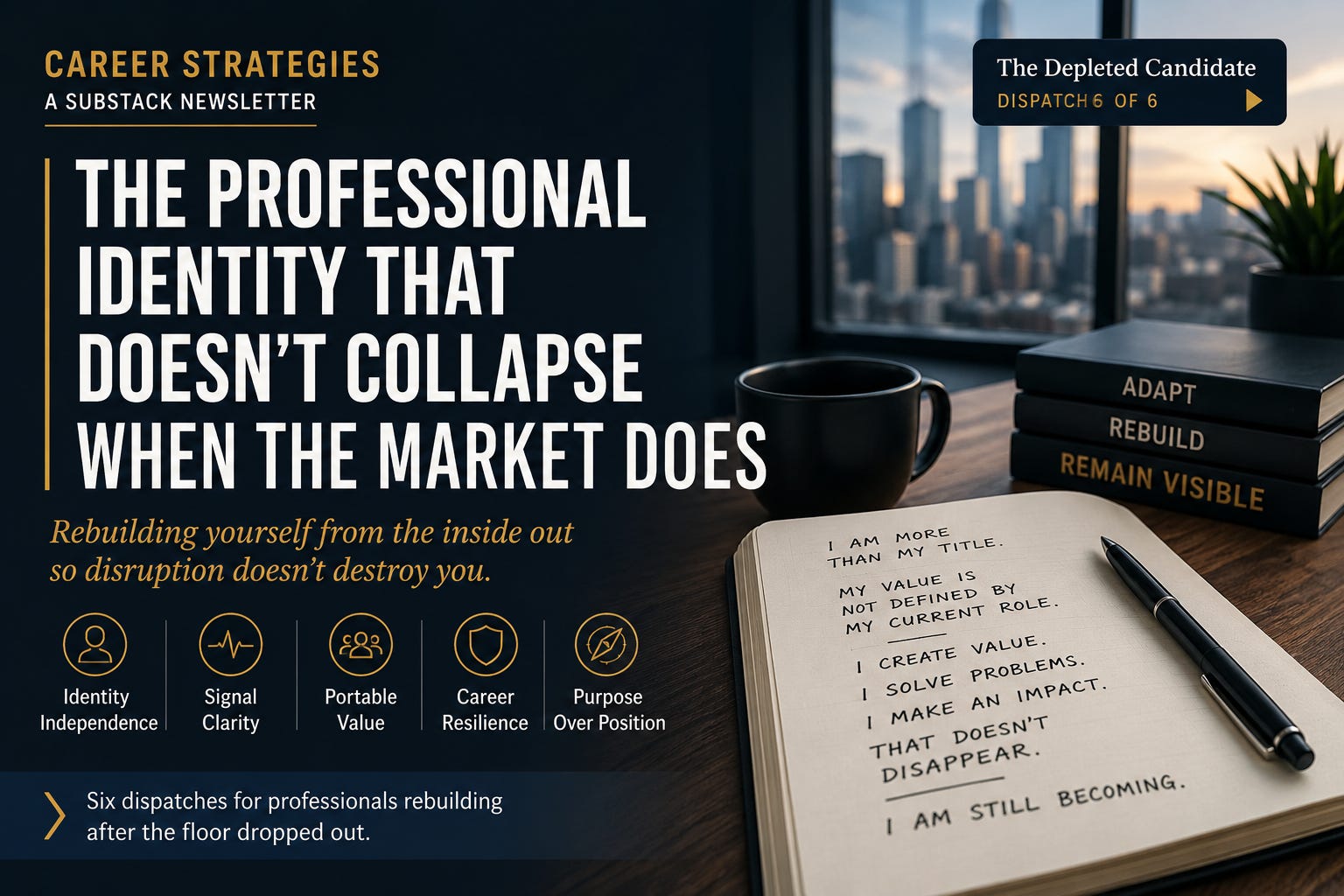
The Depleted Candidate: Rebuilding Yourself in a Job Market That Doesn’t Respond
Six dispatches for professionals rebuilding after the floor dropped out
Based on The Depleted Candidate: How to Stop Executing While Depleted — and the Framework That Actually Works
This book is free from May 3 to May 7, 2026. All we ask is that you leave an honest review.
The hardest realization comes last.
Not when the rejection emails stop.
Not when the savings account gets lower.
Not even when the interviews disappear.
It comes when you realize how much of your identity was being held together by a system you no longer control.
That is the real collapse most professionals experience.
Not financial.
Structural.
The Invisible Dependency Most Professionals Never See
For years, your professional identity was reinforced automatically.
Meetings confirmed your relevance.
Emails confirmed your usefulness.
Deadlines confirmed your importance.
Titles confirmed your status.
Performance reviews confirmed your value.
You did not have to consciously maintain your professional identity.
The system maintained it for you.
Until it didn’t.
And once the structure disappears—
many professionals discover they never actually built identity independence.
They built identity attachment.
That distinction matters more than most people realize.
Why the Modern Market Feels So Psychologically Violent
The old career model was based on continuity.
One company.
One ladder.
One direction.
One long arc of progression.
Even when jobs changed—
the structure remained recognizable.
But the modern market behaves differently now.
Roles evolve silently.
Skills expire faster.
Companies reorganize continuously.
Entire functions get redefined underneath people without warning.
The professional world became dynamic while most people were still building static identities.
That mismatch is exhausting.
Because every market disruption now feels personal.
Even when it isn’t.
The Dangerous Belief Beneath Burnout
Many depleted professionals quietly carry a belief that sounds like this:
“If I can just get hired again, I’ll finally feel stable.”
But stability built entirely on external structures is fragile by definition.
Because markets change.
Leadership changes.
Economies change.
Hiring systems change.
And if your entire sense of self lives inside those systems—
every disruption feels existential.
This is why some professionals never psychologically recover after layoffs.
Not because they lacked skill.
Because they lost the structure that interpreted their value back to them every day.
The Shift From Employment Identity to Professional Identity
This is the transition most people never consciously make.
Employment identity says:
“I know who I am because of where I work.”
Professional identity says:
“I know how I create value regardless of where I work.”
That shift changes everything.
Because once your identity becomes function-based instead of employer-based—
you stop collapsing every time the market changes shape.
You become portable.
Not just employable.
What Durable Professionals Build Differently
The professionals adapting best right now are not necessarily the smartest.
Or the youngest.
Or the most technical.
They are the people building careers that can survive interpretation shifts.
They build:
Portable visibility
Direct relationships
Recognizable expertise
Independent signal
Multiple trust pathways
Small ecosystems instead of single dependencies
This creates resilience the old career model never required.
Because the old model assumed the institution would remain stable.
The new model assumes disruption is permanent.
Why This Feels Uncomfortable at First
Because many professionals were taught that visibility was optional.
You worked hard.
Delivered results.
Stayed loyal.
Expected the work to speak for itself.
For a long time, that approach worked.
Today, it works less reliably.
Not because hard work stopped mattering.
Because interpretation became part of the job.
The market no longer simply evaluates talent.
It evaluates clarity.
Can people understand your value quickly?
Can they explain what you do to others?
Can they associate your name with a recognizable capability?
That is the new layer most professionals were never trained for.
The Career Advantage Nobody Talks About
There is an unexpected advantage hidden inside all of this.
Once you stop outsourcing your identity entirely to employers—
you begin building something far more stable.
You stop needing constant external validation to feel professionally real.
You stop interpreting every silence as personal failure.
You stop believing your value disappears every time a role disappears.
That psychological shift changes how you interview.
How you network.
How you negotiate.
How you recover.
It even changes how much fear the market can hold over you.
Because the market no longer owns your entire sense of self.
The New Definition of Career Stability
Career stability used to mean:
“One company for a long time.”
Now it increasingly means:
“The ability to remain interpretable and adaptable across changing systems.”
That is a completely different skill set.
And ironically—
many experienced professionals already possess the raw materials for it.
Pattern recognition.
Judgment.
Communication.
Operational thinking.
Crisis navigation.
Relationship management.
The problem is not capability.
The problem is translation.
The Final Reframe
You were never supposed to build your entire identity inside systems you cannot control.
Most people just never realized that until the market stopped cooperating.
This is not the end of your professional value.
It is the beginning of building a version of it that survives disruption.
Status Upgrade
Stop trying to rebuild the old version of career stability.
Build a professional identity that remains intact even when the market changes shape.
Hope Anchor
The market may stop recognizing you temporarily.
That does not mean you disappeared.
It means the system changed faster than your signal did.
Signals can be rebuilt.
Final Line
The strongest professionals are not the ones who never experience disruption.
They are the ones who learn how to remain visible, valuable, and psychologically intact while moving through it.
About the Author
Byron K. Veasey is a career strategist and leader in data quality engineering focused on helping professionals navigate job searches, burnout, and career reinvention.
He writes Career Strategies, a newsletter read by over 4,600 professionals navigating today’s evolving job market.
👉 Subscribe to Career Strategies