
Article 6: The Momentum Problem After Being Let Go

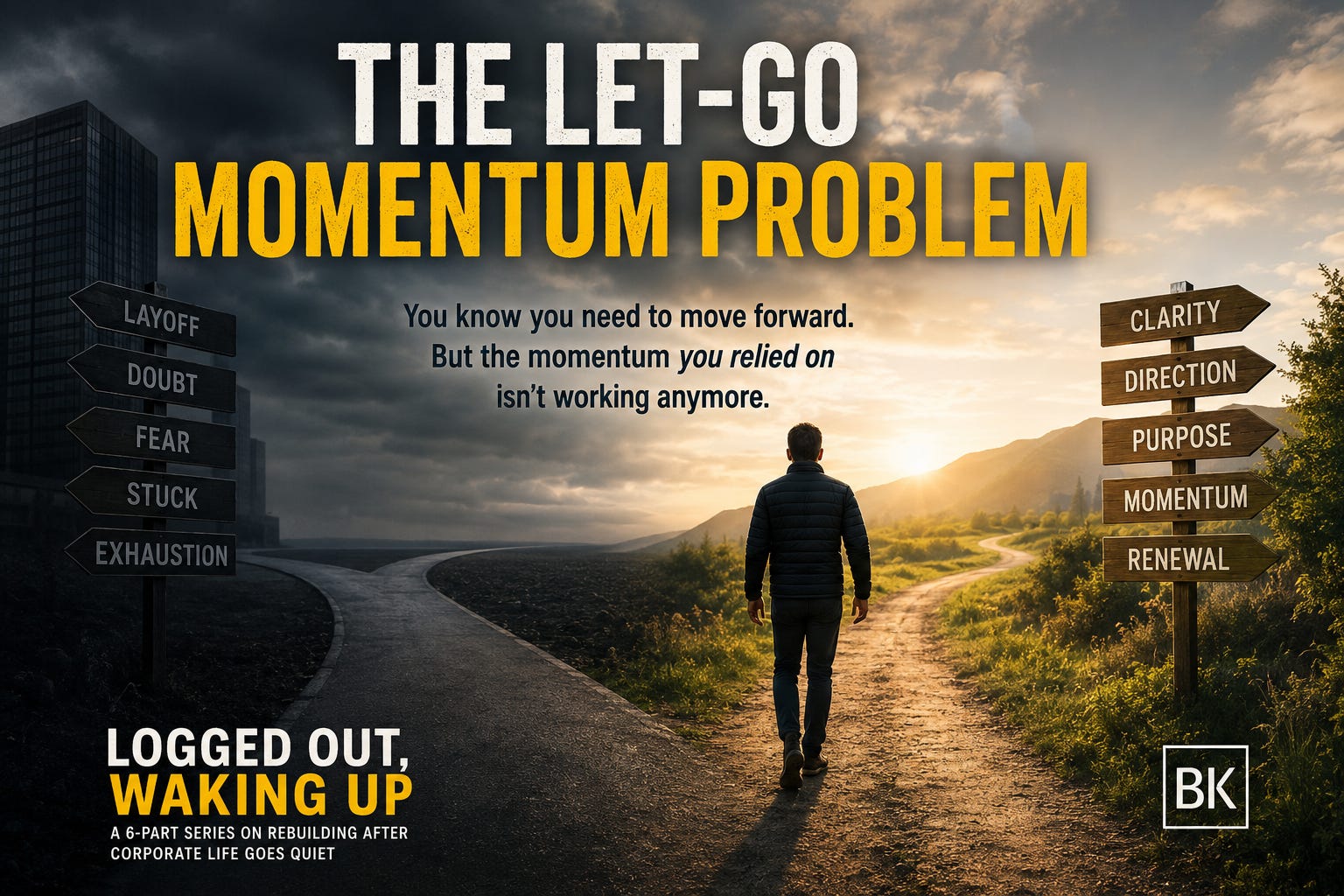
What happens when you know you need to move forward, but the momentum you used to rely on no longer works?
Series: Logged Out, Waking Up
A six-part series on rebuilding after corporate life goes quiet.
For professionals who were let go, laid off, offboarded, or quietly disconnected from the corporate system—and are trying to rebuild identity, energy, and direction before rushing into the next version of work.
Based on the book, Logged Out, Waking Up: A Recovery Roadmap for Professionals Rebuilding Identity, Energy, and Career Direction After Being Let Go.
This book is free on Amazon from May 26 to May 30, 2026.
If the book speaks to you, we ask that you leave an honest customer review.
👉 Submit a Customer Book Review
There is a moment after you are let go when the question changes.
At first, the question is survival.
What happened?
What should I do today?
How do I tell people?
What happens to my income?
How do I get steady?
How do I get through the first week without falling apart?
Then the question becomes identity.
Who am I without the title?
Who am I without the meetings?
Who am I without the company name attached to my introduction?
Who am I when the calendar no longer tells me where to be?
Then the question becomes direction.
Where am I headed?
What do I want now?
What kind of work still fits?
What kind of work can I no longer stand to do?
What kind of life should my next job make possible?
But eventually, another question appears.
It is quieter.
It is more practical.
It is also harder.
How do I start moving again?
Not frantically.
Not desperately.
Not as a performance.
Not as proof that the layoff did not affect me.
Not as a way to outrun grief.
Not as a way to silence fear.
But how do I build momentum that is strong enough to matter and gentle enough not to break me?
That is the final challenge.
Because momentum after being let go is not just about doing more.
Many professionals already know how to do more.
They know how to execute.
They know how to push.
They know how to perform under pressure.
They know how to keep going when they are exhausted.
They know how to look composed while carrying too much.
They know how to be useful inside systems that do not always take care of them.
They are not undisciplined.
The problem is that the old form of momentum may have depended on depletion.
Urgency.
Fear.
External pressure.
Constant availability.
The need to be seen as capable.
The need to be chosen again.
The need to prove the layoff did not define them.
That kind of momentum can carry you.
But it can also recreate the conditions you are trying to escape.
So the real work is not simply getting started.
The real work is learning a different kind of motion.
The old momentum got you through the system. The new momentum has to help you rebuild without abandoning yourself.
Momentum Must Be Rebuilt, Not Forced
When corporate life disappears, the structure disappears with it.
No meeting rhythm.
No project deadlines.
No manager check-ins.
No team updates.
No performance cycle.
No standing agenda.
No urgent requests waiting before breakfast.
No calendar full enough to make the day feel legitimate.
For a while, that emptiness can feel like relief.
Then it can feel like danger.
Because without the old structure, many professionals begin to doubt themselves.
Why am I not moving faster?
Why does everything take more energy?
Why do simple things feel so hard?
Why do I avoid the job search even though I know it matters?
Why can I perform under pressure for a company but struggle to organize my own next chapter?
The answer is not laziness.
It is not weakness.
It is not lack of ambition.
It is the nervous system trying to reassert itself after a major disruption.
Being let go does not only remove a job.
It removes a system of external momentum.
The job gave you instructions.
Even when they were stressful, they were still instructions.
The calendar told you what mattered.
The inbox told you what was urgent.
The organization told you what to prioritize.
The role told you what identity to inhabit.
The deadlines created movement.
Then suddenly, you are expected to generate your own direction, confidence, structure, accountability, energy, and belief while recovering from the loss of the system that supplied those things.
That is a lot.
So if your momentum feels uneven, there may be a reason.
You are not just restarting tasks.
You are rebuilding the engine underneath them.
The First Version of Momentum May Be Very Small
This is where high achievers often get frustrated.
They expect recovery to look like their former productivity.
A complete plan.
A fresh start.
A strong résumé.
A polished LinkedIn profile.
Daily applications.
Networking outreach.
Interview preparation.
Exercise.
Reading.
Reflection.
Personal branding.
Financial planning.
Maybe even starting a side business.
All at once.
Because that is what competence used to feel like.
Competence meant capacity.
Capacity produced output.
Output became evidence.
Evidence felt like safety.
But after being let go, the first version of momentum may not look impressive.
It may look like waking up at a consistent time.
It may look like opening the résumé file and not closing it immediately.
It may look like writing three honest sentences about what kind of role you want.
It may look like sending one message to one person you trust.
It may look like taking a walk before checking job boards.
It may look like saving one job description that actually fits.
It may look like refusing a role that would pull you back into an old pattern.
It may look like cleaning your workspace.
It may look like choosing one priority for the day instead of twelve.
That can feel too small to count.
But it counts.
Because after disruption, small movement is not small.
It is evidence.
Evidence that you can act without panic.
Evidence that your day can find rhythm again.
Evidence that your identity can exist outside the corporate system.
Evidence that you can walk toward the future without leaving your body behind.
Momentum begins when movement becomes repeatable.
Not dramatic.
Repeatable.
Do Not Rebuild Your Job Search Around Panic
Panic is persuasive.
It can sound like good sense.
It says:
Apply everywhere.
Take anything.
Respond immediately.
Rewrite your résumé again.
Refresh the inbox.
Check LinkedIn.
Check job boards.
Check email.
Check again.
Maybe you missed something.
Maybe someone replied.
Maybe the right job appeared.
Maybe today is the day everything changes.
Panic creates motion.
But not all motion is momentum.
Some motion is simply productivity dressed in fear.
Panic makes every silence feel like a verdict.
It makes every job posting feel urgent.
It makes every recruiter message feel like a lifeline.
It makes every rejection feel like proof that your time is running out.
It makes you chase roles you do not want.
It makes you over-explain.
It makes you under-negotiate.
It convinces you that being busy is the same as being strategic.
The modern job market is already unstable enough.
AI filters.
Automated replies.
Silent rejections.
Long hiring cycles.
Ghosting.
Reposted roles.
One-way interviews.
Recruiter drop-offs.
Generic rejection letters.
You do not need to add internal chaos to an external system that is already noisy.
The point is not to remove urgency.
Urgency may be real.
Bills are real.
Healthcare is real.
Family responsibilities are real.
Income pressure is real.
But urgency and panic are not the same thing.
Urgency says:
This matters, so I need a plan.
Panic says:
This matters, so I have to abandon myself.
That distinction matters.
You can move quickly without letting fear define the entire search.
A Recovery-Based Job Search Needs Rhythm
Most job search advice focuses on tactics.
Optimize the résumé.
Update LinkedIn.
Search for jobs.
Network.
Prepare for interviews.
Follow up.
Track applications.
These things matter.
But after being let go, tactics without rhythm can become exhausting.
You need a pace your body can sustain.
Not a fantasy schedule.
Not an influencer’s productivity routine.
Not a twelve-hour job search day that collapses by Thursday.
A rhythm.
Something that gives your week shape without turning your recovery into another performance review.
A recovery-based job search might include focused application blocks.
Not endless scrolling.
A few targeted outreach messages.
Not mass networking that leaves you feeling transactional.
Time for company research.
Not just spraying résumés into systems that may never respond.
Time to rebuild your story.
Not just edit bullet points.
Time to rest.
Not as a reward.
As part of the strategy.
Because exhausted candidates often make decisions from fear.
They apply to roles that do not fit.
They say yes too quickly.
They misread silence.
They lose access to their own judgment.
They forget they are evaluating the company too.
A sustainable rhythm protects your discernment.
It says:
I will work the search.
But I will not be consumed by it.
I will create movement.
But I will not mistake constant availability for progress.
I will pursue opportunities.
But I will not make my whole identity a market response.
That is not passive.
That is mature.
A sustainable job search is not built on constant motion. It is built on repeatable rhythm.
Momentum Needs Visible Evidence
One of the hardest things about job searching is that effort often disappears.
You apply.
Nothing happens.
You reach out.
No reply.
You interview.
No update.
You revise your materials.
Nothing to show for it.
You prepare.
No feedback.
You follow up.
Silence.
Inside a corporate role, effort usually had visibility.
A meeting happened.
A decision was made.
A deliverable moved.
A message was answered.
A dashboard changed.
A team responded.
A manager replied.
The work created signals.
In the job search, effort often disappears into systems that do not reflect it back.
That invisibility can eat away at confidence.
Not because you are fragile.
Because humans need to know that what they do matters.
So you may need to create your own evidence system.
Track what you did.
Track what you learned.
Track who you contacted.
Track which roles fit and which ones do not.
Track which language feels clearer.
Track which conversations created energy.
Track which companies raised concerns.
Track which patterns keep appearing.
Track the small moments when you showed courage.
The point is not to turn recovery into a spreadsheet obsession.
The point is to stop letting silence be your only measurement.
If the market is not giving you feedback, you need a way to see your own movement.
Otherwise, you may assume nothing is happening.
But something may be happening.
Your language is getting sharper.
Your target is coming into view.
Your nervous system is becoming steadier.
Your story is becoming more honest.
Your outreach is becoming more focused.
Your discernment is improving.
Your confidence is returning through action, not fantasy.
These are not small things.
They are the infrastructure of momentum.
You Need a Minimum Viable Day
There will be days when you can do a lot.
Use them.
There will also be days when you cannot.
Plan for them.
Many professionals create job search plans that only work on their best days.
The energized day.
The hopeful day.
The day after a good conversation.
The day after someone says, “I think I know someone you should talk to.”
The day when a role looks promising.
The day when confidence returns for a few hours.
But recovery is uneven.
The plan has to work on lower-capacity days too.
That is where the minimum viable day comes in.
A version of the day that still counts, even when your energy is low.
Maybe it is one application.
Maybe it is one outreach message.
Maybe it is twenty minutes reviewing target companies.
Maybe it is one résumé bullet rewritten.
Maybe it is one walk and one paragraph of reflection.
Maybe it is reading one job description and writing down what you do and do not want.
Maybe it is organizing your search tracker so tomorrow is easier.
The minimum viable day protects continuity.
It saves you from all-or-nothing thinking.
Because all-or-nothing thinking is dangerous after job loss.
If you cannot do everything, you do nothing.
If you miss one day, the week feels ruined.
If you are tired, you decide you are failing.
If your plan collapses, you assume you lack discipline.
But momentum does not require perfection.
It requires a return path.
A minimum viable day gives you that road back.
It says:
Even today can count.
Even in a small way.
Even without the old energy.
Even without certainty.
Even while I am still rebuilding.
That matters.
Your Network Needs Clarity, Not Desperation
It can be uncomfortable to reach out after being let go.
You may not want to sound needy.
You may not want to tell the entire story.
You may not want to admit you are looking.
You may not want to ask for help.
You may not want to be seen in transition.
So you wait.
Or you send messages that are too vague.
Just wanted to check in.
Would love to reconnect.
Let me know if you hear of anything.
I am open to opportunities.
There is nothing wrong with warmth.
But vague outreach gives people very little to act on.
Your network needs clarity.
Not desperation.
Clarity sounds like:
I am exploring opportunities where I can use my background in operations, transformation, and team leadership to help organizations stabilize execution and improve performance.
Clarity sounds like:
I am especially interested in companies that need someone who can bring structure to complexity without creating unnecessary bureaucracy.
Clarity sounds like:
I am looking at director-level or advisory roles where my experience in change, systems, and stakeholder leadership can create value.
Clarity gives people something to hold.
It helps them remember you.
It helps them connect you to the right conversations.
It helps them see your value without asking them to solve your entire career direction problem.
Desperation says:
I need something.
Clarity says:
This is the kind of problem I am ready to solve.
That shift matters.
People are more likely to help when they understand where you fit.
Not because they do not care.
Because busy people need specificity.
The clearer your ask becomes, the easier your momentum becomes to support.
The New Story Has to Be Practiced
Another reason momentum stalls is that your old story no longer works cleanly.
Before, you could explain yourself through the company.
I lead this function.
I run this team.
I own this portfolio.
I work at this organization.
I am responsible for this business area.
The structure did some of the storytelling for you.
After being let go, you may need a new story.
Not a made-up story.
Not an overly polished story.
Not a scripted performance to cover the truth.
A clear story.
What happened.
What you learned.
What you are carrying forward.
What you are looking for now.
What kind of value you create.
What kind of environment fits.
What kind of problems you solve.
This story will probably feel awkward at first.
That is normal.
You are doing more than updating language.
You are integrating an experience.
You are learning to describe yourself without leaning on the old system.
You are moving from assigned identity to chosen positioning.
Practice matters.
Say it out loud.
Write it badly first.
Rewrite it.
Tell it to someone safe.
Notice where you over-explain.
Notice where shame enters.
Notice where you shrink.
Notice where you try to make the layoff sound painless.
Notice where you rush past the human part.
Then refine it.
A strong story does not have to be dramatic.
It has to be grounded.
Something like:
My role ended as part of a broader organizational shift. I am now focusing on opportunities where I can use my background in leadership, operations, and transformation to help teams build stronger systems and execute with more clarity.
That is enough.
You do not have to confess everything.
You do not have to defend everything.
You do not have to make the layoff the centerpiece.
The point of the story is not to prove you were unaffected.
It is to show that you know how to move forward with clarity.
Momentum Is Built Through Identity-Safe Action
Some actions feel bigger than they look after you are let go.
Updating LinkedIn.
Contacting a former colleague.
Applying for a role below your previous level.
Applying for a role above your previous level.
Asking someone for an introduction.
Recording a video interview.
Explaining the gap.
Changing your headline.
Admitting you want something different.
These actions can touch identity.
That is why they may create resistance.
Not because the task is mechanically hard.
Because the task asks you to be seen in a new way.
You may not fear the résumé update.
You may fear what it represents.
You may not fear the networking message.
You may fear needing help.
You may not fear the application.
You may fear being rejected by a role you are qualified for.
You may not fear the interview.
You may fear having to perform confidence while still recovering.
This is why momentum after job loss requires compassion.
Not indulgence.
Compassion.
You have to understand what the task is actually asking of you.
Then make the action safer.
Break it down.
Draft the message without sending it.
Update one section of the résumé.
Apply to one well-matched role instead of ten random ones.
Practice the layoff explanation with a trusted person.
Record yourself answering one interview question.
Take one step that keeps your dignity intact.
Identity-safe action does not mean comfortable action.
It means action that does not require self-abandonment.
That is the kind of action you can repeat.
And repeated action becomes momentum.
You Are Allowed to Move Slowly and Still Be Serious
Speed is often mistaken for seriousness.
Apply fast.
Decide fast.
Respond fast.
Pivot fast.
Rebrand fast.
Recover fast.
Get over it fast.
Move on fast.
But speed is not the only proof that you are serious.
Depth can be serious.
Discernment can be serious.
Recovery can be serious.
Thoughtful targeting can be serious.
One strong conversation can be more serious than twenty careless applications.
One clear role thesis can be more serious than a week of panic scrolling.
One honest boundary can be more serious than chasing a role that would damage you again.
This does not mean you should avoid action.
It means you should respect the kind of action that actually builds a future.
Some momentum is loud.
Some momentum is quiet.
Some momentum looks like execution.
Some momentum looks like refusal.
Some momentum looks like preparation.
Some momentum looks like rest that prevents a bad decision.
Some momentum looks like telling the truth about what you no longer want.
You are allowed to move slowly and still be committed.
You are allowed to be careful and still be ambitious.
You are allowed to rebuild deliberately and still want success.
The next chapter does not need to be rushed to be real.
There Is a Difference Between Traction and Performance
Performance asks:
How does this look?
Traction asks:
Is this moving me closer to the right work?
Performance asks:
Do people think I am doing well?
Traction asks:
Am I gathering evidence?
Performance asks:
Can I announce progress?
Traction asks:
Am I becoming clearer?
Performance asks:
Does this make me look employable?
Traction asks:
Does this help me become better positioned?
After being let go, performance can be tempting.
You may want to post a polished update.
You may want to appear optimistic.
You may want your network to see resilience.
You may want to prove you are still in demand.
You may want to signal that everything is fine.
Sometimes that is useful.
But do not confuse visibility with traction.
Traction is quieter.
It may be a better target list.
A sharper positioning statement.
A restored sense of energy.
A more honest understanding of what fits.
A conversation with someone who opens a door.
A rejection that teaches you how to refine.
A decision not to pursue a role that would repeat the past.
A week where you stayed consistent without burning yourself down.
That is real.
Even if nobody sees it.
The rebuilding phase is full of invisible progress.
Do not dismiss it because it does not create applause.
You Need People, But Not Everyone Gets Access
Rebuilding momentum alone is hard.
You need people.
People who remind you of your value.
People who help you think clearly.
People who can introduce you to opportunities.
People who can review your language.
People who can listen without turning your pain into advice too quickly.
People who understand that being let go is not just a job event.
But not everyone deserves access to your rebuilding process.
Some people will rush you.
Some people will minimize the loss.
Some people will make your transition about their fear.
Some people will offer advice that belongs to a market that no longer exists.
Some people will say, “Just take anything.”
Some people will say, “Everything happens for a reason,” when what you need is practical support.
Some people will only recognize your old version.
Some people will not understand why you are questioning the path that once made sense.
You do not need to make everyone understand.
Momentum needs protection.
Choose the people who help you become more honest, not more ashamed.
Choose the people who can hold both urgency and care.
Choose the people who respect your need for income and your need not to disappear inside another damaging role.
Choose the people who help you see options without pressuring you to perform certainty.
The right people do not remove the difficulty.
But they make it less isolating.
And isolation is where momentum often dies.
Do Not Wait Until You Feel Ready
Readiness is complicated after job loss.
You may be waiting to feel like your old self again.
You may be waiting for confidence to fully return.
You may be waiting for the résumé to be perfect.
You may be waiting until the story sounds clean.
You may be waiting until you are less angry.
Less embarrassed.
Less tired.
Less uncertain.
Less tender.
But the next chapter usually begins before you feel completely ready.
Not because you should force yourself.
But because readiness often arrives through movement.
You do not become ready in isolation.
You become ready through contact.
A conversation.
A draft.
A small application.
A recruiter screen.
A walk.
A reflection.
A boundary.
A decision.
A revision.
A moment where you realize you handled something better than you expected.
The goal is not to wait until fear disappears.
The goal is to build enough structure that fear does not lead.
You can be uncertain and still move.
You can be tired and still take one careful step.
You can be grieving and still explore.
You can be rebuilding and still be valuable.
You can be between identities and still have something to offer.
Readiness is not a door that opens all at once.
Sometimes it is a few inches of space you create through repeated action.
Start there.
The Market Does Not Get to Be Your Only Mirror
This may be one of the most important truths in the entire recovery process.
The job market is a poor mirror.
It reflects demand imperfectly.
It reflects timing imperfectly.
It reflects algorithms.
Budgets.
Hiring freezes.
Internal candidates.
Keyword filters.
Recruiter bandwidth.
Automated systems.
Manager indecision.
Market anxiety.
Company politics.
It does not always reflect your worth.
But when you are searching, it can feel like it does.
No response feels like invisibility.
A rejection feels like judgment.
A stalled process feels like personal failure.
A rescinded role feels like proof that stability is impossible.
That is why you cannot let the market be your only mirror.
You need other mirrors.
Your evidence bank.
Your trusted colleagues.
Your past accomplishments.
Your values.
Your body.
Your role thesis.
Your conversations.
Your lived experience.
Your ability to solve real problems.
Your capacity to learn and adapt.
Your history of surviving hard things.
The market matters.
You have to listen to it.
You have to adjust to it.
You have to understand what it is rewarding and filtering.
But you do not have to worship it.
The market can tell you where your signal needs sharpening.
It cannot tell you whether your life has value.
Do not give it that much authority.
Momentum Becomes Stronger When It Is Connected to Meaning
At some point, the job search has to become more than a list of tasks.
Applications.
Messages.
Interviews.
Follow-ups.
Revisions.
Research.
These are necessary.
But if they are disconnected from meaning, they become draining.
You need to know what the movement is for.
Not in a vague inspirational way.
In a grounded way.
I am rebuilding income.
I am restoring stability.
I am creating a healthier relationship with work.
I am finding a role where my experience can matter without requiring self-erasure.
I am building a next chapter that includes my health.
I am choosing work that supports my life instead of consuming all of it.
I am proving to myself that one organization does not define my entire future.
Meaning does not remove difficulty.
But it gives difficulty a place to belong.
Without meaning, the job search becomes a punishment.
With meaning, it becomes reconstruction.
Still hard.
Still uncertain.
Still frustrating.
But not empty.
You are not just trying to get picked.
You are trying to build a professional life that can hold who you are now.
That is worth moving toward.
The Final Stage Is Not Arrival
It would be comforting if recovery had a clean ending.
You get the offer.
You accept the role.
You update LinkedIn.
You start the job.
Everyone congratulates you.
The story closes.
But the truth is more layered.
A new role may solve income and structure.
It may restore routine.
It may bring relief.
It may give you a new place to contribute.
But the deeper recovery may continue.
You may still notice old patterns.
You may still feel anxious when a meeting appears unexpectedly.
You may still overperform at first.
You may still fear being let go again.
You may still struggle to trust stability.
You may still need to practice boundaries.
You may still need to remember that being useful is not the same as being safe.
This does not mean you failed.
It means your body remembers what happened.
The goal is not to arrive untouched.
The goal is to enter the next chapter with more awareness than you had before.
To notice faster.
To choose better.
To speak earlier.
To rest sooner.
To ask clearer questions.
To refuse old patterns before they become your life again.
That is recovery.
Not becoming who you were before.
Becoming someone who can move forward with more truth.
Logged Out, But Moving Again
In Logged Out, Waking Up, the final movement is not about rushing back into the system.
It is about rebuilding the capacity to choose your next step with clarity, dignity, and care.
You were logged out of the old structure.
But you were not erased.
You lost access to a system.
But you did not lose access to your wisdom.
You lost a role.
But you did not lose the evidence of what you have built.
You lost momentum.
But you can build a different kind.
One that does not depend entirely on urgency.
One that does not require self-abandonment.
One that includes rest.
One that includes discernment.
One that includes your body.
One that includes market reality without letting the market define your worth.
One that moves in small, repeatable steps.
One that lets you become visible again without performing invulnerability.
One that lets you pursue work without handing your whole identity back to a company.
This is how momentum returns.
Not all at once.
Not perfectly.
Not always confidently.
But through daily acts of re-entry.
A message sent.
A story practiced.
A boundary honored.
A role clarified.
A walk taken.
A résumé revised.
A conversation opened.
A fear named.
A small promise kept.
A next step chosen.
You do not have to rebuild your entire future today.
You only have to begin moving in a way that does not betray the person you are becoming.
That is enough for today.
And if you keep doing that, carefully and consistently, something will start to shift.
The silence will not own the whole story.
The layoff will not be the final sentence.
The system may have logged you out.
But you are waking up.
And now, you are learning how to move again.
About the Author
Byron K. Veasey is a career strategist and leader in data quality engineering focused on helping professionals navigate job searches, burnout, and career reinvention.
He writes Career Strategies, a Substack newsletter read by over 4,900 professionals navigating today’s evolving job market.
👉 Subscribe to Career Strategies
🎙️ Listen to the Podcasts
👉 Career Strategies Amazon Books
👉 eBook Discount Store
The momentum problem shows up after the direction question stops scaring you. Most playbooks rush you back into a sprint because stillness reads as proof of being lost. What this article names is harder: some weeks of slower movement are the work, not the absence of it.
Zia.
totally resonate. Ever since leaving corporate and building my freelance life I’ve realised how everything I was doing on a day today was based off the intensity that was fabricated from building a 9 to 5 life but the other side of that spectrum is building a life I want on my own time my own creative freedom, autonomy and it’s completely different to the vast majority, that it often feels isolating, quiet and at times disorienting.
but this article definitely makes it feel more normalised and that it’s okay to take your time to readjust and realign. Perhaps that’s part of the journey I’m learning to embrace.