

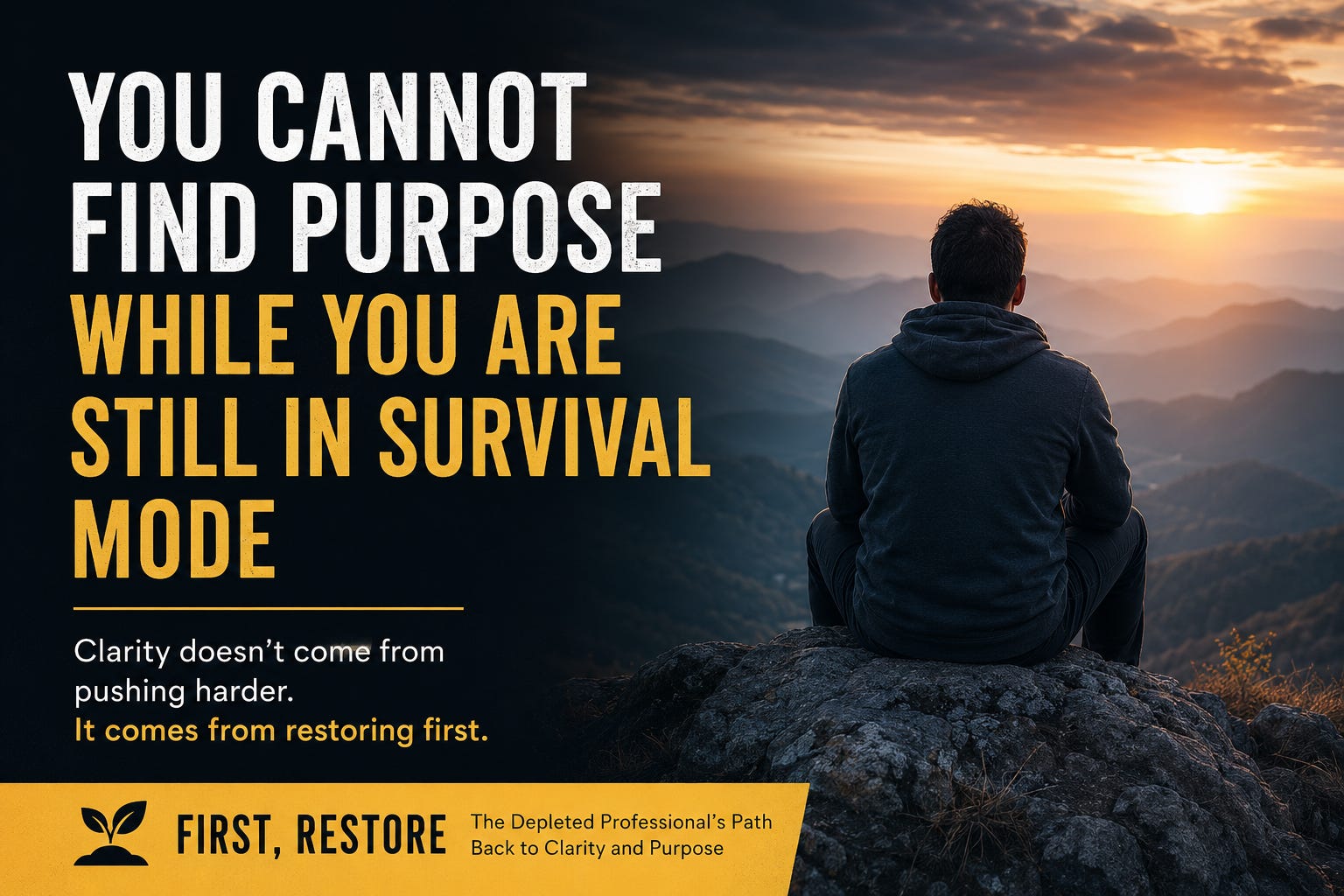
This article is based on First, Restore: The Depleted Professional’s Path Back to Clarity and Purpose. The book’s core message is that depleted professionals should restore capacity before trying to redesign their careers, because clarity depends on energy, safety, and perspective.
You want purpose again.
You want direction.
You want to feel connected to your work.
You want to wake up with more than obligation waiting for you.
You want to stop moving through your days like a person carrying responsibilities but missing yourself.
You want the next chapter to mean something.
So you start asking the big questions.
What am I supposed to do now?
What kind of work do I really want?
What matters to me at this stage of life?
Should I stay in this career?
Should I leave?
Should I rebuild?
Should I start over?
Should I want something different?
Should I be grateful for what I have?
Should I be brave enough to want more?
These are important questions.
But they are heavy questions.
And sometimes you are asking them from the wrong internal state.
You are asking for purpose while exhausted.
You are asking for vision while overwhelmed.
You are asking for clarity while your mind is still scanning for danger.
You are asking your future to speak clearly while your nervous system is still trying to survive the present.
And when the answer does not come, you start blaming yourself.
Maybe I am stuck.
Maybe I lost ambition.
Maybe I waited too long.
Maybe I am not courageous enough.
Maybe I do not know who I am anymore.
But sometimes the issue is not that you lack purpose.
Sometimes the issue is that survival mode has made purpose difficult to access.
This article is based on my book, First, Restore: The Depleted Professional’s Path Back to Clarity and Purpose.
And the truth is this:
You cannot hear purpose clearly while survival is still the loudest voice in the room.
Survival Mode Narrows Your Vision
Survival mode is designed to protect you.
It helps you get through hard seasons.
It helps you respond to pressure.
It helps you keep moving when stopping does not feel possible.
It helps you carry responsibilities when life, work, money, family, uncertainty, grief, or exhaustion demand more than you feel able to give.
Survival mode is not weakness.
It is adaptation.
But survival mode comes with a cost.
It narrows your vision.
It makes the future feel threatening instead of spacious.
It makes risk feel dangerous.
It makes change feel overwhelming.
It makes rest feel irresponsible.
It makes uncertainty feel unbearable.
It makes every decision feel heavier than it should.
When Safety Becomes the Main Question
When you are in survival mode, your mind is not primarily asking:
What would be meaningful?
It is asking:
What will keep me safe?
What could go wrong?
What do I have to prevent?
What can I not afford to lose?
How do I avoid making things worse?
Those questions matter.
But they are not the same as purpose questions.
Purpose requires room.
Survival requires protection.
And when protection is running the whole system, purpose can become hard to recognize.
You May Be Calling Fear Practicality
One of the hardest parts of depletion is that fear often disguises itself as wisdom.
You tell yourself you are being realistic.
You tell yourself now is not the time.
You tell yourself you should not want too much.
You tell yourself it is safer to stay quiet.
You tell yourself you should be grateful.
You tell yourself you do not have the energy to try.
You tell yourself you are protecting your peace.
And maybe some of that is true.
But sometimes fear sounds practical because your system is tired.
Sometimes fear sounds mature because disappointment has trained you to lower your expectations.
Sometimes fear sounds responsible because uncertainty has taken too much from you already.
Sometimes fear sounds like strategy because you have not had enough capacity to imagine anything beyond avoiding collapse.
When Desire Starts to Feel Dangerous
This is why depleted professionals can become suspicious of their own desire.
A new idea appears, and the mind immediately shuts it down.
A possibility emerges, and the body tightens.
A career shift feels interesting for five minutes, then impossible.
A dream returns quietly, and you dismiss it before it can ask anything of you.
You say:
That is unrealistic.
That is too late.
That is too risky.
That is not who I am anymore.
That is for other people.
But before you decide those statements are truth, ask a different question:
Is this wisdom speaking?
Or is this exhaustion trying to keep me from needing more energy?
Purpose Does Not Usually Return as a Grand Announcement
Many people expect purpose to arrive dramatically.
A clear calling.
A sudden answer.
A new title.
A bold move.
A complete reinvention.
A moment where everything finally makes sense.
But for depleted professionals, purpose often returns quietly.
It may return as irritation.
You notice what you can no longer tolerate.
It may return as sadness.
You realize how long you have been disconnected from yourself.
It may return as curiosity.
Something catches your attention for the first time in months.
It may return as resentment.
You recognize where you have been over-giving.
It may return as relief.
You imagine a different pace and your body softens.
It may return as anger.
You finally admit something cost you too much.
It may return as a small pull toward work, people, ideas, problems, or conversations that make you feel more alive.
The Small Signals Matter
Purpose is not always loud at first.
Sometimes it begins as a signal.
A small internal movement.
A little more energy.
A little less numbness.
A moment where you think:
I miss that part of myself.
I want more of this.
I cannot keep doing it that way.
I do not know the whole path, but I know this matters.
That may not feel like enough.
But it is not nothing.
It is data.
And when you are recovering from depletion, data matters more than pressure.
The Goal Is Not to Force Purpose
When you are exhausted, the question “What is my purpose?” can feel too big.
It can become another burden.
Another test.
Another way to feel behind.
Another reason to believe you should already have an answer.
So start smaller.
Do not begin with purpose.
Begin with aliveness.
What gives you a little energy back?
What conversations make you feel more like yourself?
What problems do you naturally want to solve?
What kind of work makes time feel different?
What do people keep coming to you for?
What do you notice that others miss?
What topics still make you curious even when you are tired?
What responsibilities drain you beyond what the task should require?
What environments make you shrink?
What environments help you think?
What version of yourself do you miss?
What version of yourself are you tired of performing?
Aliveness Is Information
Purpose often hides inside these answers.
Not because every small preference is a calling.
But because aliveness is information.
It tells you where capacity rises.
It tells you where meaning may still exist.
It tells you where your system feels less defended.
It tells you what deserves further attention.
A depleted person should not be forced to name a grand purpose before they have enough energy to notice what still feels alive.
You Need Safety Before Vision
Vision requires safety.
Not perfect safety.
Not guaranteed outcomes.
Not a life without risk.
But enough internal safety to imagine without immediately bracing.
Enough stability to think beyond today.
Enough margin to consider possibilities without feeling punished by them.
Enough trust in yourself to say:
I do not have the whole answer yet, but I can explore.
Without safety, vision collapses into threat assessment.
You do not ask:
What do I want to build?
You ask:
What if I fail?
What if I lose stability?
What if people judge me?
What if I make the wrong move?
What if I cannot recover from another disappointment?
Again, those questions are understandable.
But if every future possibility is filtered through threat, you will mistake fear for discernment.
Restoration Comes Before Reinvention
This is why restoration comes before reinvention.
Because the goal is not to become fearless.
The goal is to become steady enough to tell the difference between real risk and depleted fear.
Real risk deserves planning.
Depleted fear demands paralysis.
Those are not the same.
Your Old Purpose May No Longer Fit
Part of the discomfort may be that your old purpose no longer fits the person you are becoming.
Maybe your old purpose was achievement.
Be excellent.
Be reliable.
Be promoted.
Be needed.
Be impressive.
Be the one who can handle it.
Maybe your old purpose was survival.
Keep the job.
Protect the family.
Pay the bills.
Stay useful.
Do not fall behind.
Do not let anyone see the strain.
Maybe your old purpose was validation.
Earn approval.
Prove your worth.
Outperform doubt.
Stay ahead of judgment.
Become undeniable.
Maybe your old purpose was escape.
Get out of the situation you were in.
Build something better than what you came from.
Make sure you never have to feel powerless again.
When the Old Fuel Stops Working
Those purposes may have helped you.
They may have carried you through important seasons.
They may have built real skills, resilience, discipline, and opportunity.
But what once carried you can eventually confine you.
The purpose that helped you survive one chapter may not be the purpose that helps you live the next one.
That does not mean your past was wrong.
It means your life is asking for a more honest foundation.
You may no longer want success that requires self-abandonment.
You may no longer want achievement that costs your peace.
You may no longer want a title that gives you status but drains your spirit.
You may no longer want a life that looks stable from the outside but feels empty on the inside.
That recognition can be unsettling.
But it can also be the beginning of truth.
Purpose After Depletion Is Often More Honest
Depletion changes what you can no longer ignore.
You become less impressed by performance without peace.
You become less willing to confuse busyness with meaning.
You become less available for environments that require constant self-protection.
You become less interested in proving yourself to people who benefit from your exhaustion.
You become less patient with work that uses your strengths but disconnects you from your values.
At first, this can feel like cynicism.
But it may not be cynicism.
It may be discernment returning.
It may be your system saying:
I cannot keep abandoning myself to belong.
I cannot keep calling depletion ambition.
I cannot keep treating survival as success.
I cannot keep building a life where my body pays the bill for my image.
Recovery Becomes Wisdom
This kind of honesty may feel disruptive.
It may change what you want.
It may change what you pursue.
It may change what you tolerate.
It may change how you define success.
But that is not failure.
That is recovery becoming wisdom.
Do Not Let Urgency Choose Your Next Life
When you are depleted, urgency can become very persuasive.
You need an answer.
You need a plan.
You need income.
You need relief.
You need certainty.
You need something to change.
You need the next step to appear now.
Urgency is understandable.
But urgency does not always make wise decisions.
Urgency can push you into the first option that reduces anxiety.
Urgency can make you accept work that repeats the same pattern.
Urgency can make you choose visibility over alignment.
Urgency can make you confuse movement with direction.
Urgency can make you rebuild the exact life that depleted you, only with a different title.
The Bridge Is Not the Destination
This does not mean you should do nothing.
It means you should separate immediate needs from long-term design.
You may need a bridge role.
You may need income.
You may need structure.
You may need stability.
You may need to take practical steps before everything feels meaningful.
That is real life.
But do not confuse the bridge with the destination.
Do not let pressure convince you that the next survival move has to define your whole future.
A bridge can protect you.
A bridge can give you time.
A bridge can create breathing room.
But once you have room, you still have to ask:
What am I rebuilding toward?
What do I not want to repeat?
What kind of work can hold my skill and my humanity?
What would success look like if I stopped defining it only by endurance?
Purpose Needs Space to Tell the Truth
You may not need a dramatic breakthrough.
You may need space.
Space to think without panic.
Space to notice without judgment.
Space to grieve what did not work.
Space to admit what you want.
Space to admit what you no longer want.
Space to stop performing certainty.
Space to let your next chapter become visible without forcing it to arrive fully formed.
Purpose is difficult to access when every moment is filled with noise.
Notifications.
Applications.
Meetings.
Advice.
Comparison.
Bills.
Family needs.
Internal pressure.
External expectation.
The constant sense that you should be doing more.
When Life Gets Too Loud
At some point, the signal gets buried.
Not because purpose disappeared.
But because your life became too loud to hear it.
Creating space may feel inefficient.
But it is not wasted time.
It is how you begin to hear yourself again.
You Do Not Need to Know the Whole Future
One of the most damaging beliefs depleted professionals carry is the belief that clarity must be complete before movement begins.
You think you need the full vision.
The final answer.
The perfect plan.
The clear destination.
The confident explanation.
The story that makes sense to everyone.
But recovery-based clarity often comes in pieces.
Partial Clarity Still Counts
You may know what you cannot keep doing before you know what comes next.
You may know what drains you before you know what restores you.
You may know what matters before you know how to monetize it.
You may know what you want to explore before you know whether it will become a career.
You may know you need change before you know the shape of that change.
That still counts.
Partial clarity is clarity.
A next honest step is still a step.
You do not need to see the entire road to stop walking deeper into what is harming you.
Purpose Is Rebuilt Through Practice
Purpose is not only discovered.
It is also rebuilt.
You rebuild purpose by paying attention.
By testing small experiments.
By noticing energy.
By naming values.
By protecting capacity.
By telling the truth about what no longer fits.
By taking one aligned step and observing what happens.
By choosing less performance and more integrity.
By letting your body have a vote.
By refusing to shame yourself for needing a slower process.
The Ordinary Choices Matter
This may look ordinary.
One conversation.
One journal entry.
One boundary.
One walk without a podcast.
One honest admission.
One small project.
One day where you do not force yourself to solve your whole life.
But these ordinary choices matter.
They teach your system that the future does not have to be built through panic.
They teach you that clarity can emerge through care.
They teach you that purpose does not have to be extracted from an exhausted mind.
It can be restored through a more truthful life.
First, Restore
The world will keep asking you what comes next.
What is your plan?
What is your role?
What is your next move?
What are you building?
What are you becoming?
But you do not owe the world a fully formed answer while you are still rebuilding the capacity to hear yourself.
Before you force purpose, restore.
Before you chase reinvention, restore.
Before you confuse fear with wisdom, restore.
Before you let urgency design your next life, restore.
Before you call yourself stuck, restore.
Before you assume your ambition is gone, restore.
Before you interpret numbness as truth, restore.
You may not have lost your purpose.
You may have lost access to the part of you that can feel it.
You may not need a louder dream.
You may need a quieter nervous system.
You may not need to become someone new.
You may need enough safety to recognize who is still there beneath the exhaustion.
This article is based on my book, First, Restore: The Depleted Professional’s Path Back to Clarity and Purpose.
If you are tired of trying to force purpose, clarity, and direction from an exhausted place, this book is for you.
Before you pressure yourself to redesign your entire life, start here:
First, restore.
Get the book on Amazon:
https://www.amazon.com/dp/B0GNL1JXYD
About the Author
Byron K. Veasey is a career strategist and author, focused on helping professionals navigate job searches, burnout, and career reinvention.
He writes Career Strategies, a Substack newsletter read by over 4,900 professionals navigating today’s evolving job market.